
What Nolle Prosequi Means in Florida Criminal Cases
Jason Goldsmith, Esq
Nolle prosequi is the prosecutor's formal decision to drop a pending Florida criminal charge, ending the prosecution without a conviction and without an acquittal. Because it's usually entered before jeopardy attaches, the State may generally refile the charge within the applicable statute of limitations.
You may have seen the phrase on a court notice, docket entry, or background-check report. The case might involve a misdemeanor or felony, and the paperwork may say “nolle prossed,” “nol pros,” or “nolle prosequi.” If you're worried about what happens next, the most important point is this: the immediate prosecution has ended, but the arrest record, refiling risk, and collateral consequences may still require attention.
Table of Contents
Nolle Prosequi vs Dismissal vs Acquittal vs Other Dispositions
Consequences for Your Record, License, and Immigration Status
What Nolle Prosequi Means in Plain English
You receive a court notice saying the State entered a nolle prosequi on your Broward County criminal charge. Relief may come first, followed by practical questions: Did you win? Can prosecutors bring the charge back? Will the arrest disappear? Each question has a different answer.
In plain English, nolle prosequi means the prosecutor has formally decided to stop pursuing a pending criminal charge. The phrase may apply to every charge or only selected counts. It generally ends the current prosecution in much the same way a dismissal does, while leaving the case without a trial verdict, as explained by Britannica's legal overview of nolle prosequi.
What the filing does
The State Attorney, or a specially appointed prosecutor, makes the decision. You cannot force the State to enter a nolle prosequi, and your agreement is not required. In Florida, the filing is treated as self-executing. The prosecution ends when the notice is entered, and the notice does not require a judge's signature to take effect, according to Florida criminal defense guidance on nolle prosequi.
The filing still becomes part of the court record. The clerk and other court personnel update the docket, but they do not make the prosecutorial decision. That distinction helps explain why a case can end while related records remain visible.
A nolle prosequi ends the current prosecution without producing a trial verdict, so it results in neither a conviction nor an acquittal. There is no guilty plea or finding of guilt, but no judge or jury has decided that the State failed to prove the charge. The filing also does not establish innocence.
Practical rule: Treat a nol pros as immediate relief, not as automatic record-clearing or a guaranteed permanent bar to new charges.
The four questions that matter
After the filing, review four points:
Florida procedure: Does the notice cover every count, or only some?
Legal effect: Is the case finished for now, and has jeopardy attached?
Prosecutorial reason: Did the State cite an evidence problem, witness issue, diversion result, or another reason?
Collateral impact: Does an arrest record remain, and should you pursue sealing or expungement?
The timing affects what you do next. A nolle prosequi may support a later record-clearing strategy, but expungement is not automatic. Jeopardy timing can affect whether refiling is permitted, and the remaining record may matter to a professional license, an immigration matter, or a related civil claim. Review the docket, charging documents, and dismissal language before assuming the case is permanently finished.
Where the Term Comes From and How Florida Treats It
Suppose the State has already filed charges, and the prosecutor later tells the court that the State will no longer pursue one or more of them. The docket may then show nolle prosequi, often shortened to “nol pros.” In plain English, the prosecutor has chosen to stop the current prosecution on those charges.
The phrase is Latin and is commonly understood to mean to be unwilling to prosecute. It comes from English common-law practice, which influenced American criminal procedure and, later, Florida practice. Older English law used related formal mechanisms, including a writ issued by the Attorney General. Those historical details explain why the phrase remains part of modern legal vocabulary, even though Florida prosecutors now use it within a different court system.
Florida's prosecutorial act
In Florida, a nolle prosequi is a formal action by the prosecution abandoning a pending criminal charge. It generally occurs after an information or indictment has been filed, which separates it from a situation in which the State never files a case. Florida appellate materials describe the filing as ending the proceeding on the affected charge, with later action in that ended proceeding generally treated as a nullity, as discussed in Florida's appellate sentencing primer.
The process usually looks like this:
The prosecutor files or announces the notice.
The clerk records the entry on the docket.
The prosecution stops on the affected count or counts.
Any separate counts continue unless they are resolved separately.
The filing may cover every charge, selected counts, or selected defendants. Read the wording carefully. A case with several counts can be partly ended while the remaining charges continue.
Why jeopardy timing matters
The timing of a nol pros can affect whether the State may bring the charge again. Double jeopardy generally becomes significant after the trial reaches the point at which jeopardy attaches. In a jury trial, that commonly occurs when the jury is sworn. In a bench trial, it commonly occurs when the first witness is sworn. The result can depend on the precise procedural facts and governing law.
A prosecutor may enter nolle prosequi after indictment and before sentencing, and the disposition is usually without prejudice. That means the filing may end the present prosecution without creating a permanent bar to another prosecution. The Cornell explanation of nolle prosequi and double jeopardy describes why the timing matters.
For a Florida-focused discussion, see what double jeopardy means in Florida criminal cases. If trial has started, do not assume the filing has the same effect as a pretrial nol pros. Counsel should review the docket, the charging document, and the exact filing language before advising you about refiling, expungement timing, or possible effects on a license, immigration matter, or related civil claim.
Nolle Prosequi vs Dismissal vs Acquittal vs Other Dispositions
A prosecutor files a nolle prosequi after deciding not to continue a pending charge. A judge may order a dismissal, while a judge or jury may reach an acquittal after deciding the defendant is not guilty. Diversion agreements follow a different path because they require the defendant to complete agreed conditions before the case may end.
These outcomes differ by who acts, whether jeopardy has attached, and what may happen next. The comparison below also shows why the wording of the disposition matters for refiling and the arrest record.
Disposition | Who Decides | Jeopardy Attached? | Can State Refile? | Effect on Arrest Record |
|---|---|---|---|---|
Nolle prosequi | Prosecutor | Usually no, unless the procedural stage changes the result | Often yes, within the statute of limitations and subject to applicable law | Arrest and case information may remain until sealed or expunged |
Court-ordered dismissal without prejudice | Judge | Depends on the circumstances | Often yes | Record usually remains unless separately addressed |
Court-ordered dismissal with prejudice | Judge | Depends on the basis for dismissal | Generally no as to the barred charge | Record may remain unless separately addressed |
Acquittal | Judge or jury | Yes, after the trier of fact resolves guilt | Generally no because double jeopardy bars another prosecution | Arrest record may remain unless sealed or expunged |
Pretrial intervention or deferred prosecution | Usually prosecutor and defendant, with program or court requirements | Usually no before trial | Depends on the agreement and compliance | Record may remain during and after the program |
Informal nonfiling or dropped investigation | Prosecutor declines to file or continue before formal prosecution | Usually no formal case to terminate | May depend on limitations law and future filing decisions | Arrest or investigative records may still exist |
A dismissal can rest on a defect in the charging document, a constitutional violation, or another procedural ground. The order and its legal basis determine whether the State may file the charge again. An acquittal follows a factual determination by the judge or jury, so double-jeopardy protection generally prevents another prosecution for the same offense.
Conditional resolutions are not straight nol pros
Pretrial intervention, deferred prosecution, and specialty-court arrangements usually include conditions such as counseling, treatment, classes, reporting, or other requirements in the agreement. A straight nolle prosequi does not itself create a new program or performance obligation. A nol pros can, however, follow successful completion of a negotiated diversion arrangement.
If your case involved conditions before the filing, read the agreement instead of assuming every obligation ended. The paperwork may address costs, record treatment, probation-like requirements, or other duties. Florida defendants can review the separate process through this explanation of deferred prosecution and pretrial intervention in Florida.
A nolle prosequi means there is no conviction on the affected charge. It does not automatically erase the arrest record, guarantee that the State cannot refile, or resolve related concerns involving a professional license, immigration matter, or civil claim. Those questions depend on the disposition's wording, the procedural stage, and the steps available under Florida law.
Common Reasons Florida Prosecutors Enter Nolle Prosequi
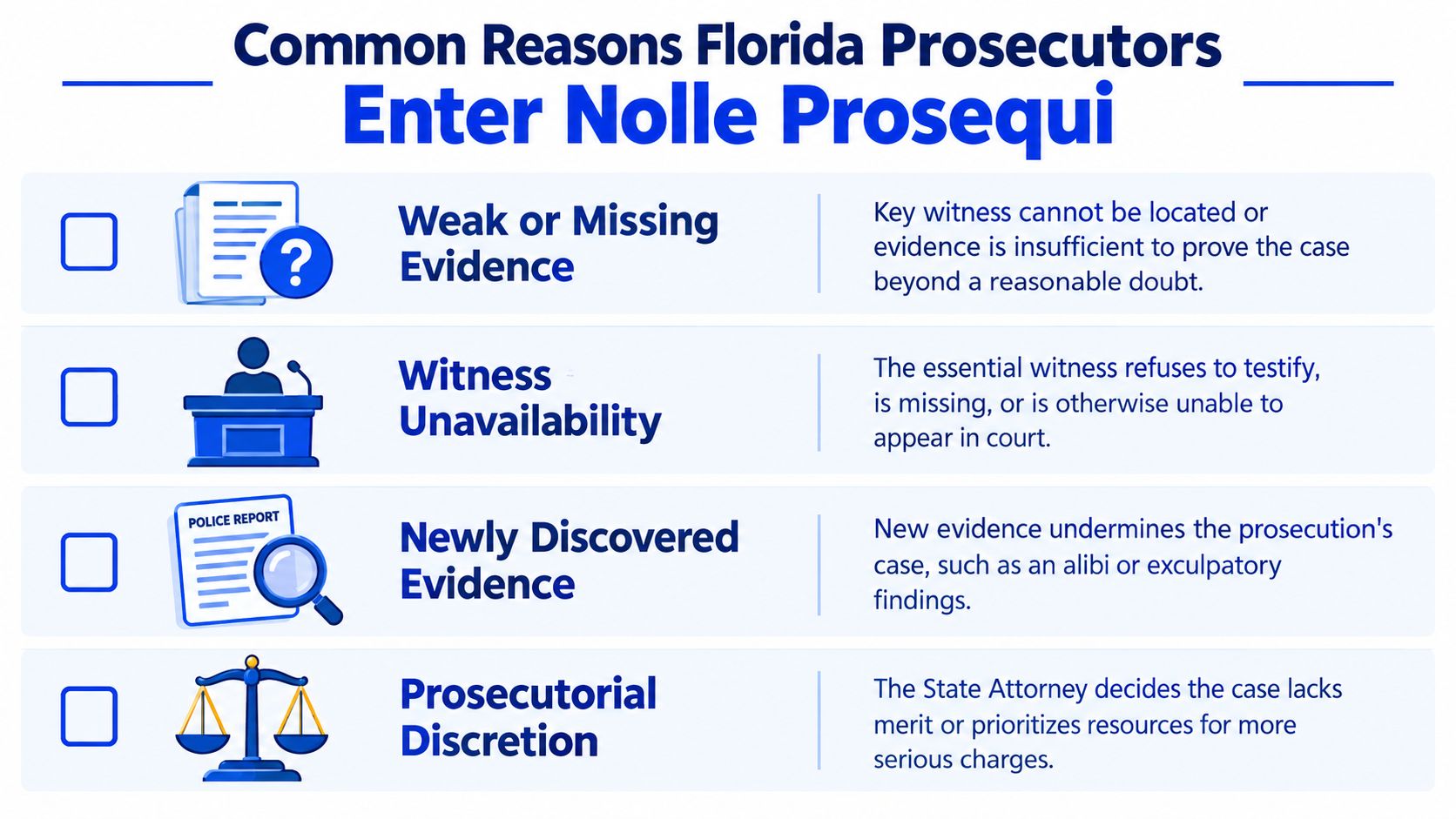
A Florida prosecutor may file nolle prosequi after deciding that continuing the charge no longer makes legal or practical sense. For example, a witness may stop cooperating shortly before a hearing, or new evidence may expose a problem the State cannot fix. The written filing may not explain the full reason, so the docket, discovery, and any related agreement deserve careful review.
Evidence no longer supports prosecution
A witness can become unavailable. Surveillance footage may be overwritten, physical evidence may not have been preserved, or later review may weaken an element the State must prove. If the remaining evidence cannot support proof beyond a reasonable doubt, the prosecutor may choose a nol pros rather than present a weak case at trial.
That decision does not establish that the arrest was proper or that the allegations were true. It means the State has chosen to stop pursuing the pending charge.
Witness problems can change the case
Witness cooperation often affects assault, theft, weapons, and domestic-violence-related prosecutions. A witness may stop responding, contradict an earlier statement, or become unavailable for a reason the State cannot overcome with other evidence. The prosecutor may then conclude that the remaining proof is insufficient.
The filing remains the State Attorney's written decision. The court record reflects the disposition, while a defendant's objection generally does not turn the filing into a trial or acquittal.
Diversion or another resolution
A defendant who completes an approved diversion program, pretrial intervention agreement, or specialty-court process may receive a nol pros on the underlying charge. The agreement controls what completion means. One count may be dismissed while another remains, and a successful program does not automatically erase the arrest record.
Read the paperwork closely. It may address costs, treatment, classes, reporting, record relief, or other duties. The prosecutor's ability to choose among these options is part of prosecutorial discretion.
Multi-defendant strategy changes
In a case with multiple defendants, one person may resolve a charge, cooperate, or become unavailable as a potential witness. The State may then abandon selected counts, narrow its theory, or lose its strategic reason to continue against another defendant.
Timing affects what can happen next. A nol pros entered before arraignment, during pretrial proceedings, or before jeopardy attaches generally leaves more room for refiling than one entered after a trial reaches a constitutionally protected stage. The docket and procedural history show which situation applies. That distinction can affect the defendant's next decisions about the case, including whether to examine available record relief and related consequences.
Consequences for Your Record, License, and Immigration Status
A nolle prosequi may end the State's prosecution, but it does not automatically erase the arrest or every consequence tied to the underlying event. Picture a background check that still lists the arrest, or a licensing agency asking about it even though the criminal charge no longer has a conviction. The disposition answers one question, whether the State continued that prosecution. Other agencies may ask different questions.
The record may remain visible
The court docket, arrest information, and law-enforcement databases can continue to show the charge and the nol pros disposition. Public access and government records are separate issues. Florida sealing and expungement may depend on eligibility requirements, waiting periods, and a separate application or order.
Other states show why timing and jurisdiction matter. Maryland generally prevents a person from filing an expungement petition based on a nolle prosequi within 3 years unless a waiver is filed, as discussed in the Maryland court opinion discussing expungement after nolle prosequi. That rule does not govern Florida, but it illustrates why you should not assume that a nol pros produces the same record remedy everywhere.
Collateral consequences require separate review
Area | Effect of Nolle Prosequi | Action Required |
|---|---|---|
Criminal record | The disposition may remain in court and law-enforcement databases | Check sealing or expungement eligibility |
Employment screening | A background check may show the arrest and disposition | Obtain accurate disposition records and address errors |
Professional licensing | Licensing agencies may ask about arrests even without convictions | Review the application language and disclosure duties |
Immigration | An arrest and underlying conduct can still matter even without a conviction | Obtain advice from an immigration lawyer before making representations |
Civil exposure | The underlying incident may still be relevant to a civil claim | Preserve records and discuss the facts with counsel |
Firearm rights | A nol pros does not automatically answer every firearms question | Review the charge, factual basis, and applicable restrictions with counsel |
Licenses and immigration
A criminal nolle prosequi does not automatically restore a suspended privilege or cancel a separate administrative action. A licensing board, motor-vehicle agency, or other regulator may have its own proceeding, deadlines, and disclosure rules. Identify each agency action and determine whether it requires a separate filing or hearing.
Immigration requires particular care. A dropped state charge can still appear as an arrest, and immigration authorities may examine the alleged conduct, charging history, and statutory consequences. Inadmissibility analysis under INA 212(a)(2) may arise even when the state case ended without a conviction. A noncitizen should obtain qualified immigration advice before making statements, accepting a resolution, or assuming that nol pros makes the matter irrelevant.
Florida also has a narrow wrongful-conviction compensation rule. Under section 961.055, a special prosecutor's entry of nolle prosequi after a death-sentence review can constitute conclusive proof of innocence for compensation purposes, as stated in Florida Statute section 961.055. That specialized provision does not establish the result in ordinary criminal cases.
For Florida-specific record sealing and expungement options, review the disposition, any other cases, and the agencies holding the records. Eligibility, filing requirements, and the practical effect of an order all need separate confirmation.
What to Do After a Nolle Prosequi in Florida
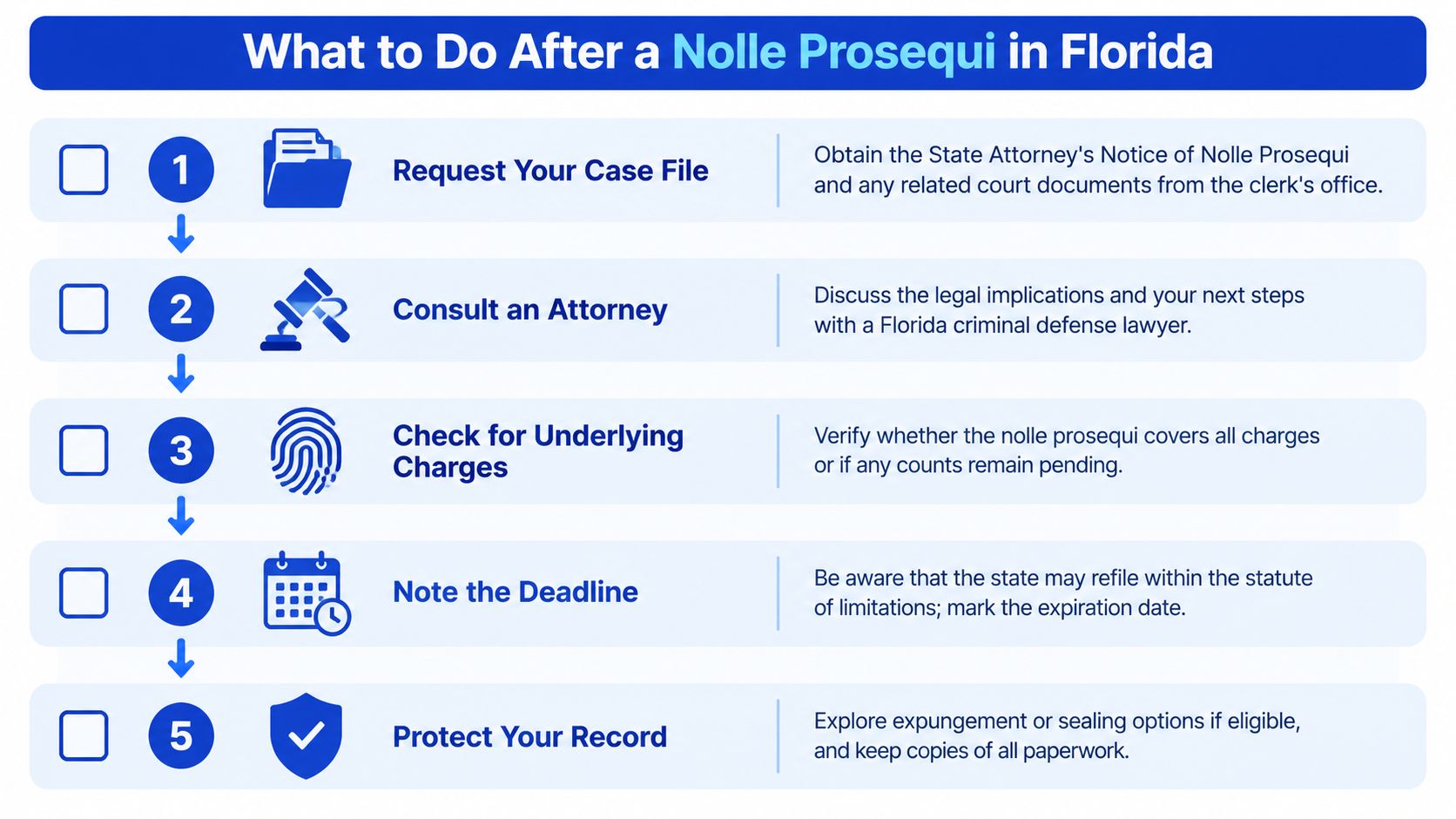
If the prosecutor entered a nolle prosequi yesterday, do not assume every problem ended with that entry. Florida cases may include several counts, separate cases, or related administrative matters. Confirm the exact scope first.
Get the paperwork. Request the State Attorney's notice and certified disposition from the clerk.
Compare every count. Check the notice against the information or indictment. A nol pros on one count may leave another charge pending.
Assess refiling risk. Ask counsel to review the statute of limitations, filing history, and whether jeopardy attached. Timing can affect both the State's options and your next decision.
Check the record remedy. Determine whether Florida's Clean Slate framework may automatically seal the eligible non-conviction disposition, or whether formal expungement is available. Verify the result with the agencies holding your records.
Review collateral issues. Confirm the status of bond and release conditions, then address licensing, immigration, and possible civil exposure separately.
An automatic seal is not something to assume. Keep copies of the notice, disposition, filings, and agency responses. A related criminal, traffic, or administrative matter may change the timing or eligibility for record relief.
A separate pretrial agreement can impose obligations that a straight nol pros does not. Review the difference in this guide to pretrial intervention in Florida. If you are not a U.S. citizen, obtain immigration advice before making statements or assuming the case no longer matters.
Florida Nolle Prosequi Questions Clients Ask Most
What should I ask my lawyer first?
Ask for the written disposition, the counts it covers, and confirmation that no related count remains pending. The phrase may describe only part of a case, so the docket matters more than a verbal summary.
Does a nol pros end every case-related problem?
Not always. A separate traffic, administrative, or criminal matter may still affect your release status, license, immigration position, or civil exposure. Review each matter separately rather than treating the filing as a universal clearance.
How long should I keep my paperwork?
Keep the notice, docket entries, disposition, and agency responses. You may need them when requesting record relief, correcting an inaccurate record, explaining the outcome to an agency, or addressing a later question about the case.
Who should confirm that my release conditions ended?
Ask your attorney, the clerk, and the jail or bond agency to verify the status. A nolle prosequi may resolve the prosecution while a hold or condition tied to another matter remains active.
What changes if the case is federal?
A federal case in the Southern or Middle District of Florida follows federal procedure. The federal docket and applicable rules control questions about the filing and any later action.
After a Florida case is nolle prossed, Ticket Shield, PLLC can review the disposition, check whether any counts remain, and discuss record-sealing or expungement steps. Visit Ticket Shield, PLLC to request a consultation about your next decision.