
Nolle Prosequi in Florida: What It Means and Why It Matters
Jason Goldsmith, Esq
You're sitting in court, trying to read a docket screen, and the prosecutor says the charge is being entered as nolle prosequi. If you've never heard the term before, it can feel like legal whiplash. The short version is this, the State Attorney has decided to stop prosecuting that charge, and the criminal case ends without a trial verdict, but that doesn't always mean the record disappears.
For a worried client in Fort Lauderdale, Broward County, Miami-Dade, or Palm Beach, the question is usually not the Latin phrase. It's whether the case is over, whether the State can bring it back, and whether the arrest can be sealed or expunged later. Those consequences matter in DUI, drug crimes, domestic violence, theft, gun charges, probation violations, and just about every other Florida criminal case where a dismissal is on the table.
Table of Contents
What Nolle Prosequi Means
A nolle prosequi means the prosecutor is formally ending the effort to pursue a charge. In plain English, the State is saying, “we are no longer going forward on this charge.” It is a dismissal decision, not a conviction, and it is not the same as a not guilty verdict.
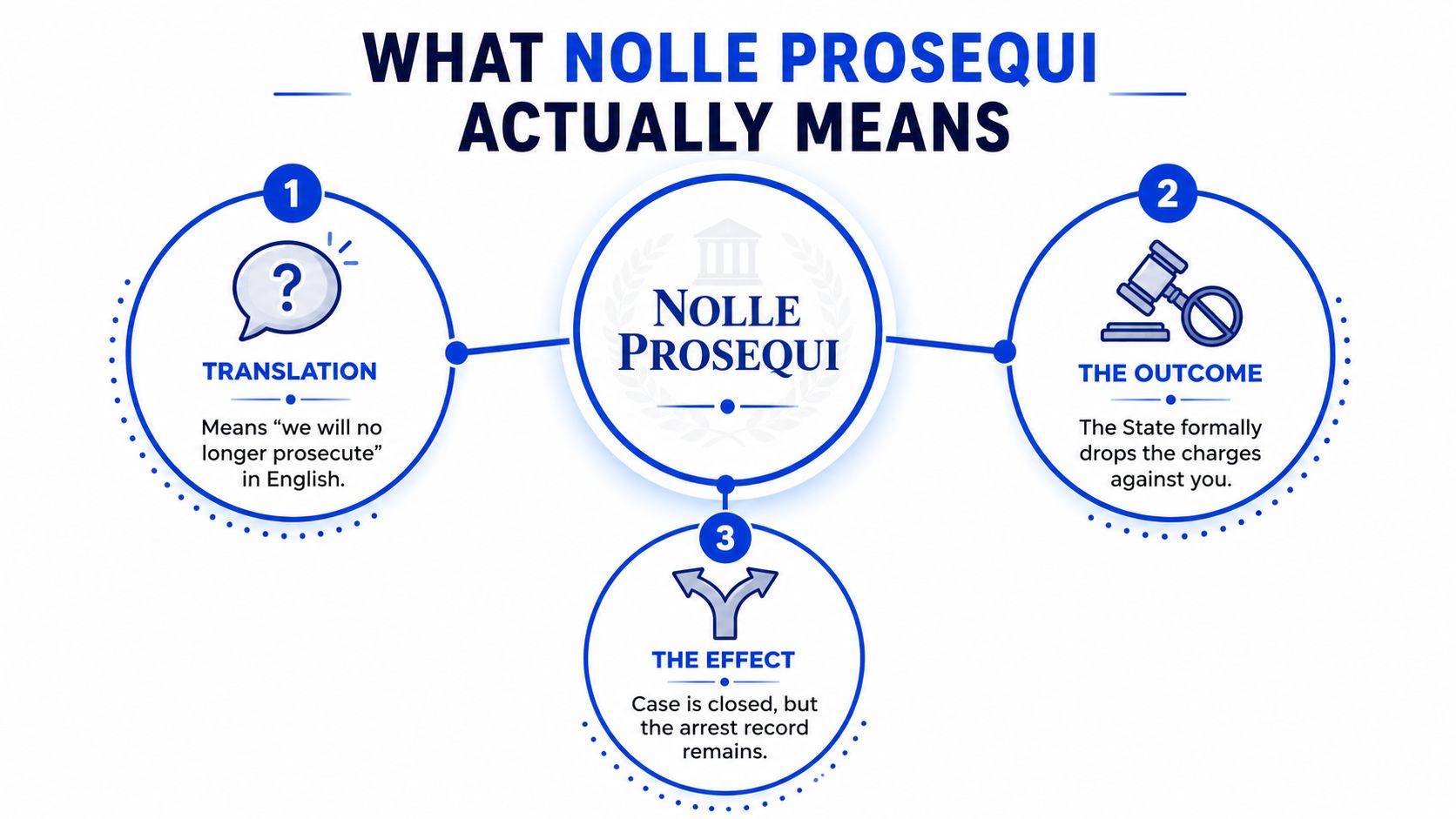
For a client, the practical meaning is usually clearer than the Latin. The charge has stopped moving. That can happen before trial, during pretrial litigation, or after the prosecutor decides the proof, the witnesses, or the legal issues are not strong enough to keep pressing the case.
A nolle prosequi can also apply to one count in a multi-count case, or to one defendant while other charges keep going. Defense lawyers pay close attention to the wording on the docket for that reason. If one count is nol prossed and another count stays active, the case is still alive.
Prosecutors use this tool for real-world reasons. A witness may stop cooperating, discovery may expose a problem, or the office may decide to narrow the case and keep only the counts it believes it can prove. In Florida practice, that comes up in DUI, domestic violence, drug possession, theft, weapons, and violent crime cases.
A client often feels relief when the charge is nol prossed, and that reaction is understandable. The case is no longer being pushed on that count. The harder question is what remains on the record, whether the State can refile, and what steps are needed to protect the result.
How a Nolle Prosequi Works in a Florida Court
A client usually learns the practical meaning in one place, the docket. The prosecutor stops pursuing the charge, the court record changes, and the case shifts from active prosecution to an ended count. In Florida, that decision belongs to the State Attorney's Office, not the defendant, and county dockets in Broward, Miami-Dade, and Palm Beach may show “nolle pros,” “nol prossed,” or a similar notation.
Who enters it and when it happens
The prosecution can enter a nolle prosequi at different points. Sometimes it happens early, sometimes after motion practice, and sometimes after a witness problem or other proof issue makes the case harder to continue. For a plain-English overview of the hearing that often sits around these pretrial disputes, see a guide to motion hearings in Florida criminal courts. In Florida court work, the key point is simple, the prosecutor can stop pushing a charge without going through a full trial on that count.
The immediate effect depends on what else is in the case. If the nol prossed charge was the only thing keeping a court date alive, that date may be cancelled or removed from the calendar. If bond conditions were tied only to that count, those conditions may fall away too. If other counts remain, the case keeps going on those counts, so a docket entry should never be read as if the whole case disappeared.
What it looks like on a docket
Clerk records often use shorthand instead of a long explanation. That is normal. The important part is that the formal record entry exists, because it can matter later for background checks, later prosecutions, and record-clearing steps.
If the docket says the case was nol prossed, read the rest of the case carefully. One dropped count does not always mean every count, every bond issue, or every court obligation is gone.

A nolle prosequi is procedural. The State enters it, the docket reflects it, and the pending prosecution on that count stops. That is why the entry matters so much in Fort Lauderdale criminal cases, where clients often need to know the same day whether they still have to appear in court or keep following bond terms.
A nolle prosequi can also apply to one count in a multi-count case, or to one defendant while other charges keep moving. Defense lawyers watch the wording closely for that reason. If one count is nol prossed and another count stays active, the case is still alive.
Nolle Prosequi vs Dismissal and With Prejudice
A client hears the State “dropped” a charge and assumes the fight is over. In Florida court, the label matters. A nolle prosequi is a prosecutor-initiated end to a charge. A dismissal is a court disposition, and whether it is with prejudice or without prejudice changes what happens next.
Why the label controls the outcome
A pretrial nolle prosequi often leaves the State free to try again later, unless a procedural bar gets in the way. A dismissal with prejudice usually shuts that door. Defense lawyers care about that difference because the docket entry can decide whether the case is finished or still hanging over the client.
That difference shows up in real cases, whether it is a Broward DUI, a Miami-Dade drug case, or a Palm Beach theft charge. If the State drops a charge because it is not ready, the case may come back. If the court dismisses it with prejudice, the defense has a stronger final result and less refiling risk.
Side-by-side comparison
Case Ending | Who Enters It | Can State Refile? | Expungement Eligible |
|---|---|---|---|
Nolle Prosequi | Prosecutor | Sometimes, depending on jurisdiction and limits | Often, if Florida eligibility rules are met |
Dismissal Without Prejudice | Court | Sometimes | Often, if the case ended without a conviction |
Dismissal With Prejudice | Court | Usually no | Often, if otherwise eligible |
Not Guilty Verdict | Judge or jury | No | Often eligible, subject to record rules |
Florida's sealing and expungement rules turn on the exact disposition, the defendant's prior history, and whether the person has already used the state's limited sealing or expungement benefit. For a broader overview, see a detailed guide to record sealing under Florida law.
Deferred prosecution can also resolve some cases without a conviction, but it is a different tool with different trade-offs and conditions. For that comparison, read how deferred prosecution works as an alternative disposition in Florida.
What Happens to Your Record After a Nolle Prosequi
A nol prossed charge can feel like the end of the case, but it does not erase the record by itself. The arrest, court entries, and background-check traces can still follow someone unless the record is handled the right way. In Florida, that usually means looking at sealing or expungement options after the nolle prosequi is entered.
Florida Statutes section 943.0585 allows certain criminal history records to be expunged after a charge was filed and later dismissed, nolle prosequi, dismissed by a court, or resolved by a judgment or verdict of not guilty Florida Statutes section 943.0585. That is helpful, but it is not automatic and it does not apply in every case.
Expungement and sealing are separate steps
A common mistake is treating a nol pros like a full cleanup. It is not. FDLE says a person is generally allowed only one court-ordered sealing or expungement in a lifetime FDLE certificate of eligibility instructions. That makes the choice matter, because using the benefit on the wrong case can close the door on a better result later.
FDLE also explains that eligibility depends on the final outcome, the person's adult and juvenile history, and whether the offense is one that can be sealed at all FDLE sealing and expungement FAQ. Some charges are off the table even when the case did not end in a conviction. For clients, that means the record question is practical, not theoretical. The wrong assumption can leave a case sitting in public view longer than expected.
A nol pros can still leave a usable path to cleanup, but only if the paperwork, eligibility rules, and prior record line up.
For a broader overview of the cleanup process, see record sealing in Florida.
Finality depends on timing
Timing also affects how much closure the case really brings. Under Massachusetts criminal procedure rule 16, if a nolle prosequi is entered after jeopardy attaches and without the defendant's consent, it has the effect of an acquittal Massachusetts Rule of Criminal Procedure 16. That rule is not Florida law, but it shows why the stage of the case matters.
For a Florida defendant, the practical point is simple. A nol pros entered before trial may still leave room for later action on the record, while a later termination can give stronger closure. The difference affects how a client answers background-check questions, how long a charge remains visible, and whether the case can be cleaned up at all.
Bottom line: A nolle prosequi may open the door to sealing or expungement, but it does not clear the record on its own. Eligibility turns on the statute, the person's history, and the exact case outcome.
A Typical Timeline From Arrest to Nolle Prosequi
A client usually wants one answer first, how long until the case is gone? The honest answer is that it depends on the charge, the county, and how hard the defense pushes back. In a routine Broward or Miami-Dade misdemeanor, a nol pros can happen early, or it can come after discovery, hearings, and more than one court date.
A representative South Florida timeline
The case usually starts with arrest and booking. First appearance follows quickly, bond is addressed, and the court process begins. After that, the State Attorney's Office reviews police reports, body-worn camera footage, witness statements, and any physical evidence.
That review can lead to a nolle prosequi if the evidence is weak or inconsistent. It can also lead to diversion, a reduced charge, or a negotiated resolution instead of a dismissal. In many low-level cases, the State's review and the defense response happen before the case gets near a trial date.
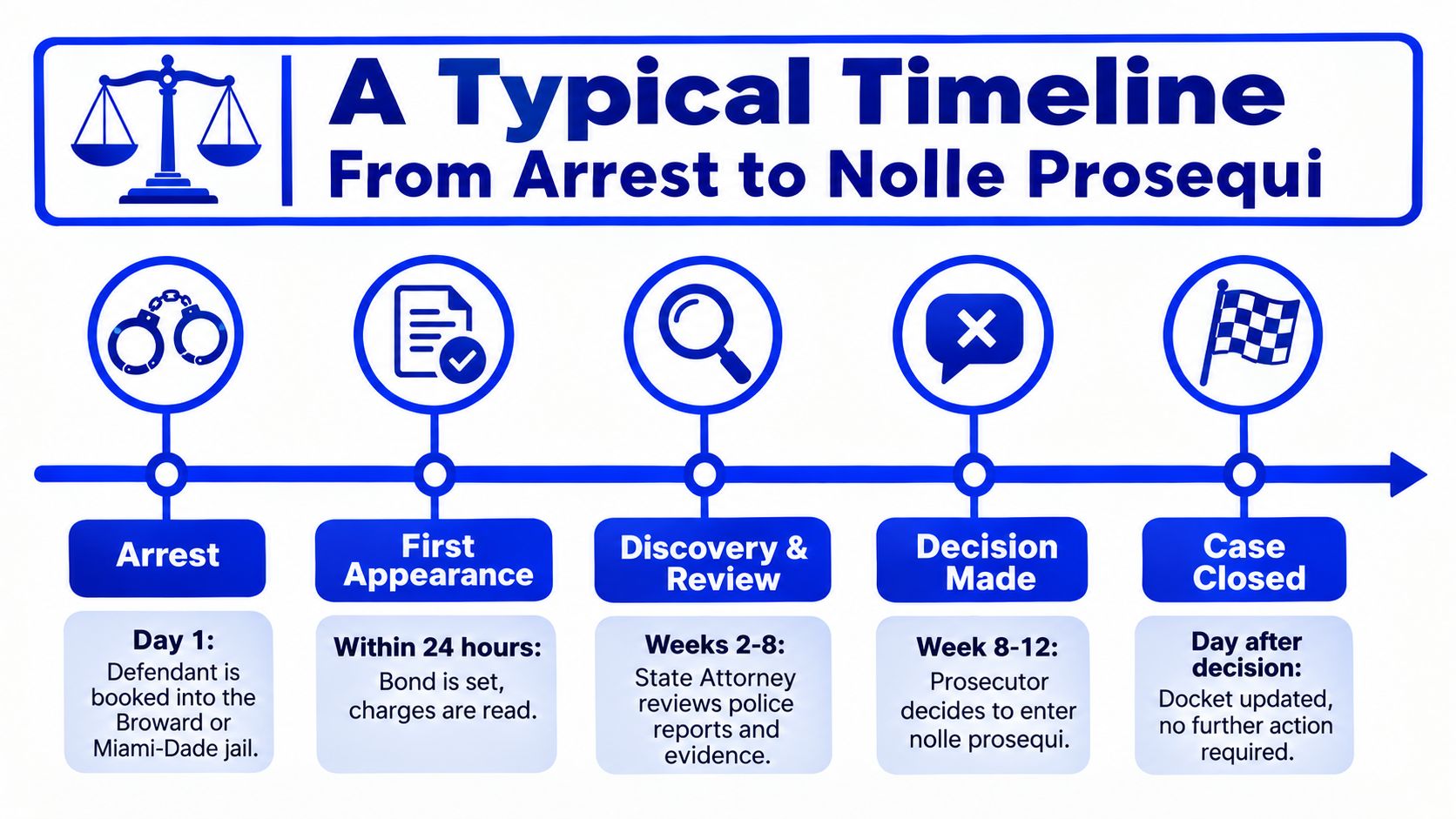
A defendant may see a nol pros at arraignment, after a pretrial conference, after a motion hearing, or on the eve of trial. The path usually gets narrower when defense counsel exposes weak evidence, missing witnesses, or constitutional problems. That matters most in drug possession, theft, and some DUI cases, where the State's paperwork or testing methods do not hold together.
What moves the case toward dismissal
Discovery review: The defense checks whether the reports, videos, and lab materials support the charge.
Motion practice: Search-and-seizure challenges and evidence suppression issues can force the State to reassess.
Diversion options: Some first-time or low-level matters may be diverted instead of fully prosecuted. For an overview of pretrial diversion programs available to Florida defendants, the key issue is whether the case fits the program before the prosecutor loses confidence in the charge.
Charge screening: The prosecutor may decide the file should not go forward after intake review.
A nol pros sometimes appears quickly because the State sees a fatal problem early. Other times it comes only after defense counsel has pressed hard enough that trial no longer makes sense. That difference tells you a lot about what was happening behind the scenes.
What You Should Do Once a Nolle Prosequi Is Entered
A nol pros can feel like the case is over, but the practical work starts there. Confirm the exact docket entry in the clerk's system, then check whether the State dropped every count or only part of the case.
Your practical checklist
Confirm the record: Check the clerk's online docket and save a copy of the disposition.
Get certified documentation: Ask for the paperwork you may need for later record-clearing.
Check sealing or expungement eligibility: Florida Statutes 943.0585 and 943.059 control the process, and FDLE limits sealing or expungement to narrow circumstances. Review the steps to seal or expunge a nolle prosequi record in Florida before you file anything.
Watch for refiling risk: A nol pros can be temporary, so timing matters.
Don't talk casually about the case: Avoid statements to law enforcement or anyone else that could create new problems if the matter gets revisited.
FDLE's frequently asked questions about sealing and expungement also explain that some offenses remain off-limits even when adjudication was withheld. People often assume a dropped case is automatically cleanable. It is not.
Why timing matters so much
A dropped Florida DUI still leaves a record behind. Florida DUI law treats a breath-alcohol or blood-alcohol level of 0.08 or higher as prima facie evidence of impairment, and it is also the unlawful per se limit for driving or actual physical control of a motor vehicle Florida DUI statute on the 0.08 limit. If the charge was dismissed, insurance companies, licensing agencies, and background checks can still see the arrest unless you handle the record correctly.
The same problem shows up in drug, theft, gun, and domestic violence cases. A nol pros may stop the prosecution, but it does not fix the record by itself. A prompt review with counsel is the safer move than waiting to see whether the case comes back.
How Defense Strategy Shapes the Outcome
A nolle prosequi is usually the result of defense work that exposes weak points before trial. The State may back off after a bad stop, a shaky search, a witness who will not hold up, or lab evidence that does not support the charge.
Where defense pressure changes the case
In a DUI case, counsel may challenge field sobriety exercises, roadside detention, or the basis for the stop. The breath-test number matters, but it is only part of the analysis. In a drug case, the issue may be a warrantless search or a broken chain of custody. In a domestic violence or theft case, the witness may be too unreliable to carry the charge.
A former prosecutor knows where a file is likely to crack, because prosecutors care about proof, witness availability, and whether the case is worth trying. That is why charging decisions matter, and why how prosecutors exercise discretion in deciding whether to pursue a case often tells defense counsel what happens next.
The strongest dismissals usually come after the defense forces the State to answer hard questions it cannot answer well.
What a good defense plan looks like
A sound defense approach usually pulls several levers at once. Discovery demands show what the State has. Suppression motions test whether key evidence should come out. Negotiation with the State Attorney can open the door to diversion, a reduction, or dismissal. In some cases, a nolle prosequi is the cleanest result. In others, the better goal is a disposition that protects record-clearing eligibility and lowers the risk of refiling.
That analysis should start early. If the State is looking for a quick conviction, the defense has to stay focused on the record, the witnesses, and the endgame, not just the next hearing.
Ticket Shield, PLLC helps Florida clients assess whether a nolle prosequi really closes the case, whether the record can be sealed or expunged, and what steps should come next after the docket changes. If you're dealing with a dropped charge in Fort Lauderdale or anywhere in South Florida, visit Ticket Shield, PLLC for a confidential consultation and get the record, bond, and refiling issues reviewed before you assume the case is finished.