How Long Is a License Suspension for DUI in Florida
Jason Goldsmith, Esq
You leave a Florida DUI stop with your license taken, a temporary permit in hand, and no clear idea whether you're allowed to drive tomorrow. The criminal court date may be weeks away, but the Florida Department of Highway Safety and Motor Vehicles can begin acting immediately. That's why the answer to how long is a license suspension for DUI in Florida can't be reduced to one number.
Florida DUI cases usually involve separate tracks: an administrative suspension, a possible refusal suspension, and a criminal revocation after conviction. Those tracks may overlap, but they don't automatically cancel one another. Your BAC, testing decision, prior record, age, offense level, and the timing of each proceeding all matter.
Table of Contents
What Happens to Your License Right After a Florida DUI Arrest
Administrative DUI Suspension Under Florida Statute 322.2615
Hardship Licenses Business Purpose Permits and Ignition Interlock
What Happens to Your License Right After a Florida DUI Arrest
A driver in Fort Lauderdale is arrested after an officer claims the driver failed roadside exercises and records an unlawful alcohol level. The officer takes the physical license, provides paperwork, and explains the administrative consequences. The driver may leave believing the court case is the only issue, but the license process has already started.
The officer may issue FLHSMV Form 74039, along with a temporary driving permit. Florida law creates a 10-day temporary permit window after arrest, so the immediate administrative process can move forward before a prosecutor files or resolves the criminal charge. The driver must act quickly if they want to challenge the administrative suspension through the Bureau of Administrative Reviews.
A request for an administrative review hearing generally must be made within that 10-day period. Missing the deadline can eliminate an important opportunity to contest the suspension, even though the criminal DUI case remains pending.
Practical rule: Treat the temporary permit as a short legal window, not as proof that the entire license problem has been postponed.
During that window, read the paperwork carefully and confirm what kind of suspension the officer imposed. A failed chemical test and a refusal follow different rules. The permit's terms also matter. Driving outside the authorization, or continuing to drive after the permit expires without another valid privilege, can create a separate traffic or criminal problem.
The administrative case is separate from the DUI prosecution. The hearing addresses the legal basis for the suspension, while the criminal case addresses whether the State can prove DUI beyond a reasonable doubt. The two matters may develop at different speeds. What happens after a DUI arrest can include both proceedings, and handling one doesn't automatically resolve the other.
Administrative DUI Suspension Under Florida Statute 322.2615
Florida Statute 322.2615 authorizes an arrest-based administrative suspension when testing shows an unlawful breath or blood alcohol level. For a driver with no prior qualifying administrative suspension, the statute provides a six-month suspension. If the driver previously had a privilege suspended under the same administrative framework, the suspension can become one year. The Florida statute describes the first-offense six-month suspension and the one-year consequence for a prior qualifying suspension in its administrative framework. Read Florida Statute 322.2615
The Florida Highway Safety and Motor Vehicles agency also identifies a breath-alcohol result of 0.08 or higher as a trigger for a six-month suspension. A first DUI conviction or administrative action commonly falls within a 180-day to one-year range, but the exact result depends on the offense type and testing history. FLHSMV's explanation of Florida DUI administrative suspension laws provides the agency's breakdown.
The administrative triggers at a glance
Trigger | Length of Suspension | Hard Period Before Hardship |
|---|---|---|
Breath or blood alcohol result of 0.08 or higher, with no prior qualifying administrative suspension | 6 months | Eligibility depends on the applicable administrative rules and review |
Breath or blood alcohol result of 0.08 or higher, with a prior qualifying administrative suspension | 1 year | Eligibility depends on the applicable administrative rules and review |
The administrative suspension is civil, not a criminal conviction. It can begin while the criminal case is still unresolved. That distinction matters in Broward County and throughout South Florida because a prosecutor's later decision to reduce or dismiss the DUI charge doesn't automatically erase an administrative suspension that wasn't separately challenged.
The administrative hearing may focus on issues such as whether the officer had lawful grounds for the arrest, whether the testing requirements were met, and whether the agency can establish the statutory elements. The hearing isn't a substitute for criminal defense. It's a separate opportunity to protect driving privileges. Understand Florida administrative license suspension before the review deadline expires.
Refusal to Submit to Chemical Testing and Implied Consent
Florida's implied-consent law creates a separate consequence when a driver refuses a lawful request for breath, blood, or urine testing. A first refusal triggers a one-year administrative suspension, while a prior refusal or prior refusal-based suspension increases the period to 18 months. Florida's published legislative analysis describes those refusal consequences under the implied-consent framework. Review Florida's implied-consent analysis
Refusal isn't the same as testing at or above the legal threshold. A failed test places the driver on the alcohol-level track. Refusal places the driver on a separate refusal track, even if the State doesn't have a breath result to introduce.
A first-time refuser may have a 10-day window to seek review and pursue a hardship permit. A second or subsequent refuser doesn't receive the same immediate permit opportunity. That difference makes the first days after arrest especially important.
The refusal can also affect the criminal case. Prosecutors may argue that the driver's decision to refuse testing shows consciousness of guilt, although the defense can challenge the circumstances surrounding the request, the warnings, the legality of the stop, and whether the refusal was clear and voluntary.
What a refusal review should examine
The traffic stop: Whether the officer had a lawful basis to stop the vehicle.
The arrest: Whether probable cause supported the DUI arrest.
The warning: Whether the officer properly explained the consequences of refusing.
The record: Whether the paperwork accurately documents the request and response.
Florida's implied-consent law and DUI refusals deserve immediate attention. Waiting for the criminal arraignment can allow the administrative deadline to pass first.
Criminal DUI Conviction Revocations by Offense Level
A criminal conviction creates a different license consequence. The court-ordered revocation follows the conviction and can last far longer than the initial administrative suspension. Florida's published DUI guidance identifies a six-month to one-year revocation for a first-time DUI, while repeat conduct can produce five-year, 10-year, or longer consequences depending on the timing and number of offenses. Florida DUI law and revocation benchmarks explain the escalation.
The conviction is reported to the licensing agency, and the criminal revocation clock generally turns on the date of conviction, not the date of arrest. An out-of-state DUI conviction may also affect Florida licensing consequences because Florida can treat qualifying out-of-state convictions as prior DUI conduct.
Criminal revocation periods by offense level
Offense Level | Minimum Revocation | Hardship Eligible? |
|---|---|---|
First misdemeanor DUI | 180 days | Generally unavailable during the first conviction revocation period for standard offenders |
DUI causing serious bodily injury | 3 years | Eligibility is restricted and depends on the applicable statutory framework |
Second DUI within 5 years | 5 years | Restricted, with eligibility depending on the record and statutory requirements |
Third DUI | 10 years | Restricted, with eligibility depending on the record and statutory requirements |
DUI manslaughter | Permanent revocation | No ordinary hardship path restores the privilege during permanent revocation |
Florida's highway safety agency states that a first DUI conviction results in a revocation ranging from six months to one year, while a DUI involving serious injury carries at least a three-year revocation. The statutory structure becomes much more severe for repeat convictions. FLHSMV's DUI administrative suspension information distinguishes those outcomes.
The practical problem is stacking. The administrative suspension or refusal suspension may already have started, but a criminal revocation can still control the driver's legal ability to drive after conviction. Serving one period doesn't guarantee that every later revocation has been satisfied.
Under-21 Zero Tolerance Suspension Rules in Florida
Florida uses a lower alcohol threshold for drivers under 21. A blood-alcohol level of 0.02 or higher can trigger an immediate administrative suspension, even though the adult DUI testing threshold is 0.08. FLHSMV states that a first under-21 suspension lasts six months, and a subsequent offense brings a one-year suspension. Florida's under-21 DUI rules describe the separate zero-tolerance track.
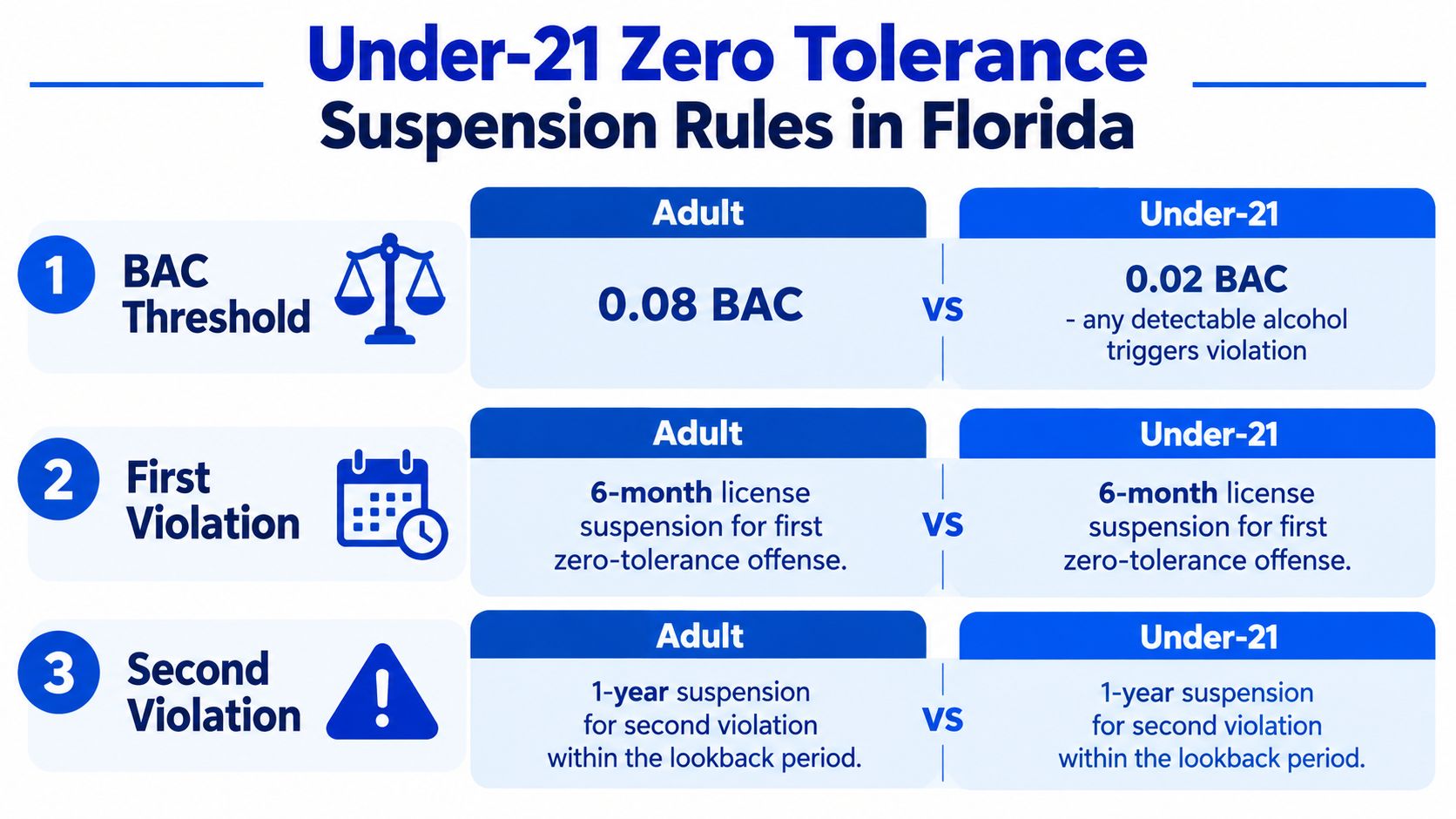
The zero-tolerance suspension is administrative and begins from the arrest-based process. The driver generally has a 10-day period to request a formal review hearing. Missing that deadline can leave the suspension in place even if the driver later disputes the underlying facts.
A zero-tolerance suspension alone doesn't require ignition interlock installation. It also doesn't prevent the State from filing a separate criminal DUI charge if the evidence supports impairment or an alcohol level at or above the adult threshold.
That distinction matters for families in Fort Lauderdale, Miami-Dade, and Palm Beach County. A young driver may face a license suspension without a criminal conviction, but a separate DUI prosecution can create additional consequences. Florida's under-21 BAC rules should be evaluated alongside the arrest report, testing records, and any criminal charging document.
Hardship Licenses Business Purpose Permits and Ignition Interlock
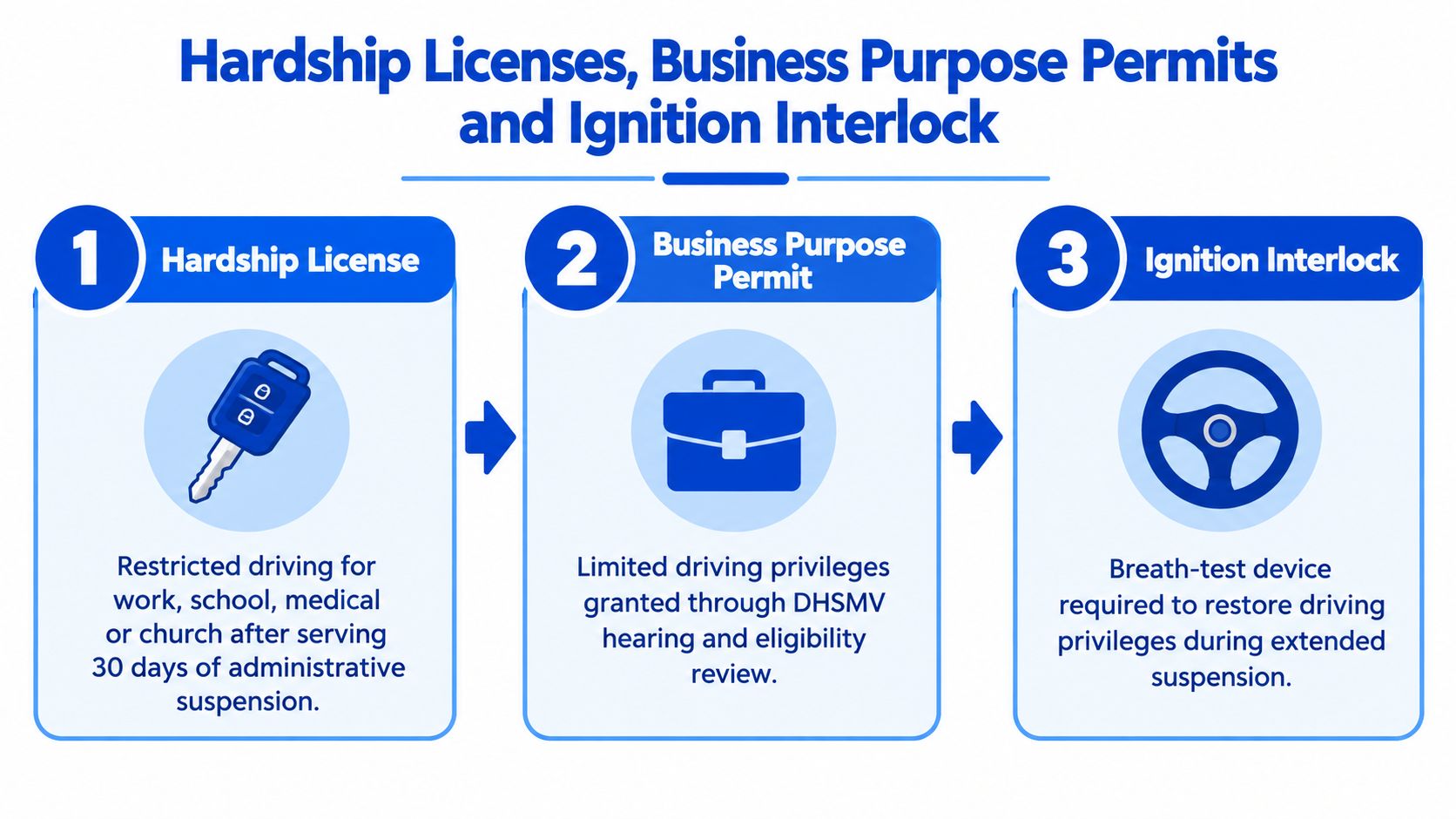
A suspended license doesn't always mean every form of driving is unavailable. Florida may provide limited pathways, but each one has a different purpose and different restrictions. A hardship license can permit driving for work, school, medical appointments, or church after the applicable waiting period, while a business-purpose order is narrower.
For an administrative suspension under section 322.2615, hardship eligibility may arise after serving 30 days. A refusal suspension has a different restriction, and hardship relief remains unavailable during the first 30 days of that refusal suspension. A criminal conviction revocation generally bars hardship relief during the first 180 days for standard offenders.
Choosing the correct driving pathway
Hardship license: This is designed for essential needs such as employment, education, medical care, and religious obligations. It doesn't create unrestricted personal driving privileges.
Business-purpose driving: This may cover an employee operating a company vehicle that isn't owned by the employee. It doesn't generally authorize personal errands or ordinary family transportation.
Ignition interlock: An IID requires a breath sample before the vehicle starts. It may become mandatory for hardship eligibility after a refusal or a prior DUI, and the driver pays installation and calibration expenses.
The trade-off is straightforward. A hardship license preserves necessary transportation but limits where you can go. An interlock may expand lawful access to a vehicle, but the device records compliance and violations. A failed test, missed calibration, or other violation can extend the restriction or jeopardize the privilege.
Driving with an interlock is a compliance obligation, not a technical workaround. Treat every device instruction and service appointment as a legal requirement.
Compliant logs may support reducing an interlock period when the governing rules permit it. The driver should preserve calibration records, receipts, and notices. If the IID reports a violation, contact counsel before assuming the restriction has ended or trying to remove the device.
This short video offers another visual explanation of the available driving pathways:
Steps to Reinstate Driving Privileges After the Suspension
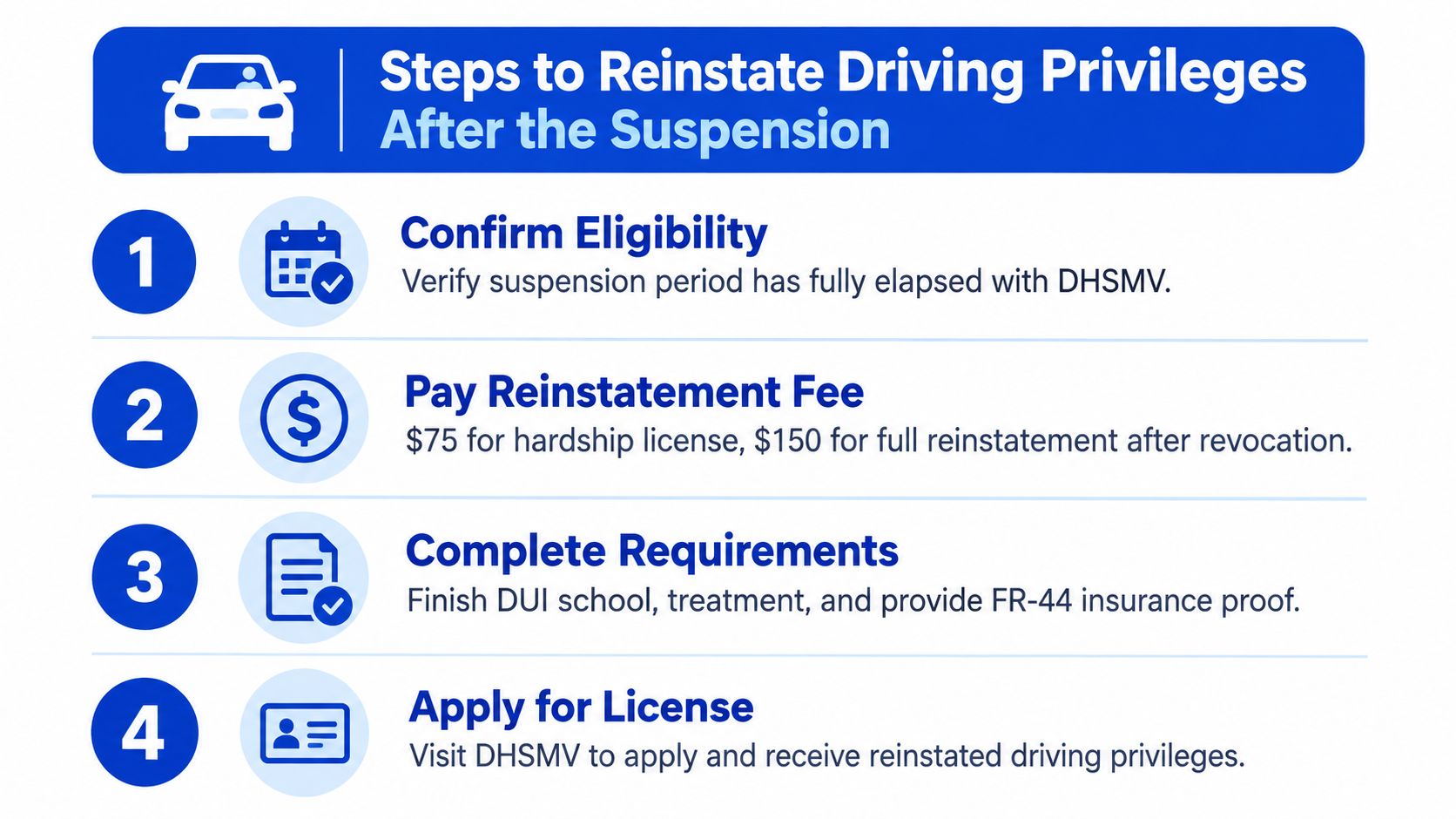
Reinstatement is a separate administrative task. A driver shouldn't rely on an assumption that the license is active because the calendar period appears to have ended. Confirm the status with FLHSMV and identify whether the remaining issue is an administrative suspension, a refusal, a criminal revocation, an IID condition, or an unresolved court requirement.
Start with the licensing record
First, verify that the applicable suspension or revocation period has fully elapsed. Then check for unpaid fines, incomplete court obligations, unresolved criminal matters, or out-of-state records. Any one of these can prevent clearance even when the primary Florida period has ended.
The reinstatement process may require payment of a $75 hardship fee or a $150 full reinstatement fee after revocation. Those amounts are identified in the applicable reinstatement guidance and should be confirmed with FLHSMV before payment.
Complete the conditions attached to the case
Drivers may need to finish DUI school, comply with a treatment evaluation or court-ordered treatment, and provide proof of required insurance. The plan may also require ignition interlock installation and documentation that the device has been installed and maintained.
Florida DUI insurance filings are commonly handled through an insurer's required certificate, and the insurance obligation may continue for three years when imposed by the licensing requirements. Confirm the exact filing with FLHSMV and the insurer because an incorrect or missing filing can delay restoration.
Apply only after the record is clear
A hardship reinstatement and a full reinstatement after revocation aren't interchangeable. Hardship driving may remain restricted to approved purposes, while full reinstatement requires completion of the longer revocation and every condition attached to it.
The practical order is:
Confirm eligibility: Verify the controlling period and unresolved holds.
Complete education and treatment: Finish DUI school and court-ordered services.
Arrange insurance and IID compliance: Submit the required proof.
Pay the correct fee: Use the fee tied to the type of reinstatement.
Apply through FLHSMV: Don't drive until the agency confirms the privilege is restored.
Florida DUI license reinstatement involves more than waiting. Keep every receipt, certificate, installation record, and agency notice.
Common Questions Florida Drivers Ask About DUI Suspensions
Do the administrative suspension and criminal revocation stack?
They're separate actions and may run concurrently, but the longer controlling period determines when you can legally drive. Serving an administrative suspension doesn't erase a later criminal revocation. The exact result depends on the dates, offense history, and agency records.
What happens to a commercial driver's license?
A CDL holder can face a one-year disqualification after certain DUI-related events, and a second qualifying offense can lead to a lifetime consequence. The commercial privilege may be affected even when the driver's personal driving options appear different. CDL holders should avoid treating a hardship license as permission to operate commercially.
Does an out-of-state DUI affect a Florida license?
It can. Florida may treat a qualifying out-of-state DUI conviction as a Florida conviction for licensing purposes. That prior can lengthen the revocation period or change eligibility for restricted driving.
Can I use a hardship license for anything?
No. Hardship driving is limited to approved purposes such as work, school, medical trips, or church. Personal convenience trips can fall outside the authorization. Keep documentation of your approved schedule and follow the restriction exactly.
What if an IID records a violation?
The device may transmit or record the event, and the agency can impose consequences that extend the restriction. Don't remove the device, ignore a notice, or assume the report is accurate without reviewing the underlying data and compliance records.
A minor underage administrative suspension may sometimes be resolved without a criminal conviction, but the event can still appear on the driving record. Because deadlines and eligibility change with the case posture, a driver in Broward County, Fort Lauderdale, Miami-Dade, Palm Beach, or another Florida jurisdiction should verify the record and deadlines promptly with a qualified attorney.
Ticket Shield, PLLC can review the administrative suspension, refusal issues, DHSMV records, and related Florida DUI charges as part of a coordinated license strategy. Visit Ticket Shield, PLLC for a confidential consultation about protecting your driving privileges and defending the underlying case.