
What Is Double Jeopardy? Your Rights in Florida
Jason Goldsmith, Esq
If you're reading this after a charge was dropped, a jury said not guilty, or a judge dismissed your case in Broward County, Fort Lauderdale, Miami-Dade, or Palm Beach, you're probably asking one question: can they try me again?
That fear is common. It comes up after DUI arrests, drug cases, theft allegations, domestic violence charges, gun cases, probation violations, and even juvenile matters. People hear the phrase double jeopardy and assume it means the government only gets one shot, no matter what happened. The basic idea is right. The details are where people get blindsided.
In plain English, what is double jeopardy? It is the constitutional rule that generally prevents the government from prosecuting or punishing you twice for the same offense. That protection matters because criminal cases don't just threaten jail, probation, fines, and a permanent record. They also bring stress, public embarrassment, missed work, family disruption, and the pressure of fighting the same accusation over and over.
In Florida, though, this right is highly technical. The answer often turns on timing, court procedure, and whether the second case is really from the same sovereign. A case dismissed before trial isn't treated the same as an acquittal after trial. A state case in Fort Lauderdale isn't always the end of the matter if federal law is involved. And a single arrest can still produce multiple charges that raise serious multiple-punishment issues.
Table of Contents
Understanding Your Rights in the Florida Justice System
Double jeopardy is one of those legal phrases people know, but often only halfway. In everyday language, it means the government usually gets one full and fair chance to prosecute a specific criminal accusation. If the State loses in the way the law recognizes, it usually doesn't get to keep trying until it finally gets a conviction.
That rule matters in South Florida courtrooms every day. A person accused of shoplifting in Broward County, DUI in Palm Beach, domestic violence in Miami-Dade, or a probation violation tied to a new arrest may hear conflicting advice from friends, family, or the internet. Some of that advice is flat wrong.
Why people get confused
Part of the confusion comes from how criminal cases move through Florida courts. Charges can be filed, dropped, amended, refiled, severed, enhanced, or transferred. A prosecutor may announce a dismissal. A judge may declare a mistrial. A case may end with a plea instead of a verdict. Those events don't all trigger the same constitutional consequences.
A second problem is that double jeopardy covers more than one thing. It can block:
A second prosecution after an acquittal
A second prosecution after a conviction
Certain retrials after a mistrial
Multiple punishments for the same offense in one case
Practical rule: The phrase sounds simple, but the outcome often depends on one narrow question. What exactly happened, and when did it happen?
When a case is dismissed, reduced, or refiled, don't assume the label controls the result. In criminal defense, procedure matters as much as substance. That's especially true in cases involving DUI, drug crimes, weapons charges, white collar allegations, and federal crimes, where overlapping agencies and overlapping statutes can create real danger.
The Constitutional Shield Your Fifth Amendment Right
The protection against double jeopardy comes straight from the Constitution. The Fifth Amendment states that “no person shall be subject for the same offence to be twice put in jeopardy of life or limb”. That rule originally applied only to the federal government until the Supreme Court's decision in Benton v. Maryland in 1969 extended the protection to state prosecutions through the Fourteenth Amendment, as explained in this overview of double jeopardy and Benton v. Maryland.
Why the rule exists
This isn't a loophole. It's a restraint on government power.
A criminal prosecution is expensive and disruptive even when the accused did nothing wrong. The rule protects people from being worn down by repeated prosecutions for the same offense. It also preserves finality. When a case ends in the way the Constitution recognizes, the government can't keep treating the accusation like an open tab.
That matters whether the charge is a misdemeanor traffic-related offense or a serious felony. If you were accused of a theft crime in Fort Lauderdale, a violent offense in Miami-Dade, or a drug charge in Broward County, the State has to play by constitutional rules from the start.
Why Florida courts must follow it
Florida judges don't get to treat this as optional, and neither do prosecutors. Once the Fifth Amendment protection applies, it binds state court proceedings just as surely as it binds federal court proceedings.
That is one reason constitutional rights should be discussed early in a case, not after damage is done. A person who understands their Miranda rights in Florida criminal cases is already thinking about how constitutional protections limit police and prosecutors. Double jeopardy fits into that same larger picture. The Constitution places real boundaries on what the government can do.
The strongest criminal defense arguments often begin with constitutional limits, not with excuses.
Historically, the idea is ancient. The principle reaches back to 355 BCE, when Demosthenes stated that the laws forbid the same man to be tried twice on the same issue, and later appeared in the 533 CE Digest of Justinian under the maxim nemo debet bis puniri pro uno delicto, discussed in this historical treatment of double jeopardy. The modern American version is part of that long tradition: finality, fairness, and limits on repeated prosecution.
When Does Double Jeopardy Protection Begin in Florida
For many defendants, this is the most important part of the whole topic. Double jeopardy does not begin at arrest. It doesn't begin when police handcuff you. It doesn't begin when the prosecutor files charges. It begins only when jeopardy attaches.
Arrest is not enough
That distinction surprises people. Someone gets arrested for DUI in Fort Lauderdale or for a drug charge in Broward County, the State later drops the case, and they assume that's the end. Sometimes it is. Sometimes it isn't. If the case ended before jeopardy attached, prosecutors may still be able to refile.
A common point of confusion involves early hearings. First appearance, arraignment, bond court, motion practice, and filing decisions are important. But they are not the same as the constitutional moment when jeopardy begins. If you're unclear on where your case stands procedurally, this explanation of what arraignment means in Florida criminal court helps place that hearing in the timeline.
The trigger points that matter
Florida follows specific attachment points. In Florida criminal cases, jeopardy attaches when the jury is duly impaneled and sworn in a jury trial, when the first witness is sworn in a bench trial, and when the court formally accepts a guilty plea, as summarized in this Florida explanation of when jeopardy attaches.

Here is the practical version:
Proceeding | When jeopardy attaches |
|---|---|
Jury trial | When the jury is sworn |
Bench trial | When the first witness is sworn |
Plea case | When the court accepts the plea |
That timing can decide whether a second prosecution is legal.
Before attachment: A dismissal may allow the State to come back.
After attachment: A second prosecution may be barred, depending on why the first case ended.
Plea context: The key moment is court acceptance, not simply discussion or negotiation.
A simple example helps. Suppose a prosecutor files a theft case in Broward County, then dismisses it before trial because a witness didn't appear. If jeopardy never attached, the State may be able to refile. But if a jury was already sworn and the State then tried to start over after an acquittal, that raises a very different constitutional problem.
The label on the court event matters less than the procedural posture. The question is not “Was my case dismissed?” The key question is “Had jeopardy attached when it was dismissed?”
Key Exceptions When You Can Be Tried Twice
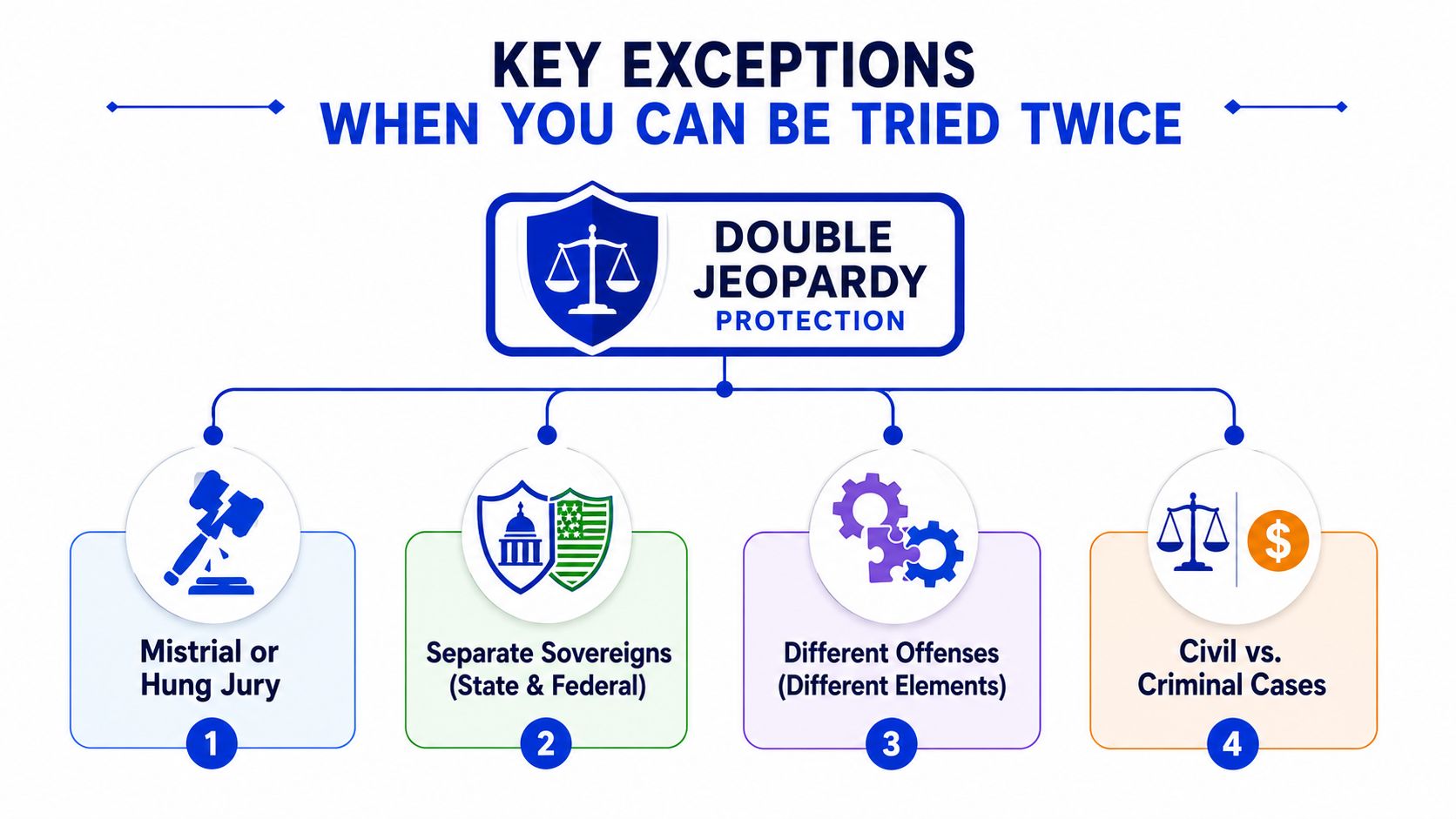
The rule against double jeopardy is powerful, but it isn't absolute. Several situations can still lead to another prosecution or another proceeding without violating the Constitution.
Mistrials and hung juries
If a trial ends in a mistrial, the case is not always over. One common example is a hung jury. If jurors cannot reach a verdict, the court may declare a mistrial, and the State may often retry the case.
That doesn't mean every mistrial opens the door to a second prosecution. The reason for the mistrial matters. Who requested it matters. Whether the defendant consented can matter. These are fact-sensitive issues that often require careful review of the transcript.
Appeals and retrials
A successful appeal can also lead to another trial. If a defendant overturns a conviction because of a legal error in the first trial, the State may often try the case again. The basic idea is that the first result was set aside because the process was flawed, not because the government was permanently barred after an acquittal.
That is why acquittals and reversed convictions are treated differently. An acquittal usually carries special finality. A conviction undone on appeal often doesn't.
Here is a useful way to think about it:
Acquittal: Usually ends the prosecution for that offense.
Conviction reversed for trial error: May allow retrial.
Mistrial: May or may not allow retrial, depending on the reason.
A prosecutor's decision to file a formal abandonment of charges can also confuse defendants. A nolle prosequi in Florida doesn't automatically mean double jeopardy prevents the State from revisiting the matter later.
A short overview may help reinforce these exceptions.
Civil cases are different from criminal cases
Double jeopardy is a criminal protection. It generally does not stop a separate civil case based on the same underlying event.
A familiar example is an assault allegation. A criminal case may end one way, while the alleged victim separately sues for money damages in civil court. That does not usually create a double jeopardy problem because civil and criminal proceedings serve different functions.
Dual sovereignty and the hidden South Florida risk
This is the exception many people never see coming. Under the dual-sovereignty doctrine, separate sovereigns can prosecute the same conduct without violating the Fifth Amendment. If a defendant is acquitted or convicted in Florida state court, the federal government may still prosecute the same underlying conduct if federal law was also violated, as explained in this discussion of the dual-sovereignty exception.
This matters in South Florida more than many people realize. Cases involving drug trafficking, firearms, fraud, immigration-related conduct, or interstate activity can attract both state and federal attention. A state case in Broward County does not always exhaust the government's options.
A state-court win can be real and important, but it isn't always the final word if federal law is in play.
Think of state and federal governments as two different rulebooks enforced by two different authorities. The act may be the same. The sovereign is not.
That risk shows up most often in:
Drug crimes with larger investigations or interstate facts
Gun and weapons charges that may implicate federal statutes
White collar crimes involving banks, wire communications, or federal agencies
Certain violent crimes tied to federal jurisdiction
So if you were found not guilty in a state case, don't assume you're automatically “in the clear” across the board. In South Florida, especially in Fort Lauderdale and the broader Broward and Miami-Dade area, overlapping investigations are a real concern in serious felony cases.
How Florida Law Shapes Double Jeopardy Claims
Federal constitutional law sets the floor. Florida law supplies important local rules that shape how courts analyze multiple charges and multiple punishments arising from the same criminal episode.
Florida's rule on multiple punishments
Under Florida Statute § 775.021(4)(b), separate sentencing is prohibited when offenses require identical elements of proof, are degrees of the same offense, or are lesser offenses whose statutory elements are subsumed by the greater offense, as summarized in this discussion of Florida Statute § 775.021(4)(b).
Florida courts also use the Blockburger test in this area. In simple terms, courts ask whether each offense requires proof of an additional fact that the other does not. If not, multiple punishments may violate double jeopardy principles.
That issue comes up often in practice:
A robbery and an assault charged from the same event
A firearm offense paired with a sentencing enhancement based on the same gun
Multiple homicide convictions arising from a single death
Lesser and greater versions of the same crime charged together
The four-part hurdle in Florida court
When a defendant raises a former jeopardy claim in Florida, courts look for four identities. There must be identity of the victims and the accused, identity of the jurisdictions, identity of the acts and circumstances, and identity of the offenses charged in a broad sense, as described in this Florida law review discussion of former jeopardy requirements.
That fourth-part analysis is one reason these motions are rarely simple. Two cases can sound similar but still fail the legal test. A change in jurisdiction alone can sink the claim. That matters when a person is facing one case in state court and another in federal court.
Florida appellate law adds more nuance. The Florida Supreme Court has held that double jeopardy is violated when multiple homicide convictions result from a single death in Houser v. State, and it has also barred certain firearm-related dual convictions arising from the same criminal episode in State v. Brown, as discussed in this Florida Supreme Court merits brief addressing those rules.
Florida double jeopardy analysis is rarely just “same facts equals same case.” Courts look at elements, legislative intent, jurisdiction, and the exact way charges are framed.
That is why a careful charge-by-charge review matters in Broward County, Miami-Dade, Palm Beach, and throughout South Florida. In many cases, the strongest defense is not against the main accusation alone. It is against improper charge stacking and improper multiple punishments.
Common Misconceptions About Double Jeopardy
People often use the phrase confidently while misunderstanding the rule. That can lead to dangerous assumptions in active cases.
Myth and reality
Myth: If I was arrested, jeopardy already attached.
Reality: Arrest is not the trigger. The critical attachment point happens later in the court process, at the specific procedural moments discussed earlier.
Myth: If the State dismissed my case once, it can never come back.
Reality: Not always. A dismissal before jeopardy attaches may leave the State free to refile.
Myth: If I beat the case in Broward County, I'm completely safe.
Reality: Not necessarily. Public discussion often leaves out the fact that double jeopardy does not bar parallel prosecutions by different sovereigns, such as state and federal authorities, even for the same act, and people often assume a state acquittal guarantees immunity when federal charges can still proceed if federal law was also violated, as noted in this overview of the Double Jeopardy Clause and separate sovereigns.
Myth: Double jeopardy means I can't face a probation violation if I pick up a new charge. Reality: A probation proceeding is not automatically barred because it involves conduct also alleged in a new criminal case. These are separate procedural questions, and the analysis can be very different.
Myth: The rule only matters in major felonies.
Reality: The protection can matter in misdemeanors, felonies, juvenile delinquency matters, and cases involving stacked counts in one information.
A quick checklist helps separate panic from legal analysis:
Check the forum: Was this state court, federal court, or both?
Check the timing: Had a jury been sworn, a witness sworn, or a plea accepted?
Check the ending: Was there an acquittal, mistrial, dismissal, plea, or reversal on appeal?
Check the charges: Are these the same offense, or different offenses with different elements?
The phrase is simple. The doctrine isn't. That is why a calm review of the docket, transcript, charging document, and court rulings matters more than internet shorthand.
How a Florida Defense Attorney Can Protect Your Rights
Double jeopardy claims are won or lost on precision. A defense lawyer has to read the procedural history carefully, compare charging documents, identify the exact attachment point, and determine whether the later prosecution involves the same offense, the same conduct, the same jurisdiction, or a separate sovereign.
What legal protection looks like in practice
In a real Florida case, protecting this right may involve:
Filing a motion to dismiss on double jeopardy grounds
Arguing that jeopardy attached before the State tried to start over
Challenging stacked counts that seek multiple punishments for the same criminal episode
Distinguishing state and federal exposure in cases with possible overlap
Reviewing plea timing, mistrial orders, and dismissal language for constitutional consequences
This is especially important in DUI cases, drug crimes, theft allegations, gun charges, domestic violence matters, juvenile cases, and probation violations, where one procedural mistake can create long-term consequences. A local defense lawyer who regularly appears in Broward County and South Florida courtrooms can spot issues that stressed defendants often miss.
If you need help understanding how local courts handle these issues, you can also learn more about working with a Broward criminal defense attorney.
The bottom line is simple. Double jeopardy is a real constitutional shield, but it only works when someone raises it properly and on time. If you're facing a refiled case, overlapping charges, or concerns about state and federal exposure, get legal advice before assuming you're protected or unprotected.
If you're worried that the State is trying to prosecute you twice, stack charges unfairly, or revive a case that should be over, contact Ticket Shield, PLLC for a confidential consultation. The firm defends clients across Broward County, Fort Lauderdale, Miami-Dade, Palm Beach, and throughout Florida, and can review your case history, explain whether double jeopardy may apply, and help protect your constitutional rights before the next court date.