
Record Sealing Florida: Clean Slate 2026
Jason Goldsmith, Esq
A lot of people start looking into record sealing in Florida after the same kind of moment. A job application asks about criminal history. A landlord runs a background check. A professional licensing board wants more detail than expected. The case may have ended without a conviction, but the record is still there, still causing friction, still forcing explanations.
That frustration is real across Fort Lauderdale, Broward County, Miami-Dade, Palm Beach, and the rest of South Florida. It's also one of the most common misunderstandings in criminal defense. Many people assume that if their case was dropped, dismissed, or resolved without a formal conviction, the record should disappear on its own. It usually doesn't.
Florida law does give some people a path to limit public access to a criminal record. But this area is full of traps, and generic guides often miss the details that matter most. From a former prosecutor's perspective, the biggest mistakes usually happen before the paperwork is ever filed. People apply when they're not eligible, use their one chance too early, or assume a sealed record becomes invisible to everyone. None of those assumptions is safe.
Table of Contents
Your Past Does Not Have to Define Your Future
A single arrest can sit in the background of your life long after the case itself is over. People see this when they apply for work, try to rent an apartment, or want to stop explaining old allegations that never resulted in a conviction. In South Florida, that problem comes up constantly in DUI, drug crime, theft, domestic violence, juvenile crime, and other criminal defense matters where the public record outlives the courtroom process.
Record sealing can help. It can restrict public access to an eligible criminal record and give you more room to move forward. That matters if you're trying to protect your reputation, pursue school, look for a better job, or avoid having an old case define every background check.
Sealing is not the same as expungement, though. They're related forms of relief, but they don't do the same thing and they don't apply to the same case outcomes. That difference shapes strategy from the start.
A clean slate is possible for some people in Florida, but it only works when the case history, eligibility rules, and long term goals all line up.
The practical goal isn't just filing papers. It's making the right decision before you use a remedy that Florida treats as limited and unforgiving.
Are You Eligible for Record Sealing in Florida
Eligibility is where record sealing Florida cases are won or lost. If you're not eligible, the process ends before it starts. If you are eligible, the next step is making sure you don't create a denial through avoidable mistakes.
The first question is how your case ended
For sealing, the usual issue is whether the court withheld adjudication instead of formally adjudicating you guilty. If you're not sure what that means, this explanation of adjudication withheld in Florida can help clarify why that distinction matters so much.
In plain terms, people often have a path to sealing when the case did not end in a formal conviction and the offense is otherwise eligible. But Florida doesn't treat this as a general second-chance system. It treats it as narrow statutory relief.
Automatic bars that stop the process
Some disqualifiers are absolute. They don't depend on how sympathetic your facts are or how long ago the case happened.
Any prior adjudication of guilt can block sealing: The Florida Department of Law Enforcement states that a person is ineligible for record sealing if they have been adjudicated guilty of any criminal offense in any jurisdiction, including prior juvenile adjudications for felonies or specified misdemeanors, and that triggers automatic denial regardless of the current case outcome, as explained in the FDLE sealing and expungement FAQs.
Some offense categories are not sealable: Florida law excludes certain offenses from sealing or expungement even if the case otherwise seems favorable.
Your full history matters, not just the case you want hidden: Applicants often focus on one arrest and overlook an older issue that still controls eligibility.
Timing matters: Trying to file while the case is still active or before all required conditions are resolved can create problems that delay or derail the petition.
Practical rule: Before spending time on forms, get the complete case history, the final disposition, and a careful eligibility review. Most failed applications start with a mistaken assumption about the record.
People facing charges in Broward County, Fort Lauderdale, Miami-Dade, or Palm Beach often come in thinking, “I wasn't convicted, so I should qualify.” Sometimes that's true. Sometimes one old case from another county or another state changes everything.
That's why the first job isn't paperwork. It's diagnosis.
Sealing vs Expunging Your Record What Is the Difference
These terms get used interchangeably, but they aren't interchangeable. If you choose the wrong remedy, or assume you qualify for the stronger one without checking the final outcome of the case, you can waste time and create false expectations.
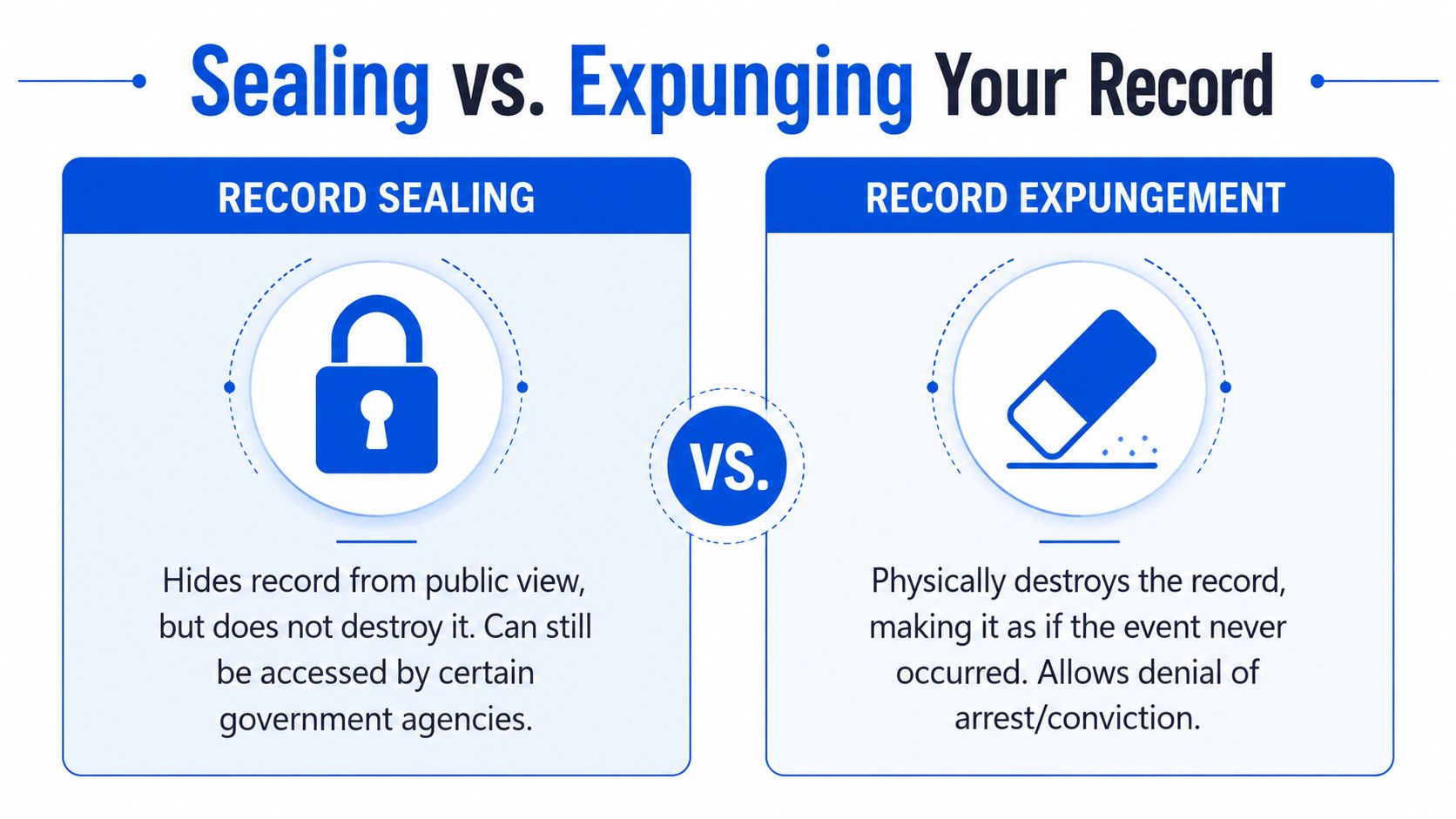
A practical side by side comparison
Criteria | Record Sealing | Record Expungement |
|---|---|---|
General effect | Hides the record from public view | Removes the record from public dissemination and results in destruction of most agency copies |
Typical fit | Often used when adjudication was withheld | Often used when the case was dismissed, dropped, or ended in a not guilty result |
Public access | Restricted | More limited than sealing |
Government access | Certain agencies can still access it | Certain agencies may still retain access for authorized purposes |
Strategic issue | Can help with ordinary background checks, but doesn't make the case disappear for every purpose | Stronger relief, but only available in the right case posture |
Which option fits which outcome
If the case was dismissed or resolved through a route that put you in a better position than a withhold, expungement may be the better fit. That's one reason pretrial resolutions can matter long after the criminal case ends. Programs and negotiated outcomes can change what relief is available later. For example, people often ask how diversion affects future relief, and this overview of the PTI program in Florida is useful when evaluating that issue.
A common client mistake is assuming sealing and expungement are just different words for the same reset button. They're not. One hides. The other goes further. But neither should be discussed in a vacuum.
Your eligibility, your final disposition, and your future plans all matter. If you want to work in a regulated field, apply for a professional license, or pursue a sensitive government position, the stronger sounding option isn't always the whole answer.
The Florida Record Sealing Process From Start to Finish
A common mistake happens before any paperwork is filed. Someone gets a job interview, a licensing deadline, or an apartment application, then starts the sealing process assuming a judge can fix it quickly. Florida does not work that way. Record sealing is a two-stage process, and the administrative stage often sets the pace.

Phase one with FDLE
The process starts with the Florida Department of Law Enforcement, not the court. Before a judge can consider sealing a record, you must apply to FDLE for a Certificate of Eligibility. FDLE's application materials require fingerprints, a certified disposition, and the processing fee listed by FDLE, which is $75, paid by certified check or money order, as stated on the FDLE sealing and expunction application information page.
That first phase is where many self-filed cases lose months.
The packet has to be complete, consistent, and tied to the correct case. If the certified disposition does not match the clerk's record, if fingerprints are rejected, or if a required signature is missing, the application can be delayed or returned. From a former prosecutor's perspective, this is one of the overlooked trade-offs in doing it yourself. The legal standard may be favorable, but clerical mistakes still keep the case from reaching a judge.
A practical walkthrough can also help if you want to see the process in another format.
Phase two in court
If FDLE issues the certificate, the case moves to the court in the county where the arrest or charge was handled. The court filing usually includes the petition, sworn affidavit, Certificate of Eligibility, and proposed order. The State Attorney's Office must also be served with the required paperwork.
Some petitions are decided on the papers. Others draw an objection or a hearing request. That usually happens for a reason. In my experience, prosecutors tend to focus on a prior disqualifier, an unclear disposition, a problem with eligibility, or a concern that the requested relief does not match the actual case history.
FDLE approval helps, but it does not guarantee that the judge will sign the order.
Where applicants lose time, and where strategy matters
The delays are usually predictable.
Incomplete application packets: Missing signatures, missing certifications, or rejected fingerprints can stop the process before it reaches court.
Wrong case documents: In South Florida, people often have cases in more than one county or multiple related docket numbers. Using the wrong disposition or wrong arrest information creates avoidable problems.
Bad assumptions about timing: FDLE review can take several months. Waiting until a background check is already pending often means the relief comes too late to help with the immediate opportunity.
Treating the case as routine: Florida's one-time-only rule changes strategy. If a person may have more than one eligible case over a lifetime, filing the first sealable case without considering the long-term consequences can be a costly mistake.
Ignoring career-specific consequences: For nurses, teachers, financial professionals, and applicants for government or security-sensitive work, a sealed record may still need to be disclosed in certain settings. That does not mean sealing is not worth pursuing. It means the decision should be made with the full career picture in mind.
The strongest petition usually anticipates the objection before the prosecutor raises it. That is the part generic guides often miss. The filing is not just paperwork. It is also a legal presentation of why this record qualifies, why the documents support that result, and why the court should grant the request without concern.
Understanding Timelines Costs and What a Sealed Record Means
A client gets a promising job interview, then asks the question I hear all the time. Can this be sealed before the background check hits? Sometimes yes. Often, no. The legal remedy may be available, but the calendar is what controls the result.
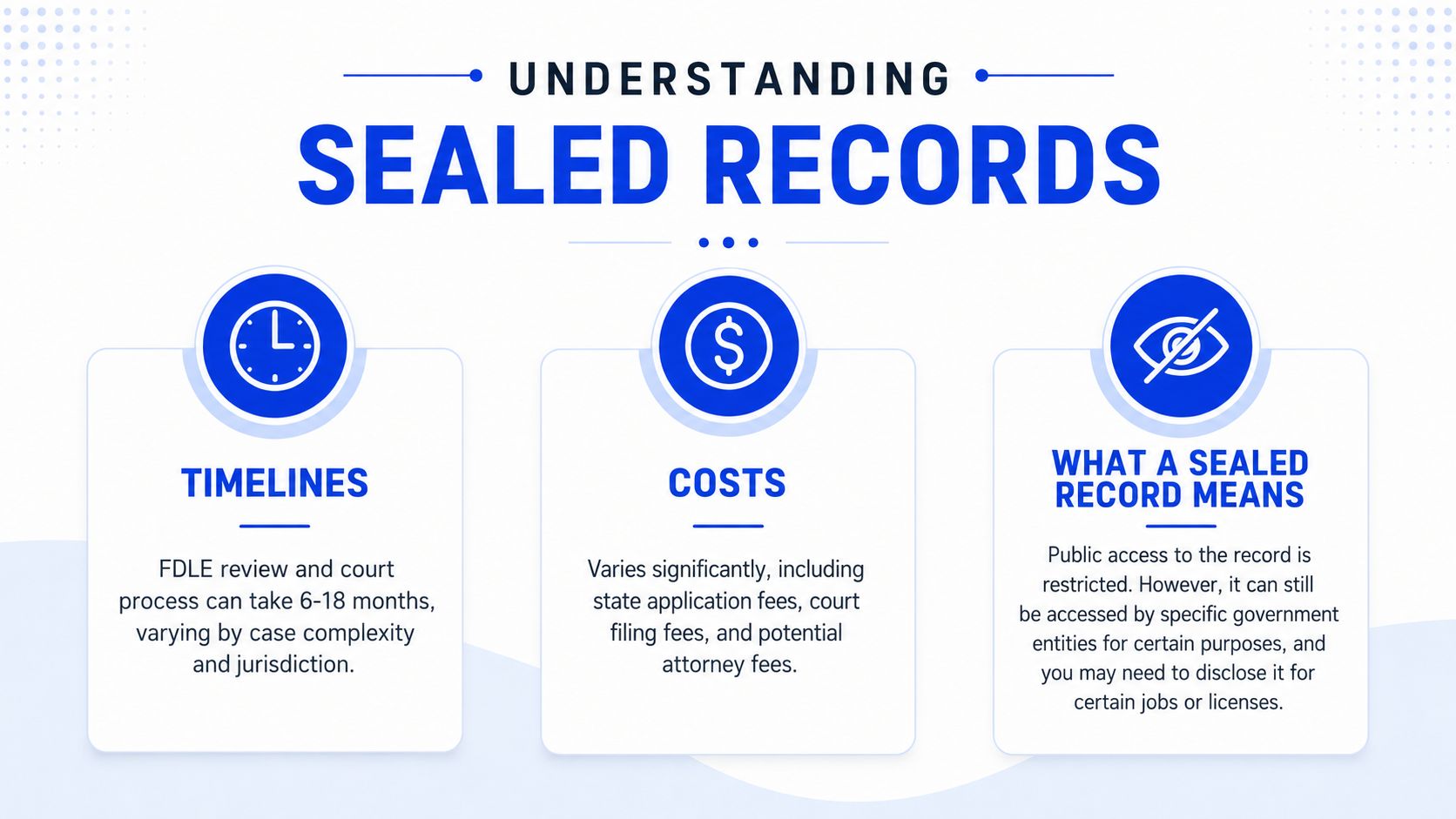
How long record sealing Florida usually takes
Florida record sealing has two parts. First, the Certificate of Eligibility process through FDLE. Then, the court process in the county where the case was handled. The FDLE stage is usually the slowest part, and it can take months before a petition is ready to file with the court.
That delay changes strategy.
If a person waits until a nursing application, school deadline, apartment screening, or employment background check is already underway, sealing may still be worth pursuing, but it may not arrive in time to solve the immediate problem. From a former prosecutor's perspective, this is one of the most common planning mistakes. People focus on whether they qualify and ignore whether the timing still helps the actual problem in front of them.
The court phase can be shorter, but it is not automatic. Some petitions move on paper. Others slow down because a document is missing, the prosecutor wants clarification, or the judge sets a hearing. A case that looks simple at the start can stall over a small defect in the packet.
That is why early review matters. If you are weighing sealing as part of a broader defense or post-case strategy, the better approach is to assess timing and risk with a lawyer who handles these matters regularly through South Florida criminal defense and record sealing services.
What you will pay and what sealing does not fix
The one cost that is fixed statewide is the FDLE application fee. FDLE lists a $75 processing fee for a Certificate of Eligibility on its page for seal and expunge process information.
Other expenses vary. Certified copies, fingerprints, notary costs, court filing practices, and attorney's fees can change from county to county and case to case. Anyone who gives a flat estimate without seeing the disposition, the arrest information, and the county requirements is guessing.
Sealing also has limits that people need to understand before they spend time and money on the process. A sealing order restricts access to the official record, but it does not automatically remove information from private background check companies, old internet postings, news archives, or every database that copied the information before the order was entered.
That distinction matters in practice. A sealed record can still improve employment and housing outcomes because the official state record is treated differently. But if the problem is a mugshot site, an old news story, or a private screening company using outdated data, sealing may be only part of the solution.
What a sealed record means in real life
A sealed record is no longer open to the general public in the same way. For many clients, that is a meaningful change. Standard searches become harder. Routine employers and landlords may no longer see the case through ordinary public record channels.
Still, sealed does not mean erased, and it does not mean irrelevant forever.
Some agencies and decision-makers can still access or require disclosure of sealed matters under Florida law. That is where strategy becomes more important than paperwork. Because Florida generally allows only one sealing or expunction in a lifetime, the question is not just whether a case can be sealed now. The better question is whether using that one chance on this case serves the client's long-term goals.
I have seen people treat sealing as a quick cleanup step, then later realize a different eligible case would have posed a greater threat to a professional license, a career change, or a future application. That is the part generic guides often miss. Record sealing is a legal benefit, but it is also a strategic choice with lasting consequences.
Why You Need an Experienced South Florida Attorney
A client calls after a background check cost her a job interview. She already read the forms, assumed the process was mostly clerical, and nearly filed on her own. What she missed was the part that causes serious damage. In Florida, a sealing case can affect the only shot you will ever get to clean up a record, and a careless filing can create problems that are much harder to fix later.

Local procedure matters more than people think
South Florida courts do not handle these petitions in exactly the same way. A filing that moves smoothly in one county can stall in another because the clerk wants different supporting documents, the State Attorney's Office raises a different objection, or the judge expects a cleaner proposed order. Those are practical problems, not abstract ones. They affect whether the petition gets signed, delayed, or denied.
I learned as a former prosecutor that weak spots in a file are usually visible early. An incomplete disposition, a confusing arrest history, or an application that glosses over a statutory issue gives the other side an easy reason to object. Good counsel spots those issues before the petition is filed, not after a hearing is set.
The strategic review also goes beyond eligibility. Certain careers create a paradox that generic guides rarely explain well. Sealing can help with many private background checks, but it does not eliminate disclosure issues for applicants pursuing law enforcement, Bar admission, and other sensitive positions. For those clients, the question is not merely, "Can this record be sealed?" The better question is, "Will sealing this record improve the result that truly matters to me?"
The right filing strategy starts earlier than people expect
Record sealing is often won or lost long before the petition is prepared. The outcome of the underlying criminal case shapes what relief is available later, which is one reason a firm that handles the full range of Florida criminal defense services can often protect options from the start.
That matters because the one-time rule changes every recommendation. A lawyer should not treat sealing as a routine cleanup step. The lawyer should compare this case against the client's future licensing plans, immigration concerns, firearm questions, school or healthcare employment goals, and any other record that may become a bigger problem later.
I have advised people not to file yet, even when they were eligible, because using that one opportunity on the wrong case would have been shortsighted. I have also seen the opposite. Waiting too long can leave a public record in place during job searches, housing applications, and professional screenings where timing matters.
Good advice lives in that tension. File too casually, and you waste a limited remedy. Wait without a reason, and the record keeps doing its damage. An experienced South Florida attorney helps you choose the right case, prepare the file the right way, and avoid mistakes that follow you much longer than the paperwork itself.
Frequently Asked Questions About Florida Record Sealing
Should I use my one chance now or save it
This is one of the hardest questions because it isn't purely legal. It's strategic. Florida imposes a strict lifetime limit on record sealing, permitting a person to seal or expunge only one criminal record in a lifetime, with no exceptions, and the existence of a prior seal or expunge petition in any Florida county permanently disqualifies the person from future record relief, as explained in this discussion of Florida expungement and record sealing myths and facts.
That means you shouldn't rush just because a case appears eligible. If the current record is minor but your future career path may be sensitive to a different pending matter or unresolved exposure, the timing deserves serious thought.
What if FDLE denies the application
Start by finding out why. Many denials come from an eligibility issue, not just missing paperwork. If the denial is based on a true statutory bar, refiling won't fix it. If the problem is documentary or procedural, the right response may be correcting the packet and reassessing the filing strategy before trying again.
Clients often assume every denial is final in the same way. It isn't. Some denials reveal a curable problem. Others reveal that the legal remedy was never available under the statute.
Do out of state cases affect Florida eligibility
Yes, they can. Prior criminal history outside Florida can matter because Florida looks beyond the single case you want to seal. That's one reason people are surprised when an old matter from another jurisdiction changes the result here.
The safest approach is to review your complete criminal history before filing anything. That includes juvenile matters, old dispositions, and any confusion over whether a case ended with a conviction or some other outcome.
Can I deny the arrest after sealing
Sometimes, but not in every context. The answer depends on who is asking and why. Private employment and housing situations are often different from law enforcement hiring, professional licensing, and sensitive government positions. The wording on the application also matters.
Is record sealing worth it if private databases may still have information
Often, yes. Official record relief still matters because it changes public access to the government record and improves many ordinary background check situations. But clients should go in with realistic expectations. Sealing is an important legal remedy. It is not a universal erase function.
If you want more answers about criminal cases, sealing, expungement, DUI charges, probation violations, domestic violence allegations, theft offenses, gun charge defense, or related Florida court procedures, review these additional Florida criminal defense FAQs.
If an old arrest is still affecting your job prospects, housing, licensing, or peace of mind, Ticket Shield, PLLC can help you evaluate whether record sealing is available and whether it makes strategic sense in your situation. The firm serves Broward County, Fort Lauderdale, Miami-Dade, Palm Beach, and clients throughout Florida. Reach out for a confidential consultation and get a clear, honest assessment of your options.
A sealed record can open doors to jobs and housing. Learn who qualifies for record sealing in Florida and how the process works.