Deferred Prosecution Florida: A Complete Client Guide
Jason Goldsmith, Esq
You got arrested, or your loved one did, and now everybody's asking the same blunt question, can this case be kept from turning into a conviction. In Broward, Palm Beach, or Miami-Dade, that question usually comes up before the shock even wears off, during the first call from jail, the first appearance, or the first late-night conversation with a family member trying to figure out what happens next. Deferred prosecution can be part of the answer, but only in a narrow slice of Florida cases, and only when the State Attorney is willing to deal.
That's the part many individuals misunderstand. Florida does use diversion, but it's a minority outcome, not a default exit. In a statewide analysis of 4,273,369 charge dispositions, only 7.4% were resolved through diversion and 4.7% by dismissal, while 84.4% ended in conviction, and dismissal rates varied by circuit from about 0.6% to 11.8% (Florida prosecution outcomes analysis). So if you're facing charges, don't assume the system is set up to hand you a clean break. It isn't.
What matters is acting early, before the prosecutor locks in a filing posture and before deadlines start running. Florida treats deferred prosecution as a negotiated tool, not a right, and the details change by office, charge, and county. If you're trying to save your license, your job, and your record, you need to know exactly where this option fits, where it doesn't, and what strings come attached.
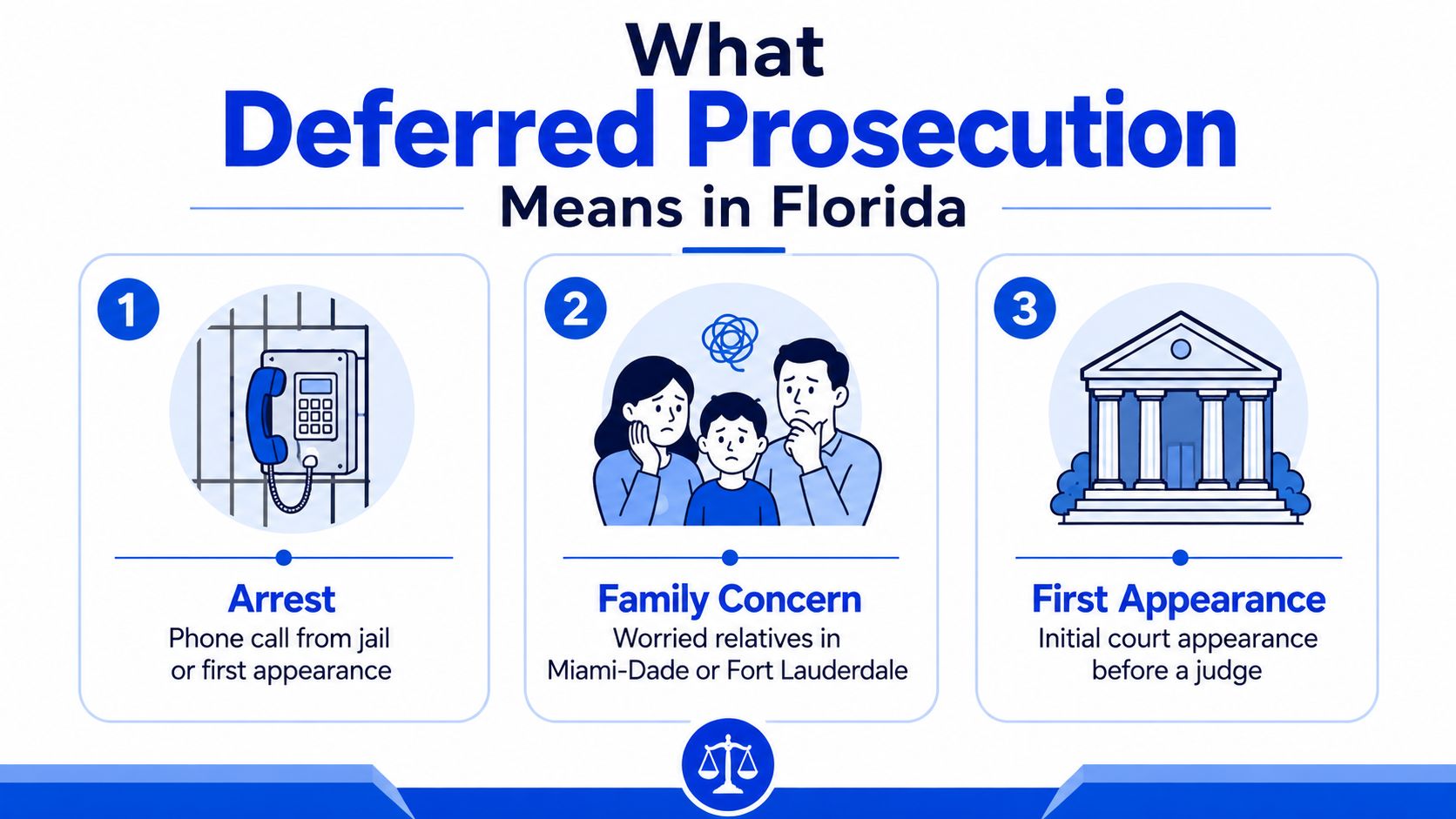
To understand how prosecutors decide whether to consider a deal, start with prosecutorial discretion in Florida. That's the primary gatekeeper.
Table of Contents
What Deferred Prosecution Actually Means in Florida
It starts with a charge, not a promise
A lot of people hear “deferred prosecution” and think it means the case is basically gone. That's wrong. In Florida, it usually means the State Attorney agrees to hold off on ordinary prosecution while you complete conditions, and if you comply, the office later files a dismissal or no-prosecution result.
That sounds simple until you're the one sitting in the booking cell, trying to explain it to a spouse who's looking at your mugshot online. The fear is real; license issues, job trouble, family pressure, and the stain of a criminal charge hanging over your name. The legal system doesn't slow down for that panic, so your response has to be fast and organized.
Florida's own court statistics show that these outcomes are tracked in official records. In the Florida Courts FY 2022-2023 Statistical Reference Guide, the disposition code “Other” includes defendants placed on deferred prosecution or other pretrial intervention, and the statewide reporting system contains historical trial-court data from January 1986 through June 2025 (Florida Courts statistical reference guide). That matters because deferred prosecution isn't some fringe workaround, it's part of the ordinary criminal justice machinery.
Practical rule: If the prosecutor hasn't filed the case yet, your lawyer's leverage is usually better. Once the office hardens its position, your options narrow.
For a defendant in Fort Lauderdale or Miami-Dade, that timing can decide whether the case is even worth putting forward for diversion. The law gives prosecutors room to be selective, and they use it.
The Three Main Florida Programs and How They Differ
The labels sound similar, the rules don't
Florida lawyers and prosecutors often use deferred prosecution and pretrial intervention like they mean the same thing. They do not always match. A deferred prosecution agreement is usually a contract with the State Attorney's Office. PTI is a different structure, often tied to more serious but still eligible cases. Juvenile deferred prosecution has its own statute and its own rules.
Here is the cleanest way to sort them out. For adults, deferred prosecution is commonly used in misdemeanor cases, while PTI is often used for certain nonviolent felonies. One Florida defense source says a Deferred Prosecution Agreement is generally used for misdemeanor offenses, while pretrial intervention is used for most third-degree, non-violent felonies (Florida diversion overview). Juveniles are different again, because Florida Statutes § 985.155 ties deferred prosecution to Neighborhood Restorative Justice Centers for first-time, nonviolent juvenile offenders.
Florida Deferred Prosecution Options at a Glance | Typical Offense Level | Usual Duration |
|---|---|---|
Deferred Prosecution Agreement | Misdemeanor offenses | Three to six months |
Pretrial Intervention | Most third-degree, non-violent felonies | About one year |
Juvenile Deferred Prosecution | First-time, nonviolent juvenile offenders | Set by the restorative justice program |
The juvenile version has extra rights language
Juvenile deferred prosecution is not just a smaller adult program. The statute lets the state attorney establish a restorative justice center, but participation is voluntary, and the juvenile plus parent or guardian must waive speedy trial and the right to a public defender while in the program. The statute also says the responsibility acknowledgment is not an admission of guilt in future proceedings (Florida Statutes § 985.155).
That distinction matters because many websites flatten all of this into one statewide “diversion” concept. That is lazy lawyering. The office handling your case will care about offense class, local policy, and whether it wants a dismissal after compliance or a straight prosecution.
If you are comparing diversion paths, read the court-ordered and negotiated versions side by side with Florida pretrial diversion basics. The differences are not cosmetic, they change the whole strategy.
Who Qualifies and Who Usually Does Not
Prosecutors want a narrow bucket, not a broad safety net
One Florida State Attorney policy is blunt about it. Deferred prosecution is limited to a non-traffic, non-domestic misdemeanor offense, and it should not be used to avoid or delay resolution of a meritorious case or as a substitute for dismissal when a case can't be filed or pursued for evidentiary, ethical, or other reasons (State Attorney deferred prosecution policy). That tells you everything you need to know about the State's mindset. This isn't a public benefit program. It's a prosecutorial choice.
So who usually gets looked at seriously. First offenders, nonviolent misdemeanor defendants, people with a weak role in the incident, and defendants who can pay costs and follow instructions. Who usually doesn't. People with serious prior records, domestic violence allegations, DUI-type matters, traffic charges tied to license consequences, or pending charges elsewhere. A prosecutor is not looking to reward chaos.
Here's the part clients miss. Even a good candidate doesn't get diversion just by wanting it. The State Attorney has to agree. Your lawyer's job is to make the facts look like a safe, responsible bargain for the office, not a favor to the accused.
Bottom line: Borderline cases are won with facts, not attitude. Clean paperwork, a stable job, treatment enrollment, and a credible compliance plan help more than promises.
That's why the local circuit matters. One county may be open to a case with a first-time petit theft and a restitution plan, while another office shuts the door because the victim is pushing hard or the charge category falls outside its policy. Florida's 3rd Judicial Circuit says pretrial intervention is also known as deferred prosecution and that dismissal comes only after all sanctions are completed and proof is provided (3rd Judicial Circuit pretrial intervention). That local rule is more important than generic statewide internet advice.
If drug possession is part of your fact pattern, you need to compare ordinary diversion with treatment-oriented programs, including Florida drug court options. Don't assume every substance case gets the same path.

How the Process Works Step by Step
The case gets negotiated, not magically solved
The path usually starts with the arrest or notice to appear, then first appearance, then arraignment, or a pre-filing negotiation window where defense counsel presses the State Attorney before the file hardens. That is the moment that matters. Once the office sees you as a compliant candidate instead of just another case number, the discussion changes.
The agreement itself is a contract. In Florida, that usually means you waive speedy-trial rights, agree to conditions like reporting and staying out of trouble, and accept financial terms. One Florida county program used a three-month term, with $220–$250 in court costs plus $150 cost of prosecution, and successful completion resulted in a No Prosecution dismissal (Florida county DPA example). If you miss the conditions, the case goes back into ordinary prosecution.
A lot of clients think the clock only matters at the beginning. It does not. Some Florida prosecutors require proof of compliance at least 30 days before expiration (Florida deferred prosecution timing issue). So if you are in a six-month program, missing paperwork at month five can still blow the deal. The substance may be done, but the file can still be sent back if the documentation is late.
Practical rule: Finish the conditions early, then make counsel verify the paperwork. Waiting until the last week is how people lose cases they were otherwise on track to beat.
Domestic-violence-adjacent matters can add more. Florida programs may require a 29-week Batterer's Intervention Program and, if indicated, alcohol or substance-use evaluation or treatment before dismissal is granted. That is not a soft landing. It is structured compliance.
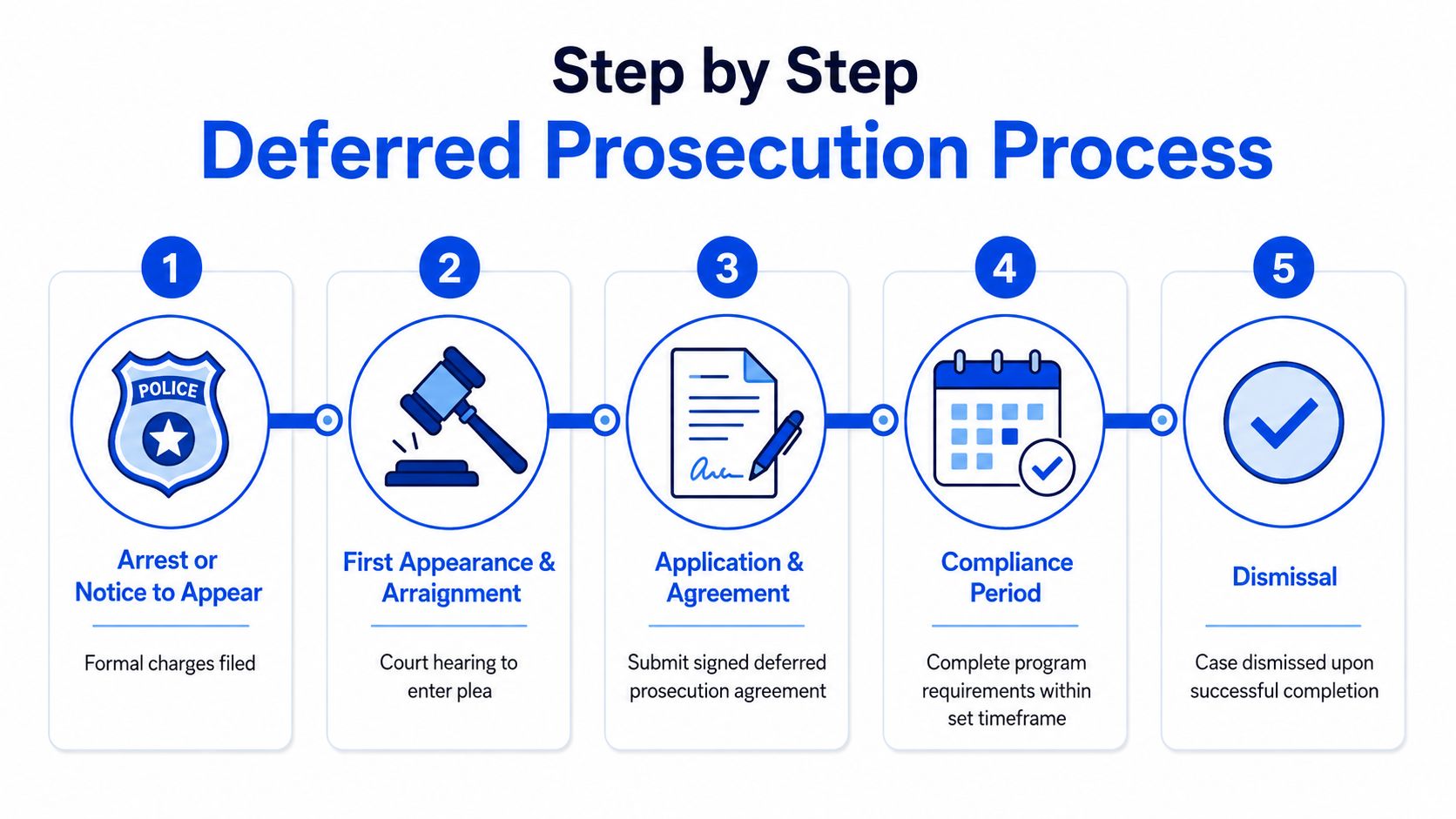
A Florida pretrial conference is often where the agreement gets approved in your county.
Common Scenarios Where Diversion Is on the Table
A first-offense petit theft case in Broward is the kind of file that can get a prosecutor's attention for diversion. If the evidence is thin, the person has no prior record, and restitution can be paid, the office may talk about misdemeanor deferred prosecution instead of pushing straight to conviction. The deal still comes with conditions, and a missed report, a new arrest, or ignored paperwork can put the case back into ordinary prosecution fast.
A misdemeanor drug possession case in Palm Beach can also fit, but only if the office sees a clean compliance problem instead of a fight over the facts. If the person is already in treatment, that helps. If there are pending charges in another case or another county, it usually hurts. Local State Attorney discretion decides how far that conversation goes.
A college student accused of simple battery is harder to sort out. If the alleged victim will not cooperate, the State may still file the case, but the file can become more negotiable when the prosecutor sees weak credibility issues or prefers structured conditions over a contested charge. A defense lawyer should turn that into a diversion packet, not a panic response.
Juvenile shoplifting follows a different track. Florida's juvenile deferred prosecution statute is tied to Neighborhood Restorative Justice Centers and first-time, nonviolent juvenile offenders (Florida Statutes § 985.155). The point is accountability through voluntary participation, not a free pass.
Domestic-violence-adjacent cases bring heavier conditions, including the 29-week Batterer's Intervention Program and treatment screening when the facts call for it. That kind of file is not a casual yes. A defendant needs to know the workload before agreeing.
The local reality is simple. Broward, Palm Beach, and Miami-Dade do not run one uniform diversion system, and prosecutors do not treat every charge the same way. The offense, the circuit, the victim issue, and the person's record all change the answer.
What Deferred Prosecution Does and Does Not Do for Your Record
Dismissal is better than conviction, but it's not invisibility
A successful deferred prosecution ending usually means the charge is dismissed or marked no prosecution. That is good, but it doesn't mean the arrest never happened. The court file still exists, and the arrest can still show up on background checks. If you want sealing or expungement, that's usually a separate legal step, not something the diversion agreement does automatically.
That matters in the practical world because employers, landlords, licensing boards, and immigration authorities don't all look at the same slice of your history. A dismissal can help a lot, but it doesn't erase every collateral issue. Clients who assume otherwise often get blindsided later.
The driver's license piece is another trap. Deferred prosecution generally doesn't directly restore a suspended license. It can help by avoiding a conviction, which can prevent new points, further suspensions, or insurance fallout, but it is not a magic reinstatement order. If your license is already suspended, you still need a separate plan.
Important distinction: A dismissal is a legal outcome. Expungement is a records remedy. Those are different tools, and they're not automatic.
Collateral issues can survive even after dismissal, especially in immigration and professional licensing cases. The same is true if you're charged again later, because a prior diversion can affect how prosecutors view you in a new case. That's why “no prosecution” should be seen as valuable relief, not total erasure.
If your goal is a clean record, the conversation has to include sealing, expungement, and license strategy from the start, not after the case is over.
How a Defense Lawyer Moves the Case Toward Dismissal
The leverage comes from spotting weakness early
A good defense lawyer doesn't wait for the prosecutor to be generous. The lawyer reads the charging documents, police reports, body cam summaries, witness statements, and lab materials looking for weaknesses that make deferred prosecution more attractive than a fight. Illegal searches, shaky witnesses, weak identification, and chain-of-custody gaps all change the State's risk calculation.
Then the lawyer packages the facts. That means school records, work letters, treatment enrollment, restitution proof, counseling records, and anything else that shows the client is already moving in the right direction. Prosecutors are more likely to consider diversion when they can justify it as a controlled resolution instead of a gamble.
The best lawyers also track deadlines. If the office wants proof of compliance 30 days before expiration, somebody needs to calendar that date and confirm the documents went in. One missed email can blow up a case that was otherwise on track for dismissal.
Ticket Shield, PLLC is one Florida firm that handles this kind of negotiation work, including direct attorney access by phone, text, or email, and court coverage in many jurisdictions so clients don't miss work. That kind of handling matters because deferred prosecution is paperwork-heavy and deadline-sensitive, and the client shouldn't be left guessing whether the file moved.

Practical rule: If your lawyer isn't actively managing the compliance calendar, you're trusting the most important part of the deal to chance.
The job is straightforward. Discover an advantage, press for the right condition, protect the waiver rights you're giving up, and make sure the State can't point to a missed deadline as a reason to reinstate the case.
Key Takeaways and Your Next Step
Deferred prosecution in Florida is narrow, prosecutor-controlled, and usually reserved for first-time, nonviolent misdemeanor cases or specific diversion tracks. It is not automatic, and it's not statewide in any meaningful practical sense.
You'll usually have to waive important rights and meet strict compliance deadlines. Speedy-trial waivers, reporting rules, costs, and proof deadlines are part of the deal.
A dismissal is not the same as expungement. The arrest and court file can still matter later unless you take separate action.
The biggest factor is whether the State Attorney agrees to offer it. Your lawyer's job is to make that offer more likely, not to pretend it's guaranteed.
If you're facing charges in Broward, Palm Beach, Miami-Dade, or anywhere else in South Florida, don't sit on it and hope the State gets soft. Reach out early, get the paperwork reviewed, and force the issue while you still have advantage.
Ticket Shield, PLLC can review your case, explain whether deferred prosecution is even on the table, and help you make a plan before deadlines start closing in. If you're dealing with a criminal charge and need straight answers from a former prosecutor, visit Ticket Shield, PLLC for a confidential consultation and get the case moving in the right direction.