What Is Prosecutorial Discretion and How It Shapes Your Case
Jason Goldsmith, Esq
Prosecutorial discretion is the prosecutor's case-by-case power to decide whether to charge, what to charge, whether to reduce or dismiss a case, and what plea or sentence to recommend, and that power can change how a case ends before a judge ever rules on the facts. In federal practice, one NIJ study found that prosecutors declined about 7% of referred cases and reduced charges in about 12% of cases, which is why a criminal case can turn on office decisions as much as on the arrest itself.
You may be sitting at home in Broward County, Fort Lauderdale, Miami-Dade, or Palm Beach right now wondering why the police report seems so serious when the charge on paper is still moving around. That gap is where prosecutorial discretion lives, and in a Florida case it can mean the difference between a dismissal, a reduced charge, a diversion program, or a conviction that follows you for years.
Table of Contents
Understanding Prosecutorial Discretion in Plain English
If you were arrested in South Florida, the next move often isn't made by a judge. It's made inside a prosecutor's office, where someone decides whether the case should move forward, be narrowed, or be dropped. That's prosecutorial discretion, and it sits between arrest and conviction as the gatekeeping function that shapes whether a case is dismissed, reduced, or prosecuted at full strength, including in federal practice where workload can affect declination and charge-change decisions (NIJ federal district data).
What prosecutors really control
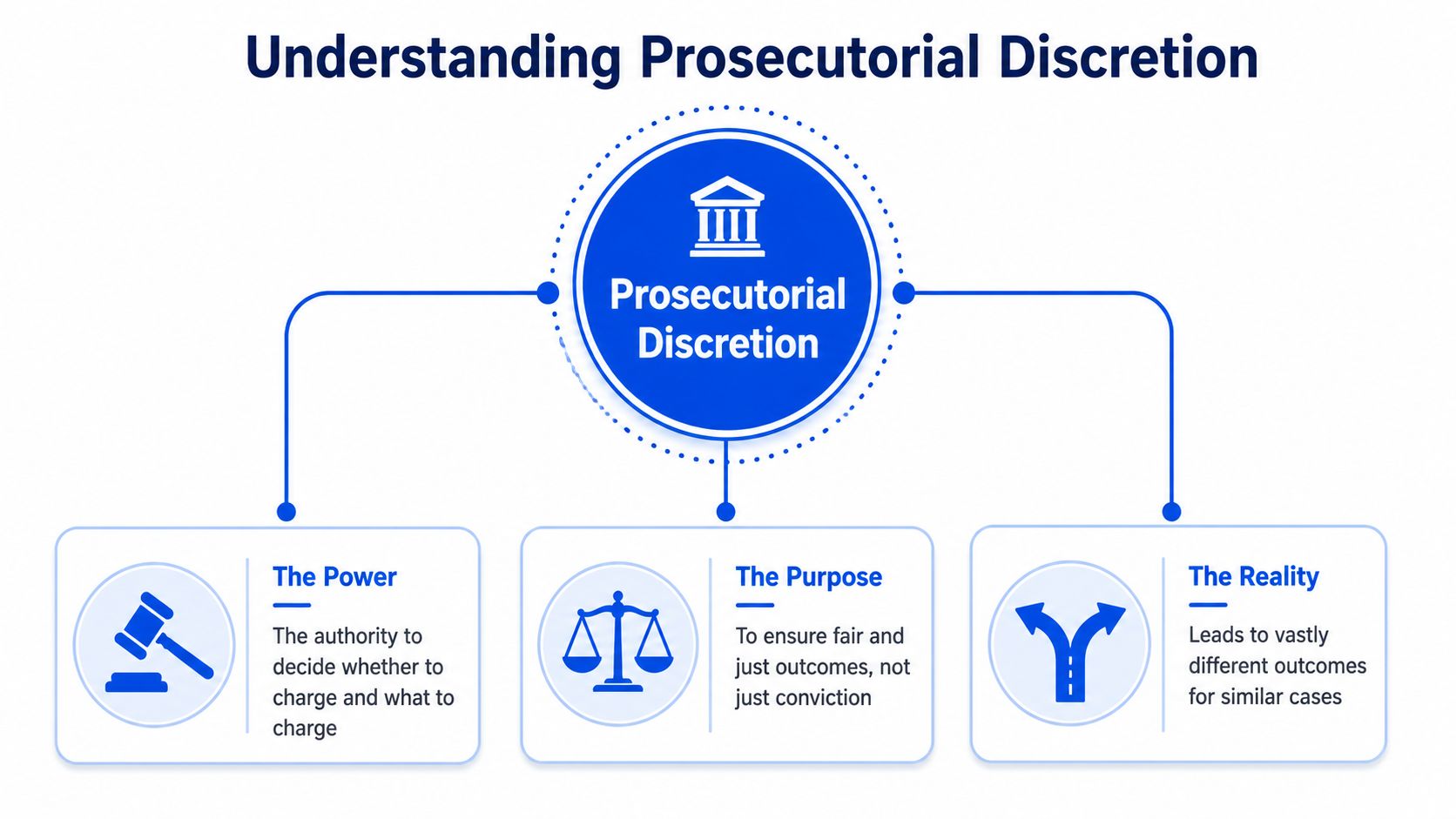
In plain English, the prosecutor can decide whether to file charges at all, which charges to file, whether to pursue an enhanced penalty, and whether to resolve the case with a plea offer instead of trial. In criminal procedure, that includes choosing among overlapping statutes and deciding whether to seek enhanced penalties, which means the same conduct can lead to very different exposure depending on the charging theory used (Cornell Wex on prosecutorial discretion).
That's why clients are often surprised when a case they thought would be “simple” suddenly turns into a felony, a traffic offense, a misdemeanor, or a diversion discussion. The charging paper is only the starting point. The prosecutor's later choices often matter more.
Practical rule: If the State can still be persuaded that the case is weak, overstated, or low priority, the best time to speak up is early.
The two questions underneath the legal jargon
The phrase "broad latitude" is often misunderstood. That phrase hides the core mechanism. Prosecutors typically work through two questions, Can I prove the case? and Should I prove the case? Research on prosecutorial decision-making indicates the balance shifts over the life of a case, with early screening driven more by evidentiary strength and later decisions more influenced by offense severity, criminal history, victim and defendant characteristics, and local resource constraints (NCJRS summary).
That matters in a Fort Lauderdale DUI, a Broward County drug arrest, or a domestic violence case filed after a heated dispute. If the State thinks the stop was shaky, the breath test was unreliable, or the witness is inconsistent, the first question gets harder. If the facts are messy but the office sees a serious injury, a prior record, or a sensitive victim issue, the second question becomes the battleground.
The Two Questions That Drive Every Charging Decision
A lot of legal explanations stop at the phrase “prosecutors have discretion.” That sounds important, but it does not tell a worried client how a real charging decision gets made. In practice, prosecutors usually answer two questions in order, first whether the case can be proven, then whether it should be pushed forward. Those are different judgments, and a defense lawyer can challenge them in different ways.

Can I prove the case
This is the evidence question. The prosecutor looks at the police report, witness statements, body camera footage, lab work, field sobriety tests, chain of custody, and any search-and-seizure problem that could keep evidence out. If a Fort Lauderdale DUI arrest involved shaky roadside testing, or a drug case came from a stop that looks unconstitutional, the proof question gets harder fast.
A former prosecutor sees this like a file with weak seams. The case can look solid from a distance, then fall apart once the stop, search, or seizure is examined closely. A motion to suppress can change the entire posture of the case, especially when the evidence depends on police conduct that may not hold up in court. For a closer look at how suppression motions work in Florida criminal cases, that issue often starts with the traffic stop, the search, or the seizure itself.
Should I prove the case
Even if the evidence can be used, prosecutors still have to decide whether pushing the case is the right use of office resources. Offense severity, criminal history, victim input, defendant background, and local policy all matter here. A first-time possession case can look very different from a repeat theft case, even if both began with an arrest and a booking photo.
A strong defense does more than say “not guilty.” It gives the prosecutor a reason to stop, reduce, or reroute the case before the file hardens into a tougher charge or a worse plea offer.
Two arrests can start out looking similar and still end up in different places. One file may include a clean record, weak proof, and a realistic alternative. Another may draw a harsher response because of prior contacts, office policy, or the way the alleged victim describes what happened.
How Discretion Shows Up Across a Florida Case
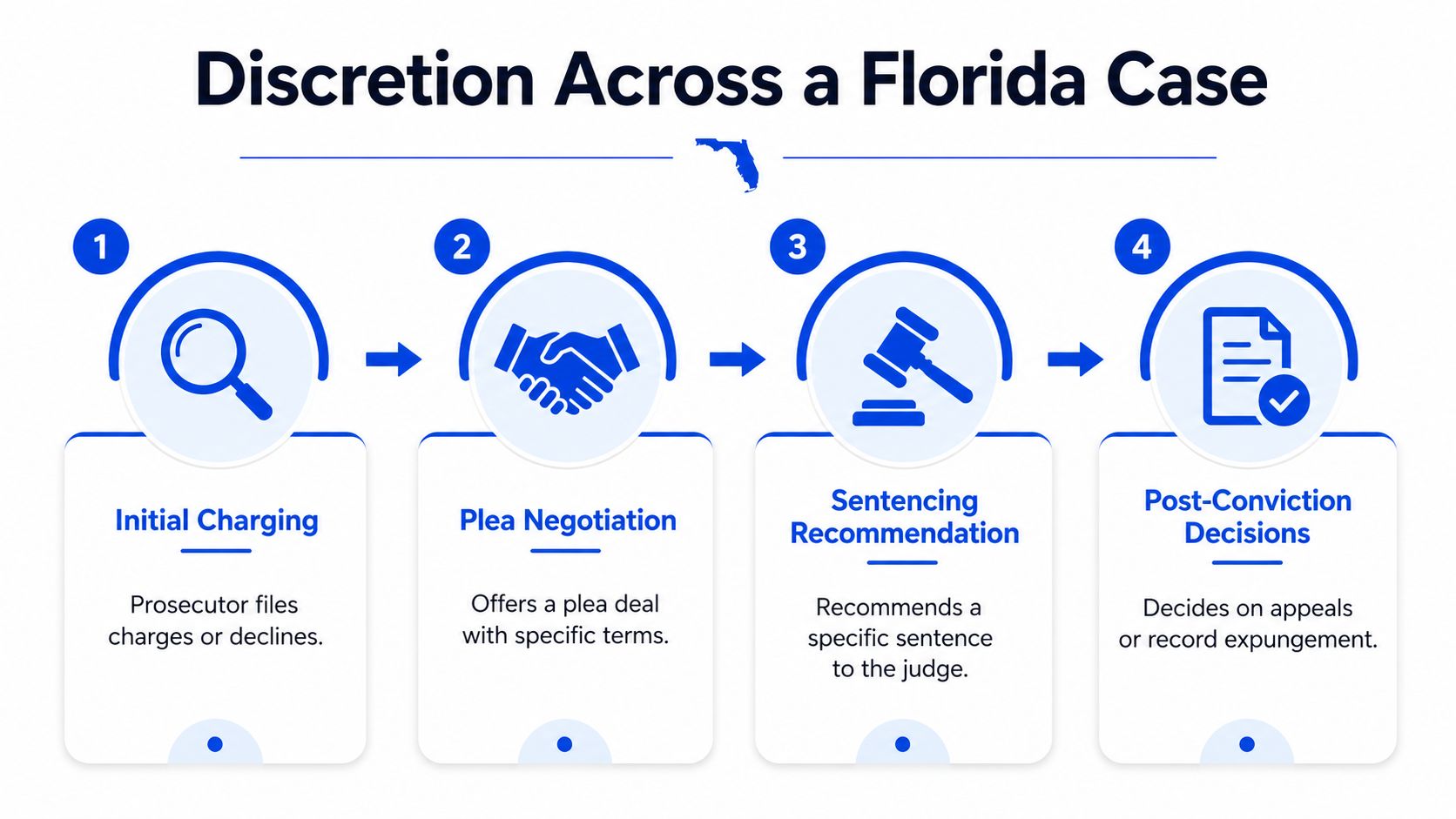
Discretion isn't one decision. It shows up at several pressure points, and each one can change the outcome in a real Florida case. If you understand the timeline, you can see where influence exists and where the case starts to narrow.
Four places where the prosecutor makes the call
Initial charging. The prosecutor can file, reduce, or decline the case. A felony theft arrest may begin as a felony file but later be treated more narrowly if the proof or value issue weakens.
Plea negotiation. Charge reductions, withholds, and agreed dispositions are discussed here. A DUI case might stay alive, but the offer may shift if the defense shows a problem with the stop or testing.
Diversion or dismissal. Some cases can be resolved through programs or through a later dismissal decision. A first-time drug possession case in Broward or Palm Beach might be more likely to land in a diversion track than a repeat matter with aggravating facts.
Sentencing recommendation. If a case resolves by plea or reaches sentencing, the prosecutor can still influence the outcome by recommending jail, probation, treatment, restitution, or another disposition.
Why the earliest conversations matter most
The most important negotiations usually happen before the case feels “real” to the client. Once the office has already filed the highest charge, it takes more effort to move the file back down. That's why early outreach matters in DUI, domestic violence, theft, weapons, and probation violation cases.
If a prosecutor is still deciding whether the State should push forward, a well-supported defense package can change the file's direction. If the office has already invested in the case, the same package may still help, but the lift is harder. That's the practical reason people talk about discretion as a tool of influence.
The idea of a nolle prosequi or dismissal also fits here. In Florida practice, that means the State stops pursuing the charge, which can happen when the prosecutor decides the case should not move forward. For more on that procedural tool, see this Florida explanation of nolle prosequi.
Florida Office-by-Office Differences That Change Outcomes
Florida law is statewide, but charging culture is local. A person arrested in Broward County may not see the same approach as someone picked up in Miami-Dade or Palm Beach, even when the facts look similar. The statute may be the same, but the office, the docket, and the available programs are not.
Local practice matters more than people expect
In Broward County, Miami-Dade, and Palm Beach, prosecutors may differ in how quickly they discuss reductions, what they view as diversion-worthy, and how they treat common charges like DUI, simple possession, retail theft, and domestic violence. One office may be more open to a structured resolution with treatment or restitution. Another may move more cautiously, especially if the file includes prior history, an alleged injury, or an aggravating fact.
That doesn't mean one county is “better” than another. It means the same arrest can travel a different path depending on courthouse norms and the individual attorney handling the case.
Common Florida Charges and Typical Discretionary Levers | |||
|---|---|---|---|
Charge Category | Common Discretionary Decision | Possible Favorable Outcome | Key Collateral Issue |
DUI | Whether to hold the charge, reduce it, or resolve with a different disposition | Reduced exposure, treatment-based outcome, or a more favorable plea posture | Driver's license consequences |
Drug possession | Whether the file supports formal prosecution or diversion | Pretrial intervention or reduced charge | Criminal record impact |
Theft | Whether the value, intent, or evidence supports a felony filing | Misdemeanor resolution or restitution-based plea | Employment screening |
Domestic violence | Whether the case is pursued as filed or treated with more caution around proof | Dismissal, reduction, or structured plea | No-contact conditions |
Weapons charges | Whether enhancements or companion charges stay in the case | Narrower charging theory | Future firearm rights |
Common charge types and what discretion can change
A first-time drug possession case may be a strong candidate for a diversion discussion if the facts and history fit. A retail theft arrest may move from felony exposure to a misdemeanor resolution if the alleged value or proof doesn't support the higher charge. A DUI can sometimes be resolved in a way that avoids the harshest path if the evidence is shaky and the defense acts early.
Domestic violence cases are different because prosecutors often take them seriously even when the facts are disputed. Still, discretion matters in how the file is charged, what conditions are requested, and whether the State insists on moving the case all the way through. That is why local knowledge inside the courthouse matters so much in Fort Lauderdale and the rest of South Florida.
What Discretion Means for You as a Defendant
When a client hears “the State has discretion,” it usually sounds abstract. In real life, it means you may face one of several very different paths, and the first few court dates often determine which path gets locked in. That's especially true if you're dealing with a license problem, a record problem, or immigration consequences on top of the criminal case.
What to expect at the front end
At arraignment, the charge is usually only the State's first version of the story. A plea offer might follow, but a plea offer is not the same as a final outcome. It is a proposal, and it can involve reduced charges, probation, treatment, a withhold, restitution, or another negotiated term depending on the case.
If the prosecutor offers diversion, that usually means the office is willing to pause formal punishment while the defendant completes conditions. If the case is dismissed, the State has stepped back from prosecution, at least for that filing. If the prosecutor recommends a sentence, that recommendation matters even though the judge still makes the final call.
Practical rule: Don't treat the first offer like the only offer. In Florida criminal cases, the early exchange of information often changes what's on the table.
The collateral consequences you should watch
Discretion can influence more than jail time. In DUI and traffic-related criminal matters, it can affect the license picture. In drug, theft, weapons, and domestic violence cases, it can affect whether you end up with a conviction on your record, which in turn affects future sealing or expungement options.
It also matters for immigration exposure, especially when the underlying conduct could be read in more than one way. A plea to one charge can be much worse than a plea to another, even if both seem minor at first glance. That's why a careful review from a Broward criminal defense attorney can be worth doing before any admission is made.
A local lawyer can also help you understand how a prosecutor's offer fits into the bigger defense strategy. For more on that courthouse-focused approach, see this Broward criminal defense overview.
Where Discretion Becomes Controversial or Unequal
Discretion is useful, but it is not automatically fair. Scholarship has long recognized that it can contribute to bias, overcharging, vindictiveness, plea bargaining abuse, and wrongful convictions, and that many charging decisions are virtually unreviewable in practice (Wright, Baughman, and Robertson PDF). That makes the prosecutor's office one of the most powerful parts of the system.
Why unequal outcomes happen
The same conduct can be handled differently because of office culture, relationships, or local norms. One defendant may get diversion, while another gets a harder plea offer. One case may be charged aggressively, while a nearly identical file gets a narrower theory or a reduction.
That doesn't always mean bad faith. Sometimes it means the office is responding to workload, victim input, or policy priorities. Still, the effect on the person charged can be dramatic, especially when the result is a permanent record or a plea that carries future consequences.
The contrarian view that matters
Discretion is not only a source of unfairness. It can also be used for leniency and racial justice when the office sets those goals and follows them. The issue is structure, monitoring, and accountability, not whether discretion exists at all.
For people in Fort Lauderdale, Broward County, Miami-Dade, and Palm Beach, that means local norms can shape who gets diversion, who faces enhancements, and who walks away with a record that follows them. Prosecutorial discretion is powerful because it can be used either to soften the system or to harden it. Defense strategy has to account for both possibilities.
How a Defense Lawyer Uses Discretion for You
A defense lawyer cannot make a prosecutor agree to anything. The lawyer can change the file the prosecutor is reviewing, and that often changes the decision. The significant advantage usually comes from acting before the case gets fixed in a high-charge posture.
A strong defense package starts by answering the two questions that drive charging decisions. First, how strong is the State's proof. Second, does this case deserve the full weight of prosecution, or is there a better result that fits the facts. That is the lens a former prosecutor uses, because office decisions usually turn on evidence strength and case gravity, even when no one says it out loud.
What a strong defense package does
A lawyer can challenge the evidence before formal charging, especially when the stop, search, identification, or testing looks weak. A lawyer can also put mitigation in front of the prosecutor early, which helps answer the second question, whether the State should push the case all the way or step back.
That package often includes police reports, body cam screenshots, witness contradictions, treatment records, employment proof, family responsibilities, restitution information, and documents that show the matter is more nuanced than the arrest summary suggests. In practice, the prosecutor is often comparing two versions of the same case, the arrest file and the fuller story.
The practical moves that matter
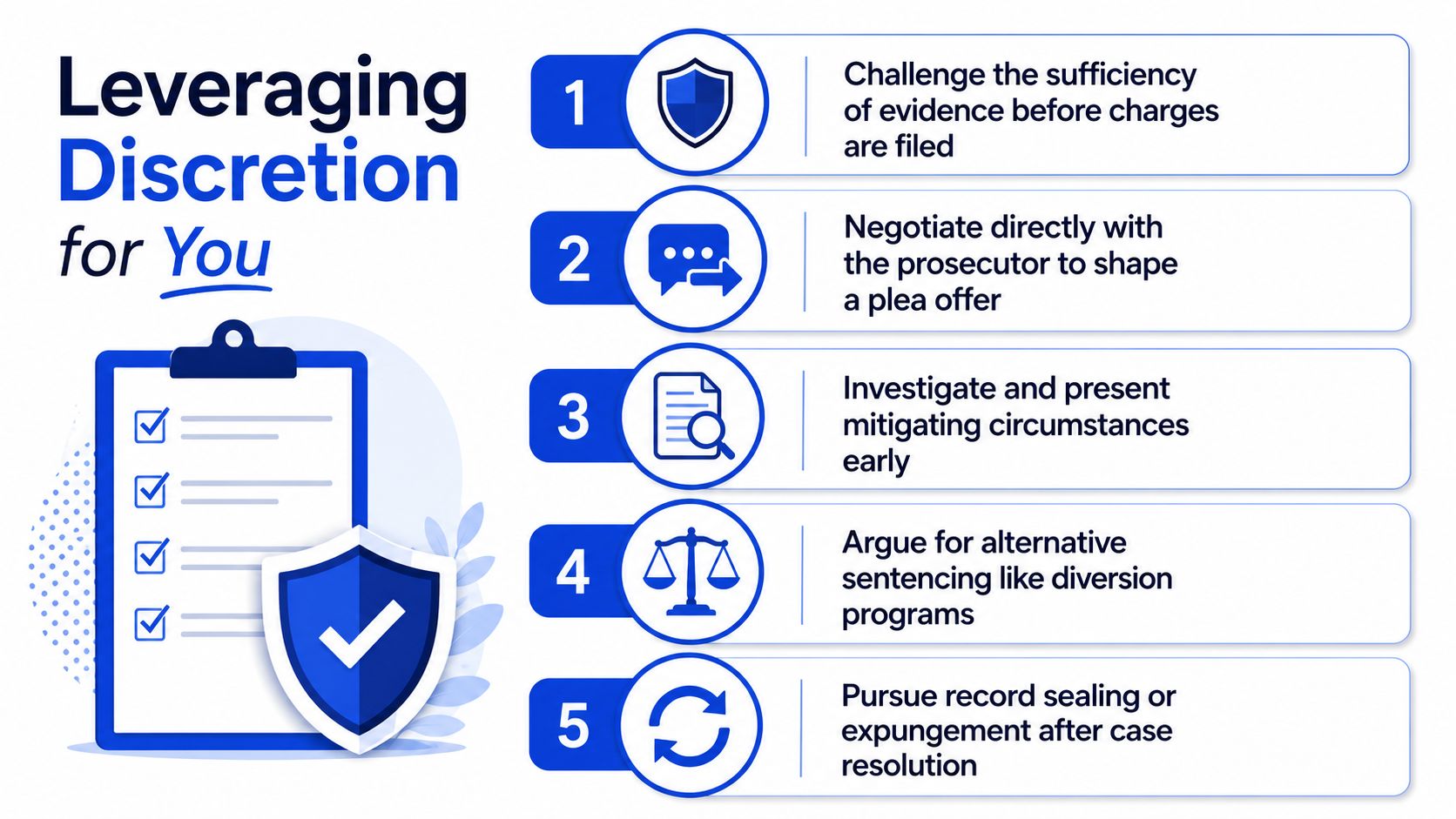
Challenge the sufficiency of evidence early. If the State's proof is shaky, the prosecutor may decide the case is not worth filing or pushing.
Negotiate directly with the assigned prosecutor. The right conversation can shift a charge reduction, diversion option, or plea term.
Document mitigation fast. The earlier the prosecutor sees the whole person, the better the chance of a fair review.
Push for alternative resolutions. Treatment, restitution, diversion, or another structured outcome can be the right answer in the right case.
Protect the path to record relief. A good resolution can matter later if sealing or expungement is available.
If the case is a candidate for pretrial intervention, that can be a major path in Florida. For a plain-English overview, see Florida PTI program guidance.
A former prosecutor understands how these decisions are read inside the office. That perspective helps identify which facts matter, which facts do not, and which facts should be placed in front of the State before the file hardens into a formal charge.
Ticket Shield, PLLC is one Florida defense option that handles DUI, traffic, criminal, and related court matters where early charging decisions can shape the result. The firm also appears in many jurisdictions, which can help a client avoid unnecessary disruptions while the defense focuses on reducing exposure and protecting the record.
Key Takeaways and Next Steps for Your Defense
Prosecutorial discretion is real, routine, and case-specific. It is strongest early, before the State has committed hard to the file, and it can affect everything from the charge itself to the plea offer, the sentence recommendation, and the long-term record impact. If you're facing charges in Broward County, Fort Lauderdale, Miami-Dade, Palm Beach, or anywhere in South Florida, the first conversation with a defense lawyer can shape what the prosecutor sees and what options stay alive.
The smartest next step is simple. Get legal eyes on the stop, the report, the evidence, and the courthouse dynamics before the case settles into a bad posture. Early intervention gives you the best chance to push for dismissal, reduction, diversion, or a more workable resolution.
If you're facing a DUI, drug charge, theft case, domestic violence allegation, or probation violation, Ticket Shield, PLLC can review the evidence, communicate with the prosecutor, and build a defense strategy around the charging decisions that matter most. Visit Ticket Shield, PLLC to request a confidential consultation and get a clear plan before the case hardens.