Pre Trial Intervention Florida: Dismiss Your Case
Jason Goldsmith, Esq
Getting arrested in South Florida can make the next few hours feel unreal. One moment you're dealing with bond, court dates, and paperwork. The next, someone mentions "diversion" or "PTI," and you're left trying to figure out whether that means your case can disappear, whether you qualify, and whether accepting it is smart.
For many people, Pre-Trial Intervention in Florida can be a real way to avoid a conviction. But it isn't automatic, and it isn't a free pass. It's a structured agreement with conditions, deadlines, and risks if you don't finish what you agreed to do.
As a defense lawyer with a prosecutor's perspective, I look at PTI as a strategic decision, not a reflex. In some cases, it's the right off-ramp. In others, fighting the case makes more sense. The key is making that decision early, before a deadline closes or a weak application gives the prosecutor an easy reason to say no.
Table of Contents
An Arrest Does Not Have to Mean a Conviction
A lot of clients first hear about PTI in a courthouse hallway, from a bondsman, or from a friend who's trying to help. Usually it's after an arrest in Broward County, Fort Lauderdale, or another South Florida court, when the immediate panic starts to settle and the long-term fear kicks in. You start thinking about your job, your record, your family, and whether one bad night is about to follow you for years.
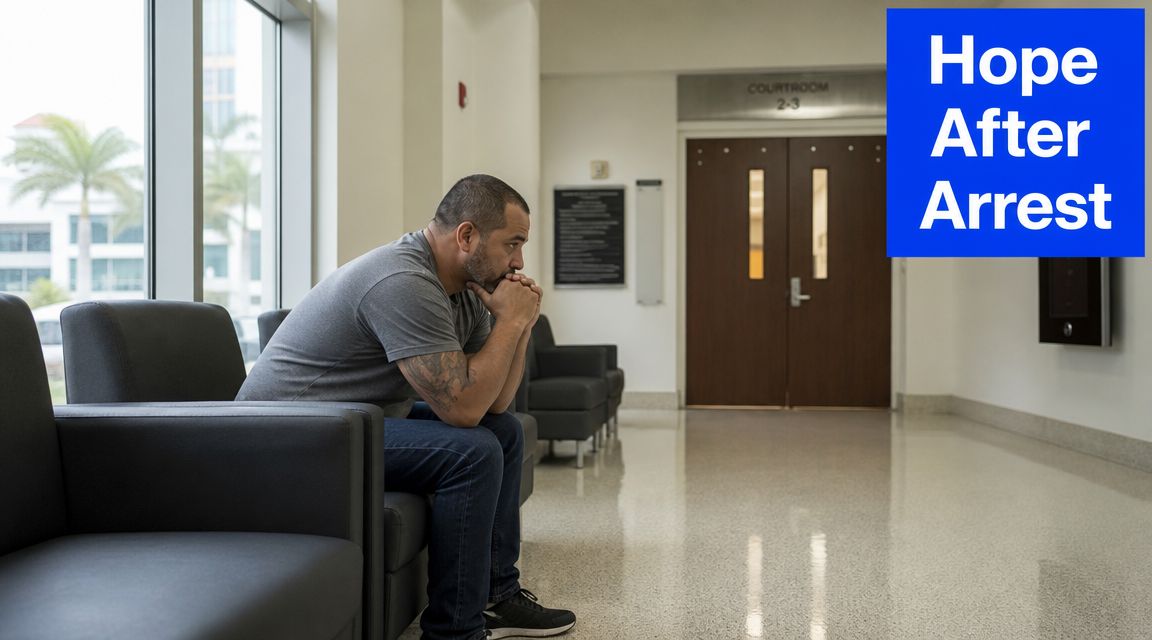
For the right person and the right charge, pre trial intervention Florida offers something important. It can create a path away from a conviction and toward dismissal. That's why people call it a second chance. But the label can be misleading if nobody explains how it functions.
PTI is not a casual favor
PTI isn't something the court just hands out because you seem like a good person. The prosecutor screens the case. The program reviews you. Your lawyer may need to gather records, present mitigation, and show why supervised diversion makes sense in your situation.
Practical rule: The earlier you talk to a defense lawyer, the more options you usually have. Waiting can turn a fixable eligibility issue into a missed opportunity.
I've seen people make avoidable mistakes right after arrest. They assume PTI is guaranteed, so they ignore dates, miss arraignment planning, or say things in court that don't help them. Others reject PTI too quickly because they think it sounds like probation. Neither approach is strategic.
The right question is not just can I get in
The better question is whether PTI is the best move for your case. If the evidence is weak, fighting may be the stronger path. If the charge is manageable but a conviction would hurt your future, PTI may be worth pursuing aggressively.
That decision should happen with a clear view of the process, the conditions, and the consequences of getting it wrong. If you've been arrested in Broward County, Miami-Dade, Palm Beach, or nearby, get legal advice early and make the decision with your eyes open.
Understanding Florida's Pre-Trial Intervention Program
Many people think PTI means the prosecutor agrees to "drop the case later." That's too simplistic. Under Florida Statute section 948.08, Florida treats PTI as a supervised diversion program run with Department of Corrections involvement for eligible people charged before or after formal charging documents are filed.
PTI is supervised diversion
That matters because PTI is a formal compliance program, not an informal promise. The statute allows a program that can include counseling, education, supervision, and medical or psychological treatment when appropriate. In real life, that means your lawyer shouldn't ask for PTI just because dismissal sounds good. The first question is whether you can complete the terms.
A practical way to think about it is this:
Feature | PTI | Probation |
|---|---|---|
When it happens | Before conviction | After conviction or plea |
Core purpose | Diversion from prosecution | Sentence supervision |
What success can lead to | Dismissal of the charge | Completion of sentence conditions |
That difference is why PTI is valuable. You're trying to avoid becoming convicted in the first place.
Why the structure is so strict
People are often surprised by how many rules can come with diversion. There is a reason for that. A review of pretrial support and supervision research reported mixed results, not automatic success. In one evaluation, the control group had a 12.6% failure-to-appear rate. The same review reported that in Washington, D.C., completing drug testing was associated with a 1.7 percentage point reduction in failures to appear and a 4.3 percentage point reduction in rearrests, while failing to complete testing was linked to 14.8 percentage points higher failures to appear and 12.4 percentage points higher rearrests than the control group.
Those numbers help explain why Florida doesn't treat PTI like a one-signature escape hatch. Supervision, reporting, treatment, and check-ins exist because the system is trying to affect measurable outcomes, especially court appearance and reoffending.
PTI works best for people who treat it like a contract with deadlines, not a loophole.
If you're considering pre trial intervention in Florida, don't focus only on the word "dismissal." Focus on whether you can live with the conditions for the full term and finish cleanly.
Who Qualifies for a Florida Diversion Program
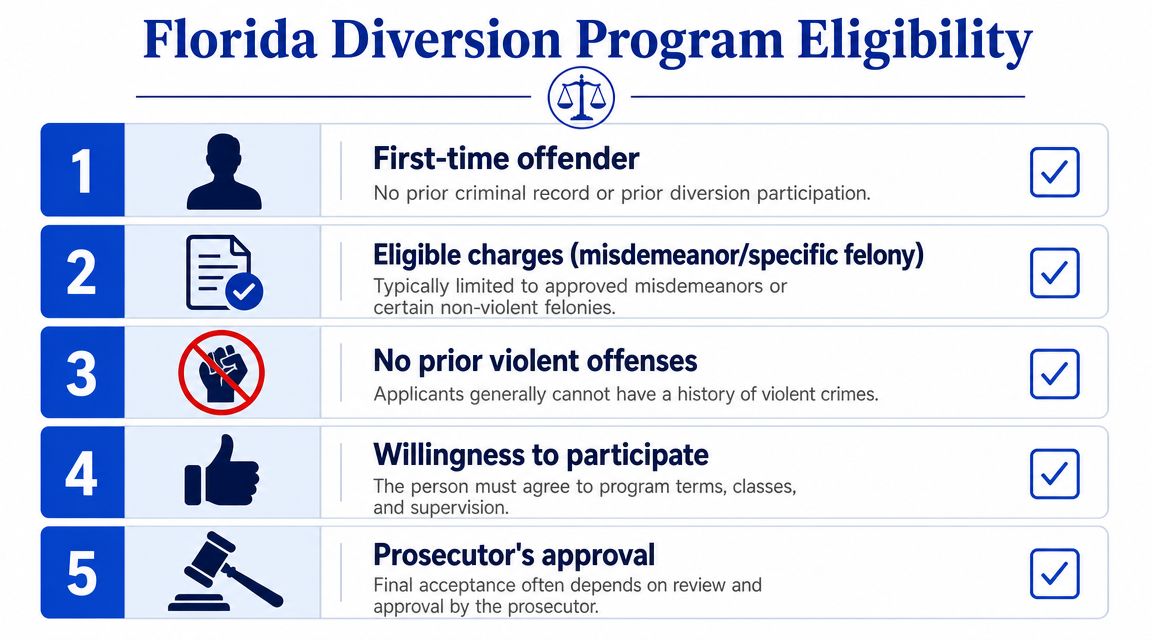
Eligibility is where online articles often oversimplify things. They say PTI is for first-time offenders and stop there. In practice, the prosecutor's office looks at the charge, your history, your background, and local office policy. Entry is screened. It is not automatic.
The basic profile prosecutors usually want
State Attorney guidance from one Florida circuit says PTI is typically used for misdemeanors and nonviolent third-degree felonies, with notable screening for background and status issues. That's consistent with how many prosecutors view these cases. They usually want someone who looks like a low-risk candidate for supervised diversion.
A strong PTI candidate often has several of these traits:
Limited or no prior record. The cleaner your history, the easier it is to argue you don't belong in the standard prosecution track.
An offense that fits local policy. Lower-level theft, drug possession, or other nonviolent charges are often discussed in this context.
Stability. Work history, school enrollment, family support, counseling, or treatment can help show that supervision will work.
A cooperative posture. Prosecutors want to see that you will comply, not fight every program rule once admitted.
If your case involves a drug allegation, it's also smart to understand how prosecutors evaluate those files more broadly. A lawyer handling diversion issues will often also look at search issues, constructive possession arguments, and charging weaknesses in the same review. That's part of why a Florida drug crimes defense resource can be useful even when diversion is on the table.
The issues that often block approval
One Florida State Attorney page states that non-U.S. residents are generally ineligible except in limited case-by-case situations and describes PTI as typically geared toward misdemeanors and nonviolent third-degree felonies through a screened process, not as a universal dismissal path. That guidance appears on the State Attorney's PTI information page.
That kind of office policy creates real-world obstacles such as:
Prior convictions or prior supervision. Even a record that doesn't look severe to you can make the prosecutor hesitate.
Residency or immigration concerns. If you're not a U.S. resident, PTI may be restricted or require special review.
Charge-specific exclusions. Some offenses may have different diversion tracks or no diversion option at all.
Facts that make the case look aggravated. The statute level doesn't always tell the whole story.
A person can be legally hopeful and still be a poor PTI candidate. Good strategy means testing both things early.
This is where negotiation matters. The prosecutor may see a rap sheet and say no. A defense lawyer may see a dated prior, a strong mitigation package, and a realistic path to compliance. Those are very different views of the same file.
Navigating the PTI Application and Approval Process
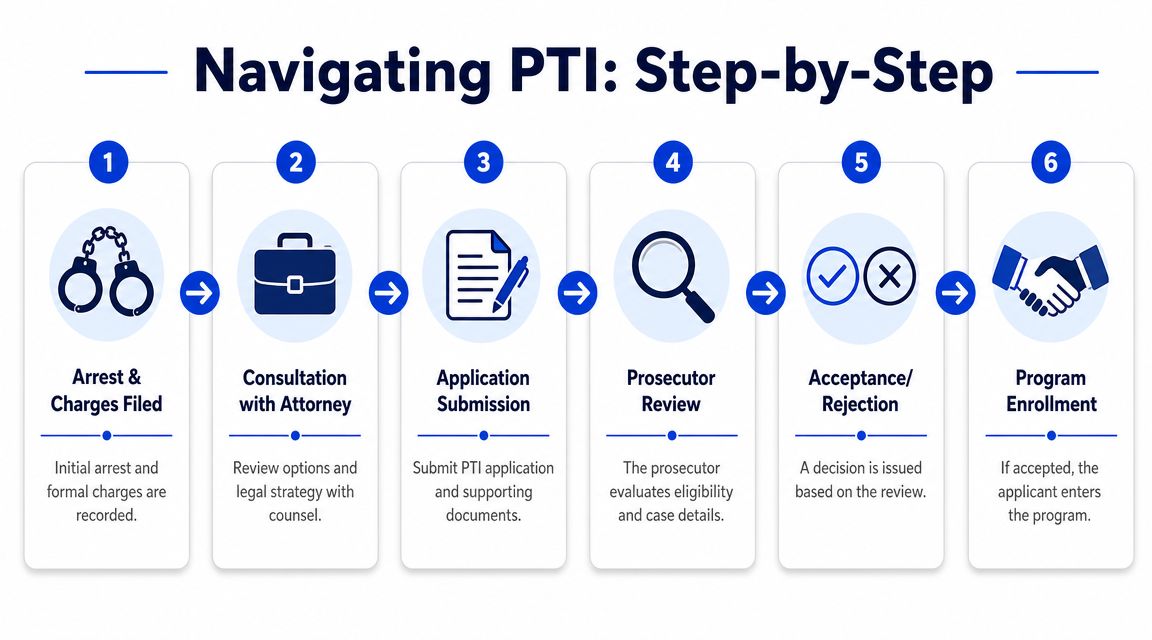
The PTI process is active from the start. Nobody moves your case into diversion while you wait. You or your lawyer usually need to identify the opportunity, confirm eligibility, assemble the materials, and push the request forward.
Early in the process, it helps to understand the flow at a glance.
What happens first
The first step is case triage. Your lawyer should review the arrest paperwork, identify weaknesses in the evidence, and decide whether PTI should be pursued, held in reserve, or rejected in favor of litigation. At this stage, former-prosecutor judgment can help. A case that looks "standard" on paper may still have search issues, witness problems, or proof problems that change the analysis.
Then comes contact with the prosecutor and, in some jurisdictions, the PTI unit or program staff. The goal is to find out whether the office is open to diversion and what they want to see.
How the application is built
PTI applications often involve more than filling in blanks. In Broward and other Florida jurisdictions, the file may include waivers, forms, records, and supporting documents. That's why a rushed or incomplete submission can hurt you.
Common parts of the process include:
Eligibility review. Your attorney checks the charge, criminal history, local policy, and any obvious disqualifiers.
Mitigation gathering. This may include school records, proof of work, counseling enrollment, restitution planning, or letters that show stability.
Waivers and forms. Some offices require a packet before they will even review the request.
Negotiation with the assigned prosecutor. Sometimes approval turns on how the case is framed and whether concerns are answered directly.
If you need to move quickly, use a criminal defense contact page for a confidential consultation before deadlines close.
A short explanation from the court-facing side can also help:
Why timing matters in Broward County
Broward County's State Attorney says felony PTI requires application within 45 days of arraignment, and the office states that successful completion of felony PTI leads to dismissal of the charge. The same Broward information describes a standard felony PTI term of one year and a packet review process with waivers and forms. In Manatee County, the program is described as a 3-month program with $55 per month in supervision fees, investigative and State Attorney costs, and 25 hours of community service. Those county-specific details appear on the Broward State Attorney PTI page.
Those examples tell you something important. PTI is local, deadline-driven, and condition-heavy. What works in Fort Lauderdale may not look the same in another county. A lawyer who handles South Florida criminal cases should be asking not just "Is PTI available?" but "What does this office require, and how fast do we need to act?"
What to Expect While in a PTI Program
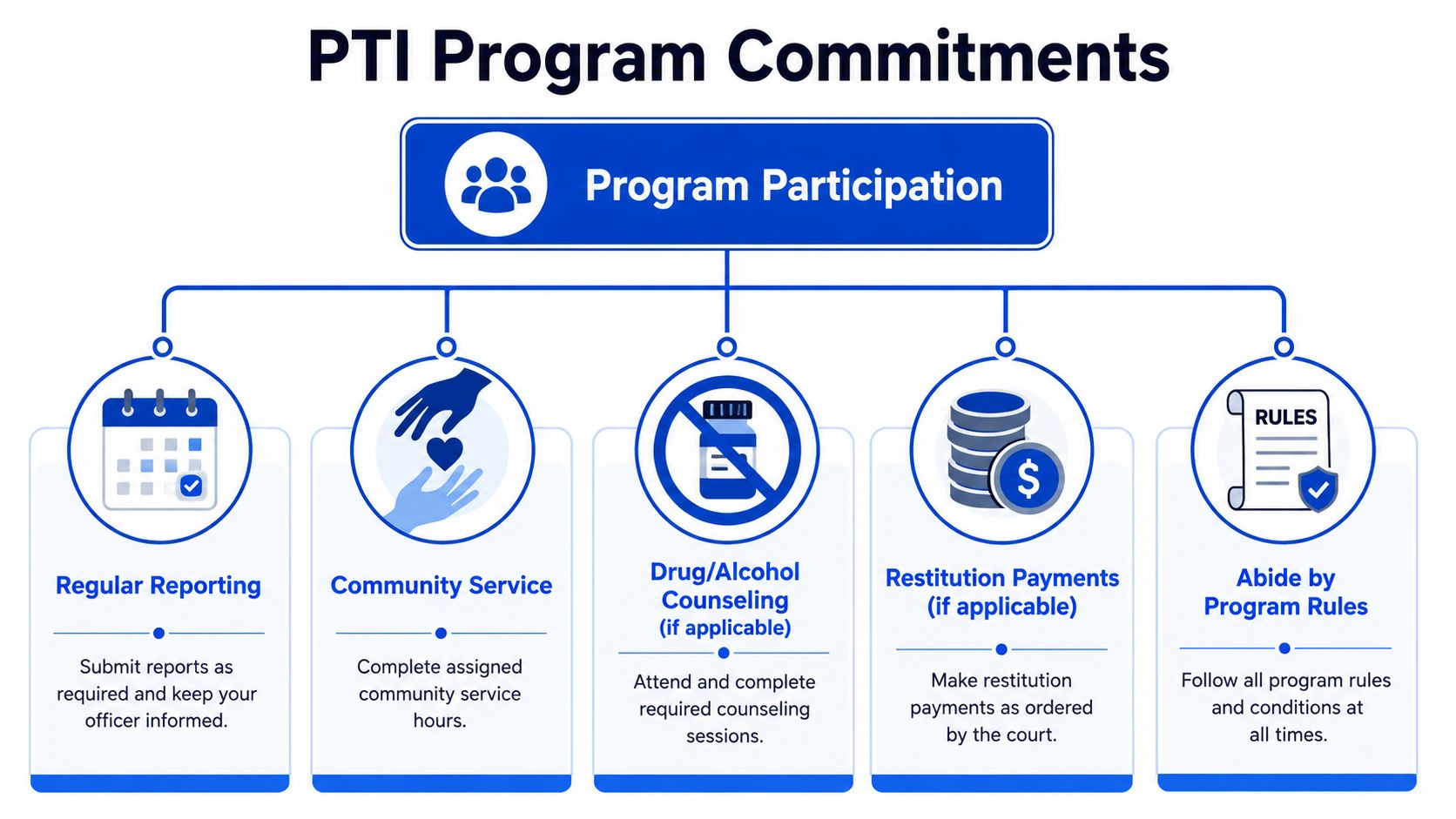
Getting accepted is not the finish line. It's the start of a supervised period where your job is simple to describe and sometimes hard to execute. Follow every condition, document your compliance, and stay out of trouble.
Daily reality during the program
The exact terms depend on the county, the charge, and your background. However, participants typically encounter a combination of supervision and corrective tasks.
That often includes:
Regular reporting. You may have to check in with a supervising officer or program contact and respond promptly to requests.
Classes or counseling. If the facts of the case suggest substance use, anger issues, or another concern, treatment may be part of the deal.
Community service and financial obligations. Some programs require service hours, supervision costs, restitution, or administrative fees.
No new arrests or violations. This is the rule that sinks many cases. A new case can put your diversion status at risk fast.
The program can feel inconvenient, especially if you work long hours or travel. That doesn't make the conditions optional. If transportation, scheduling, child care, or finances will make compliance difficult, that should be addressed before you accept the offer.
What usually causes trouble
Most PTI failures don't happen because someone committed a serious new offense. More often, people get in trouble by letting small problems stack up.
Watch for these patterns:
Missed appointments because work ran late and nobody was notified.
Unpaid obligations that were manageable at first but snowballed after a missed deadline.
Half-finished classes where attendance dropped after the first few sessions.
Poor communication with counsel when a problem could have been fixed early.
The clients who finish PTI successfully usually do one thing well. They treat every requirement like a court order, even when it feels administrative.
A good defense lawyer doesn't just help you get into PTI. Counsel should also help you understand the rules, track deadlines, and address compliance issues before they become termination issues.
Graduating PTI Getting Your Charges Dismissed and Expunged
Successful completion of PTI can put you in a far better position than a plea or conviction. But people often misunderstand the end result. They hear "dismissed" and assume the entire case vanishes from public view automatically. That's not how it works.
Dismissal is the first win
After successful completion, the prosecutor can dismiss the charge. That's the major benefit of choosing PTI in the first place. You avoided a conviction and got out of the standard prosecution track.
That dismissal can matter in everyday life. Employers, schools, licensing boards, and landlords often react very differently to a dismissed case than to a conviction.
A dismissed charge is powerful. It just isn't the same thing as an erased arrest.
If you're trying to understand dismissal language in Florida court practice, a plain-English explanation of nolle prosequi in Florida can help clarify what a formal abandonment of prosecution means.
A dismissed case can still leave a public record
Even after PTI is completed and the case is dismissed, the arrest record may still exist unless you take an additional legal step. That is where sealing or expungement enters the picture.
The practical takeaway is this:
Outcome | What it means |
|---|---|
Dismissal | The prosecution ends without a conviction |
Sealing or expungement | A separate process aimed at limiting or removing public access to the record |
Whether a person qualifies for sealing or expungement depends on the case history and Florida record-clearing rules. The important point is strategic. If your goal is a clean slate, don't stop at dismissal. Ask what record relief may be available next and when to start that process.
For many clients, PTI is best viewed as step one. Record clearing is step two.
Frequently Asked Questions About Florida PTI
Can I fail PTI and still resolve the case later
Yes, but failure changes your advantage. If you don't complete the program, the case can return to the regular prosecution track. At that point, the prosecutor may be less flexible because you were already given a diversion opportunity and didn't finish it.
That doesn't mean the case is hopeless. It means the strategy changes. Your lawyer may need to shift back to litigation, plea negotiation, suppression issues, or mitigation.
Is PTI available for DUI cases
Sometimes DUI cases involve separate diversion questions and local policies, and they often receive more scrutiny than standard low-level nonviolent cases. A DUI arrest also creates licensing and administrative consequences that exist apart from the criminal case. That's one reason a person charged with DUI shouldn't assume general PTI discussions apply cleanly to that charge.
Should I take PTI or fight the case
This is the biggest strategic question. If the evidence is weak, witnesses are unreliable, or the stop or search looks unlawful, fighting may be better than accepting months of supervision. If the evidence is strong and the charge threatens your record, PTI may be the safer path.
The decision usually turns on a few practical questions:
How strong is the State's proof. A weak case shouldn't be surrendered without careful analysis.
Can you complete every condition. If your schedule, finances, or personal situation make compliance unrealistic, PTI may be more dangerous than it sounds.
What are the collateral consequences. Employment, immigration, housing, school, and licensing concerns can change the value of dismissal.
What does the local prosecutor's office allow. Policy matters in real life.
Is PTI the same as probation
No. Probation follows a conviction or plea. PTI is a pre-conviction diversion path intended to help eligible people avoid that result if they complete the program successfully.
Where can I get answers about my specific case
Generic answers only go so far. The right answer depends on your charge, county, prior record, and the assigned prosecutor. If you need more background before speaking with counsel, Ticket Shield, PLLC maintains a Florida criminal defense FAQ page that addresses common case concerns.
If you were arrested in Broward County, Fort Lauderdale, Miami-Dade, Palm Beach, or elsewhere in South Florida, a quick review of your case can tell you whether PTI is realistic, whether fighting the charge makes more sense, and what deadlines matter right now. Ticket Shield, PLLC helps clients evaluate diversion options, challenge weak criminal cases, and pursue dismissal-focused strategies through confidential consultations.
Pre-Trial Intervention can get your Florida case dismissed entirely. Learn who qualifies, how PTI works, and the steps to get accepted.