
What Is Plea Bargain in Florida and How It Works
Jason Goldsmith, Esq
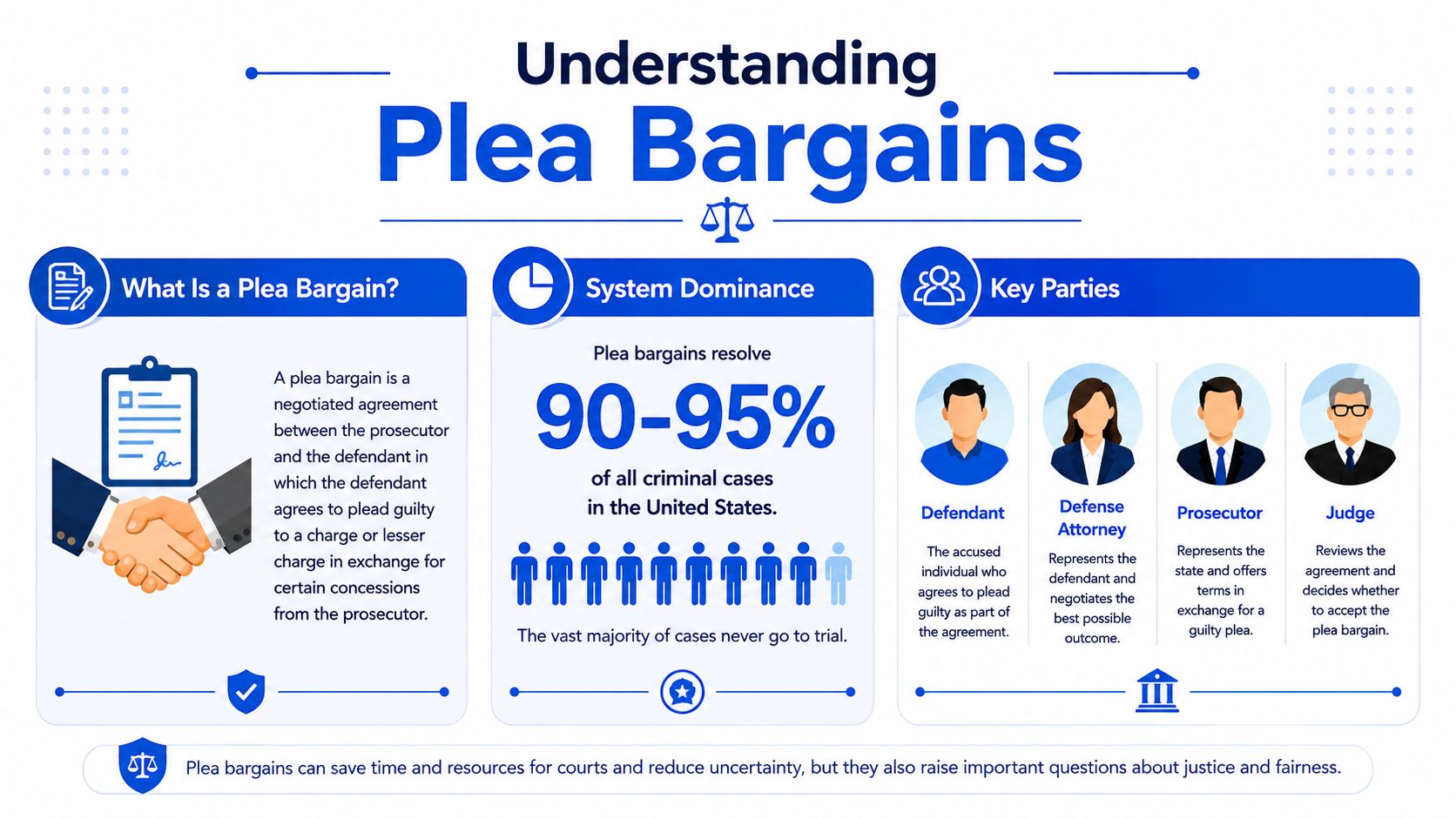
A plea bargain is a negotiated agreement in which a defendant pleads guilty or no contest in exchange for reduced charges, lighter sentencing, or other concessions from the prosecution. Nearly 98% of criminal convictions nationwide result from guilty pleas rather than trials.
That reality changes how you should view a criminal case in Florida. The most important decision may happen long before a jury is sworn, while the prosecutor and defense attorney are evaluating evidence, negotiating terms, and deciding whether the case can be resolved without trial. A plea offer can protect your freedom and reduce sentencing exposure, but it can also create a conviction record and collateral consequences that affect your license, immigration status, firearm rights, employment, and eligibility for record sealing Florida residents may otherwise pursue.
The central question isn't "What is plea bargain?" The practical question is: What exactly will you give up, what will you receive, and what consequences will remain after the hearing ends?
Table of Contents
Understanding Plea Bargains in the Criminal Justice System
The modern criminal court system relies heavily on negotiated resolutions. The Vera Institute reported that guilty pleas accounted for 97% of convictions in large urban state courts in 2009 and 90% of federal convictions in 2014, with researchers estimating that more than 90% of those guilty pleas resulted from plea bargaining rather than an open-court trial. The Vera Institute review of plea bargaining also reported that custodial sentences imposed after trial were 64% longer on average than sentences imposed through pleas.
Those figures don't mean every defendant should accept an offer. They show why negotiation is often the central battleground in a criminal case. A plea bargain can involve reducing a felony to a misdemeanor, dismissing some counts, recommending probation instead of incarceration, or resolving a case through a diversion program. The defendant gives up important rights, usually by entering a guilty or no contest plea, while the State provides a defined concession.
The parties and their roles
The prosecutor decides what offer the State will make, subject to legal and office policies. The defense attorney investigates the case, identifies weaknesses, explains risks, and negotiates for better terms. The defendant makes the final decision. A judge conducts the plea hearing and must determine whether the plea is voluntary and legally sufficient.
A plea isn't a finding that the evidence is fair or that the police acted lawfully. It may be a strategic decision based on risk, family responsibilities, employment, immigration concerns, or the possibility of a substantially worse sentence after trial. Florida criminal defense decisions should account for the entire picture, including prosecutorial discretion, rather than focusing only on the charge printed on the arrest paperwork.
Practical rule: A favorable offer is useful only if you understand every right and consequence attached to accepting it.
A plea bargain isn't a sign of weakness. In a Broward County DUI case, drug prosecution, theft accusation, weapons charge, or probation violation, negotiation can be the most effective way to limit exposure. But it works only when counsel has reviewed discovery and you understand what the proposed resolution means beyond the immediate sentence.
How the Plea Negotiation Process Works in Florida
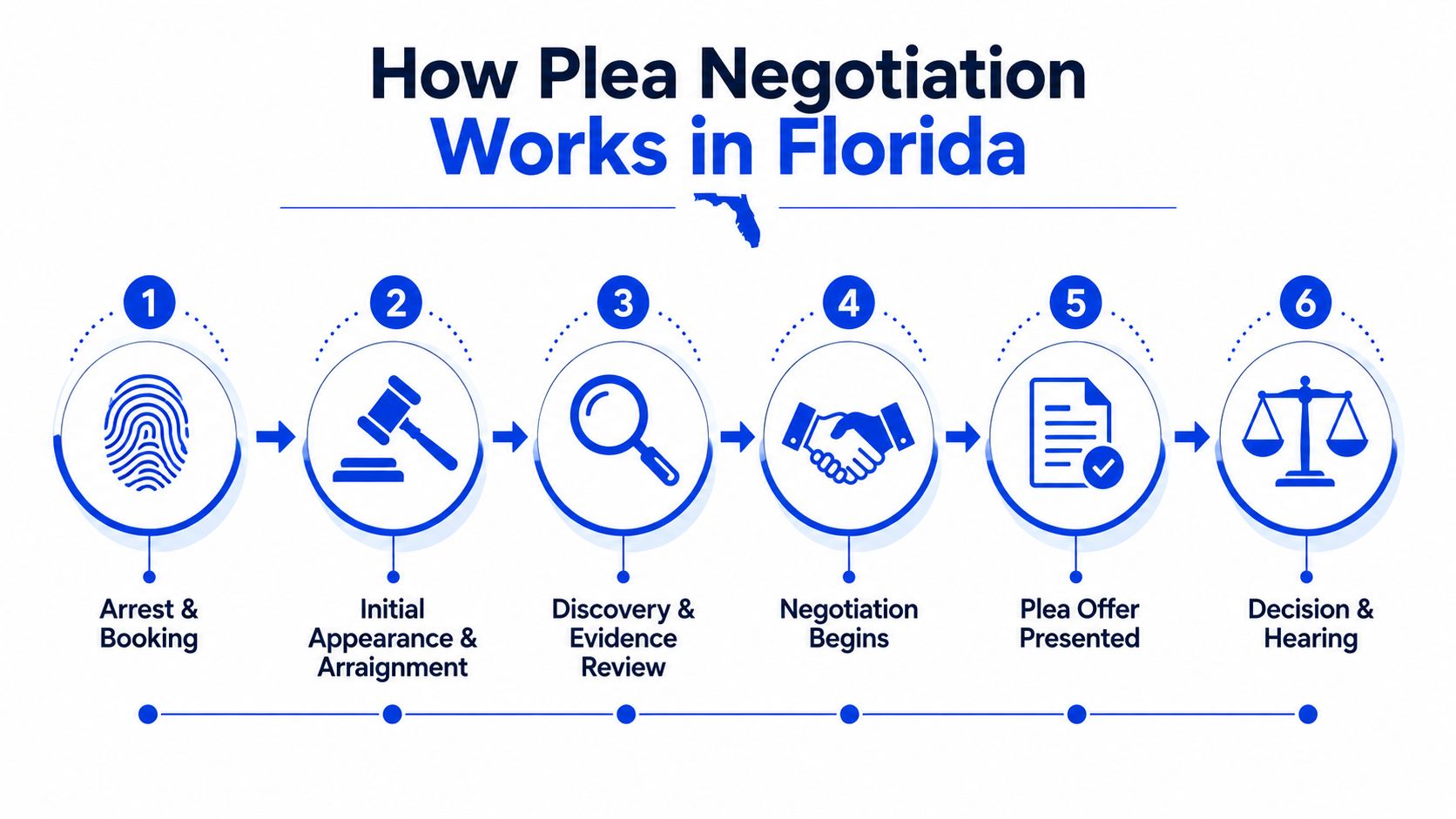
Florida plea negotiations usually develop through several connected stages. The exact timing varies by charge and court, but the decision should never be made solely from a prosecutor's first offer.
From arrest to the first offer
After arrest and booking, the defendant may attend an initial appearance where release conditions and probable cause issues are addressed. Arraignment follows, although a formal arraignment may be waived in some cases. The defendant enters a plea, receives notice of the charges, and learns how the case will move forward.
The defense then obtains and reviews discovery. That can include police reports, body-camera footage, surveillance video, witness statements, laboratory records, breath-test materials, medical records, and digital evidence. A Fort Lauderdale DUI lawyer, for example, may examine the traffic stop, field sobriety observations, implied-consent procedures, breath testing, and whether officers followed required protocols. A Broward County drug crime attorney may focus on the search, possession evidence, lab testing, and chain of custody.
The prosecutor may present an initial offer at arraignment, a case-management event, or a Florida pretrial conference. The defense can accept, reject, or counter the proposal. Negotiations may address the charge, sentence, probation conditions, restitution, treatment, community service, or dismissal of additional counts.
Three forms of bargaining
Charge bargaining seeks a different offense, such as reducing a felony accusation to a misdemeanor or dismissing selected counts.
Sentence bargaining focuses on the recommendation. The parties may negotiate incarceration, probation, treatment, restitution, or other conditions.
Fact bargaining involves an agreement about which facts the State will rely on for sentencing or which allegations will be omitted from the factual basis.
Florida law requires a criminal defendant to complete a sworn or written plea agreement before the court can accept it. The trial judge retains ultimate responsibility for determining the sentence, so the agreement is a negotiated recommendation, not an automatic sentencing order. This point matters when a prosecutor says the court will “give” a particular sentence. The judge must still review and accept the proposed resolution.
At the plea hearing, the judge conducts a colloquy. The defendant confirms understanding of the charge, rights being waived, potential penalties, factual basis, and consequences of the plea. The court also addresses whether anyone forced or improperly pressured the defendant. If the judge accepts the plea, sentencing may occur immediately or later, depending on the agreement and court procedure.
Advantages and Disadvantages of Accepting a Plea Deal
A plea offer creates a trade-off, not a free benefit. The defense must compare the actual terms with the realistic trial exposure, including the possibility of acquittal, conviction, a harsher sentence, or additional consequences.
Accepting a plea deal | Proceeding toward trial |
|---|---|
May reduce charges or dismiss counts | Preserves the right to have the State prove guilt |
May provide a defined sentencing recommendation | Leaves the result to a judge or jury |
Can resolve the case sooner | May take longer and require testimony |
May reduce uncertainty | Creates the possibility of acquittal or conviction |
Can sometimes support treatment or diversion | Allows suppression motions and trial defenses to proceed |
The most obvious advantage is control. If the prosecutor offers a misdemeanor resolution instead of a felony, or probation instead of jail, the defendant may avoid a more damaging outcome. A negotiated sentence can also reduce the emotional burden of waiting for trial and may protect employment or family responsibilities.
What accepting can cost
The defendant generally gives up the right to a jury trial, the right to confront witnesses at trial, and the privilege against compelled self-incrimination. A guilty plea typically produces a conviction. A no contest plea can also lead to sentencing and may carry similar criminal consequences, even though the defendant isn't expressly admitting the facts.
The record may affect future employment, housing, professional licensing, firearm possession, immigration, and driving privileges. An agreement that looks favorable because it avoids jail may still be harmful if it requires pleading to an offense that blocks future relief.
Pressure can distort the decision. Defendants may feel they must accept immediately, especially when they fear incarceration or don't understand the evidence. That doesn't mean every offer is coercive, but it does mean counsel should explain the terms in plain language and investigate whether the State can prove every element.
The Florida explanation of a no contest plea can help distinguish the plea language, but the practical consequences depend on the exact charge, sentence, and case history.
A short sentence can still be a long-term legal problem if the conviction creates consequences you weren't told to expect.
Hidden Consequences Many Defendants Overlook When Pleading
Many defendants understand that a plea waives trial. Far fewer understand what may be waived or triggered beyond the courtroom. Research from a Cornell-led study of reported experiences found that many participants didn't understand some basic consequences of taking a plea, even when they understood that they were giving up a jury trial. Earlier interview research also found that misunderstanding and fear could push defendants to plead guilty to exit a process they didn't fully grasp. The Cornell study on reported plea-bargaining experiences highlights why a definition alone isn't enough.
Before accepting a deal, ask counsel to address:
Driving privileges: DUI and drug-related resolutions may affect a driver's license, ignition-interlock requirements, or hardship-license options. The criminal sentence and administrative license process may not be identical.
Immigration status: A plea can create immigration consequences for a noncitizen, including removal, inadmissibility, or difficulty obtaining lawful status. Immigration advice should be obtained before entering the plea.
Firearm rights: A conviction may affect the ability to possess or purchase firearms. The charge, classification, and specific facts matter.
Professional licensing: Certain convictions can require disclosure or affect eligibility for regulated professions, occupational licenses, and certifications.
Probation consequences: Conditions may include reporting, testing, treatment, no-contact provisions, payment obligations, or restrictions on travel and association. A violation can produce a separate legal crisis.
Future record relief: A plea may make sealing or expungement unavailable even if the immediate sentence is modest.
Florida's record-sealing and expungement process is restricted. The Florida Department of Law Enforcement explains that an applicant generally must have no prior adjudication of guilt, no prior Florida record that was sealed or expunged, no pending petition involving another record, and no disqualifying offense. Florida also allows only one court-ordered sealing or expungement in a lifetime, and prior relief or certain convictions can eliminate eligibility. Review the meaning of adjudication of guilt before treating “adjudication withheld” as a complete solution.
The safest approach is to ask for a written explanation of direct penalties, collateral consequences, immigration concerns, record-relief eligibility, and every probation condition. If you can't explain the deal in your own words, you aren't ready to accept it.
When to Accept a Plea Offer and When to Fight at Trial
No formula determines the right choice. The decision depends on the evidence, the legal issues, the offer's terms, your goals, and the consequences of both outcomes.
Accepting may make strategic sense when the State's evidence is strong and admissible, the agreement substantially reduces sentencing exposure, or the offer protects you from a mandatory or unusually damaging consequence. It may also be reasonable when a diversion program, treatment resolution, dismissal path, or noncriminal disposition is available and the conditions are achievable.
The analysis should include more than the prosecutor's summary. Counsel should review the actual evidence and ask whether the State can prove every element beyond a reasonable doubt. A strong offer may become stronger after a lawyer identifies litigation risk the prosecutor hasn't fully considered.
Rejecting an offer may be appropriate when:
The search appears unlawful: Evidence obtained after an unconstitutional stop, detention, search, or seizure may be challengeable through a Florida motion to suppress evidence.
Witnesses are unreliable: Inconsistent statements, poor identification conditions, bias, or missing witnesses can weaken the prosecution's case.
The forensic evidence is incomplete: Problems with testing, preservation, chain of custody, or interpretation may create reasonable doubt.
The charge has severe collateral effects: A resolution that preserves immigration, licensing, firearm, or record-relief options may be more important than a superficially shorter sentence.
The offer demands unnecessary admissions: The factual basis should be reviewed carefully, especially where it could affect related cases or later proceedings.
Trial isn't automatically the courageous choice, and a plea isn't automatically the safe choice. A prepared defense attorney should be willing to explain both paths, identify the risks of rejecting the offer, and tell the prosecutor why the case could create problems at trial.
Real-World Plea Bargain Scenarios in Florida Criminal Cases
The following examples are hypothetical. They show how negotiation can turn on evidence, eligibility, and collateral consequences rather than the charge name alone.

A first-time DUI allegation
A driver in Fort Lauderdale is charged with DUI after a traffic stop. The State's evidence includes the officer's observations, field sobriety exercises, and an alleged refusal, but the defense identifies questions about the stop, the timing of the investigation, and the quality of the evidence.
The prosecutor initially seeks a DUI plea with standard conditions. Defense counsel investigates the evidence, challenges weaknesses, and asks whether a reduction to reckless driving is legally and factually supportable. If the prosecutor agrees, the client must still understand the new charge, sentence, driving consequences, insurance impact, and whether adjudication is withheld or entered.
A possession case and diversion
A person in Miami-Dade faces a drug possession charge. The defense focuses on whether the substance was lawfully seized, whether the State can prove possession, and whether testing supports the allegation. Instead of treating the first offer as the only option, counsel asks about diversion or treatment-based eligibility.
The client may need to complete conditions before dismissal or another favorable resolution becomes available. The attorney should explain what happens if the client fails a condition, whether the case will return to court, and whether the final result preserves record-sealing possibilities.
A theft charge involving restitution
A South Florida theft case may involve disputed ownership, identification issues, or disagreement about value. The prosecutor proposes a plea requiring restitution and probation rather than incarceration. Defense counsel examines whether the amount is supported, whether the client can comply, and whether the proposed conviction creates a worse long-term result than continued litigation.
The counteroffer may address the amount and schedule of restitution, the length and terms of probation, the factual basis, and the final disposition. The client should never agree to an amount or admission without understanding how it could affect a later civil claim or related charge.
A video consultation can help explain the documents and decision points in these cases.
These patterns apply across Florida criminal defense matters, including domestic violence, gun charges, violent crimes, sex offenses, juvenile cases, white-collar accusations, federal crimes, traffic crimes, and probation violations. The facts determine the strength of your position.
Working with a Florida Criminal Defense Attorney on Your Plea Strategy
A defense attorney's value isn't limited to relaying an offer. Counsel should test the State's case before advising you whether the offer is worth accepting.
The work often begins with discovery review. In a DUI case, that may include video, breath-test records, field-testing details, and the legal basis for the stop. In a drug or weapons case, counsel may examine consent, warrant documents, probable cause, possession evidence, laboratory results, and chain of custody. In a domestic violence case, statements, recordings, photographs, witness accounts, and injunction proceedings may affect the defense strategy.
A lawyer should also explain alternatives. Depending on the case, those may include dismissal, diversion, treatment, a reduction, a negotiated probation structure, a motion to suppress, or trial. No attorney can guarantee an outcome, and no responsible lawyer should describe a prosecutor's offer as certain until the judge accepts the agreement.
Questions to ask before deciding
What am I pleading to? Ask for the exact offense, level, factual basis, and whether adjudication is entered or withheld.
What sentence can the judge impose? Separate the prosecutor's recommendation from the court's authority.
What rights am I waiving? Confirm the trial, confrontation, silence, and appeal implications.
What happens outside the criminal case? Discuss licenses, immigration, firearms, employment, professional credentials, and record relief.
What happens if I violate probation? Request each condition in writing, including payment, treatment, testing, reporting, and no-contact terms.
What evidence supports the offer? You should understand the State's proof and the defenses available before choosing certainty.
Ticket Shield, PLLC, led by former prosecutor Attorney Jason S. Goldsmith, evaluates Florida criminal cases, reviews evidence, challenges issues such as illegal searches and unreliable field tests, and discusses negotiated resolutions or litigation options. The firm offers confidential consultations and direct communication by phone, text, or email for clients in Broward County, Fort Lauderdale, Miami-Dade, Palm Beach, and other Florida jurisdictions.
Common Questions About Plea Bargains in Florida
Is a no contest plea the same as a guilty plea?
Not exactly. A no contest plea doesn't expressly admit the facts, but the court can still impose sentence and the criminal consequences may be similar. The effect depends on the charge and the specific legal issue involved.
Can a Florida judge reject a plea agreement?
Yes. Florida's judge retains ultimate sentencing responsibility. A written or sworn agreement is a negotiated recommendation, and the judge may decline to accept the proposed terms or require clarification before proceeding.
What happens if I violate the plea terms?
The consequences depend on the agreement and the violation. The court may revoke a benefit, impose a different authorized sentence, or address a new charge. You should have counsel review the alleged violation before making statements or agreeing to a new resolution.
Can I withdraw a plea after entering it?
Sometimes, but withdrawal isn't automatic. The timing, reason, plea paperwork, and applicable procedure matter. A claim that you misunderstood a significant consequence, lacked adequate advice, or entered an involuntary plea should be raised promptly with a defense attorney.
Does a plea bargain create a criminal record?
It can. A guilty or no contest plea may result in a conviction or another court disposition that affects future opportunities. Whether sealing or expungement is available depends on the final disposition, offense, prior history, and Florida's statutory restrictions.
If you're considering a plea bargain in Broward County, Fort Lauderdale, Miami-Dade, Palm Beach, or elsewhere in Florida, Ticket Shield, PLLC can review the evidence, explain what rights and collateral consequences are at stake, and discuss negotiation, suppression motions, diversion, or trial. Contact the firm for a confidential consultation before accepting an offer or entering a plea.