
What Is a Motion to Suppress Evidence: 2026 Guide
Jason Goldsmith, Esq
You're driving home in Fort Lauderdale. Lights flash behind you. The officer asks a few questions, then asks you to step out. A quick pat-down turns into a search. Your car gets opened. A bag, a firearm, pills, cash, or a phone suddenly becomes the center of the case against you.
That moment feels final. It isn't.
As a former prosecutor, I can tell you this plainly. Police reports often sound cleaner than the stop really was. Officers skip steps. They stretch consent. They claim probable cause after the fact. They ask questions first and worry about constitutional limits later. That's exactly why one of the most important tools in a Florida criminal case is a motion to suppress evidence.
If the police crossed the line, the defense can ask the judge to keep that evidence out of trial. In many cases, that fight changes everything.
Table of Contents
Your Rights After an Arrest A Powerful Defense Tool
A lot of people charged in Broward County, Miami-Dade, or Palm Beach think the case is over once the officer finds something and makes an arrest. That's how the system feels from the back of a patrol car. It feels like the officer has all the power and you have none.
That's wrong.

In South Florida, many criminal cases begin with something ordinary. A lane change. A tag issue. A stop near a nightclub. A late-night DUI investigation. If you've already dealt with roadside testing, you should also understand how officers build roadside cases through Florida field sobriety test tactics.
The stop is only the beginning
An arrest doesn't prove the search was lawful. It doesn't prove the questioning was proper. It doesn't prove the officer had a valid basis to open your door, search your pockets, inspect your trunk, seize your phone, or keep pushing after you refused consent.
A motion to suppress is the defense tool used to attack those actions head-on. It tells the court that the State shouldn't benefit from evidence gathered in violation of your rights.
Practical rule: If the police found the key evidence by cutting constitutional corners, the defense should force that issue early.
This matters in DUI cases, drug arrests, gun charges, theft investigations, domestic violence allegations, and probation violation cases tied to a new arrest. The facts change. The pressure changes. The core question stays the same. Did law enforcement follow the rules?
Why this tool matters so much
From the prosecution side, I can tell you what creates advantage. It's not just arguing that your side has a better story. It's attacking whether the State gets to use the evidence at all.
That's the power of suppression. It doesn't ask for sympathy. It demands accountability.
What Is a Motion to Suppress Evidence Explained
At 2:00 a.m., an officer pulls a car into a checkpoint line, asks a few extra questions, opens the door, and the case suddenly grows legs. The arrest report makes it sound routine. A suppression motion is where the defense tests whether any of it was lawful.
What is a motion to suppress evidence? It is a pretrial request asking the judge to block the State from using evidence obtained in violation of constitutional or statutory rights, consistent with Cornell Law School's overview of a motion to suppress. In plain terms, the defense is telling the court that the government got the evidence by breaking the rules, so the jury should never hear it.
From the prosecutor's side, this is the motion that changes a case fast. If the drugs, gun, statements, phone data, or identification get suppressed, the State can lose its best proof in one hearing. Sometimes the charge falls apart. Sometimes the prosecutor is forced into a much better offer because the clean version of the case is gone.
That is why good defense lawyers do not treat suppression as a vocabulary lesson. They use it as a pressure point.
The real fight is over police conduct
A suppression motion is not an argument about whether you are a good person or whether the accusation sounds ugly. It is an attack on the method. Did the officer have a legal basis to stop you, detain you, search you, question you, or seize property? If the answer is no, the evidence becomes vulnerable.
Courts recognize suppression because constitutional rights mean nothing without a remedy. Federal courts adopted the exclusionary rule in Weeks v. United States, and state courts had to follow it after Mapp v. Ohio. Prosecutors know those cases are not dusty history. They are the reason sloppy police work can still wreck an otherwise strong file.
Courts don't suppress evidence to reward defendants. They suppress evidence to keep the government inside the Constitution.
In Florida practice, that principle shows up in ordinary cases all the time. Traffic stops that drift beyond their original purpose. Consent searches dressed up as voluntary when the scene was coercive. Warrants that look precise on paper but were executed far outside their limits. Checkpoint cases are a good example because they often rise or fall on procedure, not drama. If your arrest began at a roadblock, review how courts analyze DUI checkpoint legality in Florida.
What evidence can be suppressed
A suppression motion can target:
Physical evidence, including drugs, firearms, cash, phones, or items taken from a car, home, or pocket
Statements, including answers given during custodial interrogation or after rights were ignored
Warrant evidence, if the warrant was defective, misleading, stale, or executed outside its lawful scope
Derivative evidence, meaning evidence the police found only because of the original illegality
That last category matters more than many guides admit. If the first step was unlawful, later evidence can be poisoned too. A bad stop can taint the search. A bad arrest can taint the statement. A bad phone seizure can taint the extraction.
Partial suppression still changes the case
Here is the nuance that gets missed. A motion to suppress does not have to wipe out every piece of evidence to be a win.
If the judge suppresses your statements but allows the physical evidence, the prosecutor loses context, admissions, and the ability to tell a clean story. If the judge blocks part of a search but not all of it, the State may keep some proof but lose the most damaging item. If the court trims a case instead of killing it, the defense still gains ground because prosecutors charge and negotiate based on the strongest version of their evidence, not the weakened one.
That is the strategic value. Suppression is not only about total victory. It is about stripping away the parts of the case the State was counting on most.
In practice, the defense usually has to show the court why the police conduct was unlawful and tie that violation to the evidence being challenged. Once that showing is made, the hearing often becomes a close examination of officer testimony, body camera footage, dispatch timing, warrant language, and the gaps prosecutors would rather gloss over.
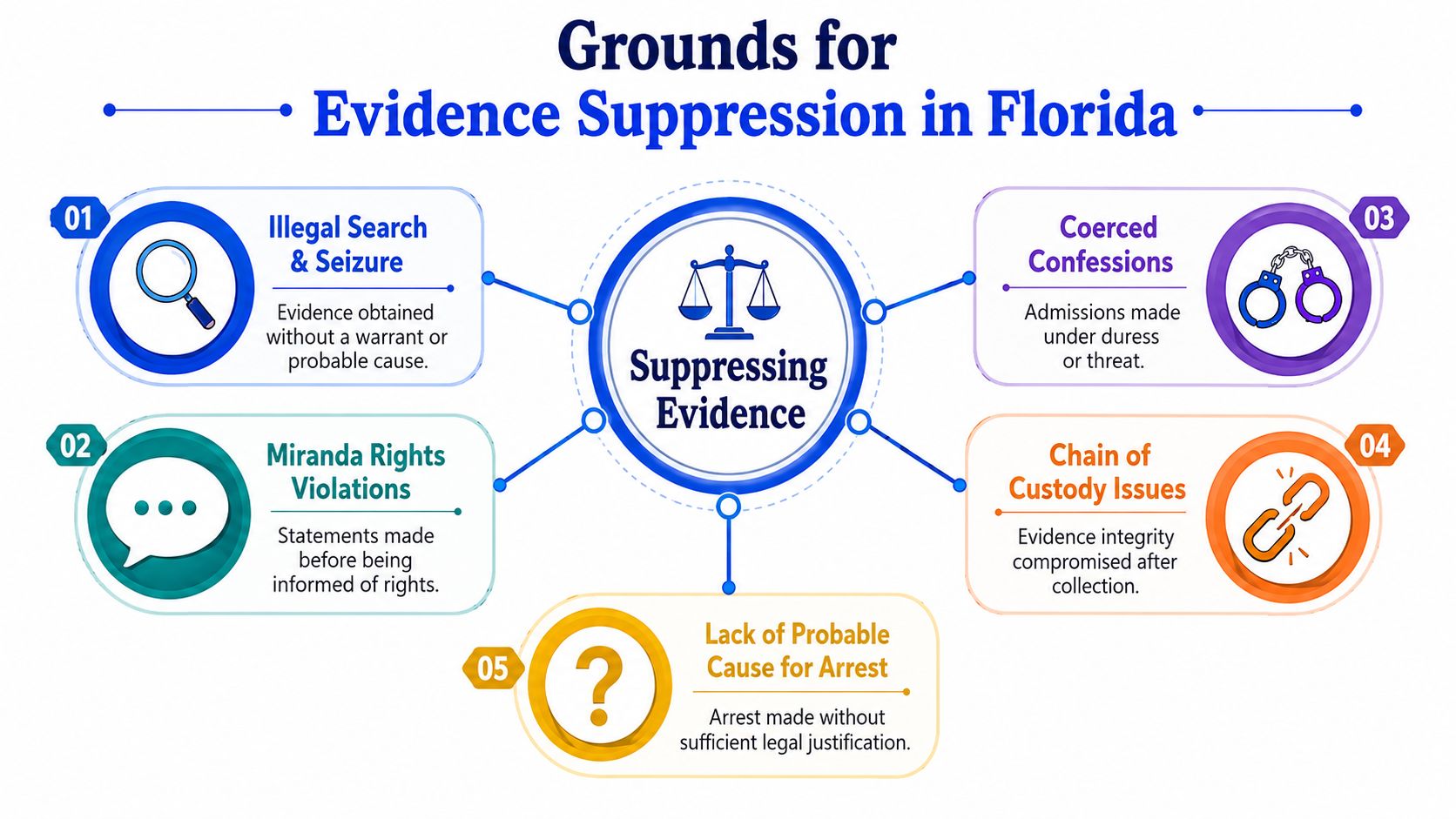
Common Legal Grounds for Suppressing Evidence in Florida
Florida suppression litigation is won on specifics. Not broad outrage. Not generic claims that the police were unfair. Specific facts. Specific constitutional violations. Specific contradictions.
If your case started at a roadblock or roadside investigation, you should also understand how courts examine DUI checkpoint legality in Florida. Those cases often turn on procedure, not just the officer's suspicion.
Illegal searches often start with routine stops
Some of the strongest suppression issues begin in ordinary encounters.
No lawful basis for the stop. If the officer lacked a valid reason to pull you over or detain you, everything that followed may be vulnerable.
Search without true consent. Officers often describe consent as voluntary even when the scene was coercive, confusing, or aggressive.
Search beyond the scope of the stop. A traffic stop for one issue doesn't automatically give police open-ended authority to search for unrelated evidence.
No probable cause for the arrest. If the arrest itself lacked legal support, evidence found after that arrest may be challenged.
A common pattern is simple. An officer says he smelled something, saw furtive movement, or thought your answers were suspicious. Those phrases appear in reports all the time. Judges don't suppress evidence because a defense lawyer dislikes those phrases. Judges suppress evidence when the facts behind those claims don't hold up.
Statements can be attacked too
Suppression isn't just about objects found in a car or home. It also applies to words.
Miranda problems can matter when police question someone in custody without properly advising them of their rights.
Coerced confessions can be attacked if officers used threats, pressure, intimidation, or improper promises.
Unwarned statements may become a major issue in drug, gun, theft, and violent crime cases where the State relies on what the accused allegedly admitted.
When officers think they already have the case, that's often when they get sloppy with questioning.
Paperwork problems matter
Search warrants look impressive in court files. They're still vulnerable when the paperwork is weak or the execution was flawed.
Here are frequent pressure points:
Issue | Why it matters |
|---|---|
Defective warrant | A judge may question whether the warrant was legally sufficient from the start |
Overbroad search | Officers can't use a warrant as a blank check to seize everything in sight |
Evidence outside warrant scope | If police searched places or seized items not covered, the defense should press that issue |
Chain of custody concerns | If the handling of evidence is unreliable, the integrity of the evidence becomes a problem |
Chain of custody fights often matter in drug cases and DUI-related evidence disputes. If the State can't clearly show what was collected, who handled it, and whether it remained intact, that weakness should be exposed.
Florida courts reward disciplined defense work
The best suppression arguments don't rely on drama. They rely on records. Body camera footage. dispatch logs. CAD notes. search warrant returns. booking videos. officer testimony compared against earlier reports.
That's where cases turn. Not in the officer's confidence. In the details the officer can't keep straight.
The Filing Process and Deadlines in Florida Courts
A good suppression issue can still be lost if the defense handles it late or carelessly. Procedure matters. In criminal court, timing isn't a side issue. It's part of the fight.
Procedure wins and loses suppression fights
Suppression motions are meant to be raised before trial, and courts can enforce strict timing rules. Some jurisdictions require a motion to suppress to be filed within 10 working days after the State gives notice that it intends to use certain evidence, according to the UNC School of Government discussion of suppression timing and notice requirements.
Even though that specific example comes from another jurisdiction, the lesson applies cleanly in Florida practice. Waiting is dangerous. If the defense sits on a suppression issue, the court may refuse to hear it or may treat the argument as waived.
That's why people charged in Fort Lauderdale, Broward County, or anywhere in South Florida need counsel reviewing the stop, arrest, search, and statements early. You don't want your lawyer discovering the suppression issue after the case is already sprinting toward trial.
What a Florida judge expects to see
In Florida courts, the defense normally files the motion in writing and identifies the evidence at issue and the legal grounds for excluding it. A judge won't reward vague complaints. The motion has to be concrete.
That usually means the filing should do several things well:
Identify the evidence clearly. Drugs, firearm, statements, phone contents, breath evidence, or other specific items.
State the legal problem. Illegal detention, unlawful search, warrant defect, Miranda issue, lack of probable cause, or another recognized basis.
Set out the key facts. The timeline matters. Who stopped whom, what was said, when the search occurred, and whether consent was given.
Show standing. The defense must connect the rights violation to the defendant in a way the court can recognize.
Defense insight: The fastest way to lose a strong issue is to file a weak motion that sounds broad but proves nothing.
A court can deny a suppression motion if it isn't timely filed or if it lacks factual support. That's not a technicality. That's a preventable mistake.
Early investigation drives the motion
Strong motions are built, not improvised. Defense counsel should be chasing the underlying material immediately:
Body camera and dash camera footage
Police reports and supplemental reports
Dispatch and call records
Search warrant documents if a warrant was used
Booking room or station video
Witness statements that contradict the police version
Florida Rule of Criminal Procedure 3.190(h) is often part of this conversation in actual practice, but the bigger point is simple. The defense has to move before trial, support the motion with facts, and force the State to justify the police conduct under scrutiny.
What to Expect at Your Suppression Hearing
A suppression hearing is one of the few moments in a criminal case where the police version gets tested in a focused, disciplined way. No jury. No theatrics. Just a judge deciding whether the State gets to use the evidence.
Early in that process, many clients also want to understand how courts look at chemical testing and impairment theories, especially in DUI and drugged driving cases involving breathalyzer test issues and THC-related evidence.
It feels like a mini trial

The hearing usually begins with the defense and prosecution appearing before the judge. The prosecutor tries to show the police acted lawfully. The defense attacks the legal basis for the stop, detention, arrest, search, seizure, or questioning.
Police officers often testify. Sometimes detectives do too. They'll explain what they say they observed and why they took each step.
Then the important part starts. Cross-examination.
Defense counsel compares testimony to reports, video, prior statements, timestamps, dispatch history, and physical realities. Officers who sound polished in a report sometimes become much less persuasive when asked precise follow-up questions in court.
Here's a helpful overview of how that process tends to unfold visually and procedurally.
What the judge is really watching
Judges usually care about a short list of things:
Credibility. Does the officer's testimony stay consistent under pressure?
Timeline. Did events unfold in the order the report claims?
Legal justification. What exact facts supported the detention, search, or arrest?
Scope. Did law enforcement go further than the law allowed?
Reliability. Does the objective evidence match the story?
A suppression hearing can be tense because it strips away the assumptions that often drive charging decisions. Prosecutors usually file charges based on reports. Judges at suppression hearings look harder.
A good hearing doesn't depend on speeches. It depends on exposing gaps that the State can't patch in real time.
The ruling may come quickly or later
Sometimes the judge rules from the bench. Sometimes the judge takes the matter under advisement and issues a ruling later. Either way, the hearing creates a record that can shape plea discussions, trial strategy, and in some cases appellate issues.
For clients, the main thing to understand is this. A suppression hearing isn't symbolic. It's where constitutional disputes become practical case-changing decisions.
Possible Outcomes and Strategic Considerations
A suppression ruling tells you how much of the State's case still survives constitutional scrutiny. That is the central question.

A full win can collapse the prosecution
When the judge suppresses the State's core evidence, the case often changes fast. A possession charge without the drugs is usually a shell. A firearm case without the gun becomes much harder to prove. A DUI case can fall apart if the stop, detention, or key admissions are excluded.
As a former prosecutor, I can tell you what happens next. The file stops looking trial-ready. The prosecutor has to ask a harder question: what admissible evidence is left, and is it enough to survive trial?
That shift matters.
A partial win can still change everything
Partial suppression is where strategy gets real. Judges do not have to throw out everything. They can suppress one statement, one search, one identification, or one part of the stop while leaving the rest in place.
Here is a concrete example. In a drug case, the judge suppresses the narcotics found during an unlawful vehicle search, but allows the defendant's roadside statements into evidence. The prosecutor still has words, but no drugs to put in front of a jury. That usually weakens the charge, changes plea discussions, and forces the State to rethink whether the case is still worth trying.
The reverse can also happen. A judge may allow the physical evidence but suppress damaging statements taken after police ignored Miranda or kept questioning after the right to counsel was invoked. That can strip the State of intent, knowledge, or ownership evidence, which are often the hardest parts to prove.
If your case involves impaired driving, the same strategic analysis applies to how to fight DUI allegations in Florida.
What a strong defense does after the ruling
After the judge rules, the defense should reassess the entire case with discipline:
Trial strength. What proof is still admissible, and what element just got harder for the State to prove?
Charging exposure. Does the ruling support dismissal, a reduction, or a narrower theory by the prosecutor?
Witness usefulness. Did the ruling undercut an officer, analyst, or civilian witness who depended on the suppressed evidence?
Plea posture. Does the State now face enough trial risk that better terms are finally on the table?
Appeal record. Did the hearing preserve a clean issue if the case continues and a conviction follows?
Partial suppression is not a consolation prize. It is often the point where the prosecution loses control of the case theory.
Good defense lawyers do not file suppression motions to make noise. They file them to cut away proof, expose procedural shortcuts, and force the State to proceed with fewer facts, weaker witnesses, and a thinner margin for error.
Frequently Asked Questions About Suppressing Evidence
Does filing a motion to suppress make me look guilty
No. It makes your defense look serious.
A suppression motion says the government must follow the law before it can use evidence against you. Judges hear these motions because constitutional limits are part of the case, not a side issue. Challenging police conduct doesn't signal guilt.
If evidence is suppressed, does the police department have to destroy it
Not necessarily.
Suppression usually means the prosecution can't use the evidence at trial. It does not automatically mean the item disappears, gets destroyed, or can never be discussed in any context. The effect of the ruling depends on what the judge excluded and why that ruling was entered.
Can a motion to suppress help in a DUI case if the machine was working
Yes, it can.
A DUI case doesn't rise or fall only on whether equipment was functioning. The defense may still examine the basis for the stop, the detention, the arrest, the officer's observations, statements made during the investigation, and whether the police followed required procedures. In many Florida DUI cases, the constitutional issue starts well before any test result.
If you're asking what is a motion to suppress evidence because you were arrested in Fort Lauderdale, Broward County, Miami-Dade, Palm Beach, or elsewhere in South Florida, get the facts reviewed quickly. Delay helps the prosecution, not you.
If you're facing charges and believe the police search, stop, arrest, or questioning crossed the line, contact Ticket Shield, PLLC for a confidential consultation. A former prosecutor's perspective can expose weaknesses the State hopes no one challenges, and early action can make the difference between living with damaging evidence and keeping it out of court.
When police violate your rights, a motion to suppress can gut the State's case. Here's how suppression works in Florida courts.