
What Is No Contest Plea and How It Works in Florida
Jason Goldsmith, Esq
A South Florida driver leaves a DUI hearing with three choices on the table, and none of them feel easy. Guilty means accepting the charge. Not guilty means fighting the case. No contest sits in the middle, and that middle can matter a lot when a criminal case could spill into a civil lawsuit, a license problem, or an immigration issue.
For people in Broward County, Fort Lauderdale, Miami-Dade, Palm Beach, and nearby Florida courts, the phrase what is no contest plea often comes up at exactly the wrong time, when the pressure is already high. The good news is that the idea is simpler than the legal Latin sounds. A careful explanation can help you see what the plea does, what it does not do, and why the difference matters for your future.
Table of Contents
Introduction to No Contest Plea
A lot of people first hear about a no contest plea after an arrest for DUI, domestic violence, a traffic offense, or another charge that could lead to both criminal court and a separate civil claim. In that moment, the plea can sound like a shortcut. It is not a magic fix, but it can be a meaningful legal choice when a defendant wants to resolve a case without making a statement that could be used later in another lawsuit.
Florida defendants often care about more than the immediate sentence. They worry about license status, background checks, and whether a plea will create problems beyond the courthouse. That is why the difference between admitting guilt and not admitting guilt matters, especially in cases involving a crash, an alleged assault, or another event that may create civil exposure. A no contest plea can leave the criminal case open to sentencing while reducing the chance that the plea itself becomes an admission in a later civil case tied to the same facts.
Why stressed readers should care
For someone sitting in a Florida courtroom, the biggest mistake is treating every plea the same. A guilty plea and a no contest plea may look similar on the criminal side, but they can carry different consequences outside the criminal case. That difference can affect civil liability concerns, and for non-citizens, it can matter in immigration analysis too.
Practical rule: Do not decide on a plea just by looking at the immediate penalty. Look at the criminal case, the civil risk, the record impact, and any immigration concern together.
Ticket Shield, PLLC works with clients who are trying to make that decision under pressure, including people charged in Fort Lauderdale, Broward County, and across South Florida. The right next step depends on the facts, the court, and the long-term consequences, not just the charge on the paperwork.
Understanding Key Concepts
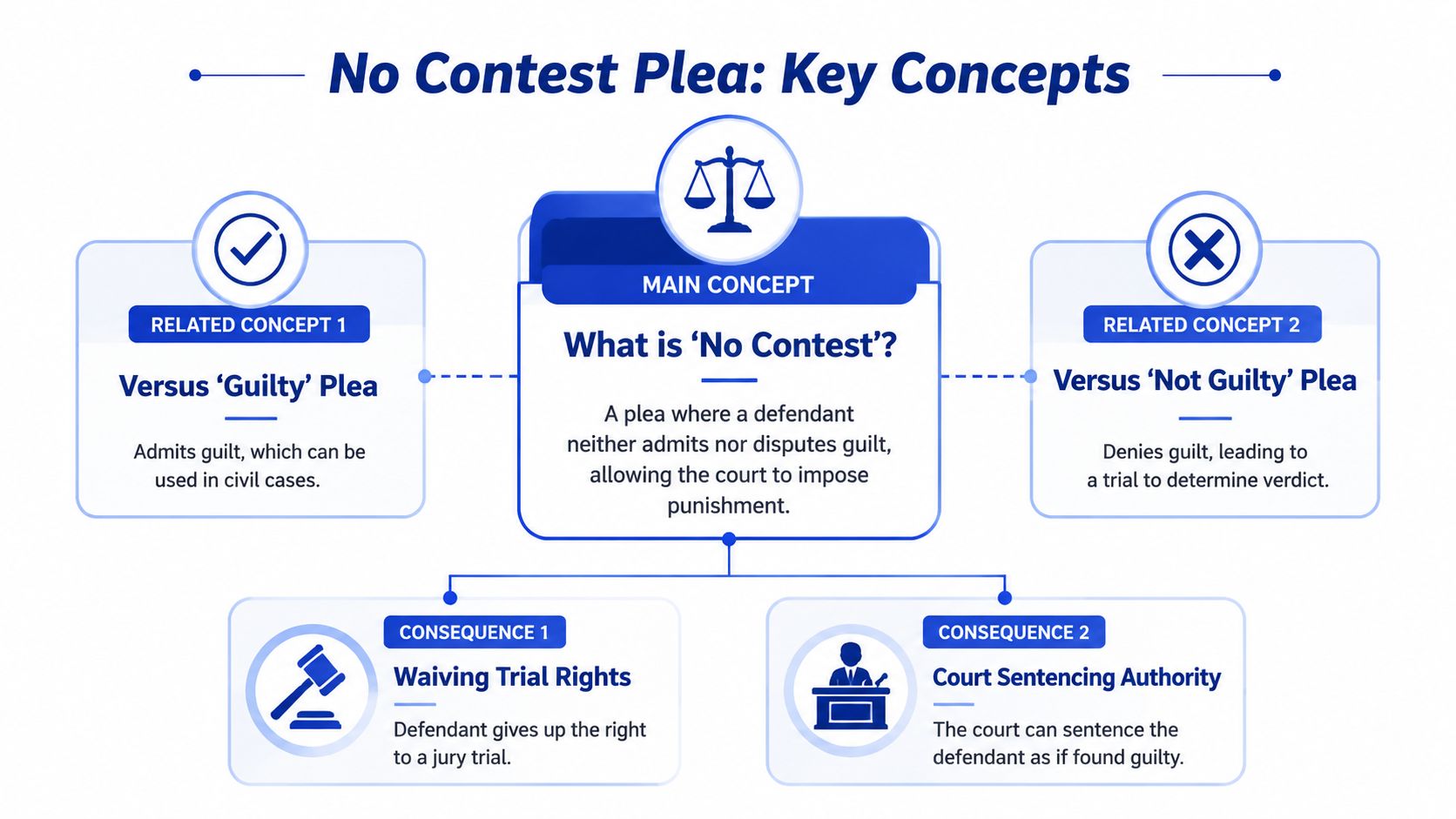
A no contest plea, also called nolo contendere, means the defendant does not admit guilt but still accepts the criminal judgment and any sentence the court imposes. In plain terms, the defendant is telling the judge, “I will take the conviction,” without saying, “I committed the act.” Cornell Law explains that a court may treat the case as resolved for sentencing, while the plea itself is not meant to operate as an admission outside the criminal case.
That distinction matters because many Florida defendants worry about what happens after the courtroom hearing ends. A plea can affect the criminal case and still leave separate questions about civil liability, record consequences, and, in some situations, immigration issues. If you want a simple comparison of how the courtroom process usually starts, the arraignment process in Florida is a helpful place to begin.
No contest, guilty, and not guilty
A guilty plea is a direct admission. The defendant says the charge is true, and that admission can carry weight in later related proceedings. A not guilty plea takes the opposite position, because it tells the State to prove the charge. A no contest plea sits between those two choices. The defendant accepts the criminal outcome without making a public admission of guilt.
That difference is why the plea often comes up in DUI, assault, drug, and weapons cases where a civil claim may follow. A crash case, for example, can lead to both a criminal charge and a later civil lawsuit over injuries or property damage. The criminal court still has authority to move the case to sentencing, but the plea itself is usually less useful as a factual admission in a later civil dispute based on the same event.
Why the plea exists
EBSCO describes nolo contendere as a plea used in U.S. criminal procedure, often in misdemeanor matters, and notes that it may require permission from the prosecution or the court (EBSCO summary on nolo contendere). That setup serves a practical purpose. It lets the case end without a trial, gives the defendant a way to resolve the charge without a formal admission, and still allows plea bargaining to do its job.
Florida also requires the plea to be voluntary and accepted by the court in a way that fits the case. A Florida criminal defense lawyer usually looks at the charge, the evidence, and the possible collateral effects before advising on this option. The idea sounds simple, but the consequences can spread beyond the courtroom. No contest is not the same thing as walking away. It is a deliberate way to resolve a criminal charge, and it can help in some situations while creating tradeoffs in others.
How to Enter a No Contest Plea in Florida
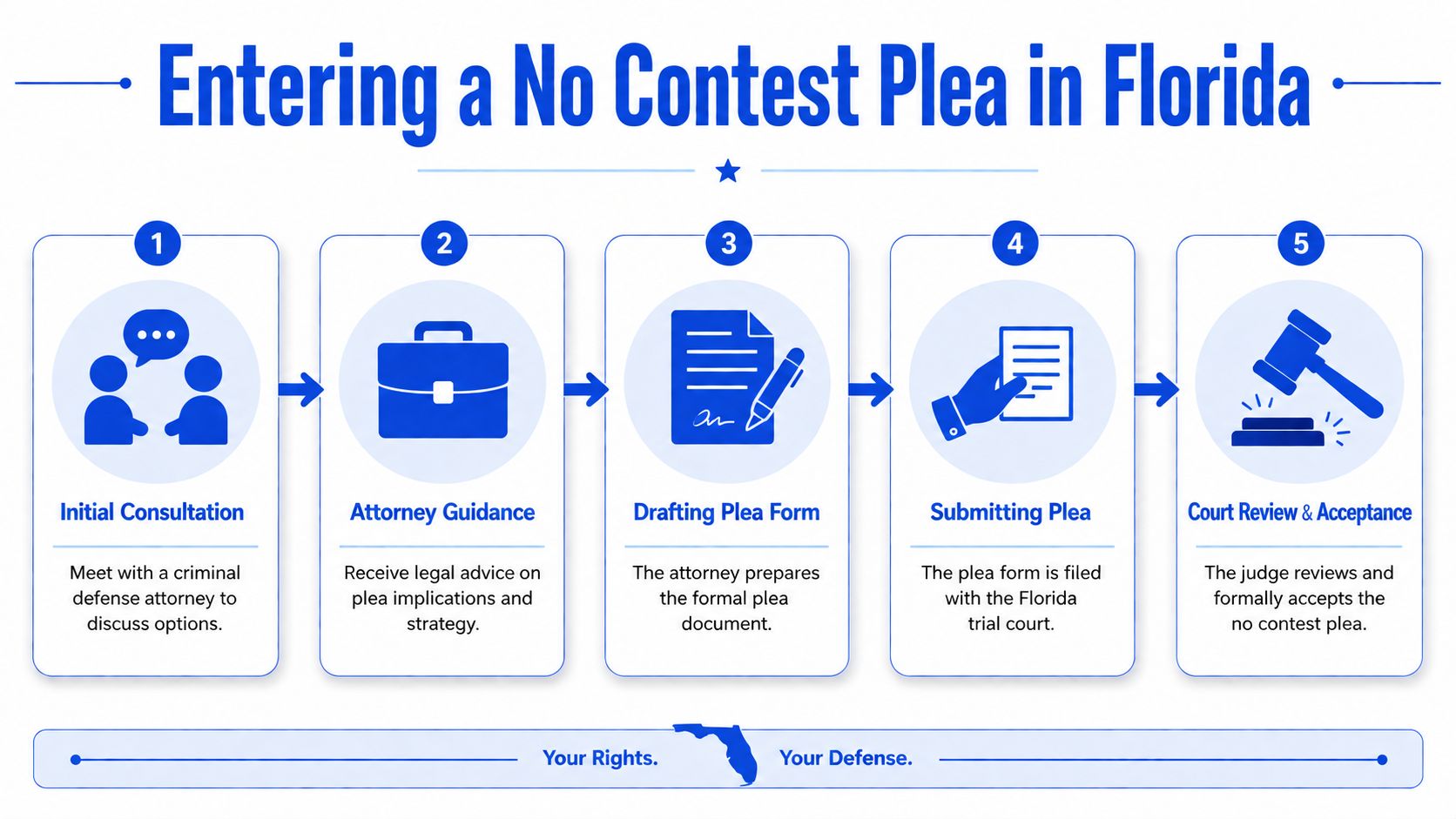
Entering a no contest plea in Florida starts with one basic question, can this plea help in the specific court and on the specific charge? The answer depends on the procedural rules, the charge type, and whether the judge will accept it. In many cases, the first step is a consultation with defense counsel who can tell you whether the plea is available and whether it protects anything important in your situation.
The practical path in Florida courts
For traffic matters, Florida's Eighteenth Judicial Circuit instructions show that a defendant seeking a no contest disposition for certain civil infractions must electronically file the plea within 30 days of the violation date through the Florida ePortal, and the form says not to submit payment with the initial plea request (Eighteenth Judicial Circuit traffic instructions). That deadline matters. Missing it can change the options available in traffic court.
For criminal cases, the process is usually more personal and more case-specific. Your lawyer may negotiate with the prosecutor, explain why a no contest resolution is appropriate, and then present the plea to the court for approval. If the court accepts it, the judge still needs a factual basis and must ensure the plea is voluntary. In plain English, the judge wants to know that the defendant understands what is happening and is choosing it knowingly.
Here's a concise way to think about the workflow:
Consult first. A lawyer reviews the charge, the evidence, and the civil or immigration concerns.
Check availability. Some cases and courts are more open to the plea than others.
Prepare the filing. In traffic matters, the plea may need to be filed through the Florida ePortal.
Wait for court action. The judge decides whether to accept the plea.
Move to sentencing. If accepted, the court can impose the punishment tied to the case.
Why the arraignment still matters
The first court date often shapes the plea path, even when the final resolution happens later. If you're unsure what happens at that stage, review what happens at arraignment so you understand how pleas fit into the larger process.
A no contest plea is only useful if it's entered the right way. A late filing, a missing court approval, or a misunderstanding about payment can create avoidable problems.
Legal and Practical Consequences in Florida
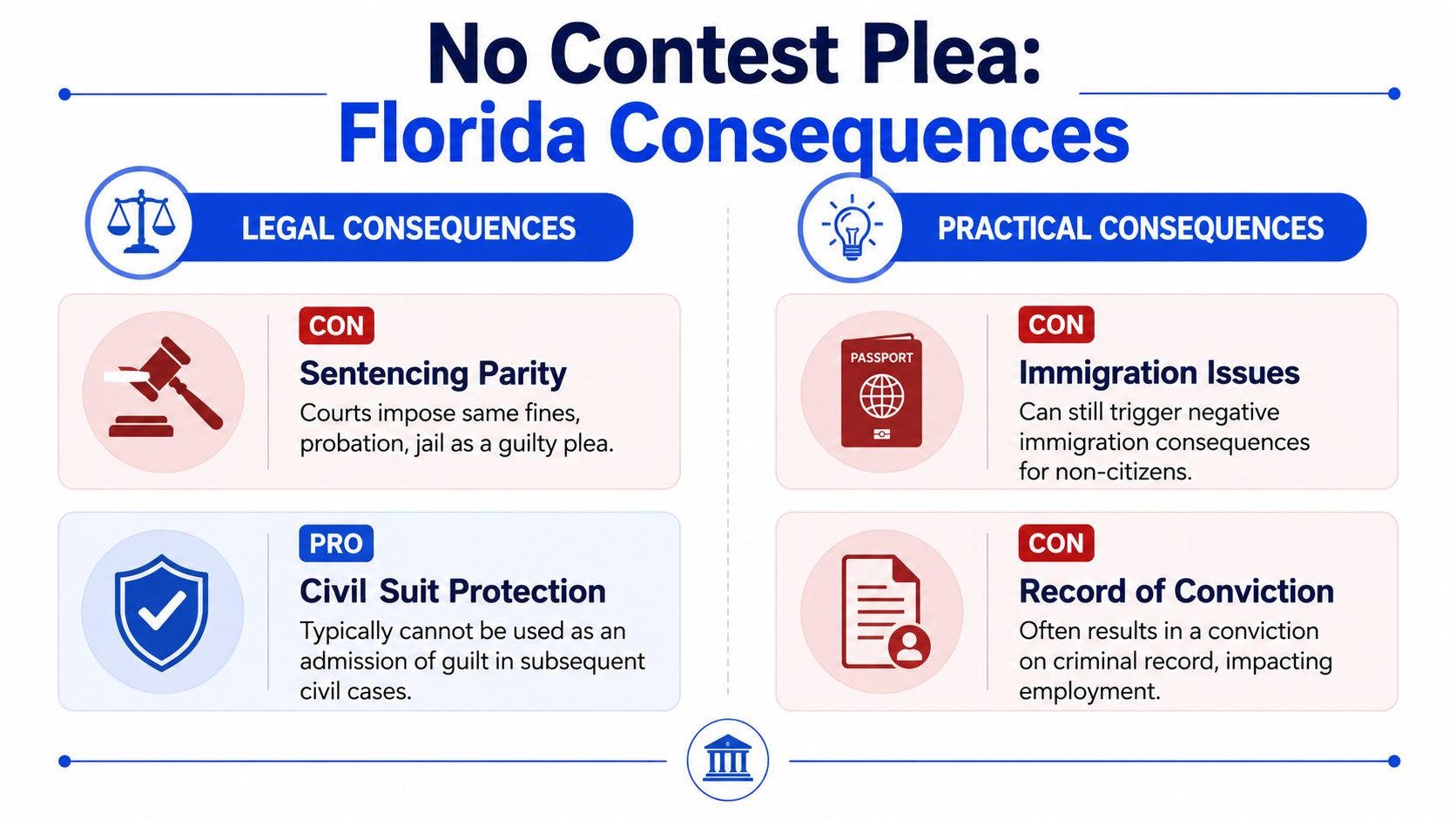
A no contest plea can sound softer than a guilty plea, but Florida courts still treat it as a real resolution of the case. If the judge accepts it, the court can still impose the same kinds of fines, probation, and jail exposure that would follow a guilty plea. Florida guidance explains that the defendant does not admit or deny the charge, yet the plea can still be used for sentencing purposes under Florida criminal procedure (Florida no contest plea guidance).
Records, convictions, and license issues
The plea is also not hidden from the record. General legal summaries describe nolo contendere as a plea that may be treated as a conviction for sentencing and record purposes, while usually avoiding a later civil admission based on the same facts (Wikipedia overview of nolo contendere). In practical terms, a background check, a licensing review, or an employer screening can still show a criminal case result even though the person did not say, “I did it.”
Traffic cases have their own procedural limits. Hillsborough County's traffic guidance says Florida Statute 318.14 limits no contest pleas for traffic infractions to once in a 12-month period and no more than three times in a lifetime (Hillsborough County traffic no contest guidance). That rule matters because a driver can use up the option faster than expected, especially if several tickets arrive close together. A plea that looks simple on paper can become unavailable later when the implications of a conviction are more substantial.
License consequences can still follow a no contest plea in DUI and other driving cases. The plea does not erase the charge, and it does not automatically protect a driver from suspension, reinstatement steps, or court-ordered conditions. If probation is part of the sentence, the person may still have reporting duties, fees, testing, or other requirements that feel very close to a guilty plea in everyday life.
Civil exposure and immigration concerns
The civil-law effect is narrower. A no contest plea usually helps avoid giving an injured person a direct courtroom admission they can point to in a later lawsuit. That difference matters in a crash case, an assault claim, or another incident where the criminal case and civil claim come from the same event.
Immigration deserves separate attention. A no contest plea can still create immigration problems for a non-citizen, even if the plea avoids an express admission in the criminal case. Florida-oriented explainers note that judges should make sure defendants understand immigration effects before the plea is accepted (Florida plea overview noting immigration consequences). A non-citizen should not treat the plea as automatically safe just because it sounds less harmful than a guilty plea.
If record relief is part of the conversation, the difference between a conviction, a withhold, and a no contest plea can matter a great deal. A clear explanation of what adjudication withheld means can help show why one outcome may affect sealing or expungement options differently from another.
Strategic Uses of No Contest Plea

A no contest plea is often most useful when a criminal case could spill into a civil lawsuit or raise immigration concerns. That pattern shows up in DUI crashes, battery allegations, domestic disputes, and some drug or weapons cases where the same facts may matter in more than one courtroom. The plea lets a person resolve the criminal charge without standing in court and making an open admission that could later be repeated in another proceeding.
Where the plea often adds value
A no contest plea is usually a negotiated tool, not a routine one. In Florida practice, that matters because the lawyer has to consider whether the prosecutor or the court will accept it, and whether the case even fits the plea's practical use. In some cases, the negotiation can also be part of a path toward a diversionary option like the PTI program in Florida, depending on the charge and the local office's rules.
A defense lawyer may push for the plea when:
Civil exposure is real. A car crash, assault claim, or injury allegation could lead to a separate lawsuit.
Immigration risk exists. A non-citizen may need to avoid an unnecessary admission.
The evidence is strong. The client wants to control the outcome rather than leave everything to trial.
The charge is in the misdemeanor range. Courts are more likely to see the plea as a practical resolution.
The civil side is where many people get confused. A no contest plea does not erase the criminal case, but it can reduce the value of the plea as a direct admission in later civil litigation. That difference can matter when the criminal charge and the civil claim come from the same event, because the injured party may still pursue damages even after the criminal case ends.
Immigration deserves the same careful attention. A no contest plea can still create immigration problems for a non-citizen, even if the plea avoids an express admission in the criminal case. A person in that position should not assume the plea is safe just because it sounds less harmful than a guilty plea.
A lawyer may also use the plea in a broader negotiation that includes a reduced charge or a sentence agreement. The client still accepts punishment, but the case closes without the same kind of factual admission a guilty plea creates. Ticket Shield, PLLC is one Florida firm that handles that kind of negotiation for people facing misdemeanor and felony charges, including traffic and probation-related matters. The right plea strategy depends on the facts, not on a slogan.
Practical rule: If a case could branch into civil court or immigration review, do not treat a plea as only a criminal-court decision.
Real-World Examples
A first-time DUI driver in Broward County may care less about the courtroom label than about what happens after the hearing. If a lawyer can secure a no contest resolution, the criminal case may still bring sentence and record consequences, but the driver does not make an express admission that could later matter in a related civil claim. That difference can matter when the stop involved a crash or property damage, because the same facts may be examined in more than one forum.
A misdemeanor assault case raises a similar choice. The client may face criminal charges and also a threatened personal injury lawsuit, and the plea choice can affect both tracks. A no contest plea resolves the criminal side without creating the same direct factual admission that a guilty plea would create. The judge still treats the plea as a conviction for criminal purposes, but the civil plaintiff usually does not receive the plea itself as an admission of guilt in the later lawsuit.
Traffic cases can look minor until the driver depends on a clean record for work. A commercial driver in South Florida may need to preserve options carefully, because Florida traffic practice limits no contest use under section 318.14 in the way noted earlier. That means the plea can help in one case and be unavailable later, so the timing matters as much as the result. A one-time decision can close off a later option.
In each of these examples, the lawyer's job is the same. Review the charge, weigh the collateral risks, and decide whether a no contest plea is the right tool or whether another outcome protects the client better. A defense lawyer who handles Florida criminal cases regularly can also spot issues that are easy to miss, including how the plea may affect civil exposure or immigration review. For a closer look at that role, see what a Florida criminal defense lawyer does.
FAQs and Contacting a Defense Lawyer
Does a no contest plea affect immigration after a visa application? It can. A plea that helps on the criminal side may still create immigration problems, so non-citizens should get advice before entering it.
Will a no contest plea show up in professional licensing background checks? Often, yes, because the plea can still operate as a conviction for record purposes, even if it avoids a civil admission. Licensing boards may review the result differently from a civil court.
What about juvenile records? Juvenile court issues are handled under a different framework, but a plea can still affect how the case is recorded and how future agencies view it. The exact effect depends on the charge, the court, and the outcome.
If you're comparing options in a Florida criminal case, speak with a defense lawyer who handles these issues daily. You can review what a Florida criminal defense lawyer does and then talk through your facts before you choose a plea. A short conversation can clarify whether no contest helps, hurts, or leaves too many questions unanswered.
A CTA for Ticket Shield, PLLC. If you're facing a DUI, traffic case, assault charge, or any Florida criminal matter and need to understand whether a no contest plea makes sense, contact Ticket Shield, PLLC for a confidential consultation. The firm is available 24/7, serves clients across South Florida, and brings prosecutorial experience to the strategy discussion so you can make a decision with real legal guidance.