
Sobriety Test Questions You May Be Asked in Florida
Jason Goldsmith, Esq
Sobriety test questions in Florida cover verbal prompts and three standardized physical tests, HGN, Walk-and-Turn, and One-Leg Stand. Florida's implied consent law also means refusing a requested breath or blood test can trigger an automatic license suspension separate from the criminal DUI case.
You're driving home from a restaurant in Fort Lauderdale or Miami when blue lights appear in your mirror. Your heart starts racing. The officer asks where you're coming from, whether you've been drinking, and why you seem nervous. Before you realize it, a routine traffic stop has become a DUI investigation.
As a former Florida prosecutor turned defense attorney, I'll tell you the practical truth: everything you say and do during the stop can become evidence. The officer isn't engaging in casual conversation. The officer is building a timeline, documenting observations, and deciding whether to request field sobriety exercises or chemical testing.
Table of Contents
What Happens When an Officer Stops You in South Florida
The first few minutes matter. An officer may begin with the reason for the stop, such as speeding, lane movement, a turn-signal issue, or another traffic concern. Then the questions usually become broader: Where are you going? Where are you coming from? Have you had anything to drink? Have you taken medication?
At the same time, the officer is observing how you respond. Speech, eye contact, hand movements, the ability to locate your license and registration, and the way you exit the vehicle may all appear in the report. Even your explanation for being nervous can become part of the officer's narrative.
A stop can also raise constitutional questions. If the officer lacked a lawful basis to stop the vehicle or prolonged the encounter without proper justification, a defense attorney may examine whether the evidence should be suppressed. The circumstances surrounding a traffic stop, including whether it was used as a pretext for a broader investigation, deserve careful review. Learn more about what a pretext traffic stop means.
Small movements become report language
Suppose you hand over your documents and say you're coming from dinner. The officer may ask whether you consumed alcohol. If you answer with a detailed story, the officer may record the details. If you pause, change your wording, or ask whether you're free to leave, those statements may also appear in the report.
The point isn't that every answer proves impairment. It doesn't. The point is that the officer is collecting observations before any standardized test begins.
Practical rule: Be respectful, keep your answers brief, and don't volunteer a narrative about what you drank, when you drank it, or how much you consumed.
You should provide required identification and documents. You shouldn't argue roadside about whether the officer is right, attempt to diagnose your own sobriety, or make admissions just because you feel pressure to explain yourself. If the investigation continues, calmly ask whether you're being detained and state that you want to speak with a lawyer before answering investigative questions.
The Three Standardized Field Sobriety Tests Explained
The standardized field sobriety tests, commonly called SFSTs, are Horizontal Gaze Nystagmus, Walk-and-Turn, and One-Leg Stand. NHTSA research narrowed an original group of 16 candidate tasks to these three tests, which remain the recognized standardized roadside battery today. The Florida field sobriety test process depends on the officer giving instructions, observing performance, and recording specific clues.
Horizontal Gaze Nystagmus
For HGN, the officer holds a stimulus, often a pen or fingertip, and asks you to follow it with your eyes while keeping your head still. The officer looks for:
Lack of smooth pursuit
Distinct and sustained nystagmus at maximum deviation
Onset of nystagmus before 45 degrees
The officer generally evaluates both eyes and records clues on each side. Two or more clues in an eye, under the applicable protocol, support the officer's conclusion that the result indicates impairment. HGN isn't a coordination exercise, but its interpretation can be affected by lighting, stimulus movement, medical conditions, and the officer's timing and positioning.
Walk-and-Turn
The Walk-and-Turn is a divided-attention exercise. The officer typically asks you to take nine heel-to-toe steps along an imagined or visible line, turn in a prescribed manner, and return with nine steps. The officer scores eight standardized clues:
Losing balance during instructions
Starting before the instructions are finished
Stopping while walking
Failing to touch heel to toe
Stepping off the line
Using arms for balance
Making an improper turn
Taking the wrong number of steps
The setting matters. Uneven pavement, traffic, poor lighting, footwear, fatigue, injury, and confusion about instructions can all affect performance without proving alcohol impairment.
One-Leg Stand
The One-Leg Stand asks you to raise one foot approximately six inches from the ground, keep the raised foot pointed forward, and count aloud until the officer tells you to stop. NHTSA's protocol identifies four clues:
Swaying while balancing
Raising the arms six inches or more
Hopping
Putting the foot down
The NHTSA protocol states that two or more clues indicate a substantially higher probability of a BAC at or above 0.08, as described in the one-leg-stand protocol materials. That conclusion still doesn't explain why a particular person showed a clue. Age, an injury, footwear, the road surface, and coordination problems can independently affect balance.
Test | Clues Count | Primary Skill Measured |
|---|---|---|
Horizontal Gaze Nystagmus | Eye-movement clues | Ocular movement |
Walk-and-Turn | 8 | Balance and divided attention |
One-Leg Stand | 4 | Balance and divided attention |
The officer's word “failed” isn't a scientific result by itself. The important questions are which clues were observed, whether the officer followed the protocol, and what innocent conditions may explain the performance.
How Reliable Are the Tests Officers Use
The tests have scientific support, but they aren't infallible. NHTSA's original laboratory work measured the individual tests at roughly 77% accuracy for HGN, 68% for Walk-and-Turn, and 65% for One-Leg Stand. The combined three-test battery produced an 86% correct arrest or release decision in that work, according to NHTSA's standardized field sobriety testing manual.
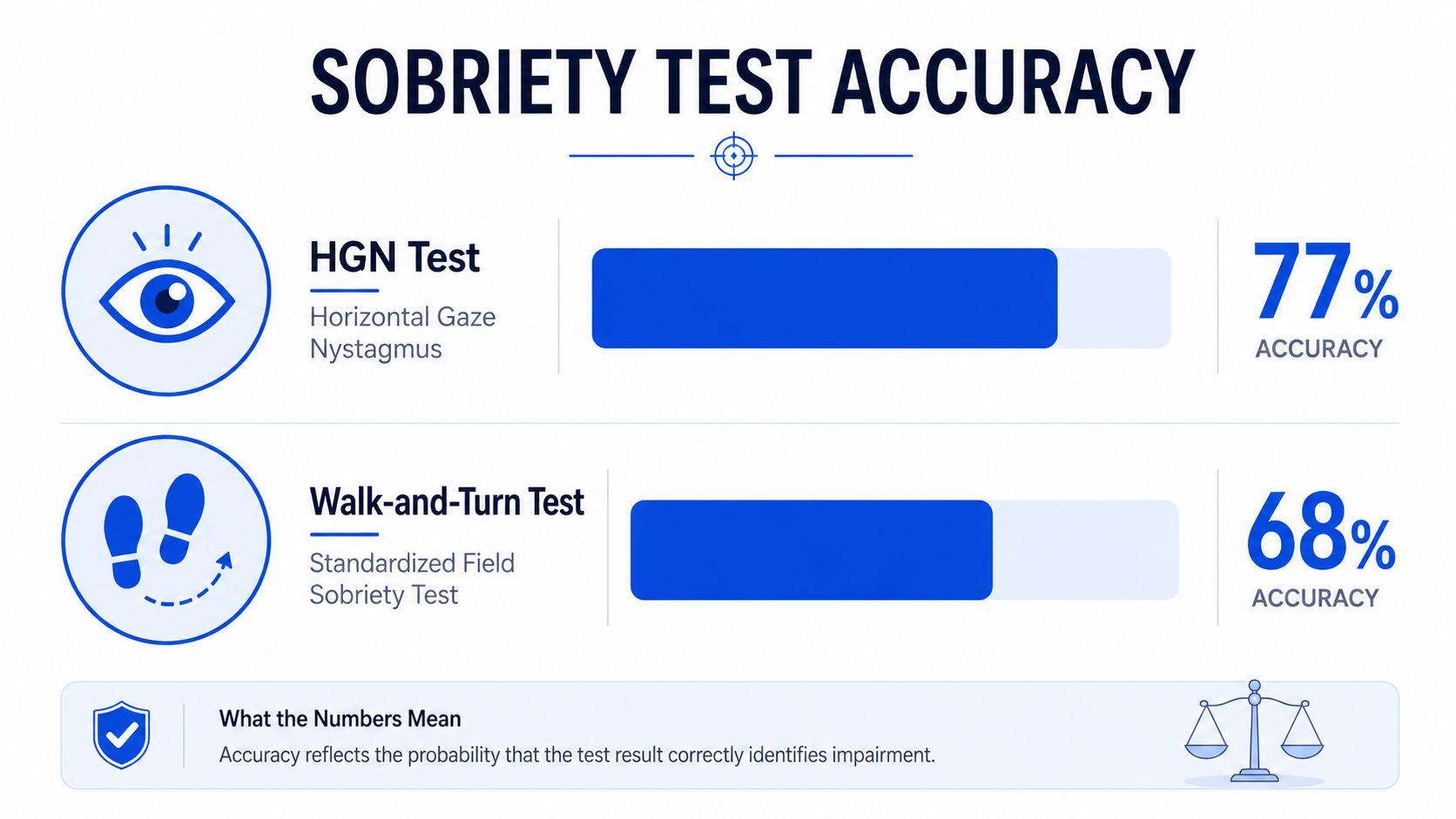
Those figures are useful because they show both the value and the limitation of the battery. An 86% correct decision rate leaves room for incorrect decisions. A single clue, especially from a test with lower individual accuracy, shouldn't automatically receive the same weight as a chemical result or other independent evidence.
Field conditions create additional problems
NHTSA manuals report that the Colorado field study also produced an 86% correct arrest or release decision, with 93% of arrested drivers having a BAC of 0.05 or higher. In the later San Diego study, the average BAC of arrested subjects was 0.15, and false positives among drivers under 0.08 were six times more common than false negatives among drivers over 0.08, as summarized in the NHTSA refresher reference manual.
The same materials report that among subjects below 0.08, 37% showed four or more HGN clues, 52% showed two or more Walk-and-Turn clues, and 41% showed two or more One-Leg Stand clues. Those findings don't mean the tests are useless. They mean the officer's interpretation requires context.
A South Florida defense lawyer should examine the pavement, lighting, weather, footwear, medical history, instructions, timing, and video. The limitations of Horizontal Gaze Nystagmus also deserve focused attention because HGN is often presented as more objective than the roadside procedure is.
Verbal Questions Officers Ask Before and During Testing
The verbal portion of a DUI investigation often starts before the officer announces a field sobriety test. Common questions include:
“Where are you coming from?”
“Where are you going?”
“Have you had anything to drink?”
“When was your last drink?”
“How much did you have?”
“Have you taken any medication?”
“Do you understand the instructions?”
Each question serves a purpose. The officer may be seeking an admission, testing your memory, listening for slurred or delayed speech, or watching whether you can divide attention between listening and moving. During HGN, the officer may say, “Keep your head still and follow the stimulus with your eyes only.” During the One-Leg Stand, the officer may instruct you to raise one leg and count aloud, often using a sequence such as “one thousand one, one thousand two” until told to stop.
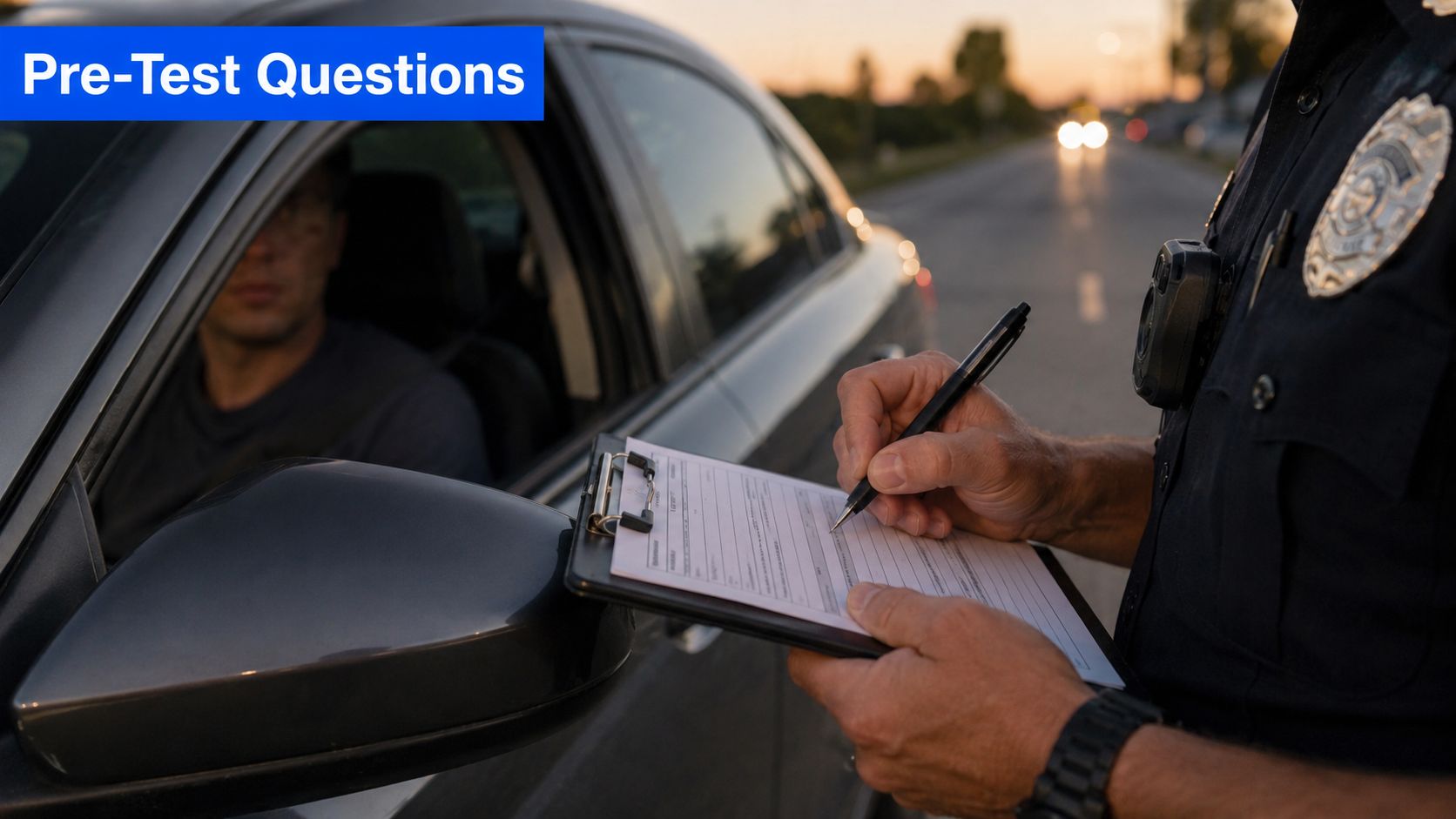
What the officer is listening for
Your answer can create evidence even when the words themselves don't establish intoxication. Officers may note whether you interrupt, misunderstand, give inconsistent times, become argumentative, or offer details that later conflict with a video or chemical test.
That doesn't mean you should be rude or refuse every instruction. Hostility can create a separate narrative about your behavior. The safer roadside approach is simple: provide required documents, remain calm, answer basic identification questions, avoid admissions, and don't volunteer information about alcohol or drugs.
You can say that you'd like to remain silent and speak with an attorney. You can also ask whether you're free to leave. Don't try to persuade the officer with a long explanation. Roadside arguments rarely improve the report, and they may give the State additional statements to use later.
Florida Implied Consent and Chemical Testing
Florida's per se DUI rule makes it illegal to drive or be in actual physical control of a vehicle with a breath or blood alcohol level of 0.08 or higher. Florida uses a 0.02 administrative threshold for drivers under 21, while commercial drivers operating commercial motor vehicles are subject to a 0.04 standard, as described in this Florida DUI law overview.
Implied consent is separate from the roadside exercises. By accepting a Florida driver's license, a driver has generally agreed to submit to a lawful breath, blood, or urine test under the circumstances defined by law. Refusing a requested test can cause an administrative license suspension, even if the criminal DUI case later produces no conviction.
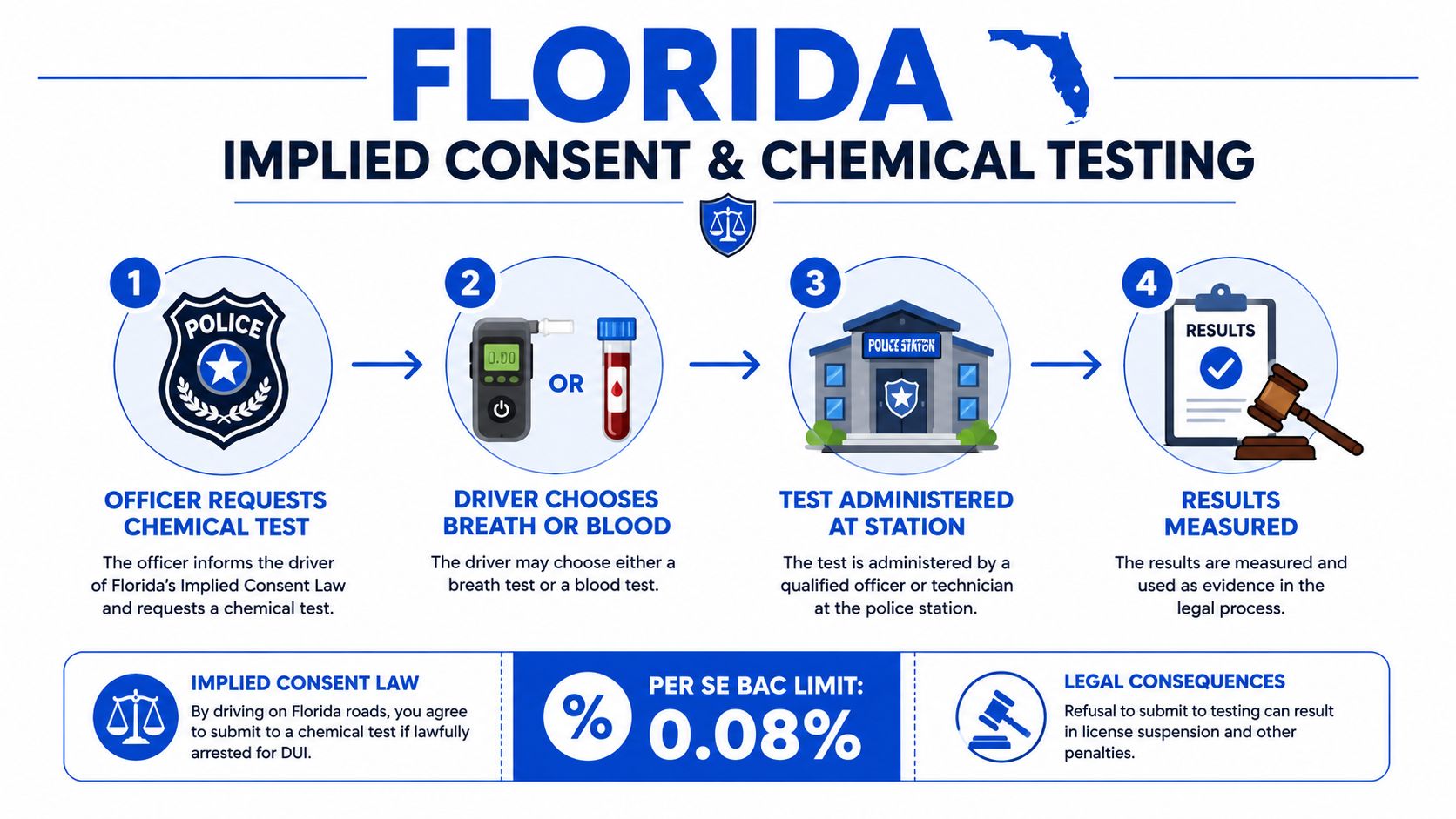
Two separate legal tracks
The criminal case proceeds through the appropriate Florida criminal court, such as a Broward County or Miami-Dade court. The license issue proceeds through the Florida Department of Highway Safety and Motor Vehicles. Those tracks have different procedures, deadlines, and consequences.
Florida drivers generally have 10 days to request a hearing to challenge an administrative suspension. Missing that window can cost you an important opportunity to contest the suspension, regardless of what happens in the criminal case.
The decision to refuse or agree to testing requires case-specific legal analysis. Refusal can create an administrative consequence and may become part of the State's evidence. Agreeing to testing can produce a result the prosecution may use, but it can also preserve an opportunity to challenge the collection, administration, machine, or interpretation. There is no universal roadside answer that replaces advice from a Florida DUI lawyer.
For a detailed discussion of the legal issues surrounding refusal, review whether you can refuse a breathalyzer in Florida.
Why Standard Sobriety Tests Fail for Drugs and Cannabis
The three-test battery was developed around alcohol-related impairment. It shouldn't be treated as a universal detector for cannabis, stimulants, opioids, or prescription medications. Balance and eye-movement clues can reflect many conditions, and a positive drug result doesn't automatically establish that a person was impaired while driving.
A 2024 observational cannabis study reported that adding Finger-to-Nose testing and observations of head movements increased suspected-impairment detection from 67% to 88%, according to the published cannabis impairment study. That finding is important because it shows that investigators have looked beyond the traditional battery when evaluating suspected cannabis impairment.
The same evidence base also illustrates the danger of overconfidence. Recent coverage described placebo participants being classified as impaired at roughly chance level, around 49.2%. A roadside conclusion can therefore reflect the limits of the test and the observer, not only the presence of a drug.
Drug DUI cases require a different analysis
Florida prosecutors may rely on driving behavior, statements, officer observations, toxicology, medical evidence, and the timing of use. Standard HGN, Walk-and-Turn, and One-Leg Stand clues may still appear in the report, but they don't answer the central question by themselves: did a particular substance impair the person's normal faculties while driving?
That gap matters in cannabis and prescription-drug cases. A defense lawyer should identify what the officer observed, whether the officer had drug-recognition training, how the sample was collected, and whether the evidence connects a substance to impairment at the relevant time.
How a Defense Attorney Challenges Sobriety Test Results
A strong Florida DUI defense begins by testing the State's proof, not by accepting the officer's conclusion that someone “failed.” The first issue may be the traffic stop itself. If the officer lacked reasonable suspicion, counsel can evaluate a motion to suppress.
The investigation should also address:
Training and certification: Determine whether the officer followed current SFST instruction and understood the scoring criteria.
Video evidence: Obtain dashcam and bodycam footage to compare the report with the actual words, timing, lighting, and movements.
Test conditions: Examine pavement, slope, weather, footwear, traffic, emergency lights, and available space.
Medical explanations: Consider inner-ear problems, neurological conditions, injuries, fatigue, age-related balance changes, and prescription medications.
Clue-by-clue scoring: Separate a documented clue from a general impression and identify whether the officer counted the same movement more than once.
Flashing emergency lights may affect visual observations, including the officer's interpretation of eye movement. Nervousness can alter speech and coordination. A knee or back injury can affect walking. These explanations don't automatically win a case, but they can weaken the State's claim that alcohol or drugs caused every observed behavior.
Florida DUI charges require proof beyond a reasonable doubt. A defense attorney with prosecutorial experience can recognize how an officer's report is likely to be used, then focus the defense on the weakest link rather than arguing every issue indiscriminately. Ticket Shield, PLLC evaluates these issues as part of its Florida criminal defense work.
Practical Steps After a Florida DUI Stop
Write down everything you remember while the details are fresh. Photograph your footwear, injuries, and any visible conditions at the location. Preserve medical records that may explain balance, vision, coordination, or medication effects.
Don't give prosecutors, insurers, or DHSMV a detailed statement before speaking with counsel. The 10-day administrative hearing deadline matters, so contact a lawyer immediately about the license suspension. You can also review what happens after a DUI arrest.
Ticket Shield, PLLC represents clients in Broward County, Fort Lauderdale, Miami-Dade, Palm Beach, South Florida, and throughout Florida. The firm combines former-prosecutor insight with a practical review of stops, sobriety test questions, video, chemical testing, and license issues.
Ticket Shield, PLLC can review the roadside questioning, field sobriety exercises, chemical-testing request, and Florida license-suspension deadline in a confidential consultation. Visit Ticket Shield, PLLC to request a free consultation and start protecting your license, freedom, and record.