What Does Adjudication of Guilt Mean? 2026 Guide
Jason Goldsmith, Esq
Adjudication of guilt means the court has formally convicted the defendant in Florida, and it can happen after a guilty plea, a no contest plea, or a trial verdict. That single word is what turns a criminal charge into a conviction record, with consequences that can follow long after the courtroom hearing ends.
If you're standing in a Broward County courtroom, hearing the judge say “adjudication withheld” or “adjudicated guilty,” the difference can feel tiny in the moment. It isn't tiny at all, because the judge's formal judgment is often the line between a case that can sometimes be managed and a case that becomes a lasting conviction.
Table of Contents
What Adjudication of Guilt Really Means
A first-time defendant in a Fort Lauderdale courtroom usually hears the word “adjudicated” and assumes it just means the judge believed the prosecutor. It means more than that. In Florida criminal practice, an adjudication of guilt is the court's formal judgment that the defendant is legally convicted, and it can follow a guilty plea, a no contest plea, or a trial verdict, turning the finding of guilt into a conviction for the offense as explained in Florida practice materials.
The legal word that changes the outcome
The everyday word guilty and the legal act of being adjudicated guilty are not the same thing. A jury can return a guilty verdict, or a defendant can plead guilty, but the case becomes a conviction only when the judge enters that formal judgment. Florida criminal practice has long treated that express adjudication as the step that lawfully supports sentencing.
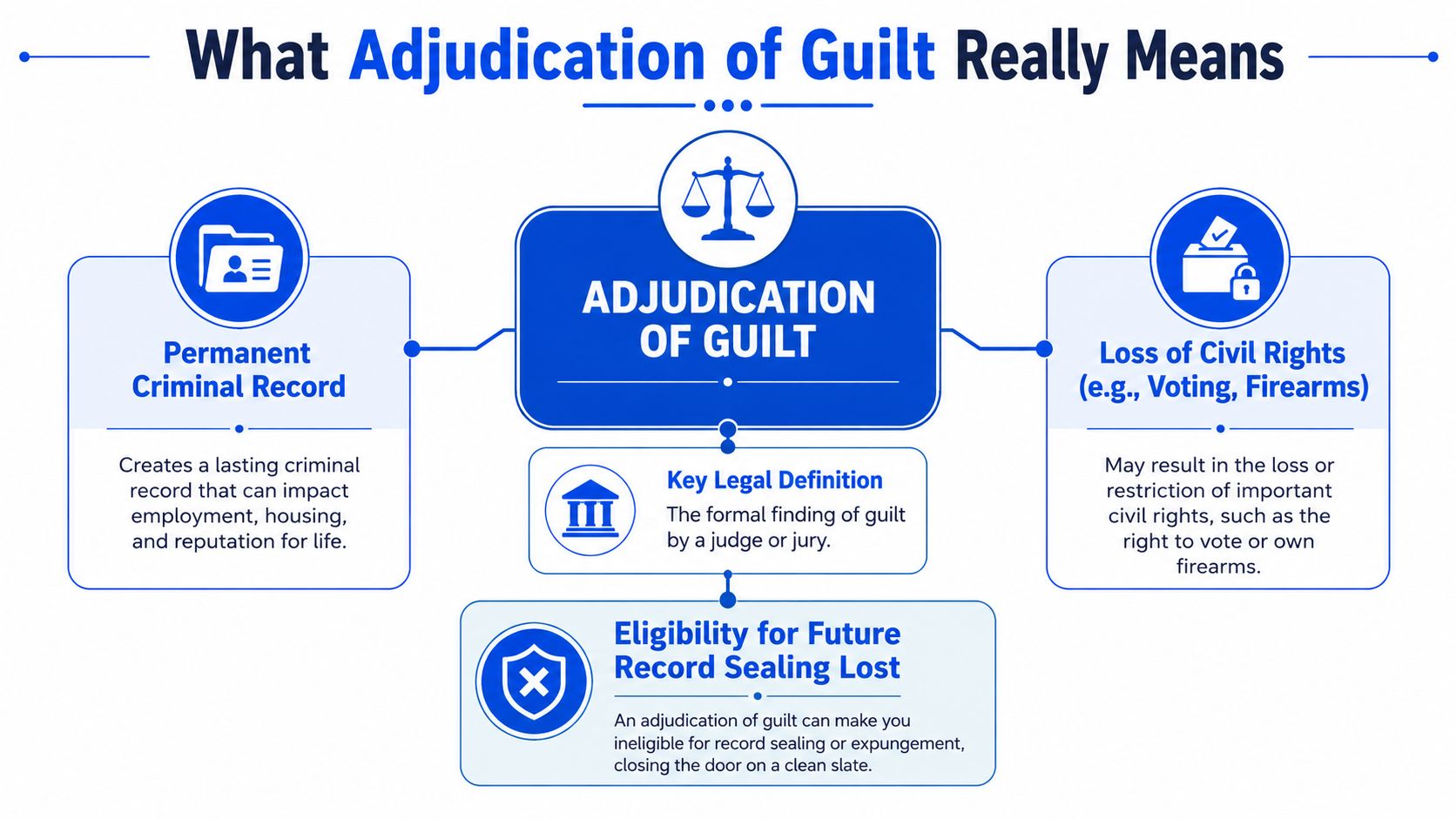
Practical rule: if the judge adjudicates guilt, the case stops being just a charge and starts functioning like a conviction record.
That's why the word matters so much in Florida criminal defense. The label on the final order affects what shows up on the record, how later courts read the case, and whether the case is treated as a conviction for adult criminal justice purposes. Juvenile court uses the same word differently, since a youth may be adjudicated delinquent when the court determines the offense was committed, but that is not the same as an adult conviction.
Why readers get tripped up
People often think the verdict or plea is the finish line. It isn't. The trial result shows what the court found, but the adjudication is the judge's formal act of entering the conviction. That distinction is small on paper and huge in real life, because the court's final judgment is what gives the case its lasting legal weight.
If you're trying to understand what does adjudication of guilt mean in a Florida case, start with this simple idea. It is the moment the court converts an accusation or plea into a conviction record. That's the hinge point prosecutors, judges, and defense lawyers are really talking about when they use the word adjudicated.
How a Florida Case Reaches Adjudication
A Florida criminal case doesn't jump straight from arrest to conviction. It moves through a series of steps, and each one creates influence or risk for the person accused. The presumption of innocence still matters at every stage, and the State has to prove guilt beyond a reasonable doubt before a judge can enter a conviction under the criminal-law standard explained in CALI's adjudication discussion.
The path from charge to judgment
The case usually begins with an arrest or charging document, then moves to first appearance, arraignment, discovery, motion practice, plea negotiations, or trial. If the defense attacks the State's evidence successfully, the case can end without adjudication. If not, the matter moves to sentencing, where the judge decides whether to enter the formal conviction.
A Broward County defendant may go through several hearings before the judge ever says the word adjudicated. That's because the legal process separates three different ideas: the accusation, the proof, and the formal judgment. The accusation is what starts the case, the proof is what the State must present, and the judgment is what turns the case into a conviction.
At arraignment, the defendant usually hears the charge and enters a plea. A strong defense lawyer uses the next phase to test the case, challenge unlawful searches, review discovery, and evaluate whether the plea offer improves the outcome. For readers who want the procedural basics, this arraignment overview helps show where the case begins to narrow.
The court can't adjudicate guilt in a vacuum. The judge needs a plea, a verdict, or another lawful basis before entering a conviction.
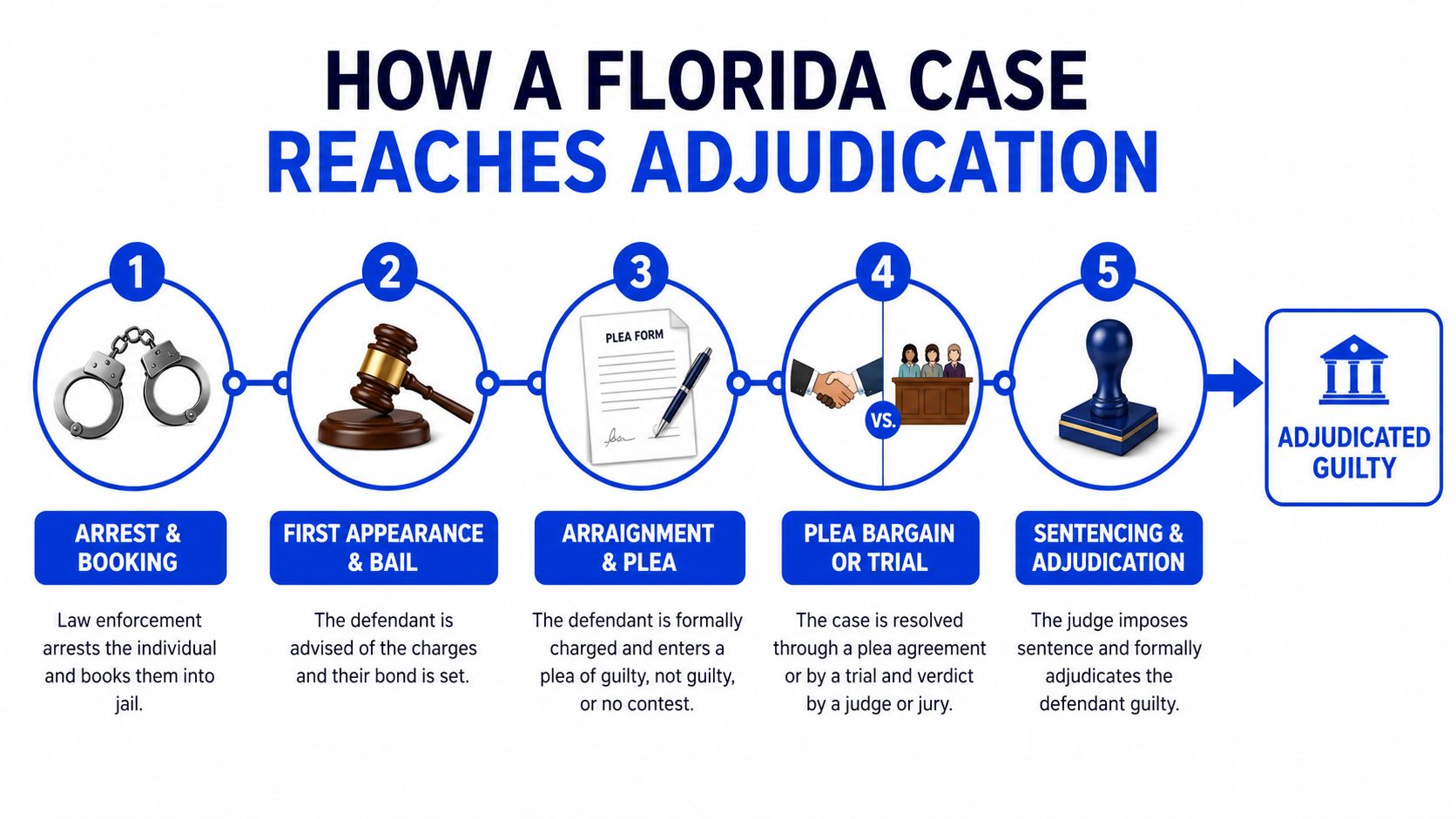
The practical takeaway is simple. Adjudication is the final judicial step, not the arrest, not the charge, and not even always the plea itself. If the case resolves before that point, the defense may still have room to protect the client from a conviction record.
Adjudication of Guilt Compared to a Withhold of Adjudication
Florida is different from many states because judges can sometimes withhold adjudication. That means the court can accept a plea or find the person guilty, but stop short of entering the formal conviction. For a client in Miami-Dade, that difference can be the entire case.
Side by side in plain English
If a judge adjudicates guilt, the person is formally convicted. If a judge withholds adjudication, the case still resolves, but the formal conviction is avoided. That is why the same plea can lead to two very different long-term outcomes depending on the exact language the judge uses.
A not-guilty verdict is different from both. A dismissal is different too. A not-guilty result means the State didn't prove the case. A dismissal means the case ended without a final finding of guilt. A withhold sits in the middle, because the person may still have admitted or been found responsible, but the court didn't enter the conviction label.
Here's the practical distinction many readers care about:
Adjudicated guilty means a conviction is on the record.
Withhold of adjudication means the court stops short of that formal conviction.
Not guilty or dismissed means the case ends without that conviction finding at all.
The difference matters because the defense often isn't chasing a perfect victory. It's often chasing the least damaging lawful outcome available. That can mean negotiating the exact wording of the final disposition so the client avoids the conviction label that follows an adjudication of guilt.
For a plain-language Florida explanation of the withheld side of the equation, see this discussion of adjudication withheld. The reason that phrasing matters is simple. A withhold can keep the case from becoming a formal conviction, while adjudication closes that door.

Florida Collateral Consequences That Follow Adjudication
The courtroom sentence is only part of the story. Once a person is adjudicated guilty in Florida, the label can affect daily life, future rights, and whether the case can ever be hidden from public view. Florida-focused sources note that adjudication of guilt can make someone a convicted felon, trigger civil-rights losses, and bar sealing, while a withhold may avoid some of those effects, especially in DUI and weapon cases where the difference can determine whether the record can later be sealed as discussed in Florida sentencing guidance.
The consequences people ask about most
A conviction can show up in background checks used by employers, landlords, and licensing boards. That matters in Broward County and across South Florida because many people aren't just worried about jail or probation, they're worried about whether the case will follow them into work, housing, and professional licensing.
Adjudication can also affect civil rights. In Florida practice, a conviction can trigger the loss of important rights, and a felony conviction can affect firearm status. That's why gun and weapons cases are so sensitive, because the conviction label itself can alter a person's status in a way a withhold sometimes avoids.
Driver's license consequences are another major issue, especially in DUI cases. The practical problem is that people often focus only on the court date and miss the licensing fallout that follows. A DUI defense lawyer has to think beyond the plea hearing and look at how the outcome will interact with the license side of the case.
Record sealing is one of the most searched issues tied to adjudication. If the court enters a conviction, the door to sealing is often closed. For more on that issue, see Florida record sealing guidance. People who expected a case to fade away are often surprised to learn that an adjudication can keep the file public.
What changes in real life
Consequence | Adjudication of Guilt | Withhold of Adjudication |
|---|---|---|
Criminal record | Formal conviction enters the record | No formal conviction entered |
Civil rights | Can trigger losses tied to conviction status | May avoid some conviction-based losses |
Firearm issues | Can create serious firearm-related consequences | May avoid some consequences tied to conviction label |
Record sealing | Often bars later sealing | May preserve sealing eligibility in some cases |
DUI and weapons cases | Can make the outcome more damaging | Can sometimes reduce collateral fallout |
Bottom line: adjudication is not just a sentence issue, it's a downstream consequences issue.
Immigration-adjacent fallout is also a real concern for non-citizens. Federal systems don't always treat Florida labels the same way state courts do, so a plea that feels manageable in county court can still create complications outside the courtroom. That's why defense strategy has to start early, before the judge enters the final judgment.
Real-World Scenarios Showing the Difference
A definition only lands when you see it applied. The same word can mean a different future for a DUI driver, a college-age theft defendant, or a person facing a weapons charge in Fort Lauderdale.
DUI in Broward County
A first-time DUI defendant may be offered a plea that ends with adjudication, or a negotiated outcome that withholds it if the charge and facts allow that result. If the judge adjudicates guilt, the person walks out with a conviction record that can affect the license side of the case and future court treatment. If the judge withholds adjudication, the person may still face punishment, but the conviction label is avoided.
Theft in Palm Beach County
A college student charged with misdemeanor theft often cares less about the courtroom jargon than about internship applications and school-related screening. If the case ends in adjudication of guilt, the conviction can follow the student into background checks and licensing questions. If the defense negotiates a better disposition, the student may avoid the formal conviction that would otherwise become part of the record.
Weapons charge in Fort Lauderdale
A weapons case is often where the difference feels most severe. If the court adjudicates guilt, the person may face the kind of firearm-related consequences that can change daily life long after the hearing ends. If the case is resolved with a withheld adjudication where legally available, the person may avoid some of the harshest conviction-based fallout.
A useful way to think about it is this. The charge tells you what the State alleges. The plea tells you how the case is being resolved. The adjudication tells you whether the resolution becomes a conviction that keeps following the person around.
Practical insight: clients should ask what the final written order will say, not just what was discussed in the hallway.
That's especially true in South Florida courts, where the same offense can end in very different long-term consequences depending on the language in the judgment. The label may be one word, but the effect can last for years.
Defense Strategies to Avoid or Limit Adjudication
A defense lawyer's job isn't just to argue in court. It's to keep the State from turning an accusation into a conviction if there's a lawful way to stop that from happening. That starts by looking for problems in the evidence and ends with negotiating the exact disposition language the judge uses.
What a defense team can do early
The strongest cases against adjudication often begin before the plea discussion. Motions to suppress can target illegal searches and seizures, which may weaken or eliminate the State's proof. In DUI cases, challenges to field sobriety procedures and breath testing can create an advantage because the State then has a harder time proving guilt beyond a reasonable doubt.
Diversion is another tool in the right case. A pre-trial diversion program can give a client a path to resolve the matter without a permanent conviction, depending on the charge and the facts. For some people, especially in lower-level cases, that route is more valuable than fighting every issue all the way through trial.
A few practical strategies often matter most:
Challenge unlawful evidence: suppression motions can reduce the State's advantage.
Push for diversion: some cases can resolve through a program instead of a conviction.
Negotiate the wording: the difference between an adjudication and a withhold is often the exact plea language.
Build mitigation: treatment, counseling, restitution, and stable employment can help shape the judge's decision.
For a structured overview of one diversion option, see Florida PTI program guidance. That kind of program can matter because it gives the defense another route to keep a conviction off the record when the facts and charge allow it.

Sometimes the better move is to negotiate down to a lesser charge that can support a withhold, instead of forcing a trial on a charge that may end in adjudication if the State wins. That's not surrender. It's risk management, and it's often the difference between a case that lingers and a case that can be managed more cleanly.
Your Next Steps and How Ticket Shield Can Help
The three choices that matter most are simple. Don't talk to law enforcement without counsel, don't assume the first plea offer is the best one, and don't let the court enter adjudication before you've had the case reviewed for a possible withhold or a better reduction. Once the judge enters the conviction language, the consequences multiply fast.
Ticket Shield, PLLC, led by former prosecutor Jason S. Goldsmith, represents people facing DUI, drug charges, theft, weapons cases, probation violations, and other Florida criminal matters. The firm reviews charging documents, looks for suppression issues, and evaluates whether a withhold of adjudication is legally available before the case is locked into a conviction record.
If you're stressed about a Broward, Miami-Dade, or Palm Beach case, that conversation needs to happen early. The goal is to understand the charge, the record consequences, and the choices that still exist before the court says the word adjudicated.
If you're facing a Florida criminal charge and want to understand whether adjudication of guilt is on the table, Ticket Shield, PLLC can review the charging documents and explain the record consequences in plain English. Visit Ticket Shield, PLLC to ask about your options before a conviction is entered and the damage becomes harder to undo.