What Is Accessory After the Fact in Florida?
Jason Goldsmith, Esq
A late-night favor can become a serious Florida criminal case before you understand what happened. You may have driven a friend home, stored a damaged vehicle, held onto a phone, or allowed someone to stay at your house. If police believe you knew that person had committed a felony and helped them avoid detection or punishment, they may investigate you as an accessory after the fact.
That label doesn't mean you committed the original crime. It describes a separate allegation focused on what you did afterward, what you knew, and why you acted. Florida law also grades the charge according to the seriousness of the underlying felony, so the consequences can vary sharply from one case to another. The law requires specific elements, prosecutors evaluate these cases by weighing certain factors, and you should take care if you're facing an accusation in Broward County, Fort Lauderdale, Miami-Dade, Palm Beach, or elsewhere in South Florida.
Table of Contents
A Florida Scenario That Raises the Question
At midnight, a 28-year-old Fort Lauderdale resident receives a call from a panicked coworker. The coworker says he crashed into a pedestrian on Las Olas Boulevard and fled the scene. He asks for a ride and somewhere to leave his damaged car.
The driver agrees. He doesn't ask many questions. He picks up the coworker, drops him at a relative's home, and parks the damaged vehicle inside his own garage. By sunrise, Fort Lauderdale police are at his door.
The driver's first reaction is likely confusion. He may think, “I didn't hit anyone. I wasn't there. I was only helping someone I work with.” That reaction matters because accessory after the fact is not just a charge for knowing the accused person or being nearby. The State must connect the alleged helper to specific conduct, knowledge, and an intent to help the person avoid consequences.
The damaged car creates obvious problems for the driver, but it doesn't automatically answer every legal question. Did he know what happened before he agreed to help? Did the coworker tell him enough to establish knowledge of a felony? Was the vehicle hidden to prevent police from finding it, or was the driver acting without understanding the circumstances? Did he voluntarily assist, or did someone pressure or threaten him?
Those details can determine whether the conduct looks like an innocent mistake, a misunderstanding, or criminal assistance. Anyone dealing with police contact should also understand the broader process described in this guide to what happens after an arrest.
The statute becomes easier to understand when you break it into separate requirements. The sections below translate those requirements into everyday language, then apply them to the kinds of facts prosecutors and defense lawyers examine in South Florida courtrooms.
The Core Elements Prosecutors Must Prove
Florida's accessory-after-the-fact rule focuses on a person who knows someone committed a felony and then provides aid with the purpose of helping that person avoid detection, arrest, trial, or punishment. The statute also addresses certain close-family limitations, so the relationship between the accused helper and the principal may matter in some cases. The relevant statutory language appears in Florida's accessory statute.
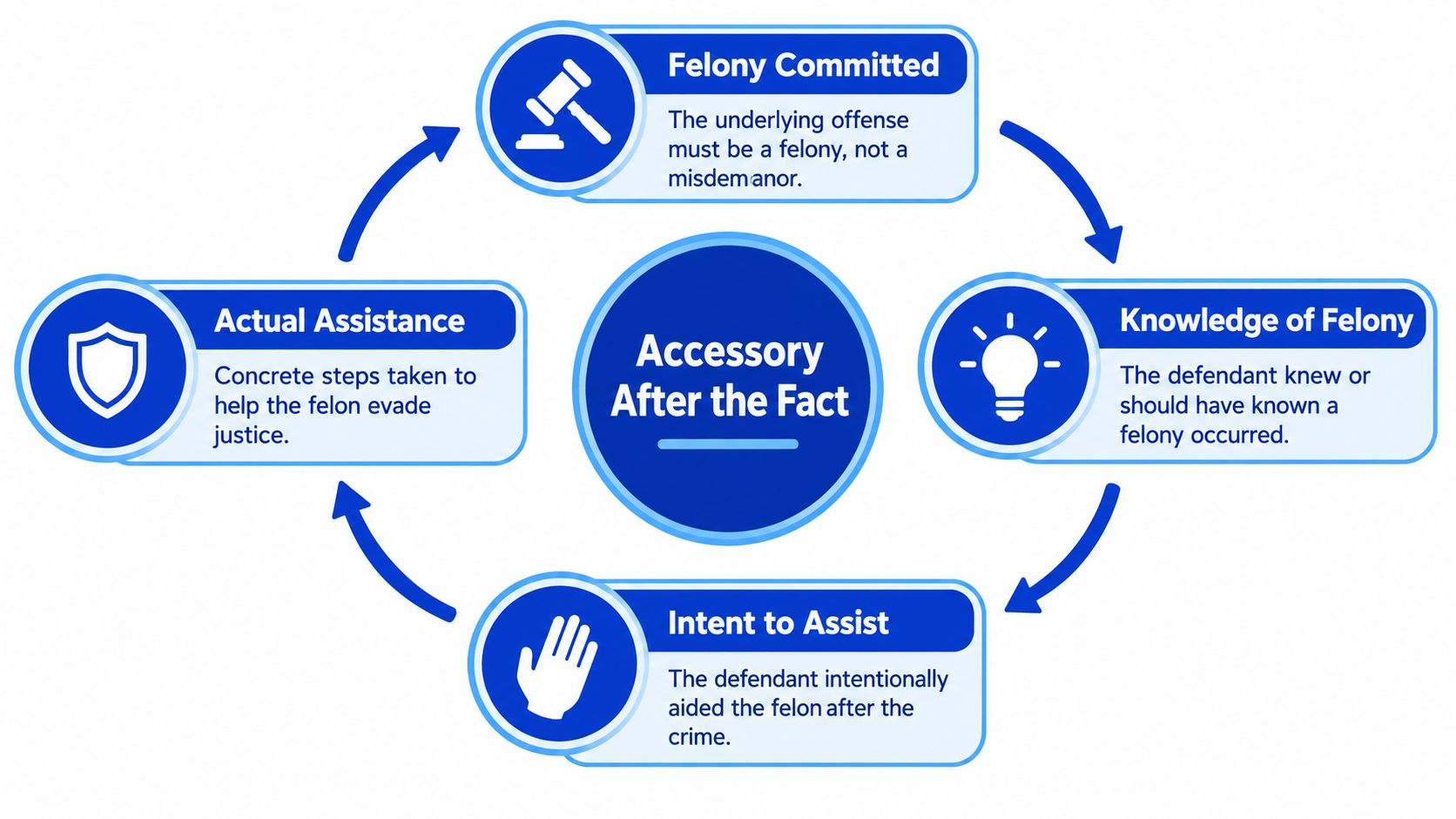
First, a felony must have been committed
The State must identify an underlying felony committed by someone else. The alleged accessory isn't being prosecuted as the person who carried out that original offense, but the underlying felony remains central because Florida grades the accessory charge according to the principal crime's classification.
In the Las Olas example, prosecutors would need to identify the coworker's alleged offense and establish that the driver assisted after that offense occurred. A vague claim that “something illegal happened” isn't the same as proving the required underlying crime.
Second, the helper must have known about the felony
Knowledge is more demanding than suspicion or association. The State may point to statements, text messages, the condition of a vehicle, conduct after the event, or inconsistent explanations. A jury could examine whether the driver was told what happened before he provided the ride and storage location.
But being friends with a suspect, receiving a late call, or seeing damage doesn't automatically prove knowledge of a felony. The prosecution must persuade the jury that the accused knew the relevant criminal facts when he acted.
Third, the assistance must occur after the crime
The alleged help must come after the underlying felony has been committed. The statute describes conduct such as maintaining, assisting, or otherwise giving aid to the principal or an accessory before the fact. Transportation, shelter, hiding property, or concealing evidence may become relevant when the surrounding facts show an effort to prevent law enforcement from finding the person or evidence.
Timing separates this charge from participation in the original offense. The Fort Lauderdale driver didn't allegedly help plan or carry out the collision. The State's theory would be that he acted afterward.
Fourth, the assistance must be intentional
The State must prove more than a helpful act. It must connect that act to an intent to help the person avoid detection, arrest, trial, or punishment. Parking a vehicle in a garage may look suspicious, but prosecutors still have to show the driver's purpose when he did it.
That is why a defense lawyer examines the exact conversation, the sequence of events, the driver's statements, and what he did when he learned more. One missing element can create reasonable doubt. Readers unfamiliar with felony allegations can also review this explanation of what a felony charge means.
How Accessory After the Fact Differs From Other Roles
People often use “accomplice,” “principal,” and “accessory” as if they mean the same thing. They don't. The timing of the alleged assistance is often the dividing line, although the prosecution must still match the facts to the correct charging theory.
Role | When the alleged help occurs | What prosecutors generally focus on |
|---|---|---|
Principal | Before or during the underlying offense | Whether the person committed the crime itself |
Aider or abettor, sometimes called an accessory before the fact | Before or during the underlying offense | Whether the person intentionally helped plan, encourage, or carry out the crime |
Accessory after the fact | After the underlying offense is complete | Whether the person knowingly helped the offender avoid detection, arrest, trial, or punishment |
Receiving stolen property | After property has been taken | Whether the person knowingly possessed or dealt with property connected to a theft, under the separate elements of that offense |
Suppose a person acts as a lookout while a friend enters a vehicle. That conduct occurs during the alleged offense and may support a theory that the person participated in the original crime. If the person only learns about the completed burglary afterward and then provides transportation to help the friend leave, the State may instead examine accessory-after-the-fact liability.
The distinction isn't merely academic. A person accused of participating in the underlying offense may face the consequences associated with that offense. An accessory after the fact faces a separate charge graded under Florida's accessory statute. The specific act, the person's knowledge, and the timing all matter.
The Fort Lauderdale driver illustrates the difference. If he helped plan the crash or encouraged the coworker to flee before the collision, prosecutors might investigate a participation theory. If he first learned of the event after it happened and then deliberately hid the vehicle, the investigation points toward a post-crime assistance theory.
The analysis also differs from receiving stolen property. That offense concerns the property and the accused person's knowledge and conduct involving it. Accessory after the fact focuses on helping a person avoid the consequences of a completed felony. The same evidence may appear in both investigations, but the legal questions aren't interchangeable.
Florida Penalty Tiers and Sentencing Exposure
Florida ties the degree of an accessory-after-the-fact charge to the seriousness of the underlying felony. That structure means the same type of alleged assistance can produce different charge classifications depending on what the principal is accused of committing.
The 2025 Florida statute describes the following grading structure:
Underlying Felony | Accessory Charge Degree | Max Prison | Max Fine |
|---|---|---|---|
Capital felony | First-degree felony | Controlled by the offense classification and applicable sentencing law | Controlled by the offense classification and applicable sentencing law |
Life felony or first-degree felony | Second-degree felony | Controlled by the offense classification and applicable sentencing law | Controlled by the offense classification and applicable sentencing law |
Second-degree felony or third-degree felony ranked level 3 through 10 | Third-degree felony | Controlled by the offense classification and applicable sentencing law | Controlled by the offense classification and applicable sentencing law |
Third-degree felony ranked level 1 or 2 | First-degree misdemeanor | Controlled by the misdemeanor classification and applicable sentencing law | Controlled by the misdemeanor classification and applicable sentencing law |
The statute expressly cross-references Florida's general sentencing provisions, including sections 775.082 and 775.083. The Florida legislative text for the accessory statute and sentencing cross-references should be reviewed alongside the current charging document because the exact exposure depends on the classification applied to the case.
Practical rule: Don't evaluate an accessory charge by looking only at the word “accessory.” Identify the underlying felony, its degree, and its ranking before assessing potential sentencing consequences.
A charge classified as a misdemeanor can still affect employment, licensing, immigration, housing, and family stability. A felony allegation can create substantially greater consequences, including restrictions that continue beyond the court case. The ultimate sentence may depend on the facts, criminal history, plea negotiations, scoresheet calculations, and the judge's ruling.
Florida also permits prosecution of an accessory even when the principal has not first been convicted. Under Florida's procedural statute, the State doesn't have to wait for a conviction of the main offender before moving forward with the accessory case. That makes early defense work important, especially when the underlying case remains disputed.
Anyone worried about incarceration should review the charge with counsel rather than rely on a general online estimate, including general information about how much time in jail may be involved.
Real-World Examples at Each Penalty Level
The grading structure becomes clearer when you hold the alleged assistance constant and change the underlying felony.
A lower-level Florida example
A college student in Gainesville stores a roommate's backpack after the roommate admits that the bag contains property connected to a third-degree felony ranked at a lower level. The student says the roommate asked for a favor and claims not to have understood the legal significance of the admission.
Under Florida's grading structure, an underlying third-degree felony ranked at level 1 or 2 can result in first-degree misdemeanor treatment for the accessory allegation. The critical facts still include what the student knew, whether the student deliberately stored the bag to help the roommate avoid detection, and whether the State can prove that purpose.
A prosecutor may view the storage location and messages as evidence of deliberate concealment. A defense lawyer would ask whether the messages show knowledge of a felony or merely show that the student accepted a vague request without understanding the circumstances.
A Broward County vehicle-burglary example
A driver in Broward County picks up a friend after the friend burglarizes a vehicle. The driver didn't help plan or commit the burglary, but the friend explains what happened and asks for a ride away from the area. The driver agrees because he wants to help the friend avoid being found.
If the underlying offense falls within the statutory category for a third-degree accessory charge, the State will focus on the driver's knowledge and the deliberate transportation. The driver may argue that he didn't know the friend had committed a felony when he agreed to the ride, or that the State has misread the timing and purpose of the trip.
A Miami-Dade homicide-related example
An acquaintance in Miami-Dade learns that another person is accused of a homicide, then destroys evidence or moves money to help that person avoid investigation. If the underlying offense is a capital felony, Florida's statute grades the accessory allegation as a first-degree felony. The seriousness of the underlying crime changes the charge classification even though the alleged helper didn't commit the homicide.
The State would likely emphasize the nature of the evidence destroyed, the communications between the people involved, and the sequence of events. The defense would examine whether the accused knew the evidence related to a felony, whether the conduct occurred after the offense, and whether the State can prove an intentional effort to prevent detection or punishment.
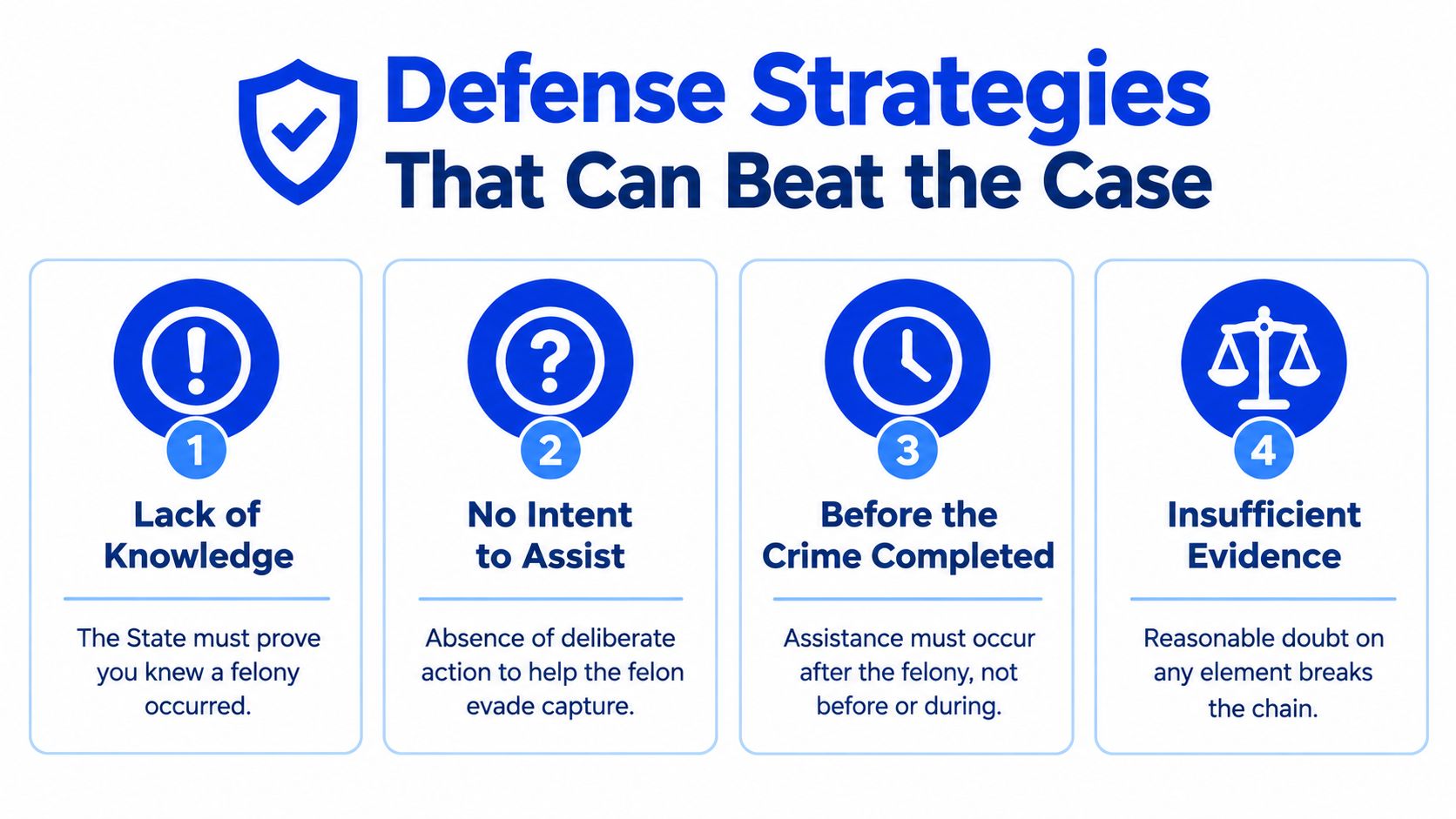
Defense Strategies That Can Beat the Case
An arrest doesn't establish that every element can be proved. A former prosecutor would start by separating what police suspect from what admissible evidence can show.
Challenge knowledge
The State must prove that the accused knew the principal committed a felony. A person may have heard an incomplete story, misunderstood a conversation, lacked access to important facts, or learned the truth only after the alleged assistance occurred.
Messages can help either side. A text saying “get rid of this because police are looking for me” presents a different issue from a message saying “can I leave my car at your place?” The defense should examine the entire conversation rather than isolated phrases. Intoxication, limited English proficiency, or a one-sided narrative may also affect whether the State can prove actual knowledge in context.
Challenge the alleged assistance
Mere presence, silence, or a failure to report doesn't automatically establish that the accused maintained, assisted, or gave aid to the principal. The prosecution needs evidence of conduct that fits the statute.
A defense lawyer may ask:
What did the accused do? Was there transportation, shelter, concealment, destruction, or another affirmative act?
When did it happen? Did the alleged assistance occur after the underlying felony was complete?
What did the accused understand? Did the person know the request related to a felony?
What alternative explanation fits the evidence? Was the vehicle stored for convenience, or was it deliberately hidden?
Challenge intent
Even if the accused performed an act that helped someone, the State still must connect it to an intent to help that person avoid detection, arrest, trial, or punishment. Coercion, threats, or duress may undermine the claim that the assistance was voluntary and purposeful.
The defense should preserve evidence showing pressure from the principal, including messages, calls, witness accounts, and the timing of threats. The facts must be assessed carefully because a general fear of consequences isn't automatically the same as legally sufficient duress.
Challenge the evidence itself
Constitutional issues can change the case. A search of a phone, vehicle, home, or garage may raise Fourth Amendment questions. Statements made during custodial questioning may raise Miranda issues. If officers obtained important evidence unlawfully, counsel may seek suppression rather than allow the State to use that evidence at trial.
Resolution options can also matter. Depending on the charge, record, county, and facts, counsel may evaluate pretrial diversion, a negotiated reduction, or cooperation discussions. Any proposal involving substantial assistance, including a possible discussion under Florida Statute section 893.135, requires a case-specific assessment and shouldn't be pursued without understanding the risks.
For a broader overview of possible approaches, review these types of criminal defenses. The strongest strategy may be a motion, a negotiated resolution, or a trial defense, depending on what the evidence shows.
What to Do Right Now if You Are Facing the Charge
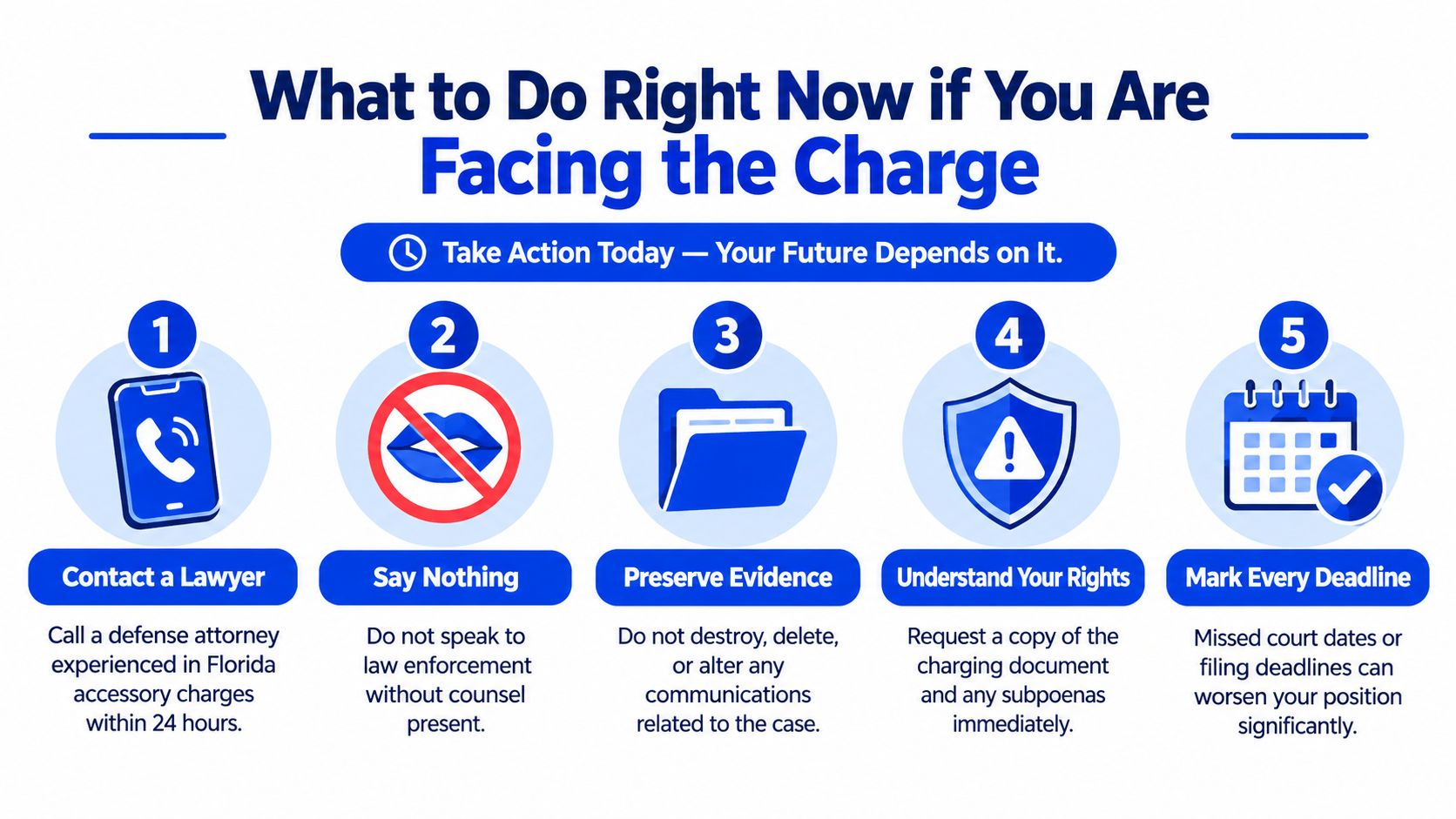
The most damaging first move is often continuing to talk without legal advice. Don't explain the case to police, a codefendant, the alleged principal, or an alleged victim. Even an attempt to “clear things up” can create statements that prosecutors later use to prove knowledge or intent.
Take these steps immediately
Stop case-related conversations. Don't discuss the facts by phone, text, social media, or in person. Don't ask another person to contact police for you.
Preserve communications. Keep texts, photos, call records, location information, emails, and relevant social-media messages. Don't delete, alter, hide, or destroy anything connected to the investigation.
Secure possible video evidence. Identify doorbell footage, business surveillance, vehicle cameras, and other recordings that may show where you were and what happened.
Write a private timeline for your lawyer. Record the times, locations, people involved, calls received, transportation provided, and statements you remember. Don't send the timeline to other people.
Obtain the paperwork. Ask counsel to review the arrest affidavit, information, warrant, subpoena, release conditions, and any court notice. Mark every appearance and filing deadline.
Early representation can help counsel address statements, preservation issues, search questions, and release conditions before the case develops further. In Broward and Miami-Dade, a lawyer can also examine the charging document, identify the alleged underlying felony, and determine whether the State's facts match the accessory statute.
Bring your timeline, charging papers, bond documents, and relevant communications to the consultation. Ask direct questions about the knowledge element, the alleged assistance, search and interrogation issues, possible motions, diversion eligibility, negotiated reductions, and the consequences of each proposed outcome.
You don't need to solve the entire case today. You do need to stop creating evidence for the prosecution, preserve evidence that may help you, and obtain advice from a Florida criminal defense lawyer who understands felony and accessory allegations.
Ticket Shield, PLLC helps people facing accessory-after-the-fact allegations evaluate the State's evidence, protect constitutional rights, and pursue a strategy built on the facts. Visit Ticket Shield, PLLC to request a consultation about your Florida criminal case and take the next step with experienced defense counsel.