
Aggravated Battery with a Deadly Weapon in Florida
Jason Goldsmith, Esq
You may be reading this after a late-night arrest, with your phone full of missed calls from a spouse, parent, or friend who doesn't know what happens next. The booking paperwork may say aggravated battery with a deadly weapon, but that label doesn't answer the most important questions: what must the State prove, what object qualifies as a deadly weapon, and how can a firearm change the potential sentence?
This is a serious Florida violent-felony charge, but an arrest isn't a conviction. The prosecution still has to prove every required element beyond a reasonable doubt, and the defense can challenge the touching, the intent, the alleged injury, the weapon classification, the reliability of the evidence, or the legality of the investigation.
Table of Contents
What This Charge Means the Moment You Are Arrested
At two in the morning, the first version of events is often already in the hands of law enforcement. A domestic argument may have ended with one person calling 911. A parking-lot confrontation may have produced cellphone video from a bystander. A restaurant fight may have left a broken bottle, a knife, or blood on the floor. By the time you search for this charge, police may have interviewed the other people involved and written an affidavit that presents one side as established fact.
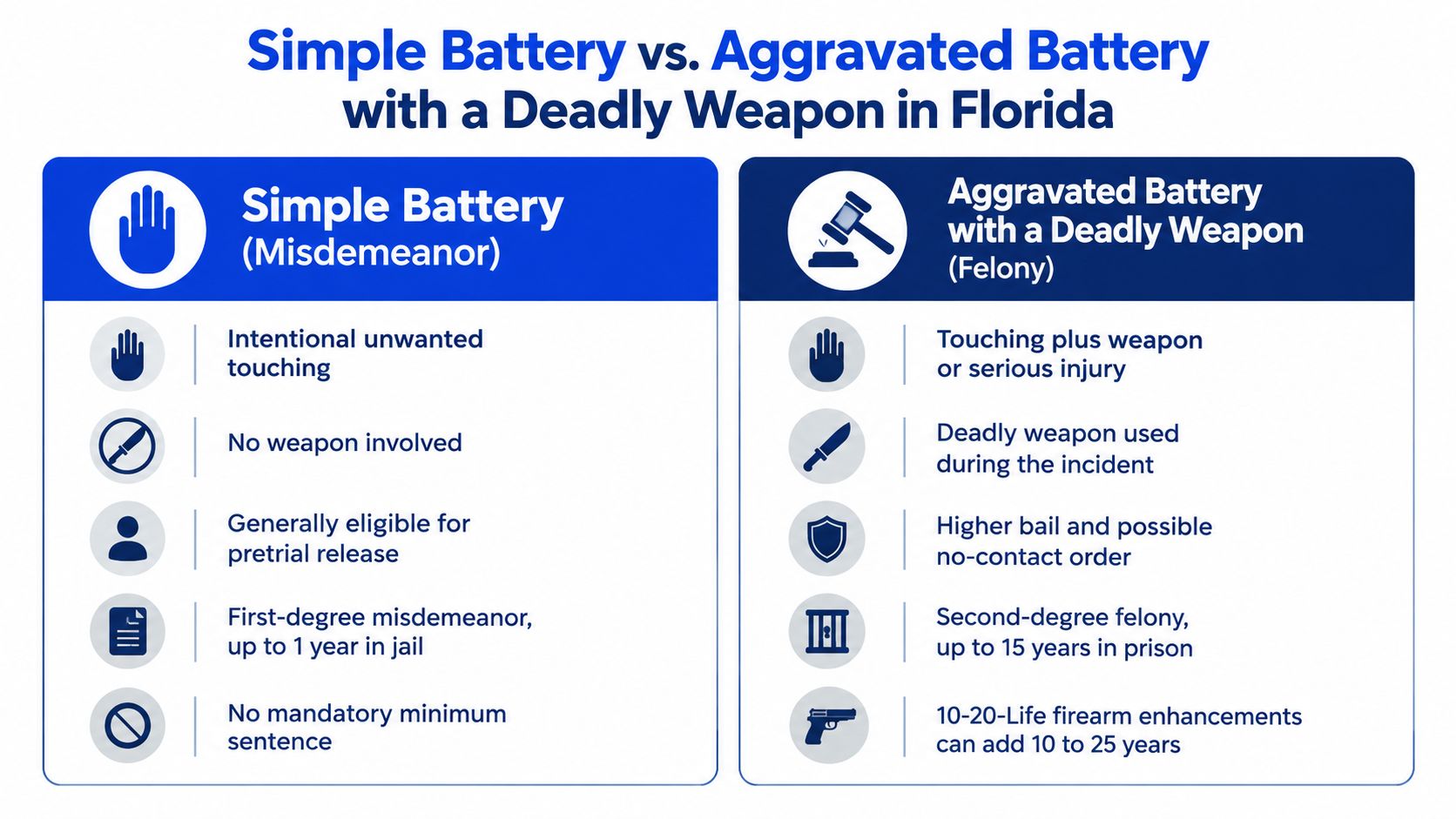
The arrest paperwork will generally identify Florida Statutes § 784.045, the aggravated battery statute. That statute makes aggravated battery a second-degree felony when the required battery is accompanied by either qualifying serious injury or the use of a deadly weapon. The legal classification turns on how the force was applied and what the State can prove, not merely on whether an object was present. You can review the statutory language in Florida Statutes § 784.045.
The immediate consequences are practical
A judge may impose conditions while the case is pending. Those conditions can include restrictions on contact with the alleged victim, limits on where you may go, and restrictions involving firearms. A no-contact condition can affect access to your home, children, personal property, or workplace, even before any trial takes place.
The arrest and charging documents can also become part of the public court record. That may create problems with employment, housing, licensing, or family proceedings. The damage can begin before the criminal case is resolved, which is why early legal advice matters even when the evidence appears incomplete.
Practical rule: Don't try to repair the situation by calling the alleged victim, asking friends to contact that person, or explaining the incident to detectives. Those efforts can create new evidence and may violate release conditions.
Being held in jail and being released with pretrial conditions are different situations, but neither determines guilt. The first court proceedings address custody and conditions, while the defense investigation should begin at once. A lawyer needs to preserve video, identify independent witnesses, examine medical records, and determine whether the object was used in a way Florida law recognizes as deadly.
How Florida Law Defines the Crime
The State's case has a sequence. It must first prove a battery, then prove an aggravating circumstance. Florida's jury-instruction materials describe aggravated battery as requiring the underlying battery plus either the serious-injury theory or the deadly-weapon theory. The Florida Bar's discussion of proposed criminal jury instructions provides useful context for that element-based analysis.
The predicate battery
The starting point is an intentional, unlawful touching or striking of another person against that person's will. The State isn't required to prove that you intended a particular injury merely by proving that you intentionally made the contact. But accidental contact, a mistaken identification, or contact that occurred during lawful self-defense can undermine this essential part of the charge.
Once the State proves or persuades a jury that a battery occurred, it must establish one of two aggravating theories.
Injury-outcome theory
Under the first theory, the State claims that you intentionally or knowingly caused great bodily harm, permanent disability, or permanent disfigurement. The focus is on the result of the force. Medical records, photographs, testimony from treating professionals, and the alleged victim's account may all become important.
Not every complaint of pain or visible mark automatically satisfies the statutory threshold. The defense examines the nature of the injury, the treatment provided, the medical diagnosis, the alleged mechanism of injury, and whether the evidence shows a lasting or substantial result rather than a temporary condition. The prosecution must prove the required level of harm, not merely an unpleasant or upsetting encounter.
Deadly-weapon theory
Under the second theory, the State claims that a deadly weapon was used during the battery. The weapon doesn't have to be a firearm. Florida appellate authority recognizes that an object can satisfy the deadly-weapon requirement when it is used in a manner likely to produce death or great bodily harm. In that analysis, the weapon need not strike the victim, and threatening use may matter if the conduct created the required realistic risk, as explained in Florida appellate authority on deadly-weapon use.
Prosecutors may plead both theories in the alternative. That approach allows the State to rely on the injury evidence if the weapon evidence is disputed, or on the weapon evidence if the injury is less serious than alleged. Defense counsel therefore has to test both routes rather than assume that defeating one automatically defeats the entire charge.
Two ways the State proves aggravated battery with a deadly weapon
Element | Injury-Outcome Theory | Deadly-Weapon Theory |
|---|---|---|
Predicate conduct | Intentional, unlawful touching or striking against the person's will | Intentional, unlawful touching or striking against the person's will |
Aggravating fact | Great bodily harm, permanent disability, or permanent disfigurement | Use of a deadly weapon during the battery |
Central evidence | Medical records, photographs, treatment history, and witness accounts | The object, how it was used, witness accounts, video, and surrounding circumstances |
Main defense question | Does the proven injury meet the statutory threshold? | Was the object used in a manner likely to cause death or great bodily harm? |
A charge involving this statute should be evaluated against the facts, not just the caption. The discussion of Florida aggravated battery charges can provide additional Florida-specific background, but the evidence in your own case controls the legal analysis.
What Florida Treats as a Deadly Weapon
Florida's approach is functional. A gun or a knife may be an obvious focus, but the question isn't limited to the object's ordinary name. Courts examine the object's capability and the way the defendant allegedly used it during the touching or force application.
A vehicle can become a weapon if driven into a person. A bottle, tool, boot, or other ordinary item may receive the same treatment if the alleged use created a realistic likelihood of death or great bodily harm. The same item may be legally significant in one incident and irrelevant in another because the surrounding facts differ.
The object matters, but use often matters more
The State will usually focus on the movement, target, distance, force, and circumstances surrounding the object. Holding an item in a threatening manner can matter even when the item never makes contact. Possession alone, however, doesn't establish the deadly-weapon theory. The prosecution must connect the object to the alleged battery and show the legally required manner of use.
Cornell's aggravated battery explanation discusses how deadly-weapon aggravated battery commonly extends beyond firearms and why legal definitions vary. Florida cases also place weight on whether the object, as used, was likely to produce death or great bodily harm.
Object Type | Legal Standard | Common Examples |
|---|---|---|
Deadly weapon | An object used or threatened in a way likely to cause death or great bodily harm | Firearms, knives, vehicles, baseball bats, bottles, tools, or shod feet depending on the alleged use |
Dangerous instrument | An object whose legal significance depends heavily on its capability and the manner in which it was used | A vehicle driven at a person, a heavy tool swung at someone's head, or a bottle used to strike |
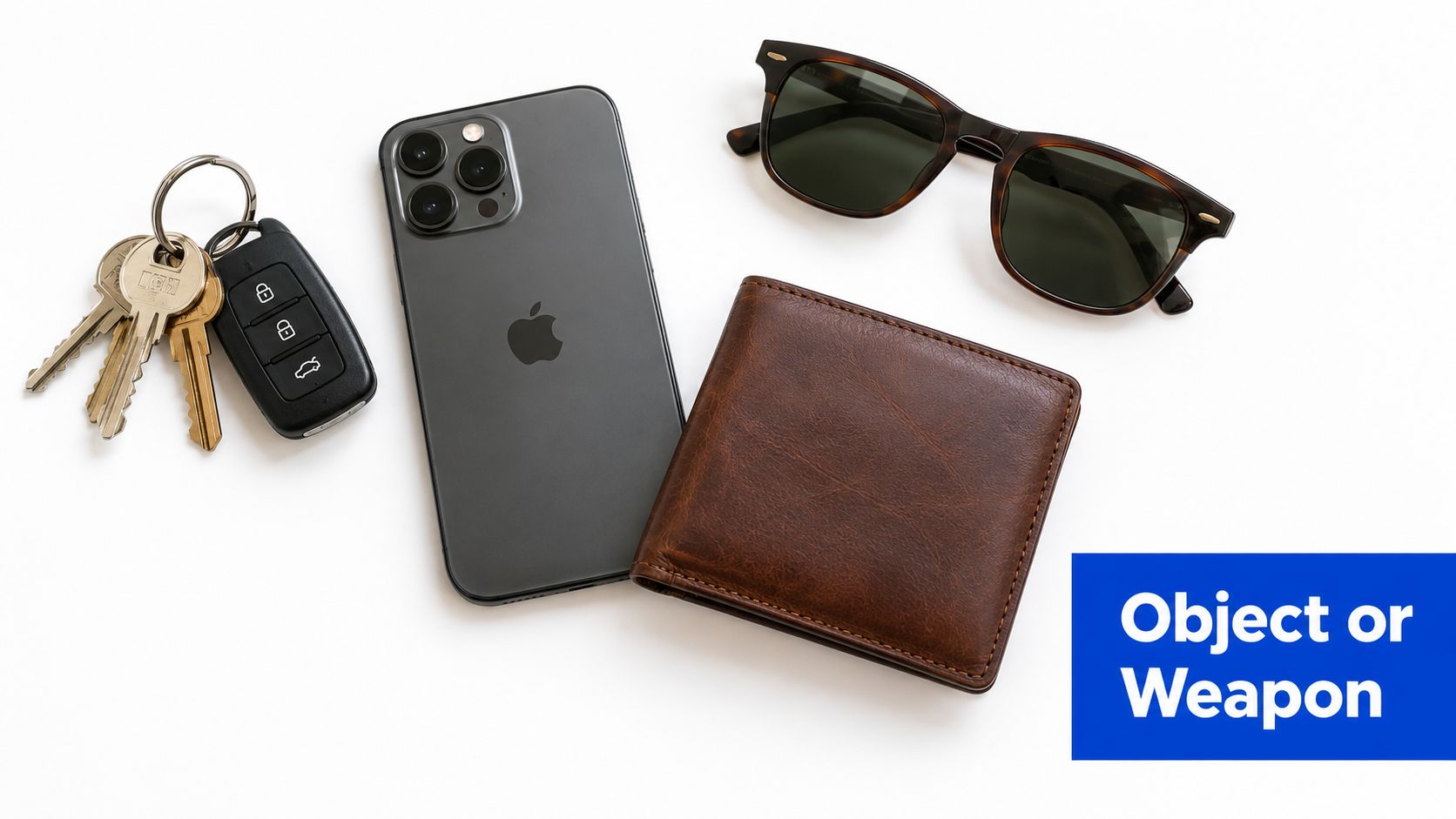
Ordinary object | An item that isn't inherently treated as a deadly weapon, but can become one if used in a qualifying manner | A phone, shoe, key, or other everyday item when the alleged conduct changes its function |
Borderline objects create real defense opportunities
The most useful defense question often isn't, “Is this object dangerous?” It's, “What exactly did the person do with it?” A folding knife kept closed in a pocket presents a different issue from a knife allegedly opened and directed at another person. A car parked near an argument presents a different issue from a car allegedly accelerated toward someone.
That distinction can affect charging, plea negotiations, motions, and trial strategy. A lawyer reviewing a weapons allegation should examine surveillance footage, photographs, the object's condition, witness descriptions, and the exact wording of the arrest affidavit. More information about Florida weapons allegations is available through Florida weapons-crimes defense information.
Common Scenarios That Lead to This Charge
The same statute can describe very different events. A restaurant dispute, a parking-lot confrontation, and a household argument may all produce the same charge while requiring entirely different investigations.
A knife during a restaurant fight
Two people argue near a bar or restaurant entrance. One person produces a knife, and the other suffers a cut. The State may pursue the injury-outcome theory if the medical evidence supports great bodily harm, the deadly-weapon theory because of the knife's alleged use, or both.
Investigators may collect surveillance footage, speak with employees, obtain 911 audio, photograph clothing, and compare witness accounts. The timing matters. Video can show who initiated contact, whether the knife was opened before or after the physical encounter, whether the alleged victim advanced, and whether the contact was defensive rather than aggressive.
A vague witness statement that someone “had a knife” isn't the same as proof of how the knife was used. The defense needs to separate possession, display, movement, and actual contact.
A vehicle in a parking-lot dispute
A road-rage confrontation may move from one vehicle to another. If one driver allegedly rams a car, accelerates toward a person, or strikes someone with the vehicle, prosecutors may argue that the vehicle functioned as a deadly weapon. The central issue becomes the driver's movement, awareness, distance, and intended target.
Dash-camera footage, security video, vehicle damage, tire marks, cellphone recordings, and photographs can make the difference. A collision doesn't automatically prove that the driver intentionally used the car as a weapon. The defense may need to examine whether the event was an accident, whether the driver was trying to leave, whether the alleged victim was in the vehicle, and whether the video contradicts the written report.
A firearm during a domestic argument
A domestic argument can become an aggravated battery case if a firearm is displayed, racked, used to strike someone, or otherwise used during alleged physical contact. The State may rely on the deadly-weapon theory even if the firearm wasn't fired and even if the alleged injury is limited.
The evidence may include 911 audio, text messages, photographs, witness accounts, the firearm's location, and statements attributed to the people present. The defense must also examine whether the alleged victim saw the firearm, whether the object was accessible, whether contact occurred, and whether the accused acted to protect against an immediate threat.
Objects that are less familiar to the public can raise the same fact-specific questions. Florida weapons law can involve unusual allegations, including claims involving items such as brass knuckles, as discussed in this Florida weapons-charge example.

Penalties You Could Be Facing
The punishment analysis has two layers. First, aggravated battery is classified as a second-degree felony. Second, firearm allegations can add mandatory minimum terms that may change the case far more dramatically than the base felony classification suggests.
Under Florida's general felony sentencing law, a second-degree felony is punishable by up to 15 years in prison, up to 15 years of probation, and a $10,000 fine, unless an enhancement applies. Florida's offense-ranking system places aggravated battery at Level 7, which can affect scoresheet calculations and the practical range discussed during plea negotiations. The statutory penalty and offense ranking are addressed in Florida's aggravated battery statute.
The firearm layer
Florida's 10-20-Life law can apply when a firearm is involved during certain felonies, including aggravated battery. The statute distinguishes possession, discharge, and discharge that causes great bodily harm or death. Those are not interchangeable allegations, and the defense must identify which conduct the State claims and what evidence supports it.
Firearm Conduct | Mandatory Minimum Prison | Day-for-Day? | Statutory Source |
|---|---|---|---|
Possessing a firearm during the qualifying felony | 10 years | The applicable minimum is mandatory under the enhancement statute | |
Discharging the firearm | 20 years | The applicable minimum is mandatory under the enhancement statute | Florida Statutes § 775.087 |
Discharging the firearm and causing great bodily harm or death | 25 years to life | The applicable minimum is mandatory under the enhancement statute | Florida Statutes § 775.087 |
The firearm statute can also reclassify a felony. A third-degree felony may become a second-degree felony, and a second-degree felony may become a first-degree felony when the enhancement rules apply. That reclassification can affect the charge level in addition to the mandatory minimum.
A bare second-degree felony may legally permit probation, but the actual outcome depends on the facts, criminal history, scoresheet, injury evidence, weapon allegation, and the judge's decision. A negotiated reduction, dismissal, diversionary resolution, or trial result may avoid the maximum exposure, but no lawyer can promise one of those outcomes before reviewing the evidence. The practical consequences of the firearm allegations are discussed further in Florida's 10-20-Life law.
Defenses and Mitigations That Apply
A defense lawyer doesn't select a theory from a menu. The right approach depends on what the video shows, what the witnesses said before speaking with police, what the medical records establish, and how the alleged object was used.
Lawful force and self-defense
Florida's self-defense and stand-your-ground rules under § 776.012 may apply when a person reasonably believes force is necessary to prevent imminent unlawful force. The analysis can include defensive injuries, prior threats, the relative positions of the people, the alleged victim's actions, and whether the accused stopped using force when the threat ended.
A statutory immunity hearing may also become important in an appropriate case. The defense needs to raise that issue with evidence, not assert that the incident was self-defense. Video, 911 recordings, photographs taken near the time of the incident, and independent witnesses can strengthen the argument. Contradictory accounts, continued force after the threat ended, or messages showing an intent to retaliate can weaken it.
Element-based challenges
The State must prove the underlying battery and the aggravating circumstance. That creates several separate opportunities to challenge the case:
Intent and contact: Accidental contact, mistaken identity, or a movement that wasn't directed at the alleged victim may undermine the predicate battery.
Weapon classification: The object may not have been used in a manner likely to cause death or great bodily harm, even if it was present or displayed.
Injury proof: Medical records may not support the claimed level of harm, or the injury may have another explanation.
Credibility: Witness accounts may change, conflict with video, or omit facts that support self-defense.
Causation: The State must connect the alleged conduct to the claimed injury, rather than rely on assumption.
A strong defense often attacks the State's sequence, not just its conclusion. Who touched whom, when the object appeared, what happened immediately before contact, and what caused the injury can matter more than the label on the arrest form.
Evidence and mitigation
The investigation should also test unlawful searches, suggestive showups, unreliable statements from other suspects, and gaps in the chain of custody for the alleged weapon. A successful suppression motion can remove important evidence, but counsel must identify the specific constitutional problem and connect it to the evidence the State wants to use.
If the evidence supports a conviction risk, mitigation still matters. Counsel may investigate eligibility for a youthful-offender or prison diversionary program, seek a reduction to simple battery where legally and factually supportable, or prepare a sentencing packet containing employment history, treatment information, family responsibilities, and other individualized facts. These options don't erase the charge automatically, and eligibility depends on the person's circumstances and the prosecutor's and court's decisions.
What to Do in the First 72 Hours After Arrest
The first few days are a poor time to improvise. Preserve your memory and your evidence, but don't create new statements that prosecutors can use against you.
Write a private factual timeline. Record the time, location, people present, words you remember, injuries, and the exact way the alleged weapon was displayed or used. Give the notes to your lawyer, not to police or the alleged victim.
Preserve physical evidence. Photograph injuries, torn clothing, damaged property, and damage to your phone or vehicle before anything is repaired or altered. Don't edit, delete, or post related photos, videos, texts, or social-media content.
Identify independent witnesses. Save names and contact information for bystanders, employees, neighbors, and anyone who saw the beginning of the encounter. Don't pressure them to change or coordinate their accounts.
Avoid contact. Don't call detectives, the alleged victim, an insurance adjuster, or mutual friends about the incident without counsel. Contact through social media can create additional problems and may violate a release condition.
Contact counsel quickly. A Florida defense lawyer can address bond conditions, request evidence preservation, investigate before memories fade, and evaluate whether the firearm-enhancement statute is implicated. A broader arrest roadmap is available in what happens after an arrest in Florida.

Key Takeaways and Next Steps
Florida's aggravated battery law gives the State two separate paths. It can pursue the injury-outcome theory, based on great bodily harm, permanent disability, or permanent disfigurement, or the deadly-weapon theory, based on how an object was used during the battery. The prosecution may allege both, but it still has to prove the underlying battery and the chosen aggravating facts beyond a reasonable doubt.
The baseline offense is a second-degree felony carrying up to 15 years in prison, up to 15 years of probation, and a $10,000 fine. The penalty calculation can change sharply when a firearm is involved. Under 10-20-Life, possessing a firearm during the qualifying felony carries a 10-year mandatory minimum, discharging it carries a 20-year mandatory minimum, and discharging it while causing great bodily harm or death carries a minimum of 25 years to life.
The fixed part is the statutory framework. The negotiable part is the evidence: whether the object qualifies as a deadly weapon, whether the alleged injury meets the legal threshold, whether the touching was intentional, whether the State can prove causation, and whether the accused acted lawfully in self-defense. An early defense investigation can also expose unreliable identifications, inconsistent statements, unlawful searches, and missing or altered video.
Don't wait for the case to explain itself through the prosecutor's version of events. Gather your timeline, preserve evidence, follow every release condition, and schedule a confidential review with a Florida defense attorney who understands violent-felony and firearm-enhancement litigation.
Ticket Shield, PLLC evaluates aggravated battery with a deadly weapon cases, including allegations involving firearms and potential 10-20-Life consequences, for clients in Broward County, Fort Lauderdale, Miami-Dade, Palm Beach, and surrounding South Florida areas. Visit Ticket Shield, PLLC to request a confidential case review and discuss the evidence, court conditions, and defense options with a Florida criminal defense attorney.