Can You Appeal a Plea Bargain in Florida: Your Guide
Jason Goldsmith, Esq
Most Florida plea bargains limit your right to appeal, but exceptions exist for jurisdictional defects, involuntary pleas, and preserved sentencing issues. Florida law also permits limited review when you expressly reserved a dispositive issue or when another law preserves the right to challenge the judgment.
You may be sitting at home after sentencing, reading the plea paperwork again and wondering whether accepting the deal closed every possible door. That concern is understandable. A plea can resolve a criminal case, but it can also waive important trial and appellate rights. The answer to “can you appeal a plea bargain” depends on what you're challenging, what the written agreement says, what happened during the plea hearing, and whether the issue was preserved.
A former prosecutor knows how quickly a plea becomes part of the court's final record. The prosecutor, defense lawyer, and judge may all treat the case as concluded unless a specific legal problem appears. That doesn't mean every challenge fails. It means the correct procedural path matters from the beginning.
Table of Contents
Understanding the Basics of Plea Bargain Appeals
After accepting a plea, many defendants expect the court process to be over. Then a sentence may be harsher than expected, a lawyer may have failed to explain a consequence, or the defendant may realize that the agreement didn't match what was promised. The immediate question is usually simple: can the conviction be appealed?
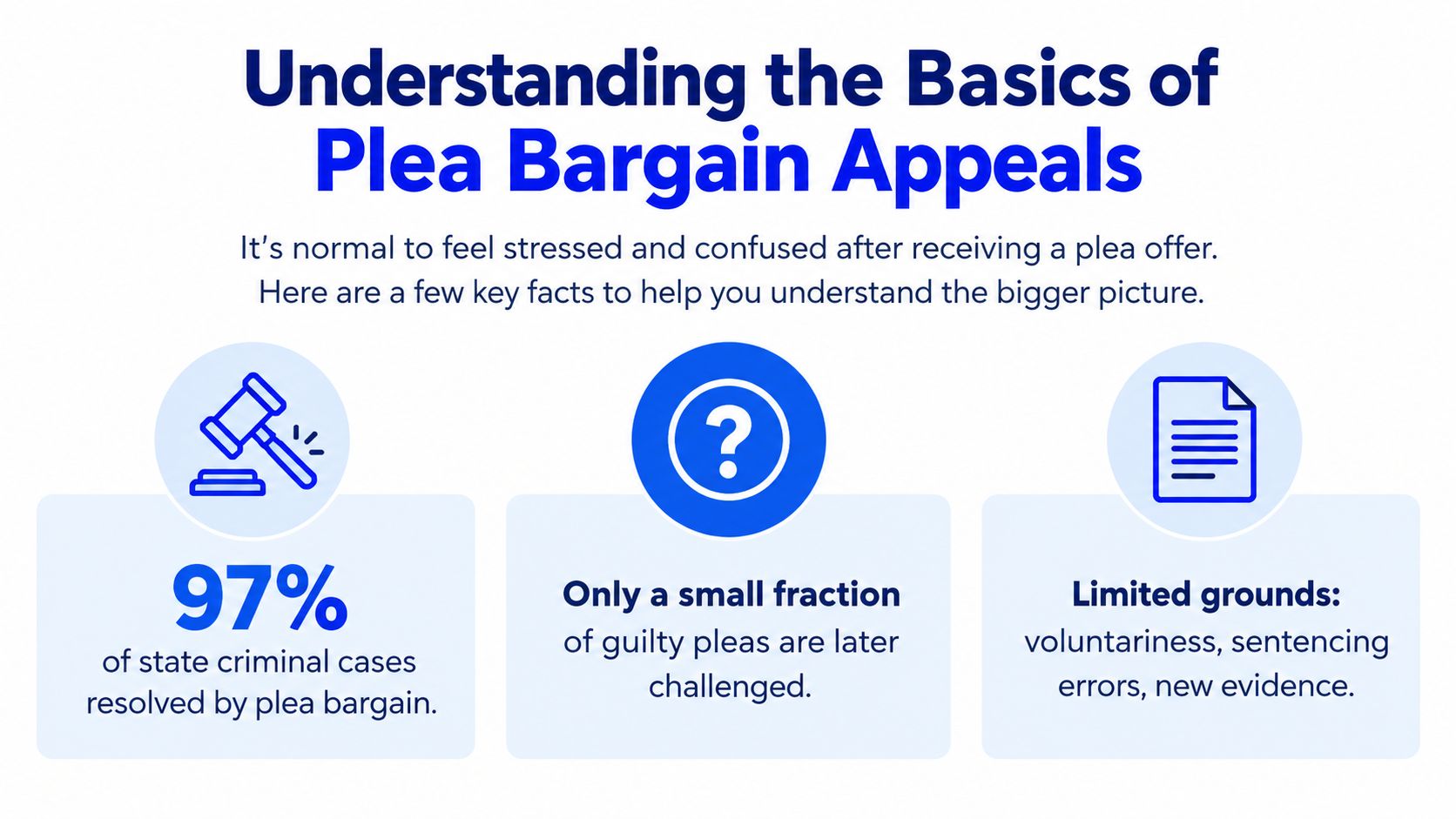
The practical answer is sometimes, but not as a general re-argument of guilt or innocence. A guilty or nolo contendere plea ordinarily gives up the right to contest many pre-plea issues and most aspects of the conviction. Florida courts favor finality in negotiated resolutions, while preserving review for defects involving legality, jurisdiction, voluntariness, or properly preserved sentencing issues.
The scale of plea bargaining explains why courts enforce that finality. In the United States, about 90% of criminal defendants accept plea bargains, and roughly two-thirds of those bargains include a waiver of appeal, according to Justia's explanation of criminal appeals. Appellate review after a plea is therefore the exception, not the ordinary next step.
What accepting a plea usually changes
A plea generally means you no longer ask the State to prove the case at trial. You also usually give up the opportunity to challenge ordinary evidentiary and pretrial rulings through a conventional appeal. The written agreement may contain an appellate waiver, which can narrow review even further.
That waiver isn't automatically unlimited. Courts examine whether you understood the plea and entered it knowingly and voluntarily. A constitutional defect, unlawful sentence, jurisdictional problem, or preserved violation of the agreement may require a different analysis.
For practical guidance on evaluating the decision before or after accepting an offer, review this discussion of plea bargaining in criminal cases. The central point is simple: a plea bargain is a binding legal decision, not merely an informal promise that ends when you leave court.
Federal Rules and Historical Context
Florida's approach fits within a broader criminal procedure tradition that treats a completed plea as final, subject to narrow protections. Federal Rule of Criminal Procedure 11 provides useful context. After sentencing, a guilty or nolo contendere plea generally can't be withdrawn merely because the defendant has changed their mind. Relief must ordinarily come through a direct appeal or a collateral attack, as described in Federal Rule of Criminal Procedure 11.
The timing makes a major difference. Before sentencing, withdrawal requires a “fair and just reason.” After sentencing, the standard is substantially narrower because the judgment has already been entered and the parties and court have relied on the resolution. The same practical distinction appears in the way lawyers evaluate Florida plea challenges. A prompt request to withdraw a plea is procedurally different from an appeal filed after judgment.
Why appeal waivers became common
Appellate-waiver provisions spread through federal plea agreements in the early 1990s, creating a major shift in post-plea litigation. Prosecutors gained greater certainty that negotiated sentences would remain undisturbed, while defendants often received a concession in exchange for limiting future challenges. Federal courts increasingly enforced those clauses when the defendant understood the waiver and entered the plea voluntarily.
The trade-off is straightforward:
Finality for the prosecution: The State receives a more predictable resolution and avoids relitigating issues the defendant agreed to waive.
Certainty for the defendant: A negotiated charge or sentencing recommendation may reduce the risk associated with trial.
Reduced review: The defendant may lose the ability to challenge ordinary errors that might otherwise be raised after trial.
A waiver still isn't a license to impose an unlawful sentence or validate a plea entered without genuine understanding. The issue is whether the claim attacks something the agreement validly waived or something the law treats as outside that waiver.
Practical rule: Read the waiver as carefully as the charge and sentence. A single paragraph can determine whether a normal appeal is available, whether permission was required, or whether the claim belongs in post-conviction court.
Florida-Specific Exceptions and Grounds
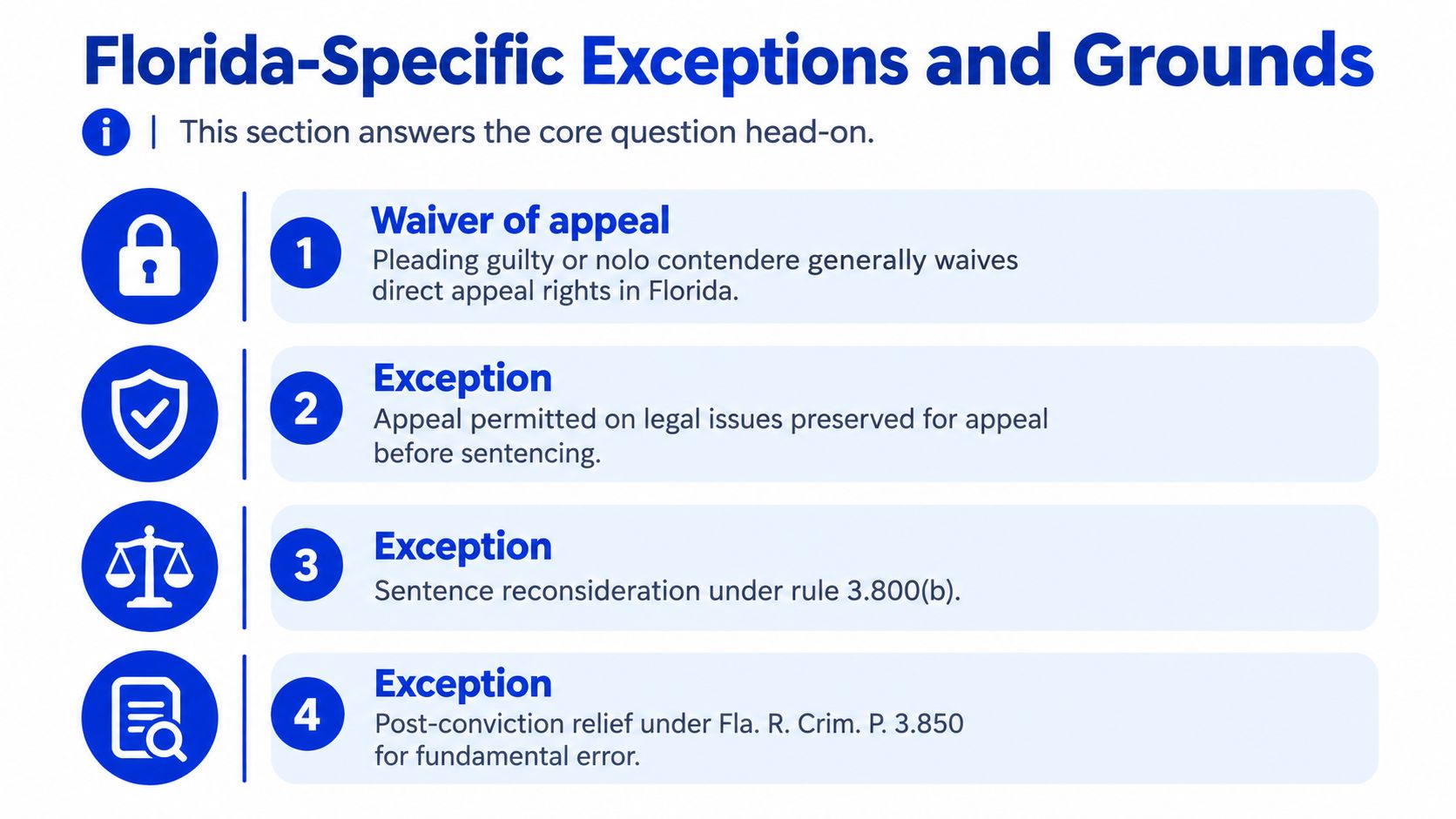
Florida starts with a restrictive rule. A defendant who pleads guilty or nolo contendere generally can't appeal the plea itself, but Florida preserves narrow categories of review. Florida Rule of Appellate Procedure 9.140 identifies the principal exceptions and explains why the specific record matters.
The exceptions that may preserve review
A direct appeal may remain possible when:
A dispositive issue was reserved: The defendant expressly reserved a legally dispositive issue before entering the plea. This usually means the issue could determine the outcome of the case and was clearly preserved for appellate review.
The court lacked jurisdiction: A subject-matter jurisdiction defect can't be created or cured just by agreement between the parties.
The State violated the agreement: A preserved plea-agreement violation may support review when the prosecutor or court failed to honor an enforceable term.
The plea wasn't voluntary: Coercion, misunderstanding, an inadequate explanation of consequences, or another defect affecting voluntariness may create a basis for relief if properly preserved.
The sentence contains a preserved error: A sentencing issue may remain reviewable when Florida procedure allows the defendant to challenge it.
Another law preserves review: Certain statutory or constitutional rights may survive the plea depending on the facts and the language of the agreement.
The distinction between a preserved issue and a new complaint is critical. A defendant may believe the sentence is unfair, but an appellate court usually won't treat every objection raised for the first time after sentencing as preserved.
Florida also distinguishes an ordinary plea challenge from misconduct allegations involving the prosecution. If the agreement or plea process raises concerns about improper conduct, understanding prosecutorial misconduct in Florida may help identify what must be proven and which court should hear the claim.
The written plea form, the plea colloquy, sentencing transcript, and any reservation language should be reviewed together. No single sentence in the form tells the entire story.
Direct Appeal Versus Post-Conviction Relief
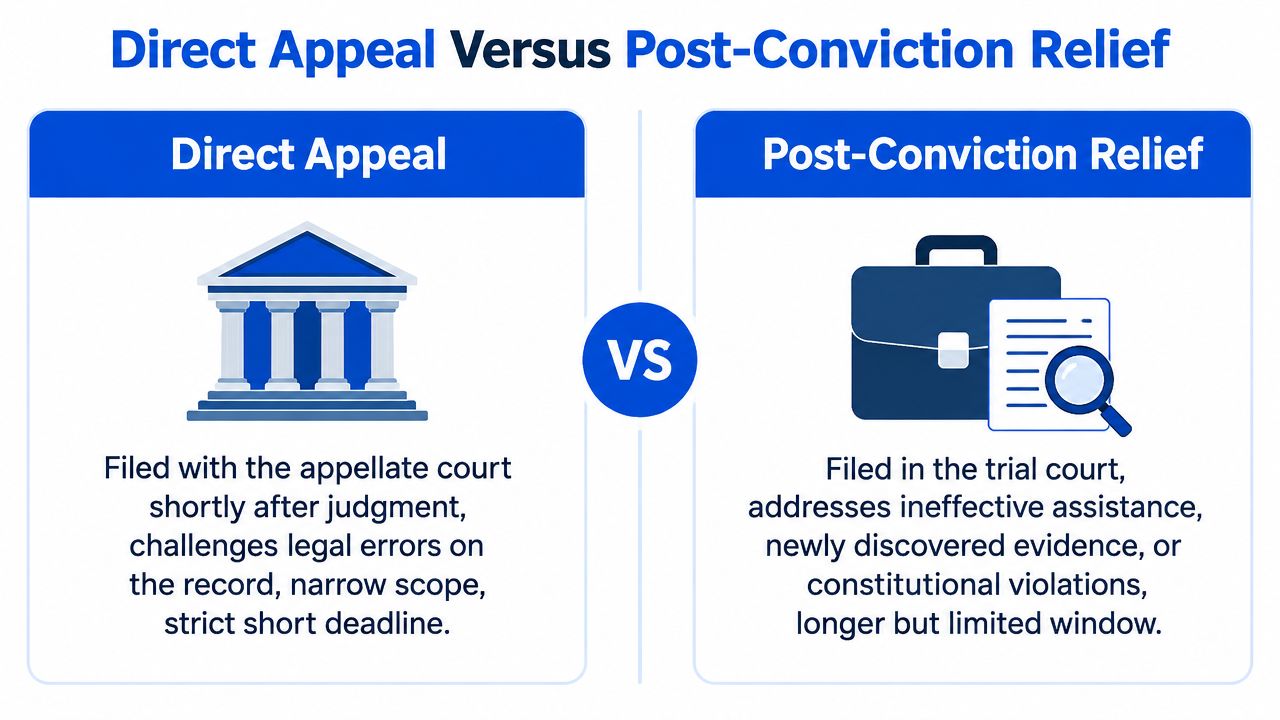
A direct appeal and post-conviction relief are different doors. Choosing the wrong one can waste time and leave a potentially available claim procedurally barred.
A direct appeal goes to an appellate court and generally relies on the existing trial-court record. The appellate judges review what the lower court did, what lawyers argued, what objections were made, and what the transcripts and filings show. Direct appeal usually isn't a new evidentiary hearing, and it doesn't allow the defendant to present a completely different version of events.
Post-conviction relief generally begins in the trial court. It can address matters that aren't fully visible in the direct record, including certain ineffective-assistance claims, newly discovered evidence, or constitutional violations. Depending on the issue, relief may proceed through a Florida post-conviction motion, habeas-type procedure, or another collateral process. This distinction is recognized in Florida post-conviction relief practice.
The right procedure depends on the claim
Claim | Likely procedural focus | Why the distinction matters |
|---|---|---|
Expressly reserved dispositive issue | Direct appeal | The issue may be reviewable from the existing record |
Sentencing error | Direct appeal or permitted sentencing motion | Preservation and the sentence record control |
Involuntary plea | Plea withdrawal motion, direct appeal, or collateral review | The court must examine what the defendant understood and whether the plea was voluntary |
Ineffective assistance of counsel | Often post-conviction relief | The claim may require evidence outside the trial record |
Newly discovered evidence | Post-conviction relief | The trial court may need to evaluate evidence that wasn't previously available |
Jurisdictional defect | Direct or collateral review, depending on the defect | Subject-matter jurisdiction can raise a fundamental legal issue |
A knowing plea often waives challenges to the evidence and ordinary trial errors. It doesn't necessarily eliminate every constitutional claim. For example, an allegation that counsel failed to explain a critical consequence may require testimony, communications, or other evidence that an appellate court can't consider for the first time on direct appeal.
Double-jeopardy-type claims and unlawful-sentence arguments also require careful classification. One may be apparent from the record, while another may depend on facts outside it. A lawyer should identify the claim first, then select the procedure, rather than filing a generic appeal and hoping the court redirects the case.
Procedural Steps and Critical Deadlines
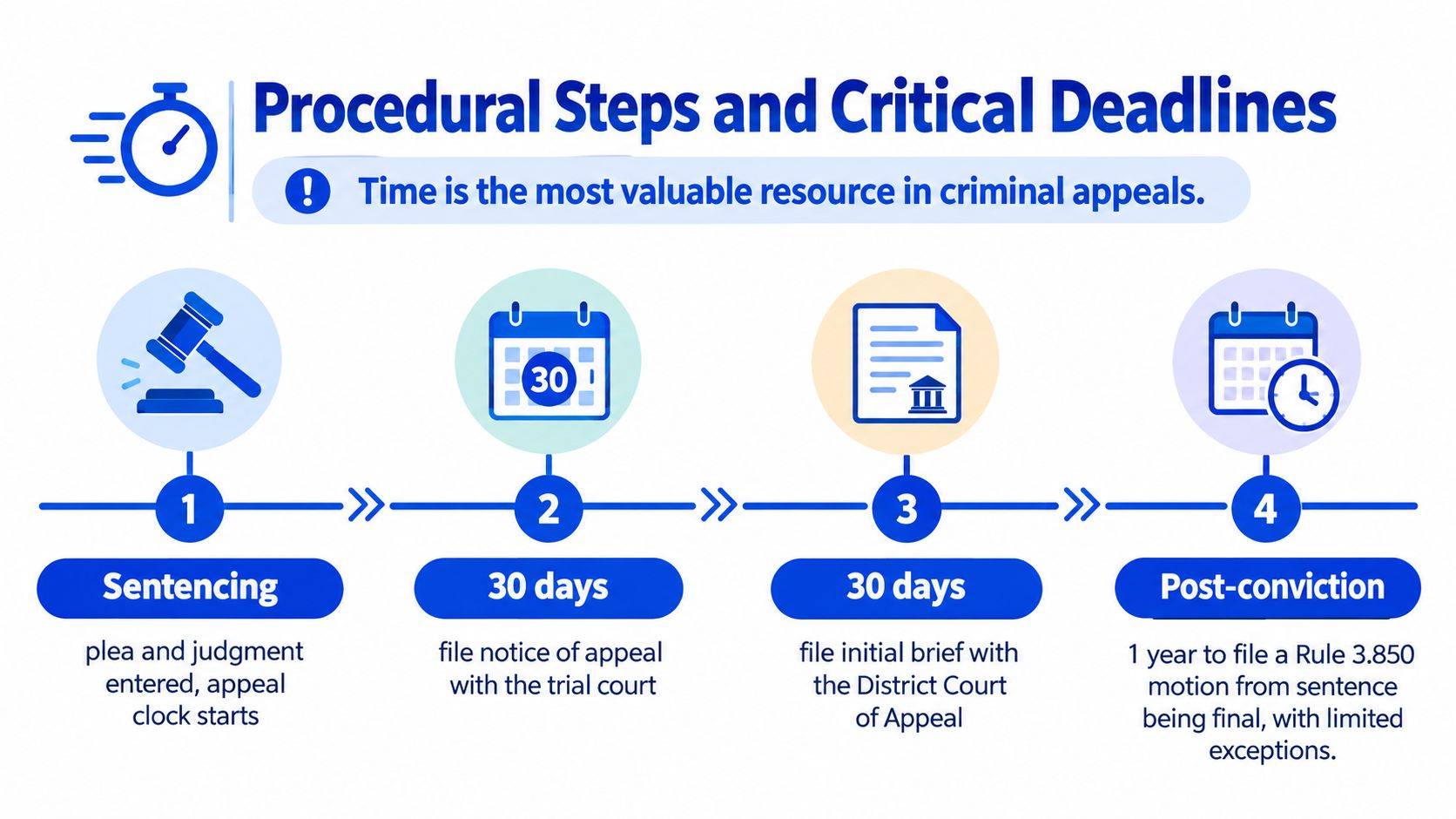
A legally strong argument can fail if the defendant misses the required procedural step. Florida plea challenges often turn on what was filed, when it was filed, and whether the trial court had an opportunity to correct the alleged error.
Start with the judgment and plea record
Obtain the documents immediately. The review should include the signed plea form, transcript of the plea hearing, sentencing transcript, written sentence, notice of appeal, and any document containing an appeal waiver or reservation.
Then ask four focused questions:
What did the defendant agree to waive? The waiver may cover broad categories, particular sentencing issues, or only specified rights.
What was expressly reserved? A reservation must be clear enough to identify the issue the defendant intended to preserve.
What happened during the colloquy? The judge's questions and the defendant's answers may support or undermine a later voluntariness challenge.
Was an objection or motion required first? Some issues must be presented to the trial court before an appellate court can review them.
Florida case law and appellate rules require a motion to withdraw the plea before certain plea-related issues may be appealed. For an unreserved guilty or nolo contendere plea, the defendant generally has 30 days after rendition of sentence to file that motion on permitted grounds, according to Florida case law addressing plea withdrawal and appeal procedure.
Why speed protects options
The first task isn't writing a long legal argument. It's identifying the deadline and filing the document that preserves the available route. A defendant should avoid informal calls to the prosecutor or assumptions that a pending conversation pauses the clock.
The appeal process may involve a notice of appeal, preparation of the record, briefing, and compliance with appellate rules. A post-conviction motion follows different requirements and may require factual allegations supported by records or sworn evidence. Questions about custody during appellate proceedings are separate from the merits, and bond on appeal should be analyzed independently.
When to Contact a Defense Attorney
Contact a defense attorney as soon as you suspect the plea was involuntary, the agreement was violated, the sentence was unlawful, or your lawyer failed to explain a material consequence. Waiting until every document is gathered can be risky because the lawyer may need time to obtain transcripts, review the agreement, and determine whether a motion must be filed first.
A former prosecutor can bring a useful perspective to this review. Prosecutors know how plea offers are documented, how waiver language is typically presented, and which parts of a plea colloquy the State will rely on to defend the judgment. That experience doesn't guarantee a result, but it can help separate a legally viable issue from a disagreement with the bargain's outcome.
What an early review should answer
A focused consultation should address:
The written terms: What charge, sentence, recommendation, dismissal, or waiver did the agreement contain?
The courtroom record: Did the judge explain the rights and consequences, and did the defendant confirm understanding?
Preservation: Was an issue reserved, objected to, or raised through a required motion?
The proper forum: Does the claim belong in a direct appeal, a plea-withdrawal motion, or post-conviction proceedings?
The deadline: What must be filed now to prevent the claim from being lost?
Appellate waivers aren't always absolute. The Department of Justice discussion of plea agreements and sentencing appeal waivers recognizes that some constitutional and statutory claims may survive a waiver. The key question is whether the defendant is attacking a waived issue or raising a defect the law doesn't permit the agreement to eliminate.
Ticket Shield, PLLC offers consultations for people evaluating plea-related options, including clients in Broward County, Fort Lauderdale, Miami-Dade, Palm Beach, and surrounding South Florida communities. Reviewing questions to ask a criminal defense lawyer can help you prepare the documents and timeline needed for a meaningful evaluation.
Key Takeaways and Common Misconceptions
The most damaging misconception is that every plea is either completely untouchable or automatically appealable. Neither statement is accurate. Florida generally limits a direct appeal after a guilty or no-contest plea, but jurisdictional defects, involuntary pleas, preserved agreement violations, preserved sentencing errors, expressly reserved dispositive issues, and other rights allowed by law may remain relevant.
Another mistake is treating an appeal as a second trial. A direct appeal usually examines legal errors in the existing record. It won't ordinarily allow a defendant to retell the facts, present every new argument, or challenge evidence that the plea validly waived.
Facts that deserve careful attention
An appeal waiver isn't always absolute. Constitutional and statutory claims may survive depending on the agreement and the nature of the defect.
A plea withdrawal motion may come first. Florida procedure can require that step before certain plea-related issues reach an appellate court.
Post-conviction relief is different from direct appeal. A barred direct appeal doesn't necessarily eliminate every collateral remedy.
The plea hearing matters. The judge's questions and your answers may become central evidence concerning voluntariness and understanding.
Deadlines control practical options. A potentially valid claim can become difficult or unavailable if the required filing isn't made on time.
If a Florida defendant enters a guilty or no-contest plea without expressly reserving a legally dispositive appeal issue, the defendant generally loses the right to appeal the judgment or sentence on that plea, while collateral review may still remain available through other post-conviction procedures, as reflected in the Florida Bar's criminal procedure rules.
Don't sign a plea agreement or wait after sentencing based on a general internet answer. Gather the plea paperwork, sentencing documents, and any messages or notes about what counsel promised, then seek a Florida-specific review of the exact record.
Ticket Shield, PLLC can review your plea agreement, plea hearing, sentence, waiver language, and potential deadlines to determine whether direct appeal or post-conviction relief may be the appropriate path. Visit Ticket Shield, PLLC to request a consultation and discuss your options promptly.