How Much Time in Jail You Could Face in Florida
Jason Goldsmith, Esq
52 months is the federal average sentence in fiscal year 2024, but that number doesn't tell you what you're really facing. In Florida, how much time in jail can range from a few days in county jail for a second-degree misdemeanor to 30 years in state prison for a first-degree felony, and the actual exposure depends on the charge level, prior record, and any sentence enhancements.
That's the part many overlook when they panic and ask for a single number. One case in Broward might end with probation and credit for time served, while another, with the same basic charge but a prior record or a firearm enhancement, can turn into years of custody. The right way to think about jail time in Florida is as a matrix of categories and multipliers, not a flat estimate.
Table of Contents
What "How Much Time in Jail" Really Means in Florida
A first arrest and a repeat arrest do not sit in the same sentencing box. A South Florida defendant facing a low-level theft charge for the first time is exposed to a very different range than someone charged again after a prior theft conviction. Prosecutors, judges, and scoresheets all read that history differently. The first question is the charge, the record, and the add-ons that attach to both.
County jail and state prison are not the same thing
Florida treats misdemeanors in county jail and felonies in state prison through the Department of Corrections system. That split affects custody, classification, and release. A short county-jail sentence is a different outcome from a multi-year prison term.
Florida law draws the line at the 364-day threshold. Once the maximum authorized punishment reaches 365 days or more, the case falls into felony territory (Florida misdemeanor and felony classifications).
Practical rule: Don't ask only, “How much time can I get?” Ask, “Is this a misdemeanor, a felony, or a charge with an enhancement that pushes it beyond the normal range?”
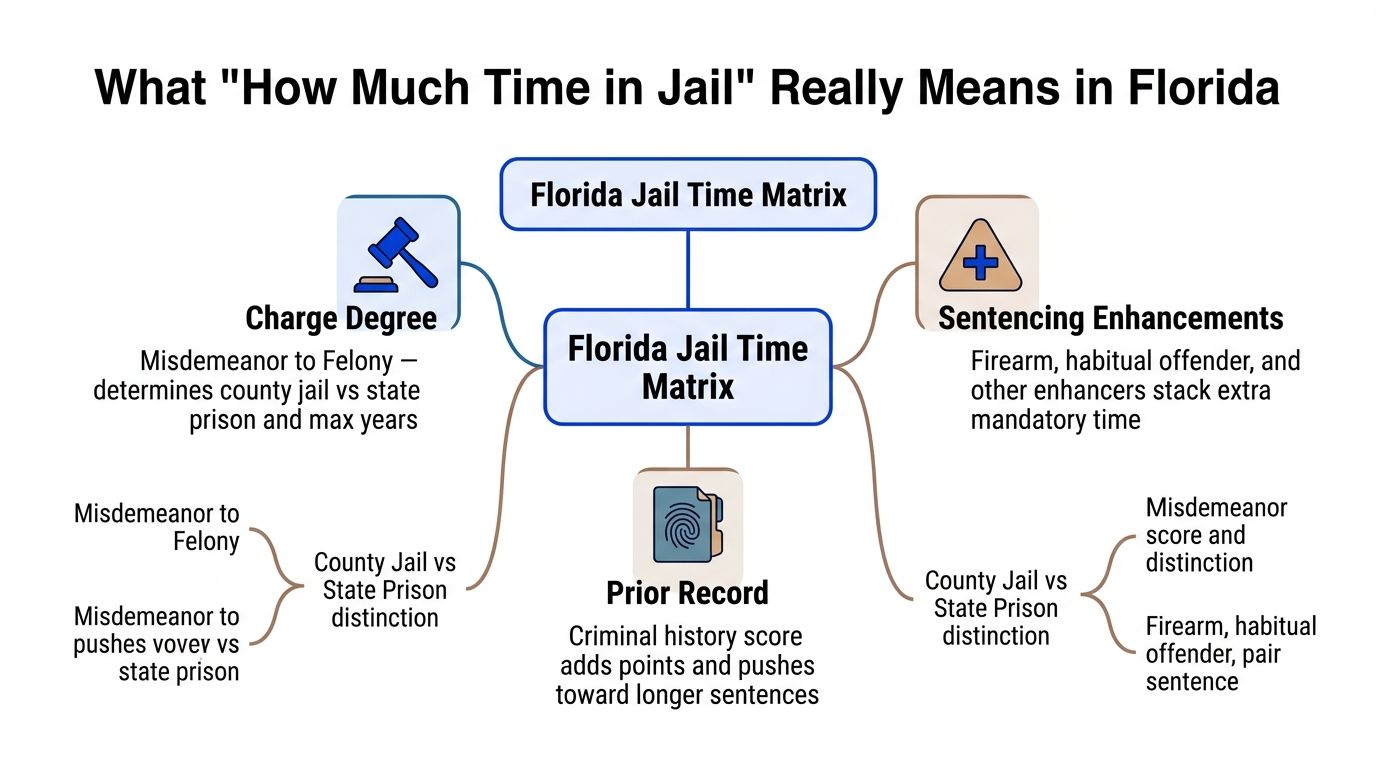
Sentencing turns on the charge degree, the criminal history, and the statutory ceiling. That is what tells a judge whether the case stays in county jail, reaches prison, or ends with probation and conditions.
Start with the categories, not the fear
Florida criminal cases generally fall into misdemeanor degrees, felony degrees, and, in the most serious cases, life or capital felony classifications. On top of that sit multipliers and enhancements, which can push the case past the base range. A realistic answer comes from the whole sentencing picture, not just the charging document.
For a plain-English overview of charge levels, see Florida criminal law basics. That framework is what makes the sentencing conversation make sense.
Florida's Misdemeanor Jail-Time Ranges
A shoplifting case, a suspended-license arrest, or a low-level battery charge can look small on paper and still put someone in county jail. In Florida, the question is not whether the charge is called a misdemeanor. It is which degree it is, whether the facts aggravate it, and whether the person has priors that let the judge push harder.
The three misdemeanor degrees
Florida has second-degree misdemeanors and first-degree misdemeanors, plus more serious offense labels that can still land in county jail. A second-degree misdemeanor carries up to 60 days in county jail. A first-degree misdemeanor carries up to 1 year in county jail.
That difference matters in Broward, Miami-Dade, and Palm Beach courtrooms. Prosecutors use the higher degree as the line where the case starts to carry real jail risk, especially when there is injury, a prior record, or a bad fact pattern. Florida misdemeanors stay in the county system, not state prison, as shown in the statute cited earlier.
What this looks like in real cases
A second-degree misdemeanor can cover simple assault, petit theft under $750, or reckless driving. A first-degree misdemeanor can include battery, possession of cannabis under 20 grams, driving with a suspended license with a prior, and a first-offense DUI, although DUI has its own separate penalty rules that can change the practical result.
Most misdemeanors do not come with a built-in minimum jail term. That is why many cases end with probation, credit for time served, or a withhold of adjudication when the judge has room to use it. The outcome usually turns on the arrest facts, the person's record, and how strong the State's proof is.
Florida Misdemeanor Jail-Time Ranges | ||
|---|---|---|
Degree | Max Jail Time | Common Charges |
Second-degree misdemeanor | 60 days | Simple assault, petit theft under $750, reckless driving |
First-degree misdemeanor | 1 year | Battery, possession of cannabis under 20 grams, suspended license with prior |
For a plain-English breakdown of charge levels, the page on Florida misdemeanor charges is a useful starting point.
Florida's Felony Prison-Time Ranges
Felonies are where the numbers get serious fast. Once a charge becomes a felony, the sentencing ceiling jumps into prison territory, the scoresheet starts to matter, and prior history can change the outcome dramatically. The defendant who thinks “I can probably just do a few months” is often underestimating the statute, the scoresheet, and the prosecutor's power.
The five felony tiers
Florida felony sentencing starts with the third-degree felony, which carries up to 5 years in prison. That covers a wide range of cases, including possession of a controlled substance, burglary of an unoccupied dwelling, and grand theft of $750 to $20,000. Some battery on law enforcement charges also land in felony territory depending on the facts and enhancements.
A second-degree felony carries up to 15 years. That's where you see offenses like aggravated assault with a deadly weapon, burglary of an occupied dwelling, and certain trafficking charges. A first-degree felony carries up to 30 years, which includes crimes such as aggravated battery causing great bodily harm, armed trafficking, and home invasion robbery.
Florida Felony Prison-Time Ranges | ||
|---|---|---|
Felony Degree | Max Prison Time | Common Charges |
Third-degree felony | 5 years | Possession of a controlled substance, burglary of an unoccupied dwelling, grand theft $750 to $20,000 |
Second-degree felony | 15 years | Aggravated assault with a deadly weapon, burglary of an occupied dwelling, certain trafficking offenses |
First-degree felony | 30 years | Aggravated battery causing great bodily harm, armed trafficking, home invasion robbery |
Life felony | Life | Kidnapping, armed robbery, sexual battery |
Capital felony | Life without parole or death | First-degree murder |
The higher tiers, life felonies and capital felonies, are reserved for the most serious crimes. In those cases, the sentencing conversation changes completely, because the statutory exposure is no longer a simple term of years.
Why the scoresheet controls the real fight
Florida's Criminal Punishment Code scoresheet can make the lowest permissible sentence very different from the statutory maximum. The scoresheet looks at the primary offense, additional offenses, victim injury, community sanction violations, and prior record points. A defendant can technically face a high maximum while still arguing for a lower lawful sentence, or, in some cases, the scoresheet can push the judge toward a prison sentence even when probation might sound possible on paper.
For more on charge levels and prison exposure, see what is a felony charge. That's the point where people usually realize they need the actual numbers, not just the label.
How Prior Convictions Increase Your Jail Exposure
Prior convictions are the first thing prosecutors use when they want more time. They don't always raise the statutory maximum, but they often change the bargaining range, make diversion less likely, and give the State a cleaner path to prison. In Broward, Miami-Dade, and Palm Beach, that history can matter as much as the new charge.
Habitual offender status changes the leverage
Florida's habitual offender laws, including Habitual Felony Offender treatment under section 775.084, can increase the sentencing range when a defendant has the right number and type of priors. The law is not automatic in every case, but once the State files and proves the qualifying history, the defendant is in a much worse position. That's the practical reason why two prior felony convictions can turn a routine third-degree felony theft case into a much harder fight.
A prior misdemeanor usually does not turn a felony into something higher by itself. But misdemeanor history can still hurt, especially if the current case is a new misdemeanor. A first-degree misdemeanor cap of 1 year is still a year, and repeat conduct makes it much less likely that the judge will go easy.
Why local practice matters
Broward judges often take a hard look at repeat theft and repeat drug cases, especially where the defendant has already had a chance before. Miami-Dade sometimes offers more room for diversion or treatment-based outcomes when the facts support it. Palm Beach can be stricter in the way it frames recidivism, especially on property and violence cases.
A prior record doesn't just add time, it changes the story the court thinks it is hearing.
Florida Habitual Offender Sentence Multipliers | |||
|---|---|---|---|
Offender Class | Prior Convictions Required | New Charge Level | Prison Sentence |
Habitual felony offender | Qualifying prior felony convictions | Any qualifying felony | Increased exposure under section 775.084 |
Habitual violent felony offender | Qualifying prior violent felony convictions | Violent felony | Increased exposure under section 775.084 |
The judge still has discretion in some cases to depart downward when the facts support it, but that's an argument, not a right. The earlier you address priors, the more room you have to negotiate before the State locks in its habitual-offender position.
Sentence Enhancements That Add Real Time
Enhancements are where otherwise manageable charges turn into prison cases. A base charge can look bad enough on its own, but a firearm, trafficking weight, or victim-related enhancement can stack mandatory time on top of the original exposure. That is the difference between a sentence you can negotiate around and one that starts with a hard floor.
Firearms and the 10-20-Life structure
Florida's firearm enhancement law, commonly called 10-20-Life and found in section 775.087, creates mandatory minimums for certain felony conduct involving a gun. The numbers are simple and severe, 10 years for possessing a firearm during a felony, 20 years for discharging it, and 25 years to life if someone is shot and injured (Florida 10-20-Life explanation).
That kind of enhancement often wipes out any realistic county-jail outcome. Once the firearm statute applies, the case is usually in state prison territory unless the defense can attack the charge itself or negotiate the enhancement away.
Drug trafficking and other add-ons
Drug trafficking charges often bring mandatory terms tied to quantity, not just the label of the drug. In practice, the amount controls the exposure, and the State usually files those cases to force an early advantage. That is especially true in South Florida, where trafficking allegations can be paired with other aggravators.
A Miami-Dade cocaine trafficking case over 28 grams can trigger a 7-year mandatory minimum, which is the kind of number that changes every conversation in the case. Once that kind of mandatory floor is in place, the defense has to fight the enhancement, the quantity, or the admissibility of the evidence, not just the headline charge.
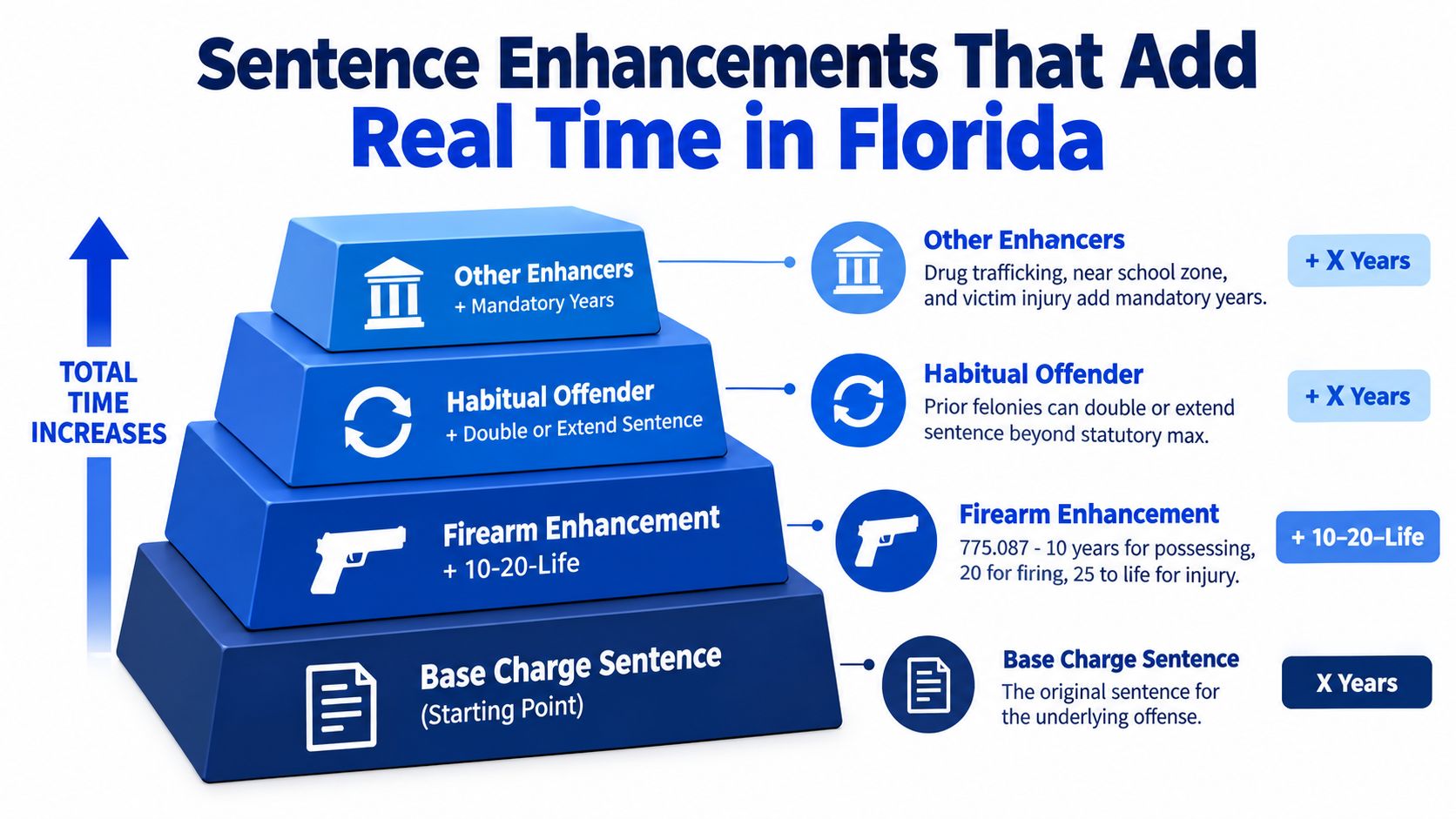
Other enhancers can include hate-crime allegations, child-victim issues, conspiracy rules, and gang-related allegations. Those labels matter because they can add years, increase pressure to plead, and limit the judge's flexibility.
Probation Violations and Pretrial Detention Exposure
Many people believe jail time only comes from a new charge. That's incorrect. Some of the most significant custody exposure happens after arrest, while someone is on probation or awaiting trial, because a violation can turn a suspended or deferred sentence into actual jail time. In South Florida, cases often get worse during this period.
Technical violations and new-law violations
Florida practice draws a major line between technical violations and new-law violations. Technical violations are things like a missed appointment, a failed drug test, or another non-criminal breach. A new-law violation means the person picked up a new arrest or new criminal allegation.
For lower-risk technical violations, recent guidance describes capped county-jail sanctions, with 90 days for a first violation and 120 days for a second in some contexts (Florida probation violation overview). Florida law also allows a court, in some probation settings, to impose up to 90 days in county jail as a special condition, and if probation is revoked, the judge can impose the statutory maximum for the underlying offense (Florida probation violation statute).
Probation Violation Outcomes in Florida | ||
|---|---|---|
Violation Type | Common Judge Response | Realistic Jail Exposure |
Technical violation | Reinstatement, added conditions, short county-jail sanction | Capped short jail stay or no jail, depending on facts |
New-law violation | Revocation, increased bond pressure, suspended sentence exposure | Full original-case exposure if revoked |
Why pretrial detention gets ignored
Recent research summaries report that spending more than a week in pretrial detention is associated with roughly 50% higher odds of missed court appearances and new arrests, and about 36% higher odds of conviction. A Minnesota pretrial report also found that people held more than one day had an average stay of 16 days and a median of 4 days, which shows how fast a short hold can turn into a much longer loss of liberty (pretrial detention research summary).
That's why a pending violation matters so much. Someone can sit in custody for weeks while the court decides whether to revoke, modify, or reinstate. In a Miami-Dade probation case, a single dirty urine test can turn remaining probation into real jail exposure if the judge loses confidence in compliance.
For a deeper look at revocation consequences, see violation of probation jail time. If you're out on bond or probation, every missed condition is a sentencing problem, not a paperwork issue.
Protecting Yourself and Lowering Your Jail Exposure
The fastest way to reduce jail exposure is to attack the case before the State hardens its position. Once a prosecutor files enhancements, stacks priors, or frames the matter as a repeat-offender case, your options shrink. The smart move is to act early, preserve negotiation power, and force the State to prove every piece of its case.
Start with the charge itself
The first defense is often the simplest one, challenge probable cause, attack illegal searches, and look for identity errors or lack of intent. If the stop was bad, the search was bad, or the State cannot prove the required mental state, the case can be reduced or dismissed. In theft, drug, weapons, and assault cases, that factual pressure is often the difference between a misdemeanor, a felony, and a dismissal.
The State's strongest leverage usually comes from silence and delay. Don't give either one for free.
Use the pretrial tools that actually help
Eligible first-time defendants may have access to pretrial intervention, deferred prosecution, or a withhold of adjudication on certain charges. Those outcomes matter because they can keep a case from ending in a formal conviction. They also help limit the collateral damage that comes with jail exposure, especially where the facts support treatment or supervision instead of incarceration.
Push for lawful credits and lower sentences
If jail is unavoidable, demand every day-for-day credit the law allows. Then make the sentencing argument the right way, with employment history, treatment, family support, and verified mitigation. When the facts support it, a downward departure may reduce a sentence below the usual floor. That's not automatic, but it is often worth fighting for in Broward, Miami-Dade, and Palm Beach courtrooms.
Avoid the hidden triggers
The mistakes that add time are usually avoidable. Don't pick up a new arrest while on release, don't contact co-defendants when the court says not to, and don't treat probation like an afterthought. A small violation can convert a manageable case into actual jail time faster than you might expect.
Ticket Shield, PLLC handles Florida criminal defense matters, including probation violations, misdemeanor charges, felonies, and the kinds of cases where jail exposure turns on priors and enhancements. If you need a direct read on your situation, visit Ticket Shield, PLLC and get the case evaluated before the State has time to build more strength.