
Types of Criminal Defenses: A 2026 Guide
Jason Goldsmith, Esq
Facing criminal charges in Broward, Miami-Dade, or Palm Beach can make every text, traffic stop, and court notice feel heavier than it should. If you're searching for a Fort Lauderdale DUI lawyer, a Broward County drug crime attorney, or help with a Florida domestic violence defense, you need the types of criminal defenses explained in plain English, fast. The right defense depends on what the State has to prove, what the police did before arresting you, and whether the evidence holds up under Florida procedure.
A former prosecutor looks at these cases differently. The first question is rarely, “How do we explain this away?” It's, “Where is the State weakest, and what can be challenged early enough to matter?” That approach is especially important in South Florida courts, where DUI stops, drug searches, probation violations, traffic offenses, and weapons cases often turn on a few critical decisions made by one officer, one lab, or one witness.
If you're trying to protect your license, your record, or your freedom, start with the defense category that fits the facts. A self-defense claim won't help if the underlying issue is a bad search. An alibi won't help if the key fight is whether the lab handled the evidence correctly. The types of criminal defenses below are the ones clients most often need to understand before they talk to police, before they go to court, and before they make a mistake that can be used against them.
Table of Contents
1. Challenging Illegal Searches and Seizures
A lot of Florida cases begin with a search that shouldn't have happened, or a stop that grew into a search without a lawful basis. In drug crimes, DUI cases, and Florida gun charge defense work, that matters because the State often depends on what police found in the car, on the person, or in the home. If the stop was unlawful, the search can fall with it.
The practical move is to force the State to justify every step, from the initial contact to the discovery of evidence. That means looking at whether there was a valid warrant, real probable cause, or a limited exception recognized in criminal procedure. It also means reviewing whether a roadside investigation went beyond its original purpose, which is where many suppression issues start.
Practical rule: Don't treat a police search as automatically valid just because an officer found something. In Florida courts, legality matters as much as the evidence itself.
In a real Broward County DUI stop, for example, a defense lawyer may attack the stop if the officer lacked a lawful basis at the outset. The same approach can help in a Miami-Dade drug case where a roadside detention turned into a full vehicle search. If police stretched the encounter past what the law allowed, a motion to suppress can change the entire posture of the case, and that's why many lawyers link early to the legal standard for probable cause before they litigate the facts.
What to request right away
Dash Cam and Body Cam Footage: Video often shows whether the officer's story matches what happened.
Dispatch and 911 Records: These can show what triggered the stop or approach.
Search Documentation: Consent forms, warrants, and inventory logs matter more than most clients realize.
Police Reports: Look for contradictions between the report and the video.
Early Motion Practice: Suppression issues usually work best when raised before the State locks in its theory.
The legal point is simple. If the search was illegal, the evidence may not survive. That can weaken a theft crime penalties in Florida case, a weapons case, or a drug possession charge before trial even begins.
2. Challenging Evidence Quality and Chain of Custody
A case can look strong on paper and still fall apart once the evidence is tested. In Florida courtrooms, the questions that matter are who handled the item, when they handled it, where it was stored, and whether the State can prove the item presented at trial is the same one collected by police. If that record has gaps, the defense has room to argue contamination, mislabeling, or simple unreliability.
That issue shows up constantly in Broward County drug crime attorney work, where the State may rely on a baggie, powder, pill bottle, or lab result. It also comes up in DUI cases involving blood draws, domestic violence cases with injury photos, and sex crimes cases involving biological evidence. A former prosecutor knows the file is only as dependable as the paperwork behind it, and that paperwork often gets rushed in busy South Florida courts.
The weak points to look for
Unclear Handling: If the reports do not show who touched the evidence, the defense can press hard on whether the item stayed intact.
Storage Issues: Evidence kept in the wrong conditions, or moved without a clear reason, gives the defense a reason to question reliability.
Lab Documentation Gaps: Missing notes, missing certifications, or inconsistent testing records can undercut the State's proof.
Identity Confusion: If the item cannot be tied cleanly to your case, the prosecution has a harder time proving it belongs in evidence at all.
That is also why a lawyer may file a motion to suppress evidence when the State cannot justify how key material was obtained, labeled, or preserved. The issue is not just whether police found something. The issue is whether the government can prove the evidence stayed reliable from collection to courtroom.
The the BJS criminal defense systems survey is not about chain of custody itself, but it does show how public defense systems operate under pressure, and why evidence handling gets litigated so often in crowded state court systems. That kind of pressure is real in Florida, where prosecutors and defense lawyers both have to work from records that may be incomplete or inconsistent. When the file is thin, chain-of-custody objections can do real damage to the State's case.
A Fort Lauderdale defense team may review forensic reports, lab certifications, property-room logs, and transfer records before trial. In some cases, the right move is to bring in an independent expert who can explain where the State's handling fell short and why that weakness matters to the jury. That does not guarantee dismissal, but it can establish an advantage the prosecution was not expecting.
If you are later dealing with a record sealing Florida issue, evidence quality can still matter because the final file depends on what was collected, tested, and preserved.
3. Alibi Defense
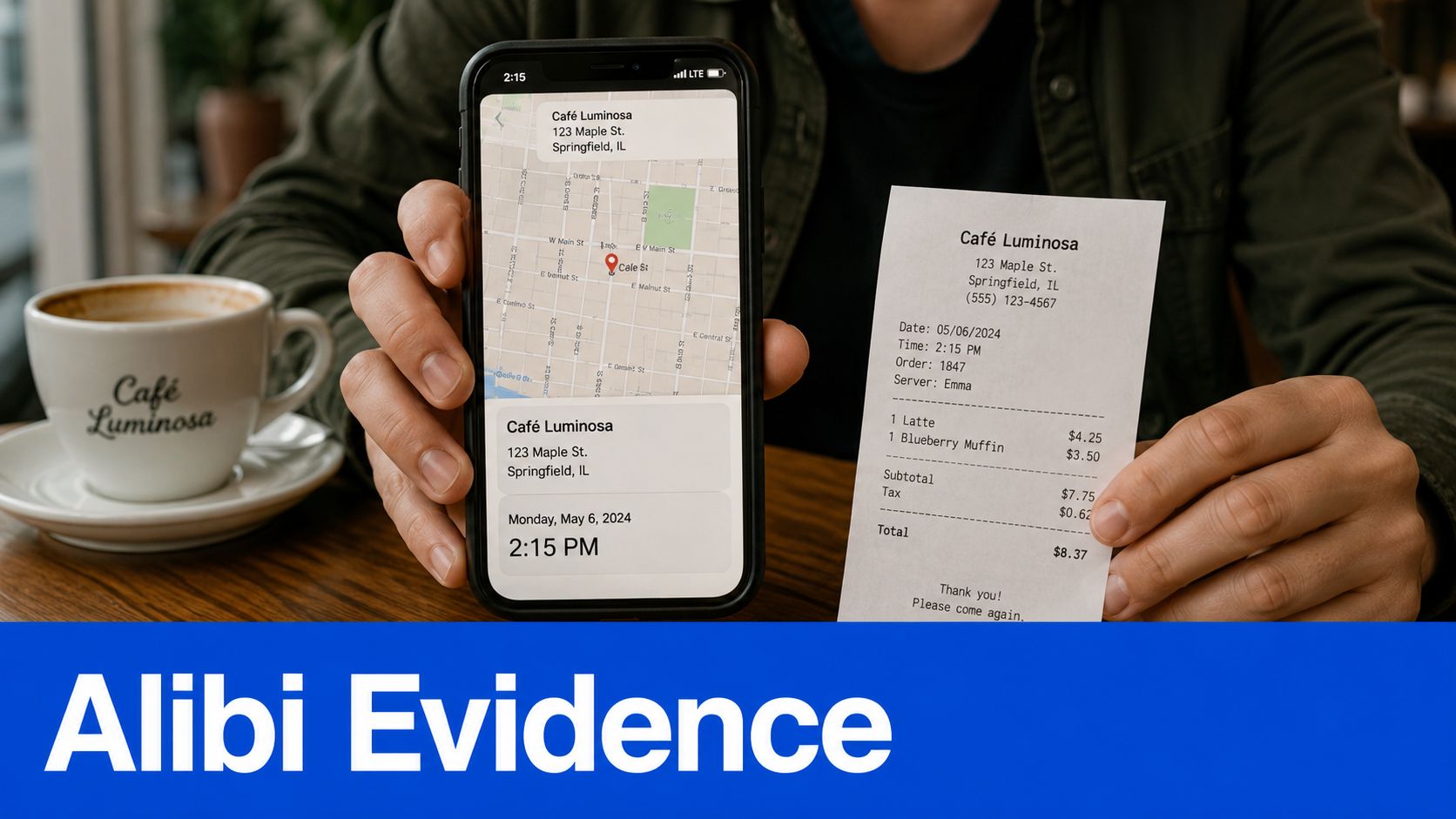
An alibi is one of the clearest defenses in criminal law, but it only works if the proof is strong and specific. The theory is simple. If you were somewhere else when the offense happened, you couldn't have committed the crime. The challenge is proving that with evidence people trust.
In South Florida, alibi defenses come up often in burglary, robbery, theft, and violent crime cases. A client may have work records, text messages, location data, or surveillance footage showing they were nowhere near the scene. Florida procedure also expects the defense to give notice of an alibi before trial, so this isn't the kind of defense you keep vague until the last minute.
What makes an alibi persuasive
A former prosecutor looks for corroboration, not just a single witness saying you were elsewhere. Jurors usually respond better when multiple sources line up. That can include a supervisor, a receipt, a phone location record, or video from a business camera.
Practical rule: The best alibi is specific, documented, and time-stamped. “I was somewhere else” is weak. “I was clocked in, on camera, and texting at the time” is much stronger.
This defense can be especially useful in theft cases where the State's timeline is sloppy. It can also help in assault or robbery prosecutions if the witness identification is shaky and the physical proof places you at another location. When the case turns on minutes, not just hours, every record matters.
A few fast steps help preserve the defense:
Save Digital Records: Keep texts, photos, app logs, and ride-share records.
Get Witness Names Early: Memories fade and witnesses move.
Pull Camera Footage Quickly: Businesses often overwrite video fast.
Secure Work Records: Timecards and schedules can be powerful.
Match Everything to the Timeline: A believable alibi has to fit the alleged offense window.
If you're dealing with a local theft crime penalties in Florida allegation, don't assume the State has the timing right. A strong alibi can force a reevaluation of the whole case.
4. Consent Defense
Consent can make a search lawful, but only if it was voluntary. That's why this defense is often about pressure, wording, and the officer's tone as much as the search itself. In DUI investigations, drug cases, and vehicle searches, police often frame questions in a way that makes refusal feel impossible.
The legal issue is whether the person understood they could say no. Officers don't always explain that right clearly, and clients often later say they felt cornered or rushed. A former prosecutor knows how those encounters are documented and where the State may overstate cooperation.
If the issue involves a search of your phone, car, or home, a clear record matters. One of the more useful Florida resources on the topic is Florida Statute 934.03, which clients often encounter when police start asking for access during an investigation.
What the defense looks for
Coercive Language: Phrases like “you have to” can change the analysis.
Authority Pressure: Uniforms, flashing lights, and multiple officers can make consent less than voluntary.
Ambiguous Requests: If police ask in a way that suggests there's no real choice, the defense can challenge that.
Implied Threats: Mentioning a K-9 or a warrant request may be relevant if it was used to pressure agreement.
This defense is also useful in the opposite direction. If you did consent and the defense is trying to argue otherwise, the State may rely on body cam video, witness statements, and your own words. That's why documentation is so important.
If police ask for consent, the safest answer is calm and clear. Don't argue. State your position, and let counsel evaluate it later.
For clients facing Florida domestic violence defense cases, the details of consent can affect a search of a phone, a home, or a shared vehicle. The same is true in traffic crimes where the police expand a routine stop into a larger investigation.
5. Mistaken Identity and Eyewitness Misidentification Defense
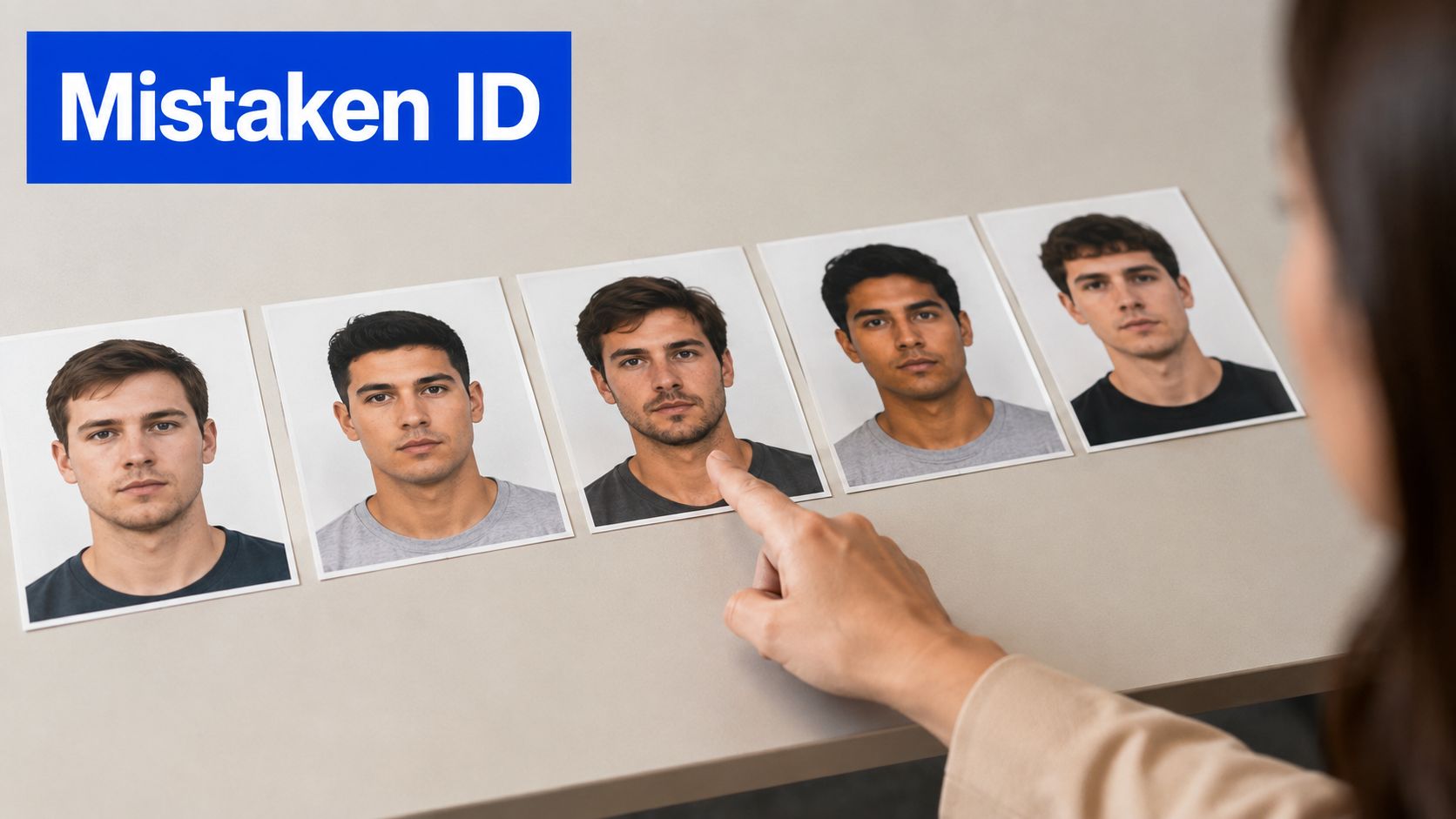
Eyewitness identification feels powerful in court, but it's not always reliable. Stress, poor lighting, distance, and suggestive police procedures can all lead a witness to identify the wrong person. That's why a mistaken identity defense is often central in robbery, assault, violent crime, and sex crime cases.
The defense works best when you can show the witness had a limited view, gave an inconsistent description, or went through a lineup that steered them toward the wrong suspect. A former prosecutor understands that juries pay attention to confidence, but confidence isn't the same as accuracy. The way a lineup or photo array is handled can matter a great deal.
How to attack an identification
Compare Early Descriptions: The first description matters more than later, polished testimony.
Review Lighting and Distance: Visibility can make or break the witness account.
Examine the Procedure: Photo arrays, lineups, and showups can be suggestive.
Look for Pressure: Police cues, repeated questioning, or feedback can contaminate memory.
Use Expert Help When Needed: Eyewitness reliability may need expert explanation in serious cases.
In a Fort Lauderdale robbery case, for instance, the defense may show the witness identified a suspect under poor conditions and with little opportunity to observe. In a Miami-Dade assault case, the lineup may have included a person who looked nothing like the original description. In a sex crime case, later forensic results may exclude the accused, which can be devastating to the State's identification theory.
The broad lesson from the criminal defenses taxonomy in Lumen Learning's course material is that defenses aren't interchangeable. Mistaken identity is not the same as a justification or excuse defense. It attacks whether the prosecution has the right person at all.
6. Lack of Probable Cause and Reasonable Suspicion Defense
Police can't just stop, search, or arrest someone because they feel uneasy. They need a lawful basis, and the level of justification changes depending on what they're doing. A stop usually requires reasonable suspicion, while an arrest or search usually needs probable cause.
That distinction matters in everything from a probation violation lawyer consultation to a roadside DUI arrest. If the officer had nothing more than a vague hunch, the defense may be able to suppress the stop or the evidence that followed. If the original contact was unlawful, the rest of the case can start to unravel.
Where the argument usually starts
An officer's report often sounds more detailed than the body cam video. That's why the defense checks the precise observations before the stop, not just what the officer said later in court. Vague words like “nervous,” “fidgety,” or “looked suspicious” are common, but they don't automatically create lawful grounds.
Practical rule: Ask what the officer saw before the stop, not after the arrest. The timeline is usually the battleground.
This defense is especially useful in traffic cases where the stop itself is questionable. It also matters in drug crimes involving street encounters, vehicle searches, and arrests based on generalized descriptions. In a South Florida case, for example, a car pulled over because it “matched a description” may still be challenged if that description was too broad to identify a particular vehicle.
A defense lawyer will usually want:
Dispatch Audio: It may show what the officer knew at the moment of the stop.
Body Cam Footage: Video can contradict a written report.
Specific Observations: The officer has to explain more than a gut feeling.
Training and Experience Details: These matter, but they don't replace actual facts.
A Suppression Motion: If the legal foundation is weak, file early.
This is one of the most important types of criminal defenses because it can defeat the case before the State gets to the merits.
7. Intoxication and Impairment Defense
A DUI arrest can look straightforward in a police report and much less certain once the evidence is tested. Officers often rely on field sobriety tests, breath results, or a blood draw, but each method has weaknesses that matter in court. A careful impairment defense focuses on those weak points before the State turns a shaky result into proof of guilt.
Field sobriety tests are subjective, and roadside conditions often make them worse. Breath testing can be affected by machine maintenance, operator error, and body conditions that distort the reading. Blood testing can be challenged through collection, storage, timing, and lab procedures. A Fort Lauderdale DUI lawyer would examine this as one of the first defense areas closely.
What to question in a DUI case
The standardized field sobriety tests, including the horizontal gaze nystagmus test, walk-and-turn, and one-leg stand, can be affected by balance problems, fatigue, medical conditions, footwear, lighting, traffic, and uneven pavement. The officer's instructions matter too, because a test that is explained poorly can produce a result that looks worse than the driver's true state. A practical review starts with the video, the written report, and the roadside conditions, then measures whether the test was fair enough to rely on.
If the tests were the weak link, the defense should examine the case from the ground up, not just accept the arrest narrative. The planned review at Florida field sobriety test should be part of that process, because the way these tests are administered often decides how much weight a prosecutor can argue they deserve. In South Florida courts, that detail can matter a great deal when the State tries to use roadside clues as proof of impairment.
The Federal government's defense structure also shows how institutional design affects case handling. The Bureau of Justice Statistics identifies three delivery models for indigent criminal defense, public defender programs, assigned-counsel systems, and contract systems, plus federal public defender organizations, community defender organizations, and CJA panel attorneys (BJS criminal defense systems). In practical terms, that structure affects how quickly evidence gets reviewed and how much time a lawyer has to challenge testing.
A strong DUI defense usually includes:
Field Sobriety Videos: Watch how the tests were administered.
Maintenance Records: Breath machines need documentation.
Operator Certification: Training matters.
Medical History: Balance or inner-ear issues can matter.
Expert Review: Toxicology review can expose technical flaws.
A blood result or breath number does not end the case. If the method was flawed, the defense may have a real argument for suppression, reduction, or dismissal.
The question is never just whether a test was taken. The question is whether the result is trustworthy enough to use in court.
8. Lack of Mens Rea and Criminal Intent Defense
A charge can look simple on paper and still fail at trial if the State cannot prove the right mental state. Florida prosecutors still have to prove more than a physical act. Depending on the offense, they must show intent, knowledge, recklessness, or negligence. If that mental state is missing, the case may fall apart even when the conduct itself is not disputed.
This defense comes up often in theft, drug possession, and white-collar cases. A person may be near contraband and still not know what it is. Someone may borrow property without any intent to steal it. A business owner may rely on an accountant or advisor and still not understand that the conduct was unlawful. The goal is not to excuse everything. It is to force the State to prove intent with evidence that supports the charge.
Why this defense matters in Florida cases
Florida courts do not treat every offense the same way. In a theft case, the State has to show more than possession or use. In a drug case, it has to prove knowledge. In a white-collar matter, the prosecutor often has to prove the person knew the conduct was wrongful, not just that a bad result happened. That distinction can matter in a Florida gun charge defense or a fraud case where possession, paperwork, and intent are all contested.
Former prosecutors look closely at the evidence that ties the defendant to the mental state at the exact time of the act. That is where many cases weaken. A text sent before the incident can support intent. A later statement may not. A confused instruction from a third party can help the defense. So can proof that the defendant was acting on incomplete information or making a mistaken assumption in good faith.
The most useful proof often includes:
Messages and Emails: They can show what the person believed.
Witness Testimony: People who know the defendant's habits and honesty can help.
Mistake-of-Fact Evidence: Honest confusion can negate intent.
Professional Advice: Reliance on an accountant or advisor may matter.
Clear Timeline Evidence: The mental state has to be tied to the moment of the act.
Practical defense work in this area also depends on how the local court views the charge. In South Florida, judges and prosecutors often focus on whether the State can connect the defendant's statements, conduct, and surrounding facts without making assumptions. That is where a defense lawyer can press for the difference between suspicious conduct and provable intent. Justia's defense overview is useful here because it separates lack of culpability, justification, and no actual crime occurred. Mens rea cases fall into the culpability category. That makes them different from a self-defense claim or a pure alibi.
9. Duress and Coercion Defense
Duress is one of the most serious defenses because it involves a person saying, in effect, “I did it because I was afraid of being hurt or killed.” Florida recognizes this as a complete defense when the threat is immediate, serious, and leaves no real way out. The threat has to be more than pressure, family conflict, or a vague fear of what might happen later.
This defense can arise in robbery, burglary, and drug trafficking cases, especially when someone says they were ordered to participate by an armed accomplice or gang member. It can also come up in cases where a person had no reasonable opportunity to contact police or escape the situation. A former prosecutor will look hard at the timeline, because duress claims often rise or fall on whether the threat was immediate.
What strengthens the defense
The best duress cases usually include proof the defendant tried to avoid harm or had a credible reason to believe the threat was real. Texts, voicemails, prior reports to police, and witness testimony can all help. So can medical records or photos showing the aftermath of threats or violence.
Practical rule: Duress is strongest when the threat is specific, immediate, and documented. General fear is not enough.
A client charged in Miami-Dade with transporting drugs, for example, may claim a gang member threatened their family. In a robbery case, the defendant may say an armed accomplice forced participation. In a burglary case, the alleged coercion still has to meet Florida's strict standards, so the defense needs more than sympathy. It needs detail.
A practical defense team will usually build:
A Timeline: Show there was no safe escape.
Threat Evidence: Save texts, calls, and messages.
Third-Party Witnesses: Independent witnesses help credibility.
Prior Reports: Previous police complaints can support fear.
Consistent Testimony: The story has to match the records.
Duress doesn't fit every case, but when it does fit, it can be powerful.
10. Self-Defense and Justification Defense
Self-defense is a justification, which means the act may have happened, but the law treats it as lawful under the circumstances. In Florida, that includes the state's Stand Your Ground law, Fla. Stat. § 776.013, which removes a duty to retreat in places where the person has a legal right to be. The key question is whether the belief in danger was reasonable at the time.
This defense is central in assault, battery, homicide, and many Florida domestic violence defense cases. It's also common in violent crime cases where the State says the accused was the aggressor, but the defense says the accused was responding to a real and imminent threat. The force used has to match the threat, and the facts have to support that response.
What prosecutors and defense lawyers look at
The defense usually turns on the scene itself. Was there a weapon? Was there a verbal threat? Were there injuries on the accused? Did surveillance or witnesses show the other person advancing first? Those details matter far more than after-the-fact arguments.
The most useful evidence often includes:
Photos of Injuries: Show the condition of the defendant right after the incident.
Scene Evidence: Broken items, damaged doors, and spacing matter.
Witness Accounts: Independent witnesses can help a great deal.
Video Footage: Surveillance can settle timing and movement.
Medical Records: They can support the defensive injury claim.
The BJS survey's historical snapshot also helps explain why self-defense cases end up in very different courtroom settings. In 1982, 43 of the 50 largest counties, covering 68% of the U.S. population, used public defender systems, while 15 states administered public defender systems and 32 other states plus the District of Columbia relied on locally administered systems BJS criminal defense systems survey. In plain terms, the defense model can affect how quickly self-defense evidence is developed and who handles it.
Self-defense is not about proving you were perfect. It's about proving the law recognizes your response as justified.
10 Criminal Defenses Compared
Defense Strategy | 🔄 Complexity | ⚡ Resource Requirements | ⭐ Expected Effectiveness / 📊 Typical Impact | 💡 Ideal Use Cases | 📊 Key Advantages |
|---|---|---|---|---|---|
Challenging Illegal Searches & Seizures (Fourth Amendment) | Moderate–High, legal motions and factual hearings | Low–Moderate, police reports, bodycam, discovery review | ⭐⭐⭐⭐, can suppress central evidence; high impact if successful | DUI, drug, weapons, vehicle searches, pretextual stops | Suppresses evidence, weakens or dismisses charges |
Challenging Evidence Quality & Chain of Custody | High, forensic and procedural scrutiny | High, lab records, expert forensic testimony | ⭐⭐⭐⭐, may render evidence inadmissible; strong in forensic-heavy cases | Drug weight/analysis, DUI blood tests, DNA/sexual-assault evidence | Exposes lab errors, undermines prosecution's core proof |
Alibi Defense (Proving Defendant Was Elsewhere) | Moderate, gather and authenticate location proof; statutory notice required | Moderate, witnesses, CCTV, phone/GPS records | ⭐⭐⭐⭐✦, can fully exonerate if corroborated | Theft, robbery, violent crimes where time/place is disputed | Complete acquittal possible; directly contradicts prosecution timeline |
Consent Defense (Demonstrating Lawful Voluntary Consent) | Moderate, factual review of interactions and recordings | Low–Moderate, bodycam/dashcam, witness statements | ⭐⭐⭐, can suppress evidence but outcome fact-dependent | Vehicle/home searches, DUI searches where consent claimed | Bodycam often decisive; prevents warrantless searches being validated |
Mistaken Identity / Eyewitness Misidentification | High, requires expert testimony and procedural analysis | High, lineup records, expert, scene photos/videos | ⭐⭐⭐, creates reasonable doubt, especially without corroboration | Robbery, assault, sex crimes where ID is focal evidence | Exposes reliability issues; has led to exonerations in similar cases |
Lack of Probable Cause / Reasonable Suspicion | Moderate, legal analysis of initial police contact | Low–Moderate, dispatch logs, bodycam, officer testimony | ⭐⭐⭐⭐, can void stop/arrest and suppress subsequent evidence | DUI traffic stops, pedestrian stops, stops based on vague descriptions | Suppresses all fruits of illegal stop; may lead to dismissal |
Intoxication / Impairment Defense (DUI) | High, scientific challenges to tests and observations | High, toxicology experts, equipment/calibration records, medical docs | ⭐⭐⭐, effective against flawed tests; BAC evidence harder to overcome | DUI arrests relying on FSTs, breath/blood tests | Undermines test reliability; can reduce charges or secure acquittal |
Lack of Mens Rea / Criminal Intent Defense | Moderate, legal/ factual proof of mental state | Low–Moderate, documents, communications, witness testimony | ⭐⭐⭐⭐, defeats convictions when intent element not proven | Drug possession, theft, white-collar offenses requiring specific intent | Targets prosecution's element of intent; may reduce or dismiss charges |
Duress / Coercion Defense | High, must prove immediacy and lack of safe escape | Moderate, threat communications, witnesses, police reports | ⭐⭐⭐, complete defense if credible but narrow application | Robbery, drug transport, crimes committed under credible threats | Can result in acquittal when threat is provable and imminent |
Self-Defense / Justification (including Stand Your Ground) | Moderate, factual demonstration of imminence and reasonableness | Moderate, witnesses, medical records, video evidence | ⭐⭐⭐⭐, strong statutory support in Florida; can fully justify force | Assault, homicide, domestic violence where threat was imminent | Complete justification if reasonable; may produce dismissal or acquittal |
Take Action with Ticket Shield, PLLC
Understanding your defense options is important, but the right strategy depends on the facts, the charge, and the court handling your case. In Broward County, Fort Lauderdale, Miami-Dade, Palm Beach, and surrounding South Florida communities, criminal cases often turn on early decisions about searches, statements, forensic records, and witness credibility. That's why it helps to speak with a Florida defense lawyer who knows how prosecutors evaluate weak points in the State's case.
Ticket Shield, PLLC, led by Attorney Jason S. Goldsmith, a former prosecutor, handles DUI, drug charges, domestic violence, theft offenses, violent crimes, weapons cases, probation violations, and other Florida criminal matters. The firm's approach is built around early issue spotting, direct communication, and customized defense planning, including challenges to illegal searches, unreliable field tests, and shaky evidence handling. For stressed clients, that kind of focused review can make the difference between reacting late and building a defense from the start.
If you're dealing with a license suspension, a pending arrest, or a court date that's coming up fast, don't wait to learn what defense fits your case. Call now, ask questions, and get a confidential consultation before the State's version of events becomes the only version on the record.
If you need help analyzing types of criminal defenses for a Florida case, Ticket Shield, PLLC can review the facts, explain your options, and help you decide what to do next. Visit Ticket Shield, PLLC to request a confidential consultation and get direct guidance on a DUI, drug charge, probation violation, or other criminal case in South Florida.