Receiving Stolen Property in Florida: A Defense Guide
Jason Goldsmith, Esq
A lot of people charged with receiving stolen property in Florida never set out to commit a theft crime.
They bought a discounted iPhone on Facebook Marketplace. They took a laptop from a friend who said he needed quick cash. They accepted tools, jewelry, or electronics as payment for work. Then police called, or showed up, and the conversation turned fast. Suddenly the issue wasn't what they paid or whether they personally stole anything. It was what they knew, what they should have known, and what the State thinks it can prove.
That kind of accusation is frightening because it can make an ordinary transaction look criminal in hindsight. In Broward County, Fort Lauderdale, Miami-Dade, Palm Beach, and across South Florida, these cases often come down to details those involved didn't realize mattered at the time: text messages, the sale price, missing receipts, serial numbers, who introduced the deal, and what happened after they learned there might be a problem.
A charge is serious. It is not the same as a conviction. In my experience, people get trapped when they assume, "I didn't steal it, so this will clear itself up." It usually doesn't. Receiving stolen property cases need a focused defense early, especially when prosecutors try to build a story out of circumstantial facts.
Table of Contents
An Accusation Can Happen to Anyone
A common version of this case starts with a deal that seemed normal at the time. Someone sees a PlayStation, a Rolex, a bike, or a MacBook listed online for less than retail. The seller says they need money fast. The buyer meets in a parking lot, pays cash or sends money through an app, takes the item home, and thinks the transaction is over.
A week later, an officer calls and says the item was reported stolen.
That moment catches people off guard because they hear the word "stolen" and assume the police will focus on the original thief. But Florida law also allows prosecutors to charge the person who received, kept, or dealt with the property afterward. In many cases, the legal fight centers on whether the buyer knew enough facts to make the purchase suspicious.
Everyday facts can look bad later
The same details that felt minor during a quick sale can become the core of the State's case:
Low price can be framed as a warning sign.
Cash payment can be described as an effort to avoid a paper trail.
No receipt or box can be used to suggest the property wasn't legitimately owned.
Changing explanations during a police interview can hurt credibility fast.
Practical rule: If police think you "should have known" the property was stolen, they'll often try to prove it through surrounding circumstances instead of a direct admission.
I've seen good people make their situation worse by trying to talk their way out of it. They think being cooperative will solve the misunderstanding. Instead, they fill gaps in the State's timeline, guess about where the item came from, or make statements that prosecutors later argue show consciousness of guilt.
Fear is normal, but speed matters
If you're reading this after an arrest, a notice to appear, or a call from detectives in Fort Lauderdale or elsewhere in South Florida, your next steps matter. Evidence that helps you can disappear quickly. Marketplace listings get deleted. Phones are replaced. Text threads are edited. Sellers vanish.
The important point is simple. An accusation of receiving stolen property often grows out of a transaction that looked ordinary until police reconstructed it. That reconstruction can be challenged, but only if the defense starts early and stays focused on the facts that are relevant.
What Is Receiving Stolen Property in Florida
A common South Florida fact pattern looks like this. Someone buys a phone, watch, power tool, or laptop through Facebook Marketplace, OfferUp, or a friend of a friend. Two weeks later, police say the item was stolen. The buyer's first reaction is usually the same: "I did not steal anything." That may be true, but it does not end the case. Florida can still charge a person who received, kept, or sold property that the State claims was stolen.
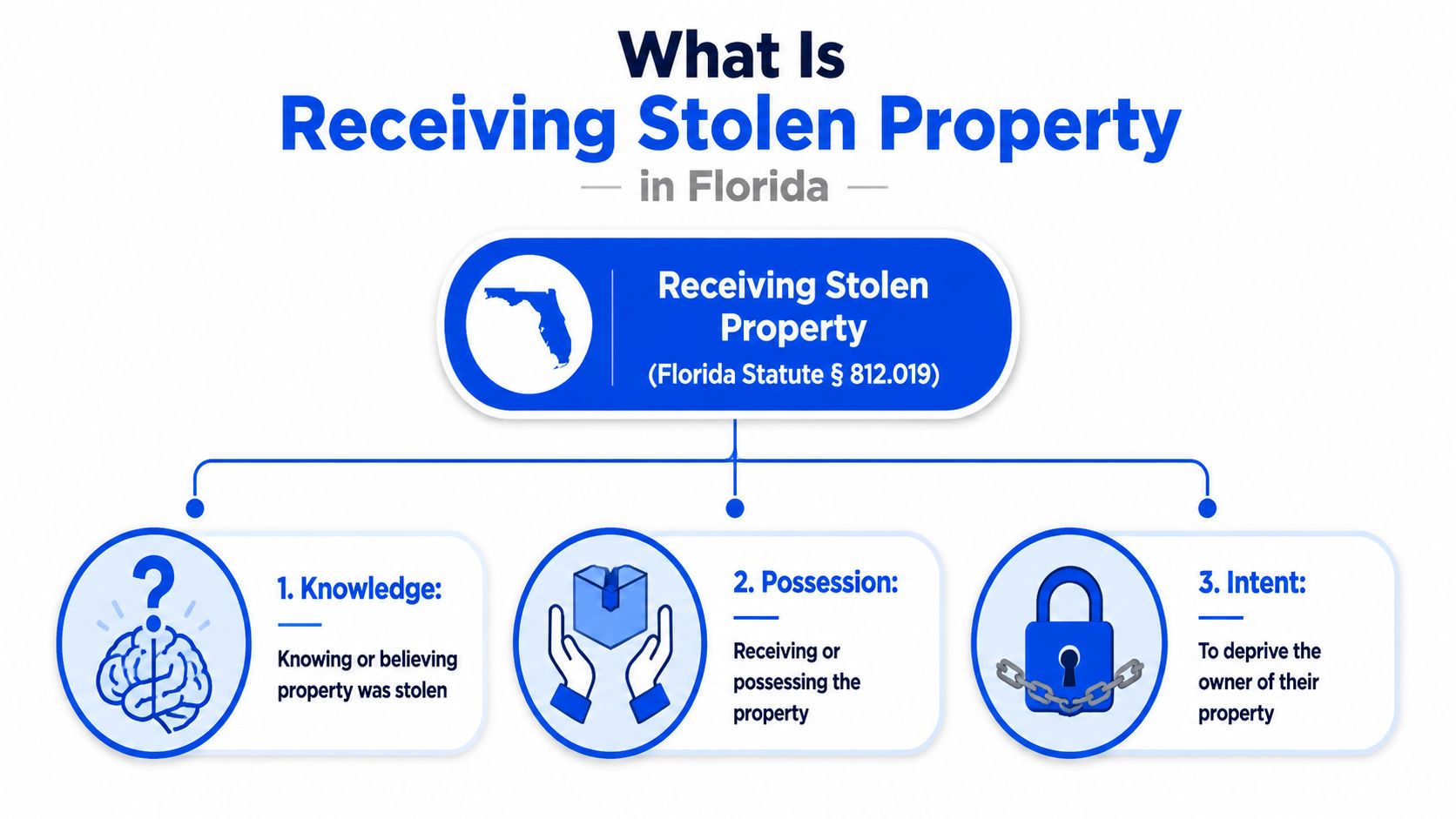
Florida treats this offense as dealing in property that was obtained through theft. In plain terms, the State has to prove more than possession alone. Prosecutors must tie the item to a theft and prove that, at the time you received or kept it, you knew it was stolen or the circumstances were suspicious enough that they will argue you should have known.
The three issues the State tries to prove
Prosecutors usually build these cases around three legal points:
Possession or control
The State must show you received the property, retained it, or disposed of it. Title and formal ownership are not required. Control over the item can be enough.Knowledge
This is usually the main fight. The question is whether you knew the property was stolen, or whether the surrounding facts were suspicious enough for the State to argue that a reasonable person in your position would have recognized the problem.Intentional dealing with the property
The prosecution also has to prove that your handling of the property was not accidental or innocent. Selling it, hiding it, pawning it, transferring it, or keeping it after learning facts that point to theft can all become part of the State's theory.
The knowledge element decides many of these cases.
As a former prosecutor, I can say this plainly. The State almost never has direct proof of what a person was thinking. Prosecutors prove knowledge with circumstantial evidence and ask the judge or jury to connect the dots. They focus on the details surrounding the transaction, your statements, what you did after the purchase, and whether your explanation fits the evidence.
That is where Florida cases get difficult for defendants and interesting for defense lawyers. "Should have known" sounds objective, but in court it is argued through very specific facts tied to your situation. A skilled defense attorney does not just say, "My client did not know." The better approach is to attack the inferences one by one. Was the price suspicious for a used item? Was the seller someone the buyer had dealt with before? Did the item come with messages, receipts, packaging, or a plausible explanation? Did police ignore facts that supported an innocent purchase?
Those details matter because suspicion is not proof beyond a reasonable doubt.
These cases are no longer limited to jewelry, vehicles, and electronics. They can also involve online transfers, account access, stored business data, and other forms of property that do not fit the old picture of "stolen goods." The legal issue stays the same. The State must still prove possession, knowledge, and intentional dealing with property tied to a theft.
For a broader look at related offenses, see this Florida theft and property crimes hub.
In many receiving stolen property cases, the central dispute is not whether the item was stolen. The real dispute is whether the State can prove you knew enough about the circumstances to be treated as part of the crime.
Florida Penalties Based on Property Value
One of the first questions people ask is, "Am I looking at a misdemeanor or a felony?" That's the right question because value often drives charging decisions, plea bargaining strength, and sentencing exposure.
The law in many states uses value thresholds to increase or reduce penalties. That makes valuation evidence more important than commonly assumed. It also creates room for defense work, because the number assigned to the property isn't always as clear or as reliable as police reports suggest.
Why value becomes a battleground
The prosecution may rely on an owner's estimate, an online listing, a replacement cost, or a broad description in a report. Those figures don't always reflect fair market value. If the item was used, damaged, incomplete, or old, the alleged amount can be inflated.
Value is important because it can change how the offense is treated and what kind of sentence a person faces.
As one example of how much valuation affects exposure, Massachusetts General Laws Chapter 266, Section 60 sets a first-offense ceiling of up to 2.5 years in jail and/or a $3,000 fine when the property value does not exceed $1,200, but raises exposure to up to 5 years in state prison and/or a $5,000 fine when the value exceeds $1,200 or for repeat offenses (Massachusetts receiving stolen property penalty thresholds). The Florida takeaway is practical, not geographical. When value controls severity, the defense should challenge the State's proof of value instead of treating that issue as secondary.
Penalty table
The exact charge level in Florida depends on how the State classifies the alleged property value under Florida theft statutes and the facts of the case.
Property Value | Offense Level | Maximum Penalties |
|---|---|---|
Lower alleged value range | Misdemeanor-level exposure may be argued in some cases | Jail exposure, probation, fines, court costs, and a permanent record can all be in play |
Mid-range alleged value | Felony-level exposure becomes a serious concern | Potential prison exposure increases, along with probation conditions and collateral consequences |
Higher alleged value or aggravating facts | More serious felony treatment is possible | Greater sentencing risk, stronger pressure in plea negotiations, and more lasting record consequences |
Key point: In a receiving stolen property case, value isn't just about money. It's about classification, leverage, and long-term consequences.
What this means in South Florida courts
In Broward County, Miami-Dade, and Palm Beach County, prosecutors routinely look at police reports and quick valuation summaries when deciding how to file a theft-related case. That means the first number attached to the property can shape the case before the defense has had a real chance to test it.
A careful defense lawyer looks at:
Condition of the property
Age and depreciation
Whether accessories or components were missing
Whether the owner's claimed value reflects market reality
Whether multiple items were grouped together in a way that inflates the total
If the State overstates value, the defense may be able to push for a reduction in charge severity or improve the posture for negotiation. In some cases, the valuation fight is almost as important as the knowledge fight.
Building a Defense Strategy in South Florida
A strong defense to receiving stolen property doesn't rely on a single slogan like "my client didn't know." That alone usually isn't enough. Prosecutors expect that response, and they often come prepared with texts, timing, sales details, and statements they say prove otherwise.
The better approach is to break apart the State's theory piece by piece.
Most defenses focus on knowledge and intent
The most common winning ground is the prosecution's effort to prove what you knew.
A useful defense may be built around one or more of these themes:
Legitimate purchase circumstances
If the transaction looked normal, that matters. Meeting at a residence, paying a market-based price, reviewing the item, seeing a working device, or having a message trail can all cut against the idea that the purchase was obviously suspicious.Mistaken belief about ownership
People buy and accept property from coworkers, relatives, neighbors, romantic partners, and longtime friends. A defense may argue you had a reasonable basis to believe the person had the right to sell or transfer the item.Lack of criminal intent
Sometimes a person held the item briefly, didn't try to hide it, and didn't attempt resale. Those facts can matter when the prosecution tries to frame ordinary possession as criminal conduct.Intent to return or resolve the issue
Conduct after learning there may be a problem can also matter. If someone tried to return the item, preserve it, or cooperate through counsel, that can fit a very different narrative than deliberate concealment.
When prosecutors don't have direct proof of knowledge, they often ask jurors to stack one suspicious fact on top of another until it sounds like certainty. A defense lawyer's job is to separate suspicion from proof.
A related theft charge sometimes appears in the same factual neighborhood. If your case involves allegations about resale, transfer, or trafficking, this overview of Florida dealing in stolen property defense may also be useful.
How a defense lawyer attacks circumstantial evidence
Florida prosecutors often rely on circumstantial evidence because they rarely have direct admissions. Qualitatively, many convictions involve defendants who insisted they didn't know the property was stolen, yet the State persuaded the court or jury that the circumstances were enough. That is why these cases turn on detail.
The defense may challenge circumstantial proof in several ways:
Attack the suspicious-price argument
A low price can sound bad in a courtroom. But lots of legitimate sales happen below retail. People need rent money. They move. They upgrade devices. They sell gifts they don't want. The question isn't whether the deal was good. The question is whether the facts made theft obvious.
Reconstruct the transaction
Screenshots matter. Payment app records matter. Marketplace profiles matter. So do timestamps, location data, and the sequence of communications. If the seller acted like a normal owner and your messages reflect an ordinary transaction, that can undercut the State's narrative.
Limit the damage from statements
Many defendants hurt themselves during informal police questioning. They guess, fill silence, or try to sound helpful. A defense lawyer works to keep unreliable or contextless statements from becoming the centerpiece of the case.
Challenge possession itself
Constructive possession arguments can be weak. If the item was in a shared home, shared vehicle, or common area, the State still has to prove more than mere proximity.
I've handled enough theft-related cases to know that prosecutors in Fort Lauderdale and West Palm Beach often present these charges as common-sense cases. Sometimes they are. Sometimes they are built on assumptions that collapse once the timeline, the valuation, and the witness statements are tested carefully.
The Criminal Case Process from Arrest to Trial
Those facing such charges often fear the process almost as much as the charge itself. They don't know which hearing matters, whether they have to speak, or when a case can improve. The Florida court process becomes easier to manage once you see it in order.
What happens first
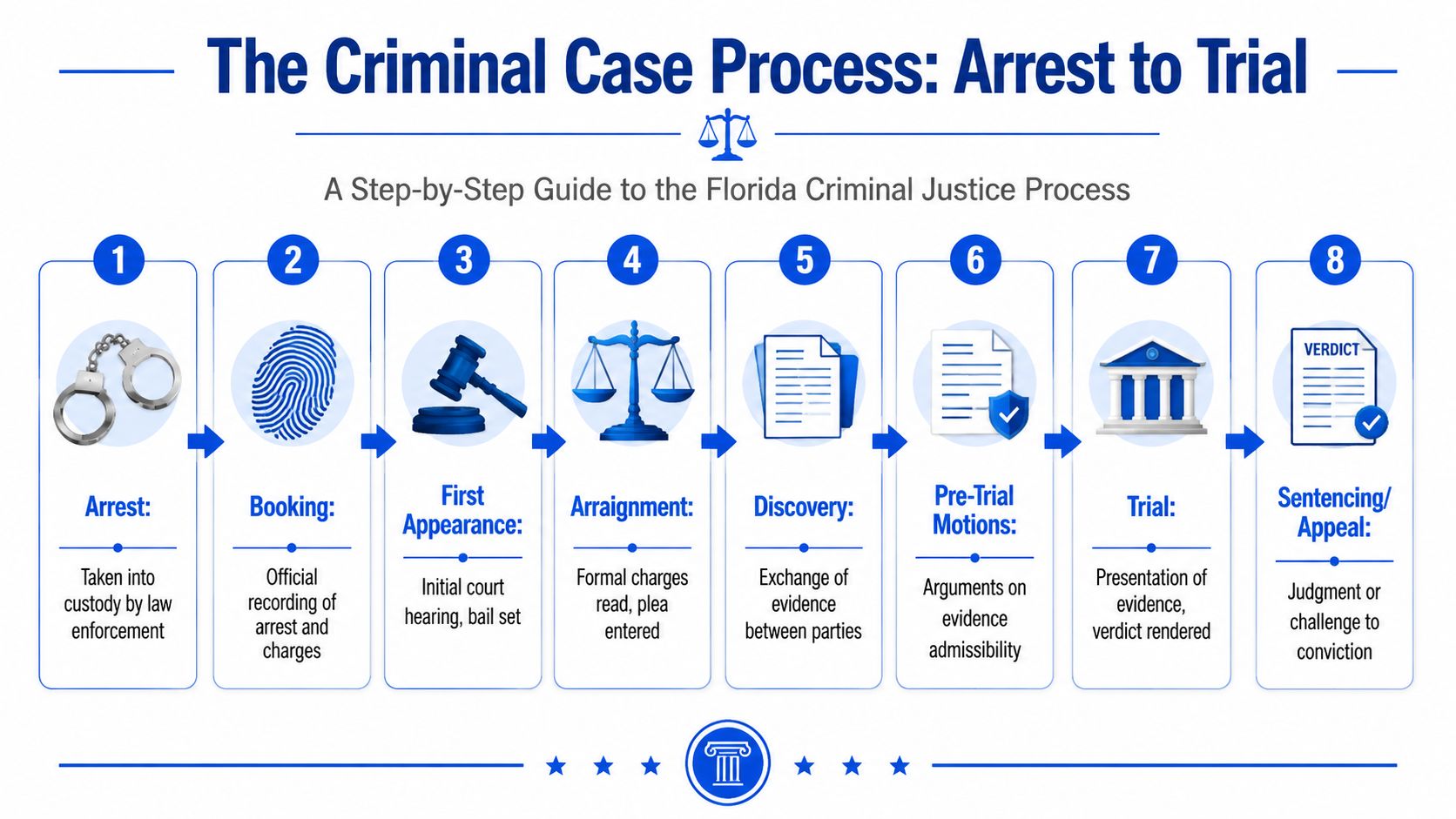
After an arrest, the case usually starts with booking and a first appearance. That is where bond and release conditions are addressed. The court may set restrictions that affect travel, contact with witnesses, or other case-related issues.
Next comes arraignment, where the formal charge is announced and a plea is entered. In many misdemeanor and felony cases, a lawyer can handle procedural appearances and reduce how often you need to miss work or disrupt your life.
A typical sequence looks like this:
Arrest or notice to appear
Law enforcement starts the criminal case.First appearance and bond
The judge reviews release conditions.Arraignment
The defense enters a plea and preserves rights.Discovery
The State turns over reports, recordings, witness information, and other evidence.
Where cases are won before trial
A lot of important work happens after discovery begins. During this time, the defense studies body camera footage, pawn records, phone evidence, surveillance, and witness statements. Legal issues are also identified.
Those issues may include:
Motions to suppress statements if police questioning violated rights
Challenges to search and seizure
Attacks on weak valuation proof
Negotiation for reduction or dismissal
Diversion discussions when the facts and background support it
Some defendants may qualify for alternatives to a conviction, depending on the charge, the county, and the person's history. In some cases, a program like Florida pre-trial intervention can create a path toward dismissal.
Most criminal cases don't turn on a dramatic trial moment. They turn on what the lawyers uncover, preserve, and challenge in the weeks and months before trial.
If the case doesn't resolve, it moves toward trial. At trial, the State has to present admissible evidence and prove every element beyond a reasonable doubt. The defense can cross-examine witnesses, challenge assumptions, present contrary evidence when appropriate, and argue that suspicion isn't enough.
If there is a conviction, sentencing follows. If there is a legal basis to challenge the result, post-trial motions or an appeal may be available.
Immediate Steps and Protecting Your Future
If you're under investigation or already charged, the first few decisions matter more than is commonly understood. Small mistakes can make a weak case stronger for the State.
What to do right now
Start with these priorities:
Stop talking about the facts with police
You have the right to remain silent. Use it. Even truthful explanations can be misheard, shortened in a report, or turned into admissions.Stay off social media
Don't post about the transaction, the seller, the property, or your frustration. Prosecutors love screenshots because they freeze a bad moment forever.Preserve every piece of evidence
Save receipts, Cash App or Zelle records, Marketplace messages, call logs, screenshots, packaging, serial number photos, and contact information for anyone who saw the transaction.Write down the timeline while it's fresh
Do this for your lawyer, not for police. Include where the sale happened, what was said, who was present, how much you paid if relevant, and when you first learned there might be a problem.
Possible off-ramps from a conviction
Not every receiving stolen property case ends in a conviction. Some are reduced. Some are dismissed. Some are resolved through diversion. In other situations, the prosecution later abandons the case, which can happen through a Florida nolle prosequi.
That matters because a favorable outcome may open the door to record relief later. Depending on the disposition and your history, sealing or expungement may become part of the long-term strategy to protect employment, licensing, housing, and reputation.
The worst move is waiting and hoping the case disappears on its own. Early legal advice can preserve defenses, prevent damaging statements, and put the case on a far better track.
FAQs About Receiving Stolen Property Charges
What if I returned the item right away
Returning the property can help, but it doesn't automatically end the case. The key issue is still what the State claims you knew at the time you received or kept it. Quick return may support a lack-of-intent argument, depending on the facts.
Does buying from a pawn shop automatically make me guilty
No. A lawful purchase from a business doesn't automatically prove criminal knowledge. Still, police and prosecutors may examine paperwork, identification records, pricing, and whether the transaction looked ordinary.
Can I be charged if the property was a gift
Yes, you can be charged, but the State still has to prove the required knowledge and intent. If you accepted a gift without reason to think it was stolen, that can be a strong defense theme.
What if I never stole anything myself
You don't have to be the original thief to face a receiving stolen property charge. These cases focus on what happened after the theft and what the prosecution says you knew.
Should I call the detective to explain
Usually, no. People often think they can clear up a misunderstanding by talking. In practice, they often give the State new statements to use against them. Talk to a defense lawyer first.
If you're facing a receiving stolen property charge in Broward County, Fort Lauderdale, Miami-Dade, Palm Beach, or anywhere in Florida, Ticket Shield, PLLC can help you assess the evidence, protect your rights, and build a defense customized for the facts of your case. A confidential consultation can clarify what you're facing and what options may be available now.
Receiving stolen property charges hinge on what you knew. Learn what prosecutors must prove and how to fight the charge in Florida.