What Is a VOP Felony in Florida and What Happens Next
Jason Goldsmith, Esq
A felony VOP is not a new felony charge. It is an alleged violation of felony probation, and Florida may revoke probation and resentence you up to the original felony maximum under the lower preponderance-of-the-evidence standard.
You may be reading this after a probation officer called, after someone in your family was arrested on a violation warrant, or after a court notice appeared without much explanation. In Broward County, Fort Lauderdale, Miami-Dade, Palm Beach, and other South Florida courts, the first hours can feel confusing because a VOP doesn't follow the same path as a new criminal prosecution.
The accusation might involve a missed appointment, an unpaid obligation, a failed treatment requirement, or alleged new criminal conduct. Those situations don't carry the same legal consequences. A technical violation may qualify for modification or an alternative sanction, while certain high-risk felony probationers may face detention without bail before the violation hearing.
This guide explains what a VOP felony means in Florida, how the court process works, what penalties may follow, and what steps can protect your position. If you're trying to understand Florida criminal procedure more broadly, Ticket Shield, PLLC also provides an overview of Florida criminal laws.
Table of Contents
Introduction to VOP Felony Cases in Florida
A person on felony probation in Broward County might receive a call directing them to report immediately. Another person might come home to find officers waiting with a VOP warrant. A family member may hear only that the person is being held on “probation,” without knowing whether that means a new felony, a missed appointment, or something more serious.
The first point is simple: a felony VOP means violation of felony probation. The court is deciding whether the person broke a condition of an existing supervision order. It isn't automatically a new felony case, and it doesn't give the person a new jury trial on the original offense.
Florida treats the allegation seriously because probation is a conditional alternative to incarceration. The person received an opportunity to remain in the community under court-ordered rules. If the State proves a violation by a preponderance of the evidence, the judge may continue probation, modify its conditions, or revoke it. If probation is revoked, the court can resentence the person for the original felony.
A VOP can threaten the sentence that probation allowed you to avoid, even though the alleged violation itself isn't a separate felony charge.
The risk depends on several details, including the original felony class, the exact probation condition, whether the alleged conduct was technical or criminal, prior violations, and whether the person has a special high-risk designation. A new arrest can create additional pressure, but an arrest doesn't automatically establish guilt in the new case.
Families should avoid treating a VOP as something that will resolve on its own. A probation violation lawyer can review the conditions, the affidavit, the evidence, detention status, and possible alternatives before the hearing. Early preparation may also help preserve defenses in a related DUI, drug crime, domestic violence, theft, weapons, or other criminal case.
What a VOP Felony Means Under Florida Law
Probation is court-ordered supervision in the community. Instead of serving the entire sentence in custody immediately, a person must follow conditions imposed by the court. Those conditions may include reporting, treatment, testing, travel restrictions, employment requirements, payment obligations, or compliance with all criminal laws.
Felony probation generally relates to a more serious underlying offense than misdemeanor supervision. The important question isn't whether the word “felony” describes the alleged breach. It describes the original offense connected to the probation order.
A useful analogy is a conditional agreement. The court permits a person to remain in the community, but that freedom comes with enforceable terms. If the State alleges that a term was violated, the court holds a supervision proceeding to decide what happens next.

The court, not a jury, handles the violation question
Under Florida Statutes section 948.06, a judge may find a violation when there are reasonable grounds and the State proves the allegation by a preponderance of the evidence. That means the State must show that the violation is more likely than not, rather than proving it beyond a reasonable doubt as required for a new criminal conviction.
The court may revoke, modify, or continue probation. If it revokes probation, the judge may adjudicate guilt on the original offense and impose a sentence that could have been imposed at the original sentencing. Florida court materials describe this as exposure tied to the underlying felony grade. A third-degree felony carries exposure up to 5 years, a second-degree felony up to 15 years, a first-degree felony up to 30 years, and a life felony up to life imprisonment. These felony-class figures come from the Florida courts' VOP outline.
A conviction on alleged new conduct isn't required for the VOP itself. Alleged new criminal conduct may support the supervision violation before a separate criminal case is resolved. That doesn't mean the person is guilty of the new offense. It means the VOP and new prosecution are separate legal tracks.
For readers researching the underlying charge, what a felony charge means in Florida is a different question from what happens after a probation allegation. The original felony classification usually determines the sentencing ceiling in the VOP proceeding.
How a VOP Differs From a New Criminal Charge
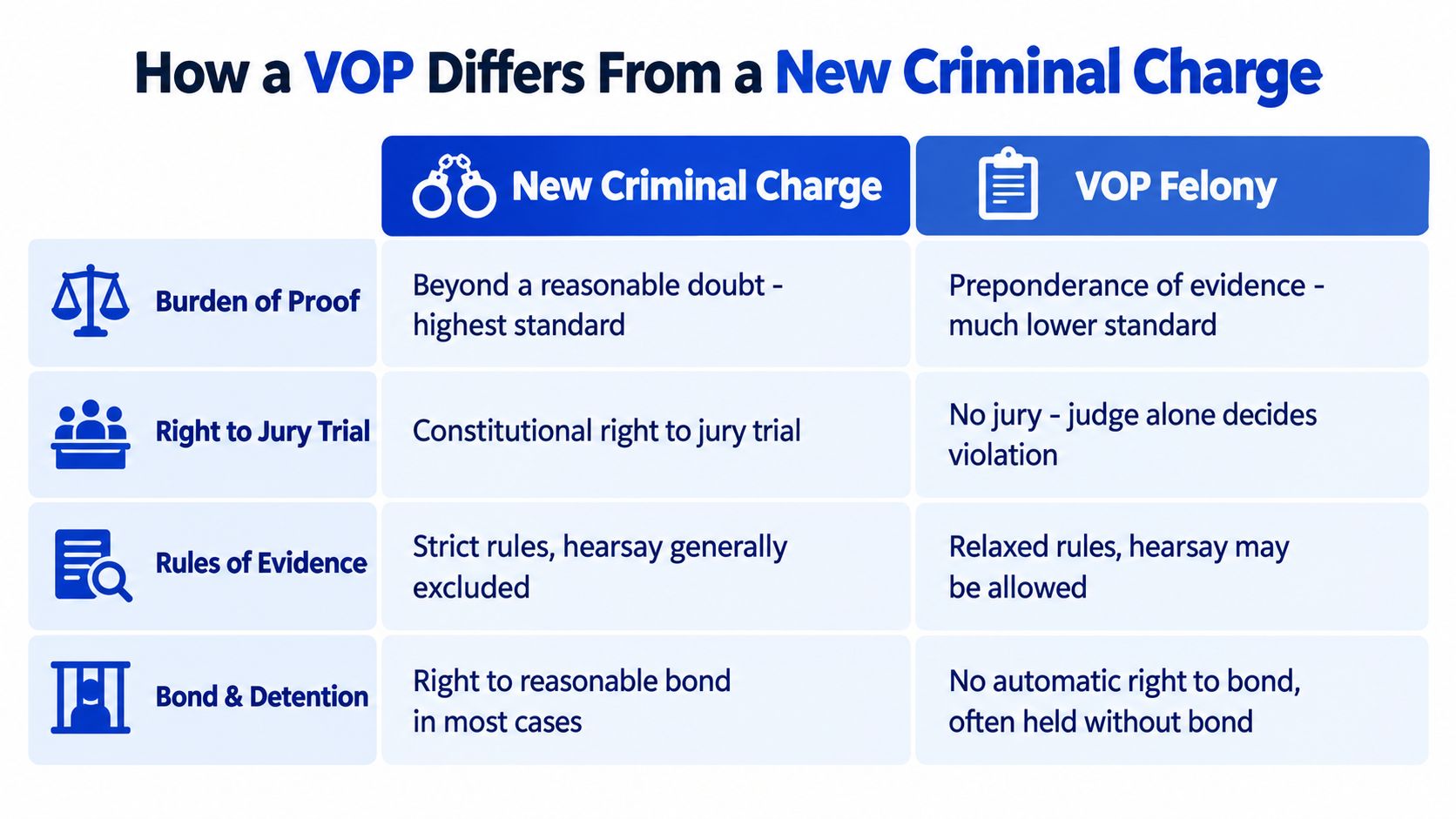
A VOP and a new criminal charge may arise from the same event, but they ask different legal questions.
A new prosecution asks whether the defendant committed a new offense. The State must prove every required element beyond a reasonable doubt, and the defendant generally has a constitutional right to a jury trial. A VOP asks whether the person violated a condition of supervision. The judge decides that issue, and the proof standard is lower.
Two proceedings, two different questions
The distinction matters in a practical example. Suppose a person on felony probation is arrested for allegedly possessing drugs. The new drug case may remain pending, be dismissed, or eventually result in an acquittal. The State may still pursue a VOP based on evidence it claims shows a violation of the probation condition requiring compliance with criminal laws.
That result can seem unfair to families because the person hasn't been convicted of the new offense. The legal explanation is that Florida treats the VOP as a supervision matter, not as a second trial for the new charge.
Legal issue | New criminal charge | Felony VOP |
|---|---|---|
Main question | Did the defendant commit a new offense? | Did the person violate probation? |
Proof standard | Beyond a reasonable doubt | Preponderance of the evidence |
Decision-maker | Judge or jury, depending on the case | Judge |
Proceeding | New criminal prosecution | Supervision proceeding |
Possible result | Conviction, acquittal, dismissal, or other resolution | Continue, modify, or revoke probation |
The central distinction: A VOP is about compliance with supervision, not a new finding of guilt after a criminal jury trial.
The evidence rules and available constitutional protections can also differ. A defense lawyer must examine how the State obtained its evidence, whether the probation condition was clear, and whether the alleged conduct establishes a violation. The defense may also need to coordinate the VOP strategy with the new case so that statements made in one proceeding don't damage the other.
A person shouldn't assume that dismissal of the new case automatically ends the VOP. The two matters may require separate motions, hearings, negotiations, or factual challenges. That is one reason a VOP allegation deserves prompt attention from a Florida criminal defense attorney.
Florida VOP Process and Court Procedures in Broward County
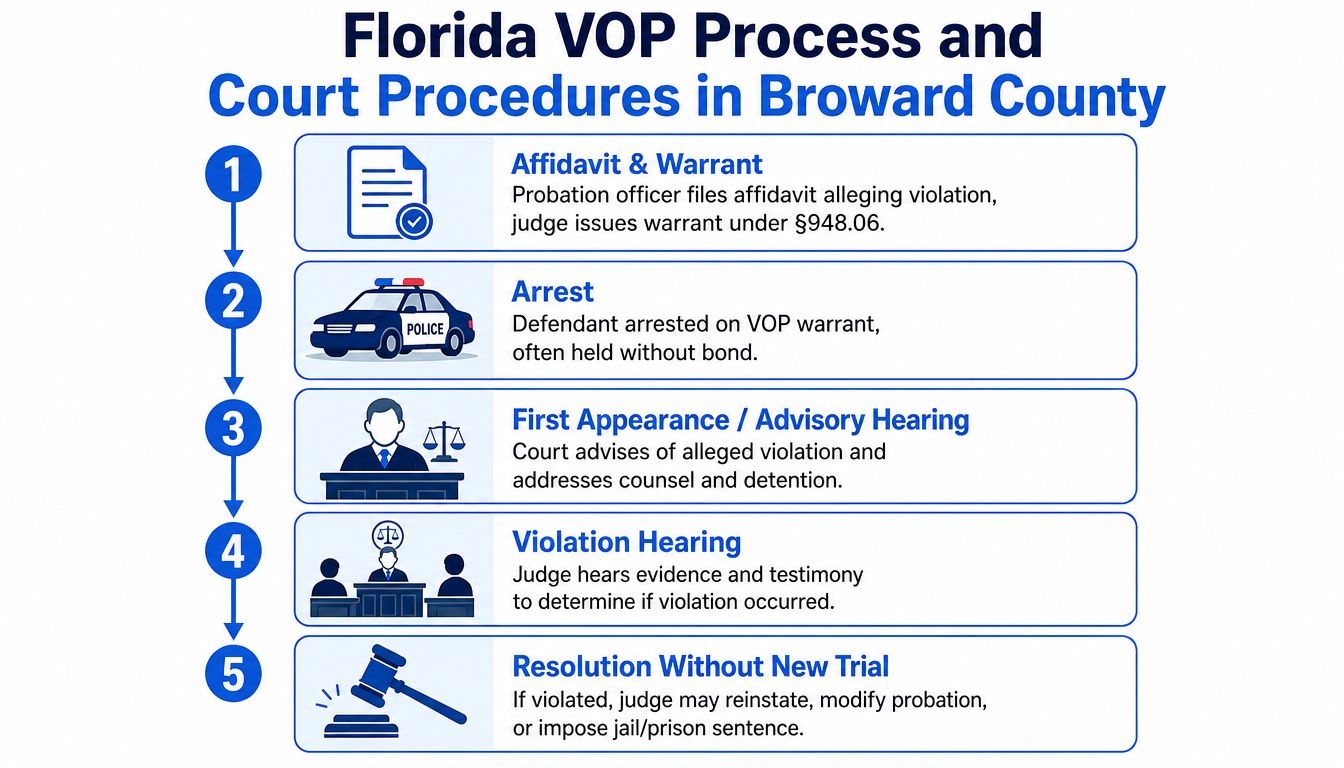
Florida law provides several ways a probation violation can reach court. Under Florida Statutes section 948.06, an officer may act without a warrant when there are reasonable grounds to believe a material violation occurred. A judge may also issue a warrant based on an affidavit from someone with knowledge of the facts.
The person may be returned to the court that imposed probation. In South Florida, that can mean navigating different calendars, detention procedures, and courtroom practices in Broward, Fort Lauderdale, Miami-Dade, or Palm Beach, depending on the original case and the alleged conduct.
The usual procedural path
Affidavit or violation report: The probation officer or another person with knowledge describes the alleged breach. The document should identify the condition involved and the factual basis for the allegation.
Warrant, arrest, or direct handling: The court may issue a warrant. In some circumstances, an officer can handle the violation without first obtaining one. An arrest can lead to detention while the court addresses the violation.
First appearance or advisory hearing: The court advises the person of the allegation and addresses counsel and detention. The court may also determine whether the person can be released while waiting for the violation hearing.
Violation hearing: The State presents evidence and witnesses. The defense may challenge the allegation, cross-examine witnesses, present evidence, and argue that the State hasn't met the preponderance standard.
Disposition: If the judge finds no violation, probation continues under the existing order. If the judge finds a violation, the court may continue supervision, modify its conditions, or revoke probation and impose a sentence connected to the original felony.
Why detention status matters
Certain felony probationers may face no-bond detention before the violation hearing. Under Florida Statutes section 903.0351, that risk applies to specified classifications, including a violent felony offender of special concern, a habitual violent felony offender, a three-time violent felony offender, or a sexual predator.
A person or family member should gather the probation order, violation paperwork, release documents, treatment records, employment records, travel permissions, testing information, and messages relevant to the allegation. Don't discuss the substance of the allegation casually with probation officers, witnesses, or anyone posting about the case online.
The process differs from a standard Florida arraignment, so a family shouldn't assume that ordinary bond expectations or criminal-case timelines apply.
Penalties and Possible Outcomes for a Felony VOP
A felony VOP doesn't produce one automatic result. The judge may continue probation, modify it with additional conditions, impose an alternative sanction, or revoke probation and resentence the person for the original offense.
The underlying felony class controls the maximum exposure if probation is revoked. The alleged breach affects how the court views the case, but the violation itself doesn't become a separate felony with its own classification.
Original felony class | Maximum exposure if revoked | Violation type impact |
|---|---|---|
Third-degree felony | Up to 5 years | A technical or low-risk violation may support continued or modified probation, while repeated or serious conduct can increase revocation risk. |
Second-degree felony | Up to 15 years | The court evaluates the original offense alongside the nature of the violation, prior compliance, and available mitigation. |
First-degree felony | Up to 30 years | A serious violation can place the suspended sentencing benefit at substantial risk. |
Life felony | Up to life imprisonment | The original felony grade creates the highest stated exposure if probation is revoked. |
The felony-class sentencing ranges appear in Florida court materials and Florida probation-violation practice references, including this explanation of Florida VOP jail time.
Technical violations and alternative sanctions
Florida distinguishes lower-risk technical violations from new-law violations and certain excluded categories. For eligible low-risk cases, the law allows alternative sanctions instead of full revocation. One statutory pathway can include up to 90 days in jail as a special condition of modified probation for a first or second low-risk violation, as described in this Florida probation framework from Hornsby Law.
That possibility doesn't mean every technical violation receives a short sanction. Eligibility, prior violations, the exact condition, the person's risk classification, and the judge's findings all matter. New alleged offenses may create much greater exposure, especially when the State presents evidence suggesting danger or deliberate noncompliance.
High-risk violent-offender cases
For a violent felony offender of special concern, Florida law takes a stricter approach. If the court finds that the person poses a danger to the community, revocation is required and the court may impose a sentence up to the statutory maximum, or longer if otherwise allowed.
Revocation also has a financial and custody-related consequence that families often miss. Under section 948.06, the person forfeits gain-time or commutation earned up to release on supervision if probation is revoked. The exact outcome still depends on the record, the original sentence, the allegation, and the court's findings.
Common Defenses and Practical Steps After a VOP Allegation
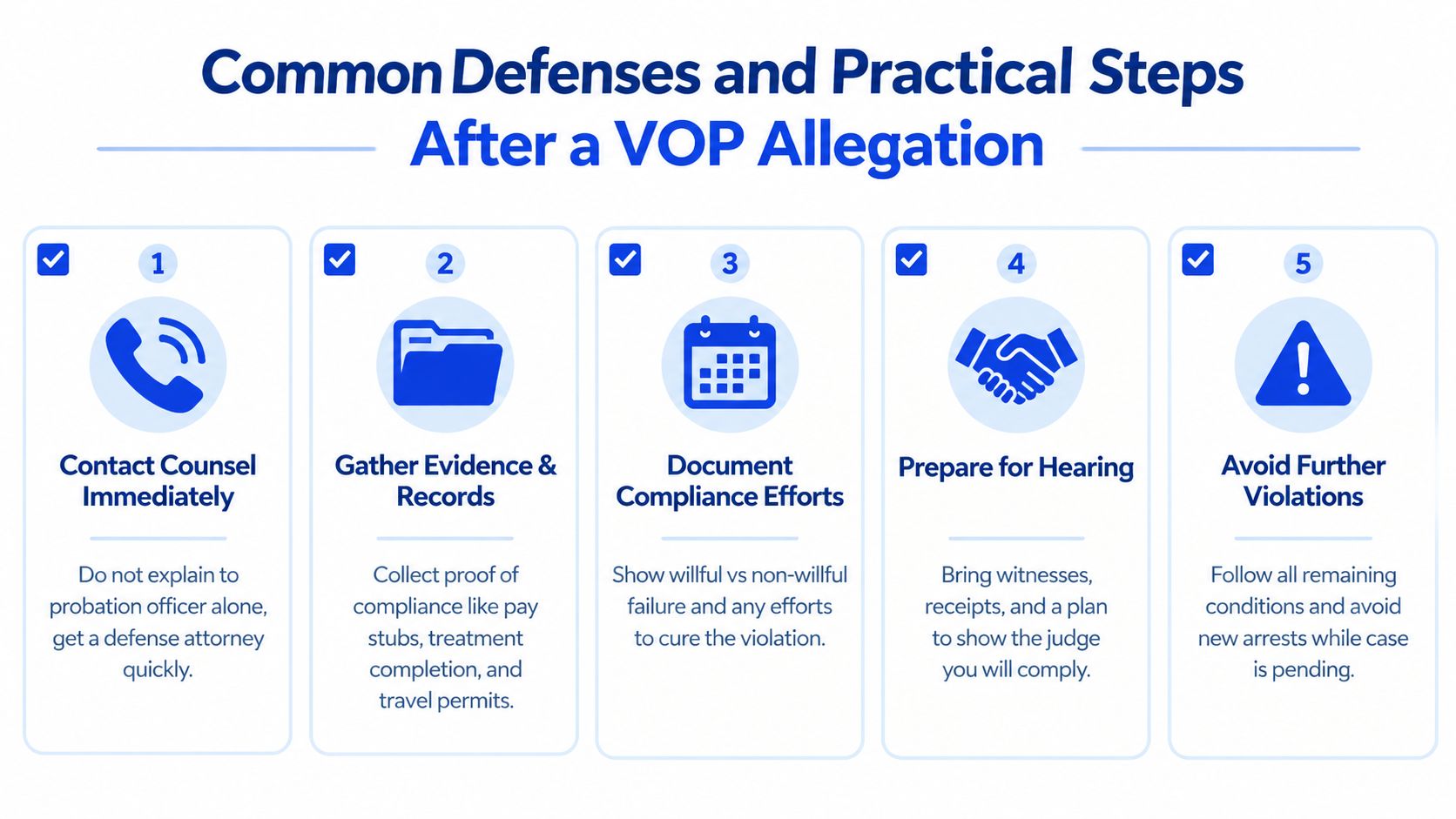
A VOP allegation requires action, but panic rarely improves the situation. Start by identifying the exact condition the State says was violated and obtaining the affidavit, warrant, probation order, notices, and supporting records.
Steps to take immediately
Contact counsel quickly: A probation violation lawyer can address detention, communicate with the court, and protect the defense from avoidable statements.
Collect compliance records: Save treatment attendance, testing records, employment documents, travel permissions, payment receipts, medical records, and communications with probation.
Document the explanation: Transportation problems, a schedule conflict, hospitalization, misunderstanding, or another obstacle may matter when the State alleges a willful violation.
Follow every remaining condition: Continue reporting, testing, treatment, curfew, no-contact requirements, and other conditions unless counsel or the court provides different lawful direction.
Prepare for detention issues: If the person is being held without bond, counsel should review the statutory classification and prepare for the hearing addressing custody.
Defense issues that may change the result
The defense may argue that the State hasn't shown the alleged violation by a preponderance of the evidence. It may challenge whether the probation condition was clear, whether the person received adequate notice, whether the affidavit accurately describes the conduct, or whether the evidence connects the person to the alleged breach.
For a technical allegation, willfulness and ability to comply can be central. A missed appointment caused by a documented medical crisis is different from deliberate refusal to report. A failed requirement may also have an explanation involving transportation, work, treatment access, or unclear instructions. The facts must be supported with records, not just a general denial.
For an alleged new-law violation, the defense should protect the separate criminal case while evaluating the VOP evidence. The State may rely on police reports, testimony, or other information before the new case reaches a final resolution. A defense strategy may challenge the reliability, timing, admissibility, or meaning of that evidence.
Recent Florida decisions continue to interpret the technical-violation framework, including the distinctions involving eligibility, prior violations, and violent felony offender of special concern classifications. The 2025 First District Court of Appeal decision illustrates why the precise statutory category matters.
Protecting Your Rights and Next Steps With a Florida Defense Attorney
A felony VOP is a high-stakes supervision matter, but revocation isn't automatic. The State still must prove an alleged violation under the governing standard, and the defense can challenge the facts, the condition, the procedure, the evidence, or the requested punishment.
The most important choices often occur before the hearing. A lawyer can review the original sentence, identify the felony classification, assess technical-violation eligibility, investigate any new-law allegation, address no-bond detention, and prepare mitigation showing why continued or modified probation may be appropriate.
In Broward County and surrounding South Florida courts, families also need clear communication about where the case is pending, what paperwork controls, and what the next hearing will address. A consultation should produce a practical plan, not a promise of a particular result.
Ticket Shield, PLLC's Florida probation violation resource explains how counsel may defend allegations involving technical noncompliance or alleged new criminal conduct. The firm is based in Broward County, handles Florida criminal defense matters, and offers access to Attorney Jason S. Goldsmith, a former prosecutor, for confidential case evaluation.
If the allegation involves a DUI, drug charge, domestic violence case, theft offense, violent crime, gun charge, sex offense, juvenile matter, federal case, traffic crime, injunction, or record issue, the VOP strategy may need to account for that related proceeding as well. Prompt legal review can help protect your freedom, employment, family responsibilities, and defense in the original case.
Ticket Shield, PLLC can review the probation order, violation allegations, detention status, and potential defenses in a confidential consultation with a Florida defense attorney. Visit Ticket Shield, PLLC to request guidance for a Broward County, Fort Lauderdale, Miami-Dade, Palm Beach, or other Florida VOP case before the next hearing.