
Implied Consent Law Florida: A Complete Guide for Drivers
Jason Goldsmith, Esq
The officer has taken your license, your car is sitting at the roadside, and a printed warning is being read while the blue lights continue flashing. You may be wondering whether refusing the breath test protects you from a DUI charge. In Florida, that decision can now create two separate legal problems, not one.
Florida's implied consent law connects your driving privilege to lawful chemical testing after a DUI arrest. Since the October 1, 2025 change known as Trenton's Law, a first refusal of a lawful breath or urine test can also become a criminal case. The practical answer is direct: “Just refuse” is no longer reliable advice. Your arrest facts, the warning language, your medical condition, and your prior refusal history all matter.
Table of Contents
The Moment a Florida Officer Asks You to Blow
You're standing beside your vehicle on a South Florida roadway. The officer may have already asked you to perform field sobriety tasks and may be holding a portable breath tester. At the station, the officer may later request an evidentiary sample on an approved Intoxilyzer 9000. Those are different stages, and confusing them can lead to bad decisions.
The roadside question sounds informal, but after a lawful DUI arrest it carries legal consequences. Under Florida Statutes § 316.1932, operating a motor vehicle in Florida means you've already consented to approved chemical or physical testing for alcohol or controlled substances in the circumstances covered by the statute. Your consent is also tied to the process of applying for and using a Florida driver license.
What you can do in those first minutes
Before arrest, field sobriety tasks and a roadside portable breath test generally serve as investigative tools. You can ask what test the officer is requesting, but don't argue roadside about the entire DUI investigation. Once you're arrested and the officer gives the implied-consent warning, the situation changes.
Your practical choices are limited:
Submit to the requested test. The result may create evidence for the State, but the collection process, machine records, observation period, and chain of custody can still be examined.
Refuse. Refusal can trigger an administrative suspension and, under current law, a separate criminal charge.
Ask for clarification. You can ask what test is being requested and whether you're under arrest, but don't assume that silence preserves your position.
A failure to give a clear response may be documented and treated as a refusal under the administrative process. Don't make roadside statements about how much you drank, why you won't test, or what you believe the law permits. If you want to understand how roadside questions can affect the case, review this guide to sobriety test questions.
Practical rule: Treat the warning as a legal event, not a casual conversation. The exact words, timing, and recording may become central evidence in Broward County or any other Florida court.
What Florida's Implied Consent Statute Actually Says
The core rule appears in § 316.1932. A person who operates a motor vehicle in Florida is deemed to have consented to approved testing when lawfully arrested for a DUI-related offense. The statute covers breath, blood, urine, and related testing in the circumstances it authorizes.
The consent isn't based on signing a roadside form. Florida links it to the privilege of driving. The license application process reinforces that framework, because applying for and using a Florida driver license means agreeing to the statutory requirements.
That distinction matters. A field sobriety task occurs during the investigation and before arrest. Implied consent attaches to the post-arrest chemical-testing process described by the statute. An officer still needs a lawful basis for the stop and arrest. Implied consent doesn't give police unlimited authority to stop anyone, arrest anyone, or demand any sample under any conditions.
The warning has legal importance
The officer must advise you of the consequences of refusing the requested test. After the 2025 change, the warning also needs to address the criminal consequence applicable to the refusal. The warning should be examined word for word through the body-camera recording, arrest paperwork, and the form or card used by the agency.
An officer's paraphrase may matter, particularly if it omits the current misdemeanor warning or materially changes the information you were supposed to receive. A language barrier, inability to hear, medical incapacity, or confusion about the requested test can also affect whether the State can prove a valid refusal.
The Florida Department of Highway Safety and Motor Vehicles, or DHSMV, handles the administrative suspension under § 322.2616. Criminal prosecutors handle the refusal offense under § 316.1939. The statutes operate together, but they don't create one single proceeding.
Statute | Subject | Key effect |
|---|---|---|
Implied consent | Connects lawful DUI arrests and approved chemical testing | |
§ 322.2616 | Administrative suspension | Governs license seizure, temporary driving authority, and refusal suspensions |
§ 316.1939 | Criminal refusal | Makes a first refusal a second-degree misdemeanor and a repeat refusal a first-degree misdemeanor |
The driver-license application is the legal hook. It means the State doesn't need to prove that you freely negotiated testing terms at the roadside. But the State still must prove the required statutory conditions, including a lawful arrest, a lawful request, the required warning, and a refusal. If you're weighing whether to refuse, read this explanation of whether you can refuse a breathalyzer in Florida.
How Breath Blood and Urine Testing Works at the Roadside
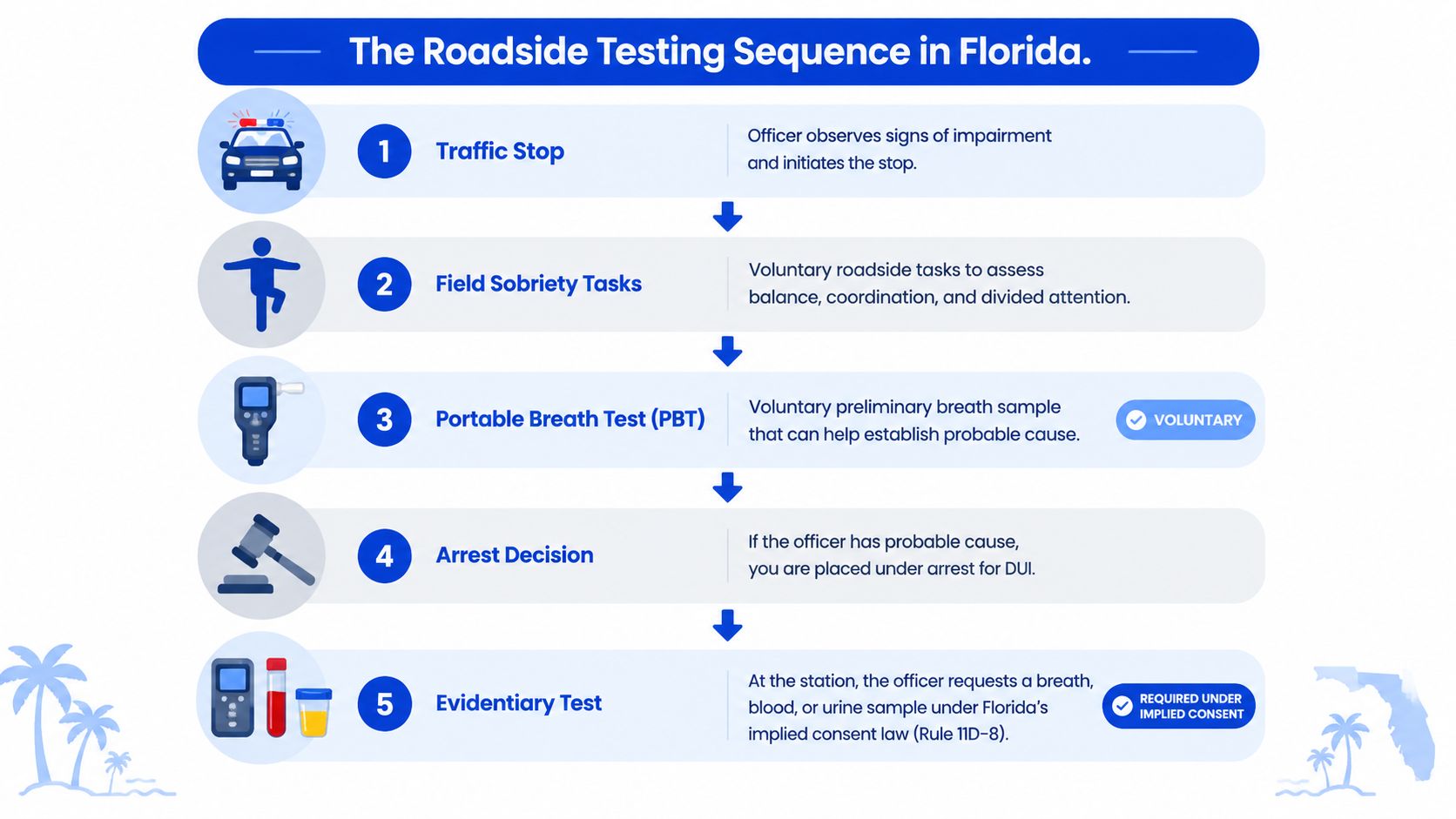
Florida DUI investigations often move through several distinct steps. Officers may begin with observations during the traffic stop, continue with field sobriety tasks, and use a portable breath tester to help develop probable cause. The roadside portable breath test isn't the same as the evidentiary breath test requested after arrest.
Breath testing
After arrest, an officer may request an evidentiary breath sample using an approved instrument such as the Intoxilyzer 9000. The procedure includes an observation period and requires valid samples under the applicable testing procedures. Defense counsel examines whether the officer continuously observed the driver, whether the machine was properly maintained, whether the operator followed the procedure, and whether the recorded samples were valid.
The roadside device and the station instrument serve different purposes. A preliminary reading may influence the arrest decision, while an evidentiary result is offered as formal proof. The distinction can affect suppression motions, cross-examination, and the weight a judge or jury gives the evidence.
Blood testing
Blood draws involve a different medical and evidentiary process. Florida law authorizes blood testing in circumstances involving suspected death or serious bodily injury and for unconscious drivers under the statutory conditions. The State must still establish that the draw was legally authorized and that the sample was properly collected, preserved, tested, and documented.
A defense review should include the medical records, consent or warrant materials when applicable, phlebotomist qualifications, laboratory procedures, and chain of custody. These are not interchangeable issues. A flaw in a blood draw requires a different defense from a flaw in an Intoxilyzer procedure. See the related discussion of legal blood draws in Florida.
Urine testing
Urine is less common in ordinary alcohol investigations. It may become relevant when breath or blood testing isn't available or in investigations involving suspected controlled substances. Timing, collection procedures, laboratory handling, and the relationship between a detected substance and impairment require careful analysis.
The requested test shapes the defense. A breath case may center on observation and instrument records. A blood case may center on medical collection and laboratory reliability. A urine case may raise questions about what the result proves about impairment at the time of driving.
License Suspension vs Criminal Charges Two Separate Tracks
A refusal can activate an administrative DHSMV case and a criminal prosecution. They involve different decision-makers, different records, and different legal consequences.
The administrative track begins when the officer seizes the license, issues the applicable temporary permit if the driver is otherwise eligible, and gives notice of suspension. Under § 322.2616, a first refusal carries a 12-month suspension, while a second or subsequent refusal carries an 18-month suspension.
The criminal track is handled by the prosecutor and criminal court. Under § 316.1939, a first refusal is a second-degree misdemeanor. A second or subsequent refusal is a first-degree misdemeanor.
Issue | Administrative track, § 322.2616 | Criminal track, § 316.1939 |
|---|---|---|
Decision-maker | DHSMV hearing officer | State prosecutor and criminal court |
Main issue | Whether the statutory suspension requirements were met | Whether the State can prove the criminal refusal offense |
First refusal | 12-month license suspension | Second-degree misdemeanor |
Repeat refusal | 18-month license suspension | First-degree misdemeanor |
Timing | Immediate notice and a limited hearing deadline | Criminal case through Florida courts |
Defense focus | Warning, lawful arrest, refusal, prior history, agency records | Lawful stop and arrest, warning, request, refusal, proof beyond a reasonable doubt |
These tracks don't automatically cancel each other. A favorable result in one forum doesn't necessarily erase the other proceeding. You need a coordinated strategy that preserves evidence for both, especially the warning recording and the officer's account of the request.
For an overview of the administrative side, review administrative license suspension in Florida. A Fort Lauderdale DUI lawyer should address the hearing deadline and the criminal case together, not treat the license issue as paperwork that can wait.
Why Refusing the Test Is Now Riskier Than Ever
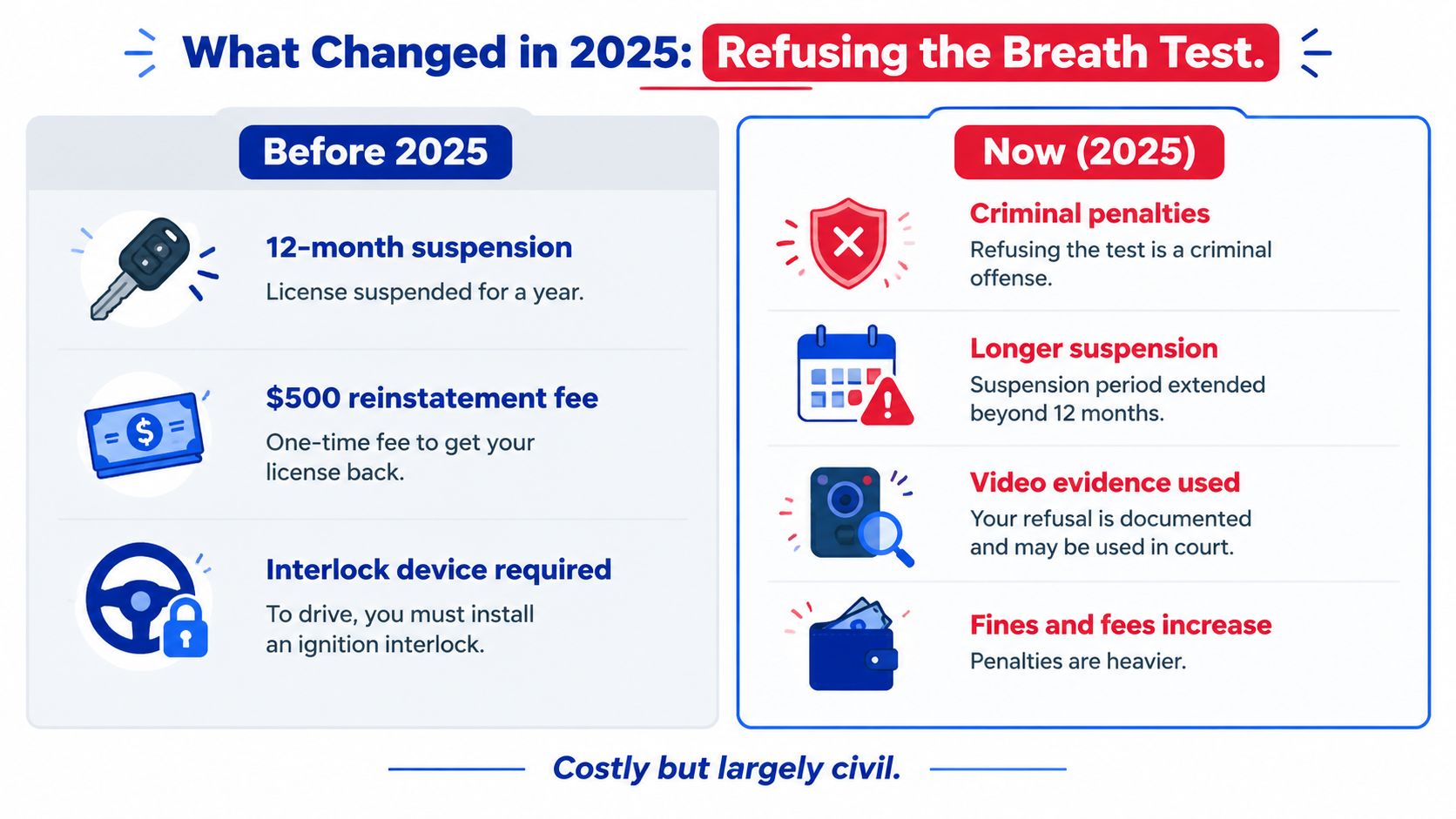
The old calculation focused on a license suspension. That calculation changed on October 1, 2025, when Florida began treating a first refusal of a lawful breath or urine test as a criminal offense under Trenton's Law.
The current consequences are layered. A first refusal can produce a 12-month administrative suspension and a second-degree misdemeanor. A repeat refusal can produce an 18-month administrative suspension and a first-degree misdemeanor. The criminal case doesn't replace the administrative case, and the suspension doesn't disappear because the DUI prosecution later changes.
The safer decision framework
I don't tell clients that testing is always harmless. A breath, blood, or urine result can provide the State with evidence, and the test must be reviewed for technical and constitutional defects. But I also don't tell clients that refusal is automatically the smart move. After 2025, refusal can hand the State an additional charge before anyone litigates the accuracy of the test.
Refusal may still have strategic value where the State cannot establish a lawful arrest, where the officer gave an incomplete or outdated warning, or where a medical condition prevented a meaningful opportunity to comply. The unconscious or otherwise incapable person exception also matters. Florida law recognizes that an unconscious or incapable person is deemed not to have withdrawn consent under the statutory framework.
What relief can and can't do
Florida's published administrative guidance states that hardship reinstatement isn't permitted in the administrative suspension context. That makes the early hearing decision especially important. A restricted driving option may exist under separate statutory requirements, but you shouldn't assume that a work-related need automatically restores ordinary driving privileges.
Your body-camera recording may show whether the officer explained the current criminal consequence. Your medical records may show why you couldn't provide a sample. Your prior refusal history may determine which criminal and administrative category the State alleges. Those details can change the defense significantly.
For the broader 2025 DUI changes, read Florida's new DUI laws. Old advice about always refusing doesn't account for the current criminal exposure.
Your 10 Days to Fight the Administrative Suspension
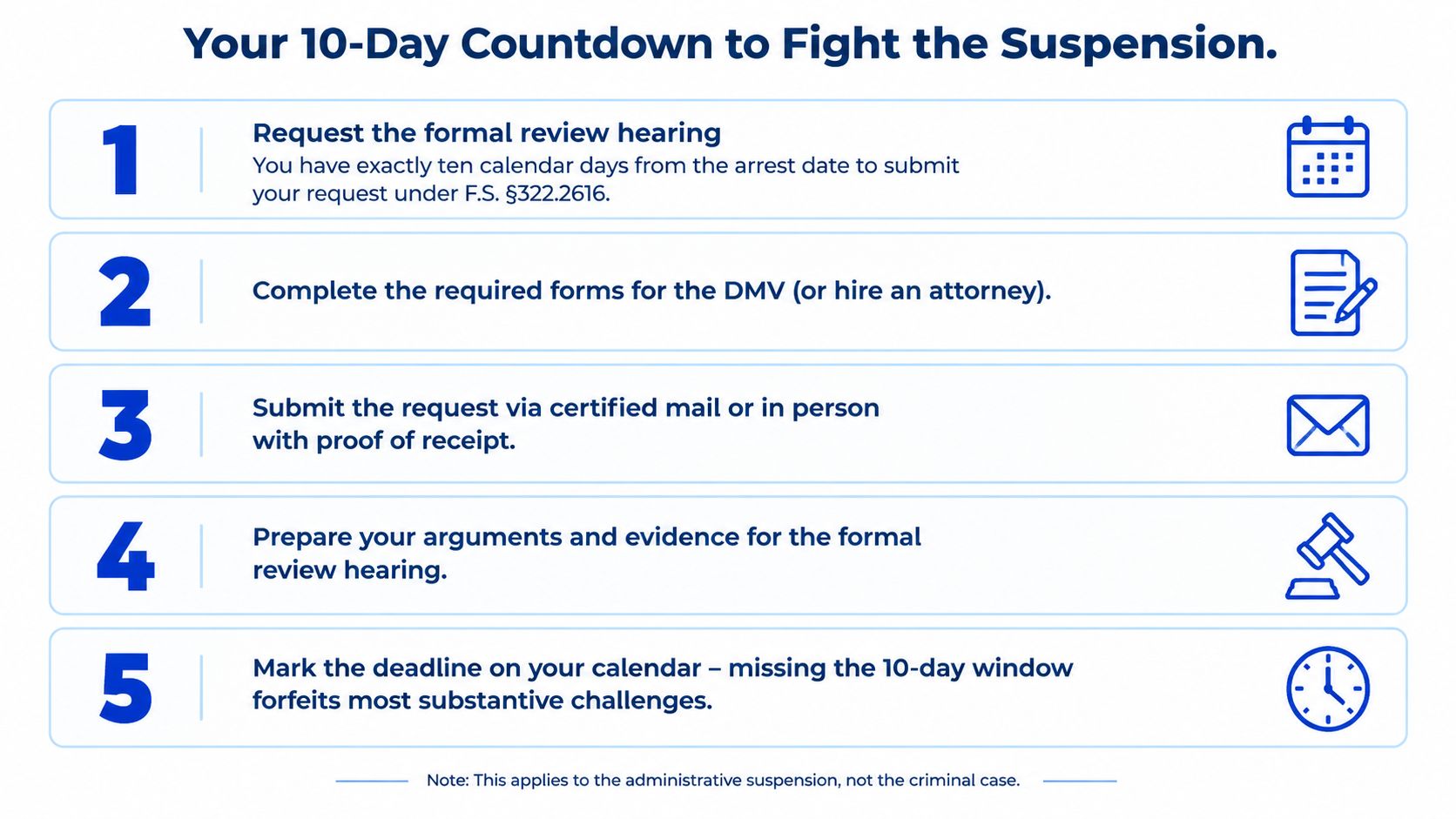
Florida gives you only 10 days from arrest to request a formal review hearing of the administrative suspension under § 322.2615. If you miss that deadline, the suspension takes effect and you lose the most useful opportunity to challenge the administrative record.
Start with the paperwork the officer gave you. Find the notice of suspension, temporary permit, citation, and arrest information. Preserve each document, then calendar the deadline immediately. Don't rely on a general DMV visit or a later criminal court date. The administrative clock is its own problem.
What the hearing can expose
Request the records needed to test the State's version of events:
Arrest materials: Obtain the sworn arrest report and probable-cause affidavit.
Warning evidence: Secure the exact warning card, written form, and body-camera or station video.
Testing records: Request breath-machine maintenance and operation records when a breath test was involved.
History proof: Require certified documentation supporting any allegation of a prior refusal.
The hearing officer can examine statutory issues such as whether the officer had probable cause for the DUI arrest, whether the driver was asked to submit to the test, whether the driver refused, and whether the suspension category is correct. The precise scope depends on the type of suspension and the records presented.
The deadline isn't a formality. Missing the 10-day window can prevent you from challenging the suspension while the evidence is still available and the officer can be questioned about the central facts.
A formal review isn't the criminal trial. A successful administrative challenge doesn't guarantee dismissal of the criminal charge, but it can reveal warning defects, inconsistent reports, or prior-history errors that also matter in criminal court. If the deadline has passed, contact counsel promptly anyway. Waiting longer only reduces the available options.
Defenses and Remedies That Actually Work in Florida
The strongest implied-consent defenses are fact-driven. A lawyer shouldn't promise that a technical objection will win. The lawyer should identify the exact legal requirement the State can't prove and connect it to a recording, document, witness, or medical record.
Warning defects
The warning must communicate the consequences required by current law. After Trenton's Law, an officer who fails to advise a first-time refuser that the refusal itself can be a second-degree misdemeanor may create a serious defense issue. Compare the officer's words to the current statutory language, not to a memory of what the officer intended to say.
A Spanish-language warning, poor audio, rushed reading, or material paraphrase may matter. Body-camera footage is often more reliable than an arrest report because it captures the actual exchange.
Unlawful stop or arrest
Implied consent assumes a lawful DUI arrest and lawful test request. If the traffic stop lacked reasonable suspicion, or if the officer arrested without probable cause, counsel can challenge the seizure and the evidence that followed. The defense should examine dispatch records, dash-camera video, body-camera footage, witness accounts, and the sequence of roadside events.
Incapacity and involuntary refusal
A driver who was unconscious or otherwise incapable may fall within the statutory exception. Medical incapacity can also matter where the driver suffered an asthma attack, diabetic episode, traumatic injury, or another condition that prevented meaningful compliance. The question is whether the facts show a genuine inability, not a later explanation for declining the test.
Defense category | Legal basis | Winning facts |
|---|---|---|
Improper warning | Statutory warning requirements | Recording shows omitted criminal warning or material deviation |
Unlawful stop | Fourth Amendment and Florida constitutional protections | Officer lacks specific facts supporting the traffic stop |
Unlawful arrest | Probable-cause requirement | Observations and testing don't establish probable cause |
Medical incapacity | Statutory incapable-person exception | Medical records and video show the driver couldn't comply |
Incorrect prior history | Administrative and criminal classification rules | DHSMV lacks reliable certified proof of an earlier refusal |
A prior refusal error is especially important because misclassifying a first refusal as a repeat refusal can affect both tracks. The response may include a formal review request, suppression motion, motion to dismiss, negotiation, or trial defense. For drivers in Fort Lauderdale, Broward County, Miami-Dade, Palm Beach, and surrounding South Florida communities, the right remedy depends on the record, not a generic checklist.
Next Steps and Frequently Asked Questions
The first 48 hours should be organized around preservation and deadlines, not explanations to police or rushed decisions about a restricted license.

Your immediate action plan
Preserve recordings and paperwork. Save the citation, photograph the warning card, and write down what the officer said while the memory is fresh.
Calculate the DHSMV deadline. The statutory period is measured from the arrest. Confirm the exact date on the paperwork and request the formal review before the window closes.
Avoid uncounseled statements. Don't discuss the facts with investigators, prosecutors, insurers, or anyone else who may later become a witness.
Gather medical evidence. If diabetes, asthma, injury, unconsciousness, or another condition affected the refusal, request the relevant records promptly.
Get legal advice before choosing a license remedy. A Florida criminal defense attorney can evaluate the administrative and criminal tracks together.
Frequently asked questions
What does refusal cost?
The consequences aren't limited to a fee. A refusal can bring an administrative license suspension and a separate criminal case. The exact result depends on whether the State alleges a first or repeat refusal and whether the required warning and arrest conditions can be proven.
Can I get a hardship license?
Florida's published guidance says hardship reinstatement isn't permitted for the administrative suspension itself. Other restricted-license options may depend on separate statutory conditions, so don't assume that employment needs alone solve the problem.
Is an interlock automatically required?
Don't assume an ignition interlock requirement applies identically to every refusal case. Eligibility and restrictions depend on the driver's history, the type of suspension, and the applicable statutory pathway.
Can a refusal charge be sealed or expunged?
That depends on the final disposition, criminal history, eligibility rules, and the records involved. A conviction creates different consequences from a dismissal or other resolution, so discuss record relief before accepting a disposition.
Will insurance rates increase?
A refusal or DUI-related record may affect insurance underwriting, but the impact depends on the insurer and the driver's complete record. Ask counsel about the legal record first, then speak with an insurance professional about coverage.
Do out-of-state licenses face the same penalties?
A non-Florida license doesn't eliminate Florida's authority to impose consequences arising from conduct in the state. The exact licensing effect may involve Florida procedures and the issuing state's rules.
The 2025 criminalization of first refusals changed the decision tree in October, and old advice about “always refuse” no longer survives a careful reading of § 316.1939.
If you're facing a Florida DUI refusal, Ticket Shield, PLLC can review the warning, body-camera evidence, arrest records, prior refusal history, and 10-day DHSMV deadline as part of a coordinated defense plan. Contact Ticket Shield, PLLC for a confidential consultation about protecting your license and defending the criminal case in Broward County, Fort Lauderdale, Miami-Dade, Palm Beach, or elsewhere in Florida.