Florida Criminal Laws: A Complete Guide for the Accused
Jason Goldsmith, Esq
You can get pulled into Florida's criminal system in minutes. A traffic stop in Fort Lauderdale turns into handcuffs, or a domestic violence warrant shows up before you've had time to think, and suddenly you're trying to understand bond, charges, court dates, and whether one mistake can follow you for years. The hardest part is that florida criminal laws are not just about the offense name on the arrest form, they're also about sentencing rules, deadlines, and local court practices that can change the outcome.
A lot of people assume the charge tells the whole story. It doesn't. In Florida, the charge is only the starting point, and the State's case often turns on how the arrest happened, what evidence was collected, whether the filing came on time, and how the sentencing rules treat the person's record. That's why a simple explanation of the statute isn't enough when your freedom, license, or job is on the line.
Table of Contents
When the Arrest Happens
A Broward County traffic stop can go from routine to terrifying in one conversation. Maybe the officer says your speech sounded off, asks you to step out, and then the arrest starts to feel unreal, like it's happening to someone else. Or maybe you're at work when a relative calls from Palm Beach County and says there's a domestic violence warrant, and now your phone won't stop buzzing while you try to figure out what to do first.
Practical rule: the first thing that matters is not panicking, it's protecting your rights before you start explaining yourself.
That first shock is where people make mistakes. They talk too much, assume the officer will “clear it up,” or sign papers without understanding what they mean. If police asked questions after you were detained, the issue can turn on what was said and when, which is why people often look at a clear explanation of Miranda rights before they say anything else.
Florida criminal cases move fast at the beginning and slowly after that. The State may already be building a file while you're still trying to process the arrest, and local practice in Fort Lauderdale, Miami-Dade, or Palm Beach County can affect bond, release, and how quickly your case gets traction. That's why a defense lawyer's early role is usually less about dramatic courtroom moments and more about finding an advantage before the case hardens into a routine file.
The emotional reality is simple. You're scared because you don't know what the next step is, and the system is built with terminology that sounds colder than it feels. The good news is that Florida criminal law has rules, timelines, and pressure points, and once you understand those, the process stops feeling random.
How Florida Organizes Its Criminal Statutes
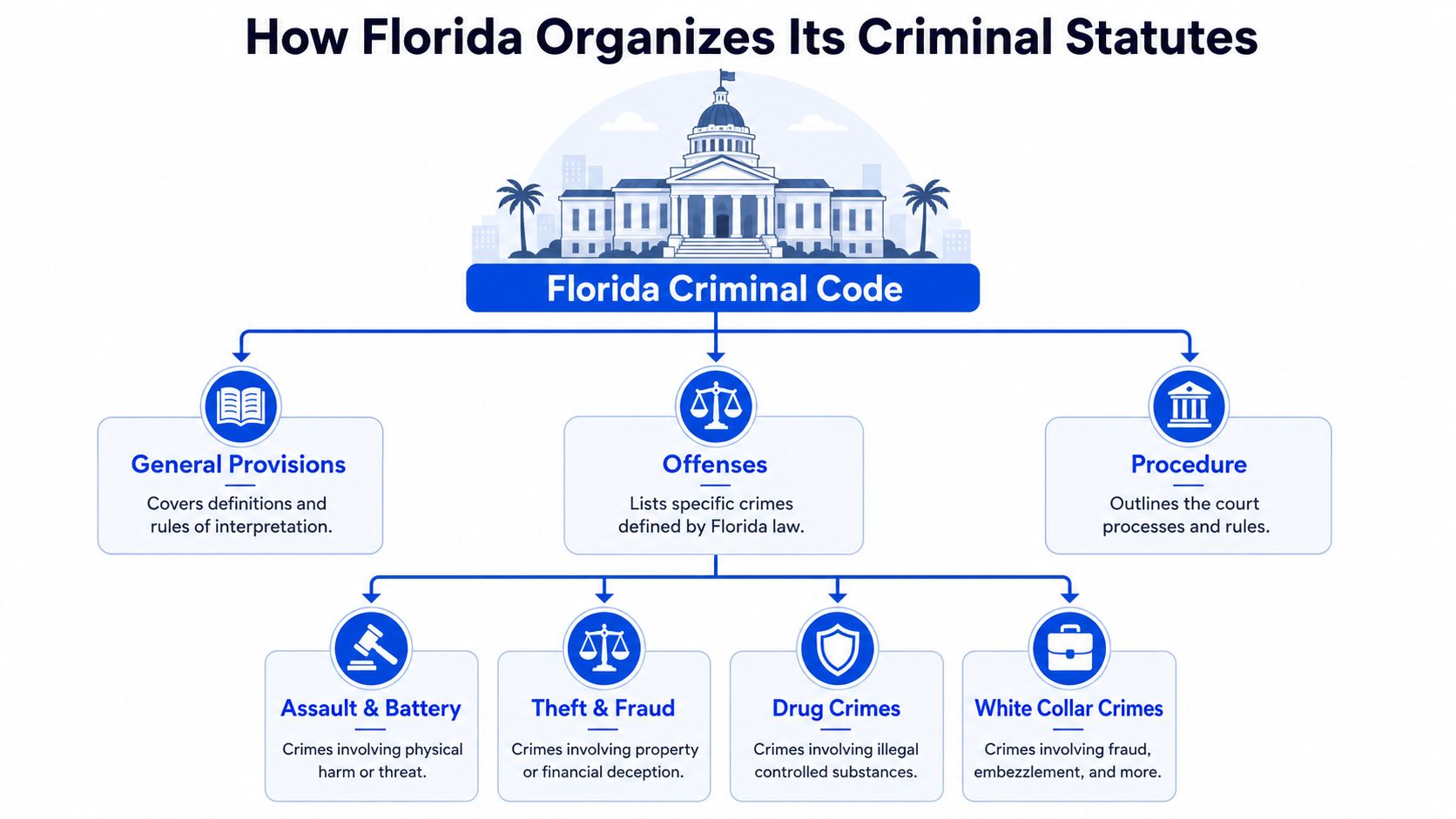
Florida doesn't use one single standalone penal code. Substantive crimes are spread across Title XLVI, which covers chapters 775 through 896, while criminal procedure sits in Title XLVII. That split matters because the thing you're accused of and the process the court uses to handle it live in different parts of the law, and each side has its own rules, deadlines, and weaknesses (Florida criminal statutes overview).
The map underneath the charge
Think of the system in layers. At the top are the general rules that apply across criminal cases. Beneath that are the offense chapters, like DUI, drugs, theft, violent crimes, and weapons. Underneath both of those are sentencing rules that decide what happens if the charge sticks. A lawyer who knows where the charge lives can often spot whether the State filed the right offense, used the right enhancement, or leaned on the wrong procedural shortcut.
That structure also helps explain why readers get confused when they hear people say “Florida criminal code” as if it's a single book. It isn't. A DUI charge is not handled the same way as a theft charge, and a weapons case doesn't use the same statutory language as a probation problem. Even within one case, the charge chapter, the procedure chapter, and the sentencing chapter can all pull in different directions.
Why deadlines matter
Florida has hard charging deadlines, called statutes of limitations. The time limit is 4 years for first-degree felonies, 3 years for other felonies, 2 years for first-degree misdemeanors, and 1 year for second-degree misdemeanors or noncriminal violations (Florida statutes of limitations). That matters because a case can be barred even when evidence still exists, which is why defense lawyers check dates early instead of waiting to see what happens.
If the State missed the filing window, the defense may have a complete answer before the facts ever reach a jury.
The practical lesson is simple. Florida criminal laws are not a single rulebook, they're a set of connected systems. If you know which chapter controls the offense and which procedural rule controls the case, you're already ahead of someone who only knows the arresting officer's version.
Common Criminal Offenses and What the Penalties Really Mean
The charge on paper rarely captures the whole exposure. A DUI can threaten a driver's license, a drug case can bring jail time and a record that affects work, and a theft allegation can turn on a dispute about value rather than a dramatic act of stealing. In South Florida, those differences matter because the same statewide law can feel very different in Broward County, Miami-Dade, or Palm Beach County depending on the facts, the judge, and how the case is scored.
Offense Category | Typical Degree | Max Fine | Max Prison |
|---|---|---|---|
DUI / traffic-related criminal case | Depends on charge and record | Depends on charge | Depends on charge |
Drug crimes | Misdemeanor or felony | Depends on chapter and degree | Depends on charge |
Theft crimes | Misdemeanor or felony | Up to $1,000 for first-degree misdemeanor, up to $500 for second-degree misdemeanor | Depends on degree |
Domestic violence / violent crimes | Often felony in serious injury cases | Up to $10,000 in the aggravated battery example | Depends on degree |
Gun and weapons charges | Usually felony if prosecuted as a criminal case | Depends on charge | Depends on charge |
Sex crimes | Often felony | Depends on charge | Depends on charge |
Juvenile crimes | Delinquency case, not adult conviction | Depends on alleged offense | Depends on disposition |
White collar crimes | Often felony | Depends on charge | Depends on charge |
Federal crimes | Separate system | Depends on federal statute | Depends on federal statute |
Probation violations | Not a new offense in the same way | Depends on original case | Can include jail or prison |
Record sealing and expungement | Post-case relief | Not a new penalty | Not prison, but affects record relief |
How Florida sentencing changes the real risk
Florida uses the Criminal Punishment Code, a point-based felony sentencing system that applies to almost all felonies committed on or after October 1, 1998 (Criminal Punishment Code manual). The offense severity ranking chart uses 10 levels, and the court computes a numeric scoresheet for each felony offender (Florida Statutes section 921.0022). Prior record, victim injury, and other scored factors can push the score upward and increase prison exposure.
That's why a case that sounds “low-level” can still become serious. The point total can make prison more likely, and statewide rules don't always land the same way in every county. In one statewide analysis, people with scores in the 22-to-44 range accounted for an estimated 4,500 prison admissions, or more than 15% of all admissions, while the state average showed only 11% of those scoresheets received a prison sanction (Florida sentencing analysis).
A few charges people commonly misunderstand
Theft cases often turn on value. Florida grand theft can be charged at third degree when the value is $750 or more but less than $5,000, so the number attached to the property can decide the charge itself (Florida theft statute).
Domestic violence cases can turn on injury. Florida aggravated battery happens when someone intentionally or knowingly causes great bodily harm, permanent disability, or permanent disfigurement, or uses a deadly weapon (Florida battery statute).
Criminal traffic cases can be more than a ticket. A DUI or reckless driving file can trigger license problems, court appearances, and insurance fallout that outlasts the sentence.
Record sealing and expungement matter because the long-term harm sometimes comes from the record, not the punishment itself.
In Florida, low-level doesn't always mean low-impact. A case may end with probation or dismissal, but the consequences can still reach employment, licensing, immigration, and family court issues.
Understanding Florida misdemeanor charges helps, but the bigger point is this, the label on the charge is only one piece of the exposure.
The Florida Court Process From Arrest Through Appeal
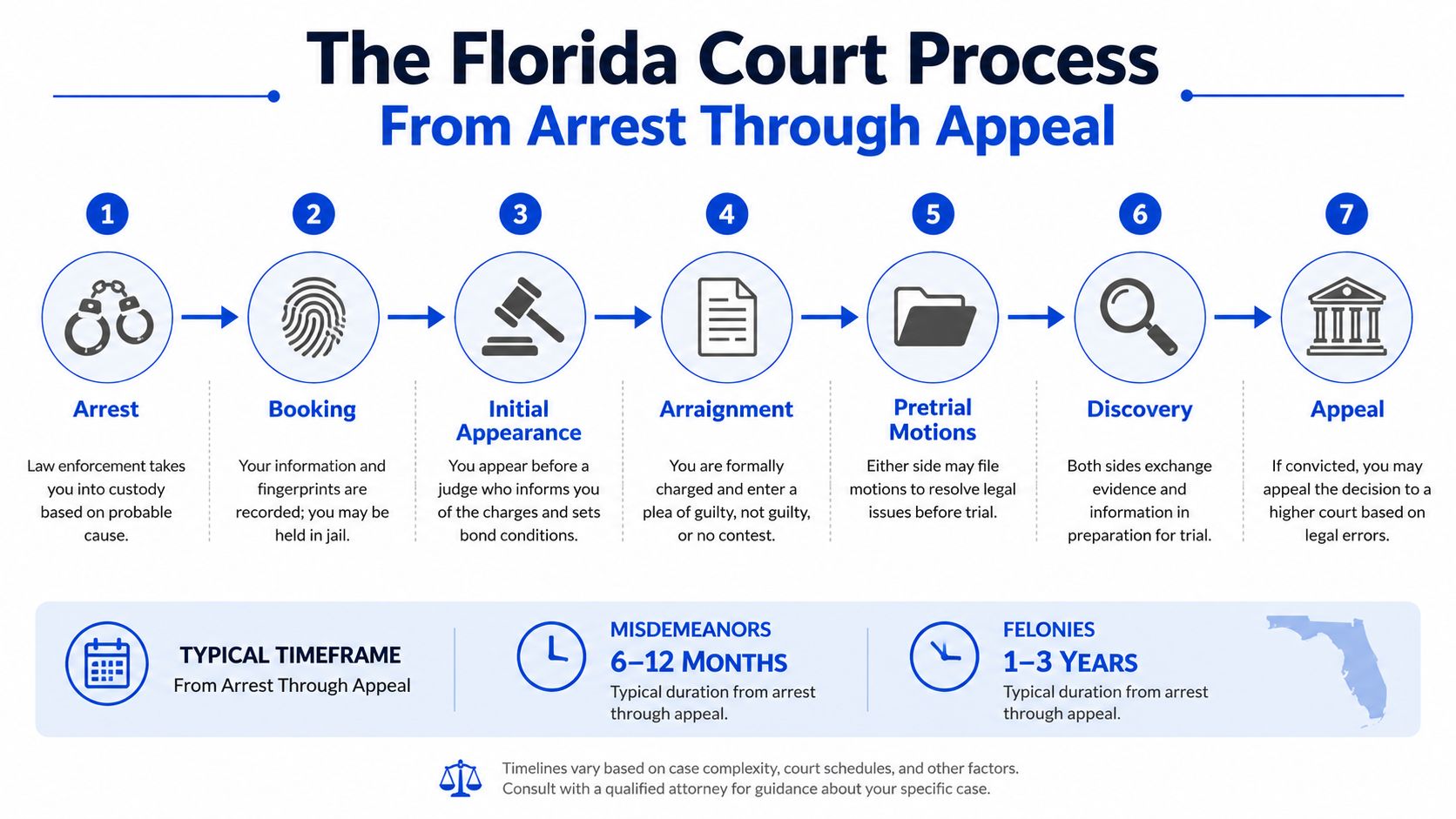
The case starts long before trial. A person gets arrested, booked, and brought before a judge, and those first decisions often shape everything that follows. In Broward County, Miami-Dade County, and Palm Beach County, court calendars and pretrial handling can differ, but the basic stages stay the same.
The first court steps
At the initial appearance, the judge addresses bond and reads rights, and those early hours are often the most important for setting the defense tone. Some people are released on a citation or pretrial terms, while others stay in custody until a bond is set. If bond is high or release is denied, the practical consequences start immediately.
The arraignment comes next, and that's where the plea is entered. Many readers see the arraignment as a formality, but it's not meaningless. It's one of the first points where the defense can see how the State is framing the charge and whether the filing lines up with the facts.
You can read more about what arraignment means in a Florida criminal case if the court date is approaching and you're still trying to understand the terminology.
Discovery, motions, and negotiation
Discovery is where the State has to turn over its evidence. That can include reports, body camera footage, witness statements, lab results, and other material the defense needs to evaluate the file. If the evidence doesn't match the arrest narrative, that gap can change the entire case.
Practical rule: don't treat a plea offer as the first real answer, because it often comes before the defense has seen the full file.
Most Florida cases resolve through plea negotiations rather than trial. That doesn't mean every plea is a good deal. A defense lawyer has to ask whether the client is getting reduced exposure, whether a conviction can be avoided, and whether a different legal challenge would be stronger than bargaining early.
Appeal comes last, and it's limited. Appellate courts look for legal errors, not simple disagreements with the jury's view of the facts. The deadline to file is strict, so if a verdict comes back wrong, the paperwork has to move fast.
The point is this. Florida criminal cases are not one event, they're a sequence of choices. If the defense moves early enough, it can affect bond, discovery, negotiation, and sometimes whether the case should have been filed the way it was.
Constitutional and Evidentiary Defenses in Florida Criminal Cases
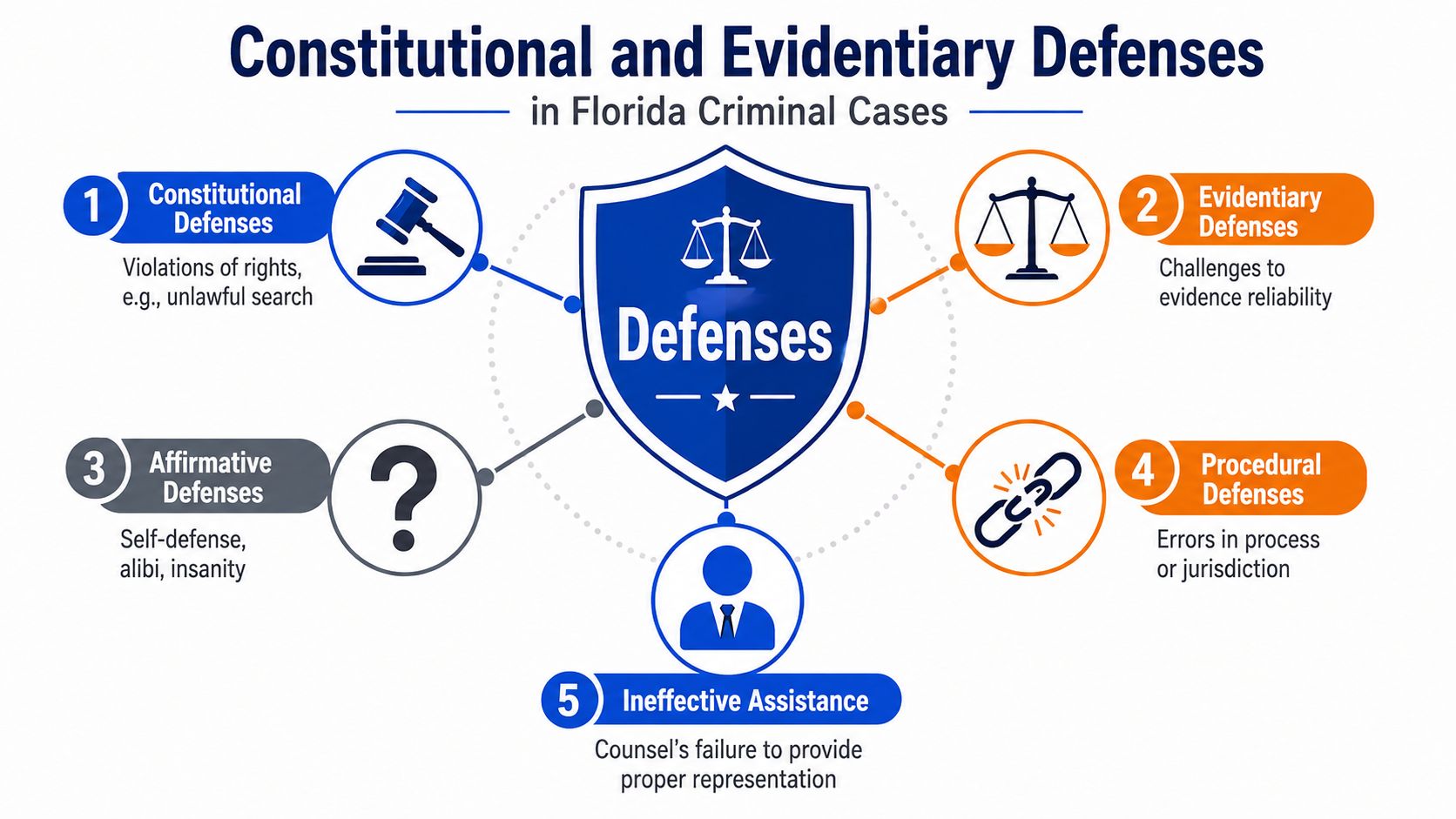
A strong defense often starts with a simple question, did the police and prosecutors follow the rules? If the stop was illegal, the search was unlawful, the test was unreliable, or the filing was defective, the case can weaken fast. That's why defense work in Florida often focuses less on dramatic arguments and more on pressure points the State has to prove.
Search, seizure, and suppression
The Fourth Amendment limits police power, and Florida courts take that seriously. A traffic stop has to be supported by lawful grounds, and an illegal search can lead to suppression of critical evidence. That's why defense lawyers file motions to suppress when the stop, search, or seizure doesn't line up with the Constitution.
A suppression motion is often most useful when the State's case depends on one piece of evidence. If the officer found drugs in a car, or a gun during a stop, the legality of that stop can decide the whole file. You can also read more about how a motion to suppress evidence works in Florida if the arrest involved a search.
Testing, witnesses, and procedure
Florida defense lawyers also attack the reliability of the evidence itself. In DUI cases, field sobriety tests can be challenged, breath testing can be questioned, and witness observations can be tested against the record. In fraud, weapons, or sex crime cases, digital or forensic evidence can be attacked if the State can't lay the proper foundation.
The jury doesn't get to hear everything just because the police collected it.
Procedural defenses matter too. If the State delayed filing, used the wrong charge, or violated the right to speedy trial, the defense may have a path to dismissal or other relief. Cross-examination can expose bias, inconsistent stories, and police mistakes, which is often where the case becomes less certain than the arrest report suggests.
There's also a practical reason motion practice matters. A well-drafted motion can force the State to show its work, and sometimes that alone changes the outcome. In Florida criminal cases, the defense doesn't need to prove innocence first, it needs to make the State meet its burden.
How to Choose a Criminal Defense Attorney in South Florida
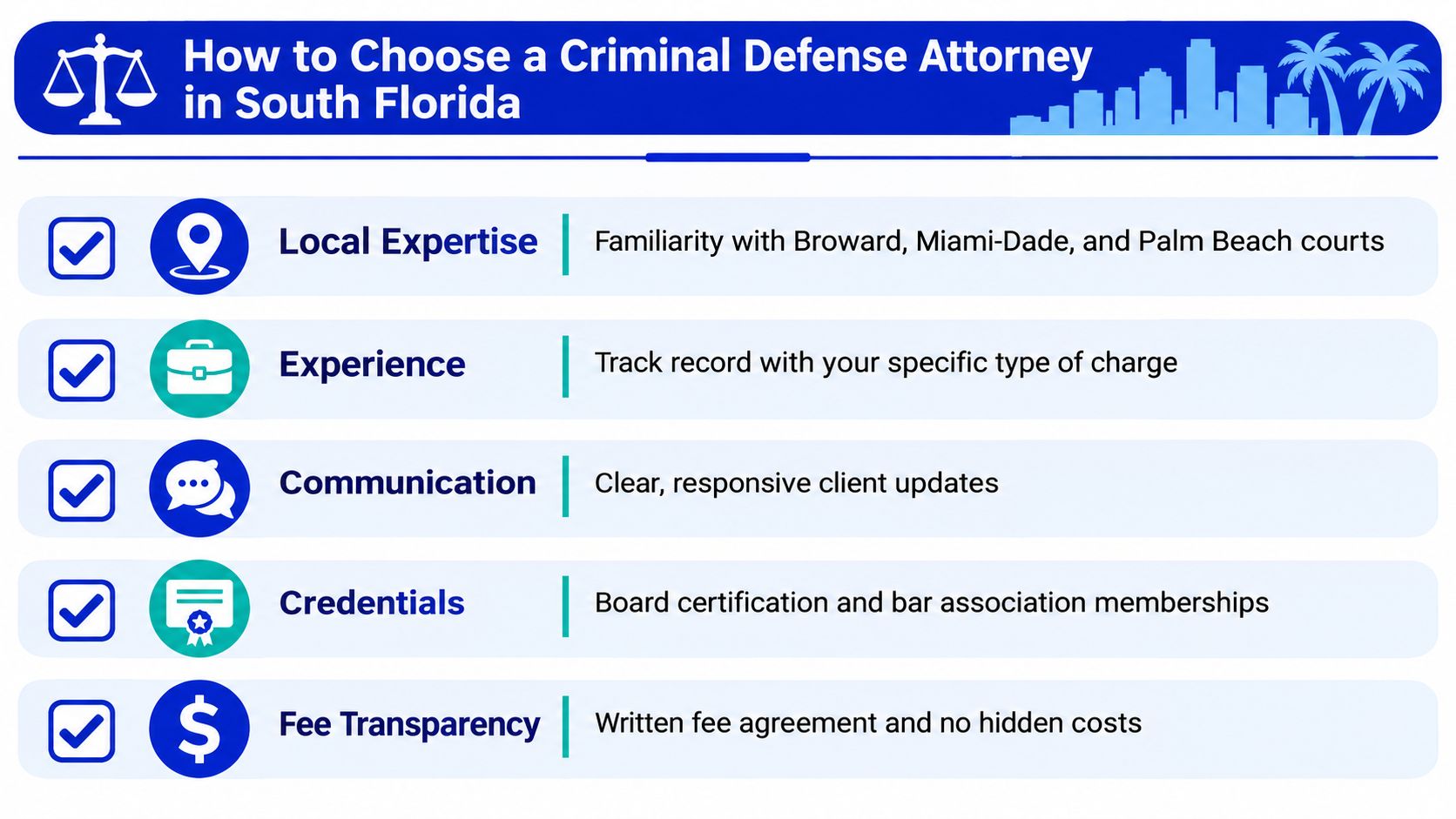
The right lawyer should be able to explain your case in plain English. If you're in Fort Lauderdale, Miami, or West Palm Beach, you want someone who knows the local court culture, understands the type of charge you're facing, and can tell you what the next move means. Former prosecutor experience can help because it gives a defense lawyer a clearer view of how the State builds its case and where it usually breaks down.
Questions worth asking in a consultation
Local experience: Does the lawyer regularly handle cases in Broward County, Miami-Dade, and Palm Beach County?
Charge-specific work: Has the lawyer handled DUI, drug, theft, probation, weapons, or domestic violence cases like yours?
Communication: Will you get updates by phone, text, or email, and who answers when you call?
Strategy: Does the lawyer explain both plea and trial options without jargon?
Transparency: Is the fee agreement written and clear?
A few red flags should make you pause. Be careful with anyone who guarantees an outcome, can't explain the charges without hedging, or seems to hand the file to someone else after the consultation. The first meeting should feel like a real conversation, not a sales pitch.
One option people in South Florida may look at is Ticket Shield, PLLC, a Florida criminal defense firm that handles DUI defense, criminal defense, and traffic matters that overlap with criminal exposure, including license suspension and reinstatement issues. That kind of practice matters because the right lawyer has to understand both the charge and the collateral damage that follows it.
The consultation is your chance to judge the lawyer as much as the lawyer is judging the case. You want direct answers, a realistic plan, and someone who can tell you what needs to happen next without talking around the issue.
Taking the Next Step After Reading This Guide
Florida criminal laws can feel overwhelming because they blend the charge, the procedure, the sentencing rules, and the consequences into one moving system. Once you understand that structure, the case stops looking like a mystery and starts looking like a set of legal problems that can be challenged. That's the value of getting informed early, you can make better decisions before the State locks the case into its own version of events.
The important pieces are the same ones that keep coming up in Florida courts, the statute itself, the sentencing framework, the deadlines, and the constitutional defenses that can narrow or defeat the State's case. In South Florida, where local practice can influence how a file moves, early legal help can make a real difference in how you respond.
If you're facing charges in Broward County, Fort Lauderdale, Miami-Dade, Palm Beach County, or anywhere else in Florida, the next move is a confidential consultation with a defense lawyer who can look at the facts, the filing, and the process with fresh eyes. A calm, informed review is often the fastest way to figure out what matters and what doesn't.
If you're dealing with a DUI, drug charge, theft case, probation problem, or another criminal allegation in South Florida, Ticket Shield, PLLC can review the charge, the evidence, and the court process with you in plain English. Visit Ticket Shield, PLLC to speak with a Florida criminal defense team that handles these cases across Broward County, Miami-Dade, Palm Beach County, and throughout Florida.