Lawyer for Violation of Probation: Expert Defense
Jason Goldsmith, Esq
If you've just gotten a call from your probation officer, seen a warrant, or heard that court filed a Violation of Probation against you, it can feel like the floor dropped out from under you. People in Broward, Fort Lauderdale, Miami-Dade, Palm Beach, and across South Florida usually have the same first question, can this really send me back to jail over something that sounds minor?
The answer depends on the allegation, the paperwork, and what the State can prove. A lawyer for violation of probation focuses on those details immediately, because a VOP case is not treated like a brand-new criminal charge in the manner often assumed. The process moves fast, the standard of proof is lower than in a new prosecution, and the difference between a technical mistake and a new arrest can shape everything.
At Ticket Shield, PLLC, the approach is straightforward. As a former prosecutor, Attorney Jason S. Goldsmith understands how probation cases are built, where affidavits go wrong, and which facts really matter when the judge is deciding whether probation should continue, change, or be revoked.
Table of Contents
Your Guide to Facing a Probation Violation Accusation
The moment you hear the words probation violation, panic is a common reaction. Maybe you missed an appointment, tested positive, changed jobs, fell behind on fees, or were arrested for something unrelated. That fear makes sense, but panic helps the State, not you.
A violation allegation does not mean you have already lost. It means probation says you broke a condition, and the court now has to decide what happens next under Florida's probation rules, including the authority in Florida Statute § 948.06 to issue a warrant and hold a violation hearing before a judge decides whether to continue, modify, or revoke probation. In practice, that means the first legal task is not arguing about emotions. It is checking the affidavit, the notice, the warrant, and the proof line by line.
Practical rule: the faster a defense lawyer sees the paperwork, the more options usually stay on the table.
A seasoned lawyer for violation of probation earns the fee by focusing on what the judge can rely on and what can be challenged before the hearing gets out of hand. At Ticket Shield, the work starts with the same question a former prosecutor would ask, what proof is strong enough to move the case forward, and what can be attacked before the court makes a decision? For people needing a local probation violation lawyer near me, local procedure matters as much as the facts, and the timing of each step can change the result.
A strong defense often starts before the hearing date is even set. If the affidavit is vague, the reporting is inconsistent, or the allegation does not match the probation condition, those problems should be raised early. The goal is to move the case from fear to facts, because once you know the steps, the process becomes a legal fight instead of a mystery. Florida probation violation procedure
Understanding Probation Violations in Florida
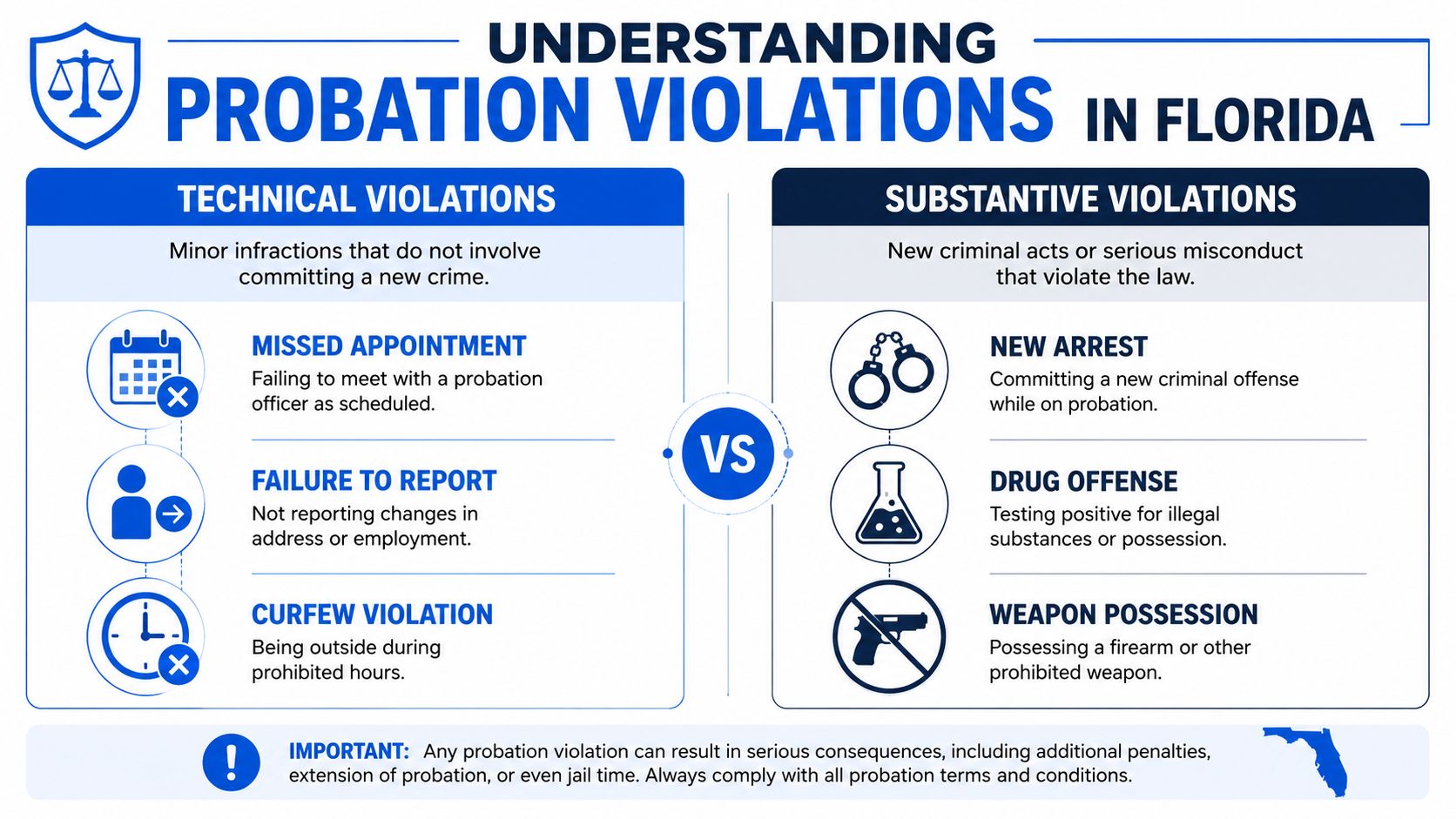
A probation violation in Florida usually starts with a simple problem that turns into a court issue, a missed meeting, a failed drug test, a new arrest, or another condition the court says was broken. Florida law and probation practice treat those problems differently, so the first step is identifying whether the case is a technical violation or a substantive violation. A missed appointment does not carry the same weight as alleged new criminal conduct, even though both can lead to a warrant and a hearing.
Technical violations
Technical violations are failures tied to the supervision rules themselves. Common examples include missing probation-officer meetings, failing a drug test, not reporting a change of address, or ignoring another supervision condition that does not involve a new criminal charge probation conditions and technical violations. These cases usually turn on whether the failure was willful, whether the person had clear notice, and whether the probation records substantiate the allegation.
That difference matters because a violation can be filed even when no separate offense was charged. A missed appointment can still bring a person into court, even if no one arrested them for a new crime common alleged violations. In practice, technical cases often leave more room for a defense lawyer to argue for a continued probationary sentence, especially when the person has otherwise complied and the problem looks isolated.
Substantive violations
Substantive violations involve alleged new criminal conduct, or conduct the State says amounts to a new offense. That can include a new arrest, a drug-related offense, or unlawful weapon possession while the person is still on probation. Courts usually treat those allegations more seriously because the State is saying the person did more than miss a reporting rule, it is saying the person picked up new criminal exposure.
Florida's statutory framework gives the court broad authority once a violation is alleged, and § 948.06 is the statute attorneys focus on because it governs warrants, hearings, and the judge's range of responses. For a closer look at how technical violations are handled, see Florida technical violation of probation. The pertinent question is whether the conduct matches a specific probation condition and whether the State can prove it with reliable evidence. That is why a lawyer for violation of probation spends so much time comparing the affidavit, the probation terms, and the proof before the hearing starts.
The Florida Violation of Probation Legal Process
A probation violation case often starts before a client ever walks into a courtroom. A probation officer files an affidavit, a judge may issue a warrant, and the person can be arrested and held while the case moves ahead. In South Florida, that sequence can move fast once the State says probation was violated.

The process usually begins with the Affidavit of Violation of Probation. That document is the State's starting point, and its details matter later. If the affidavit is vague, internally inconsistent, or built on hearsay, a defense lawyer has a reason to attack it early instead of waiting until the hearing.
The next step is the warrant and arrest stage. Florida law allows the court to issue a warrant when probation is alleged to have been violated, and the person may be taken into custody before the hearing. After the arrest, the first appearance is often the first time the person hears the formal allegation and learns the court's immediate position on release or detention.
A VOP hearing is not a new trial. It is a focused hearing about whether the court believes probation was violated and what should happen next.
What happens after that depends on how the State proves the claim. In many Florida VOP hearings, the State does not have to prove the allegation beyond a reasonable doubt. The court may apply a lower standard, such as preponderance of the evidence, which is why early attacks on affidavits, hearsay, and mismatched records matter so much probation hearing standard. That lower burden changes the defense strategy. The case has to be handled quickly, carefully, and with attention to every detail.
A former prosecutor can matter here because the State's file usually reveals the weak point in the case before the hearing starts. In Broward, Miami-Dade, and Palm Beach, judges often focus on practical issues like whether the conduct violates a specific probation term, whether notice was proper, and whether the evidence stays consistent from the affidavit to the reports to any lab records. This is also where a lawyer should be ready to challenge the State's paperwork against the hearing record, as explained in the Florida VOP hearing process.
Consequences of a Probation Violation in South Florida
A judge in South Florida usually has three basic choices after a violation hearing. Probation can be continued as-is, modified with tougher or different conditions, or revoked altogether, which can expose the person to jail or prison tied to the original case. The right outcome depends on the alleged violation, the person's history, and how the defense presents the facts.
The national picture shows why these hearings matter. The Council of State Governments Justice Center found that probation and parole violations send large numbers of people back to prison, and that technical violations make up a substantial share of those admissions Council of State Governments Justice Center. That result matters in Florida, because conduct that looks minor on paper can still lead to a serious loss of freedom.
In a Broward or Miami-Dade courtroom, judges usually focus on practical questions. Was this a one-time setback or part of repeated noncompliance? Did the person try to report, test, pay, or correct the problem? Was there a new arrest, or was it a technical issue that could be handled with stricter supervision instead of incarceration?
Judges respond to specifics. A clean record on supervision, proof of effort, and a realistic plan for compliance can matter more than broad promises.
Mitigation matters because it gives the judge a lawful reason to choose a less severe response. A lawyer can present employment, treatment, transportation problems, family responsibilities, or other facts that explain why jail is not the right answer. A lawyer for violation of probation also has to think several steps ahead, especially when a judge is weighing whether to continue supervision, tighten the terms, or impose a sentence tied to the original case. A former prosecutor can be useful here because prosecutors know how these files are usually built, which issues tend to matter most, and where the State's case is likely to be weakest before the hearing even starts.
Strategic Defenses a Probation Violation Lawyer Can Use
A probation violation case can often be defended, but the defense has to target the right points. In practice, the issue is rarely one dramatic argument. It is usually a mix of the State's proof, the wording of the probation terms, and whether the court is being asked to respond more harshly than the facts justify.
A good defense starts with the hearing itself. In Florida, a VOP case usually turns on whether the judge sees a willful and substantial violation, so counsel has to know exactly what the State can prove, what the probation officer wrote, and where the paperwork leaves room for doubt.
Challenging whether the violation was willful and substantial
The first question is often whether the violation was willful. If someone missed reporting because of a documented emergency, a medical issue, a breakdown in communication, or another nonwillful problem, that can change how the judge views the case. The same is true when the alleged failure is minor and the person otherwise tried to comply.
Judges also look at whether the person had a real opportunity to comply. If transportation failed, if a treatment provider changed an appointment, or if the probation terms were unclear in practice, those facts can matter more than the State expects. A lawyer for violation of probation should be ready to separate a technical miss from conduct that shows disregard for supervision.
Attacking the affidavit and proof
The affidavit matters because it frames the hearing. If the affidavit is vague, inconsistent with police reports, or unsupported by records, those weaknesses can be used to limit the State's case. Many probation hearings also rely on documentary evidence, so a defense lawyer should compare lab results, toxicology records, appointment logs, and any written notice before the hearing begins, as discussed in probation hearing defense approach.
The procedure matters just as much as the facts. A Florida VOP hearing can involve the affidavit, the warrant or notice, the alleged conditions, testimony from the probation officer, and any records the court is willing to consider. If one of those pieces does not hold up, the State's theory gets weaker fast. That is where a former prosecutor often has an edge, because prosecutors know how these files are built, which details are usually treated as routine, and where the record tends to break down once it is tested in court. Ticket Shield, PLLC uses that kind of review to identify what the State can prove and what needs to be challenged.
Using mitigation to protect the outcome
Mitigation is not an excuse. It is the context a judge needs before deciding whether revocation is necessary. Proof of treatment attendance, employment, family support, or completed conditions can show that a violation does not define the whole case.
If the violation is tied to a lower-level matter, it can also help to look at how the Florida case is being handled as a probation issue rather than only as a new criminal accusation. A useful overview of that approach appears in the firm's discussion of misdemeanor probation violation issues. The point is straightforward. A smart defense puts the strongest facts in front of the judge early, instead of waiting to see whether the court asks for them.
Immediate Steps to Take if Accused of a VOP
The worst thing you can do after learning about a VOP accusation is improvise. People sometimes call the probation officer to argue, skip court because they're scared, or try to explain themselves to police without counsel. Those choices usually make the case harder.
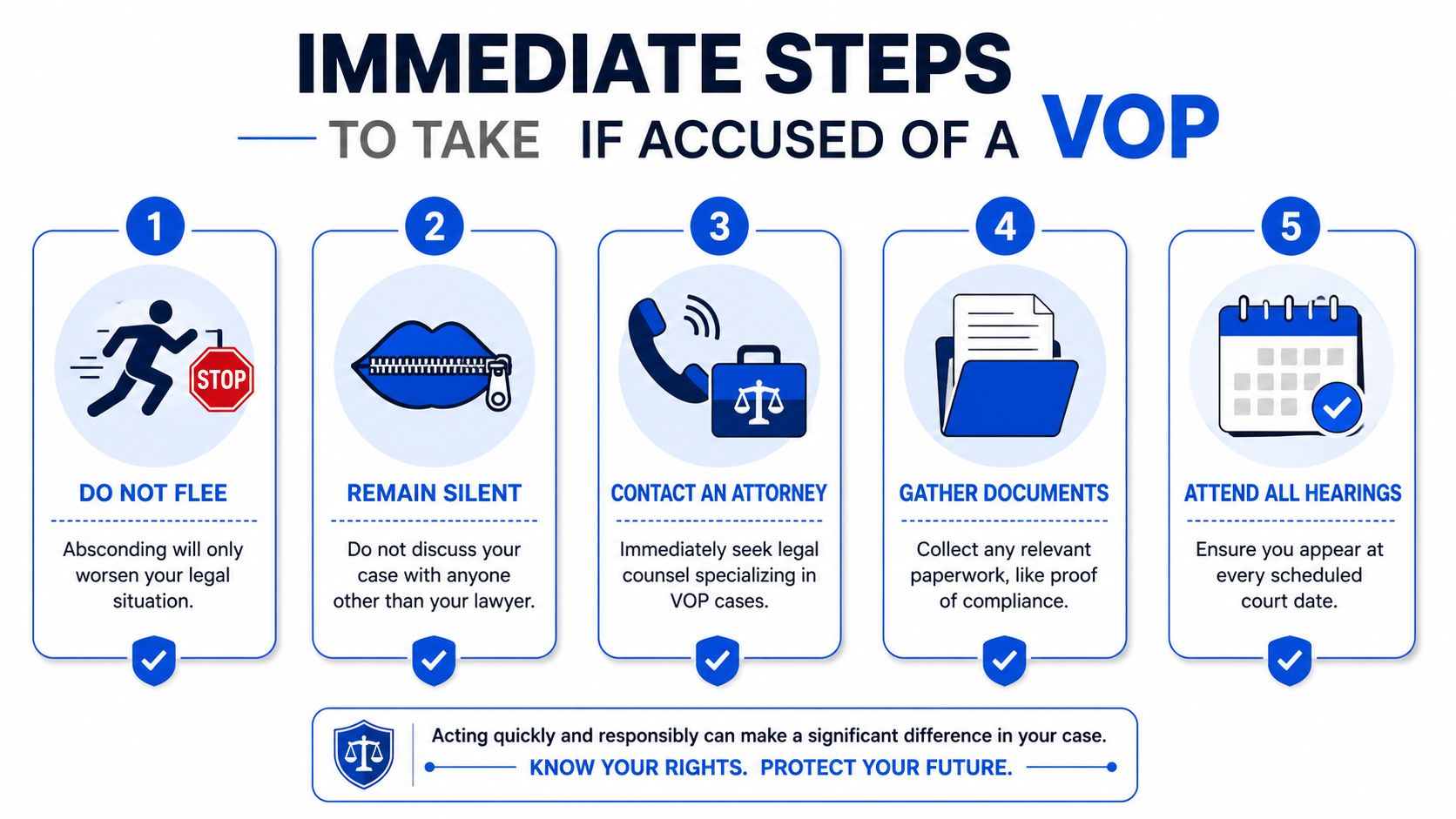
Here's what to do right away:
Do not flee: Leaving town or avoiding the warrant makes the case worse and limits defense options.
Remain silent: Don't discuss the allegation with law enforcement, friends, or on social media.
Gather documents: Save texts, emails, treatment records, pay stubs, receipts, and proof that you tried to comply.
Track every court date: Missing a hearing can create a new problem on top of the violation.
Call a lawyer immediately: The earlier counsel reviews the affidavit and warrant, the more time there is to protect you.
The reason urgency matters is that bond, release, and hearing strategy can change quickly once the court files the paperwork. If you're trying to figure out what to do next, a confidential consultation with a Florida probation violation attorney is the right next move. For someone who needs direct help now, a firm like Ticket Shield, PLLC can review the allegation, explain the local process, and map out the first response.
FAQs About Violation of Probation in Florida
Can I get a bond on a VOP warrant?
Sometimes, but not always. Many people are held while the case is pending, especially when the warrant is tied to alleged noncompliance or a new arrest, so this issue should be addressed immediately with counsel.
Do I have a right to a public defender for a probation violation?
Indigent defendants generally have a right to request a public defender when jail time is possible, but the appointment process and the point when that right attaches can vary by county and court public defender availability in VOP cases. That's why it's important to ask quickly, not assume the answer.
Is a violation of probation the same as a violation of community control?
No. Both are supervision cases, but community control is a different and often stricter form of supervision. The consequences can be serious in either setting, but the conditions, procedures, and court response can differ.
If you're facing a probation violation anywhere in Broward County, Fort Lauderdale, Miami-Dade, Palm Beach, or nearby South Florida courts, contact Ticket Shield, PLLC now for a confidential consultation. The sooner your case is reviewed, the sooner you'll know what the State has, what can be challenged, and what can be done to protect your freedom.