Violation of Probation in Florida Jail Time
Jason Goldsmith, Esq
Florida courts can impose up to 90 days in county jail as a special condition of probation instead of fully revoking probation, but the result depends on whether the allegation is technical or involves a new law violation, along with your prior violation history. In some low-risk categories, the available jail sanction is lower, while a substantive violation can expose you to revocation and a sentence tied to the original offense.
You may be reading this because a Broward County probation officer called unexpectedly, an affidavit of violation reached your home, or someone you care about was arrested on a VOP warrant in Fort Lauderdale, Miami-Dade, or Palm Beach County. The fear usually comes down to one question: How much jail time am I facing?
After handling VOP hearings as both a prosecutor and a defense attorney, I'll give you the answer without sugarcoating it. Jail is possible, but jail isn't automatic. The key issue is which legal category applies, whether the violation was willful and substantial, what your record shows, and whether your lawyer gives the judge a credible alternative to revocation.
Table of Contents
What a Violation of Probation Really Means in Florida
A probation officer calls about a missed appointment. An affidavit of violation arrives at your home. Or you learn that a VOP warrant has been issued after an arrest in Broward, Miami-Dade, or Palm Beach County. The immediate fear is usually simple: will you go to jail?
A VOP, short for violation of probation, means the State claims you failed to follow a condition in your existing sentence. The allegation might involve missing an appointment, failing to complete treatment, testing positive, leaving Florida without permission, failing to pay required costs, or facing a new criminal charge.
A VOP is a separate proceeding from a new criminal trial. The judge is deciding whether you violated the current probation order and what consequence fits that violation. The court is not retrying the original offense.
That history still matters. The judge may review the original charging documents, plea or trial record, sentencing arguments, and your performance on supervision. The same judge who imposed probation often decides whether to continue it, change its conditions, or revoke it.
Why the stakes feel higher
A new criminal case requires proof beyond a reasonable doubt. At a VOP hearing, the State generally must prove a willful and substantial violation by the greater weight of the evidence. Your defense must address two separate questions: whether the alleged conduct occurred, and whether the court should treat it as serious enough to justify a harsh sanction.
The prosecutor may file an affidavit of violation and request a warrant or notice to appear. Do not assume the allegation disappears because your supervision term is nearly over. The court can still address the violation through the pending process.
Practical rule: Do not explain the facts to your probation officer, the prosecutor, or the judge until a defense lawyer has reviewed the allegation and your original probation order.
The better question is not just whether jail is possible. Ask which violation category applies and whether Florida's low-risk technical violation rules restrict the sanction available to the judge. The statutory framework appears in Florida Statutes section 948.06, which provides alternatives to full revocation in qualifying cases.
Your response can also affect later options involving early termination, record sealing, or expungement, depending on how the original case was resolved. For background on how an adjudication can affect those options, review what adjudication of guilt means.
The Three Types of Probation Violations Florida Courts Recognize
Florida VOP cases become easier to understand when you separate three categories instead of treating every allegation as identical.
A technical violation involves breaking a supervision rule without necessarily committing a new crime. Failure to report, traveling without permission, associating with prohibited people, driving without permission, missing treatment, and failing to follow testing requirements can fall into this group. The judge still looks at whether the conduct was deliberate and significant.
A substantive violation usually involves an allegation that the probationer committed a new criminal offense. A new misdemeanor may receive a different response from a new felony, but both can affect the court's view of whether probation remains appropriate. The new criminal case and the VOP are separate proceedings, so a favorable development in one doesn't automatically resolve the other.
The third category is the newer low-risk technical violation framework. Florida law provides alternative sanctions for qualifying first or second low-risk technical violations. The current rules can limit the jail sanction in qualifying first-violation cases to up to 5 days in county jail, and certain cases permit up to 21 days in county jail rather than immediate revocation. The statutory language appears in Florida Statutes section 948.06.
A practical category check
Violation Category | Typical Examples | Realistic Jail-Time Exposure |
|---|---|---|
Technical violation | Failure to report, unauthorized travel, prohibited association, driving without permission | Continued probation, modified conditions, or a jail sanction depending on the facts and eligibility |
Low-risk technical violation | A qualifying first or second low-risk technical allegation | A capped alternative sanction may apply, including up to 5 days in qualifying first-violation cases or up to 21 days in certain cases |
Substantive violation | A new misdemeanor or felony allegation | Modification may be possible, but revocation and a sentence tied to the original offense become more serious possibilities |
The category isn't determined by the label on the warrant alone. Your prior violation history, the precise condition, the underlying offense, and the statutory eligibility requirements all matter. A person accused of missing one appointment is not in the same position as someone accused of a new felony, even though both may receive a document titled “violation of probation.”
For a focused explanation of technical allegations, review Florida technical violation of probation defense. If a 2024 legislative analysis applies to the case, Florida also created a second tier for certain repeat low-risk violations, allowing up to 120 days in county jail as a special condition in specified circumstances. The Florida Senate legislative analysis describes that second-tier framework.
How the Violation of Probation Process Works in Florida
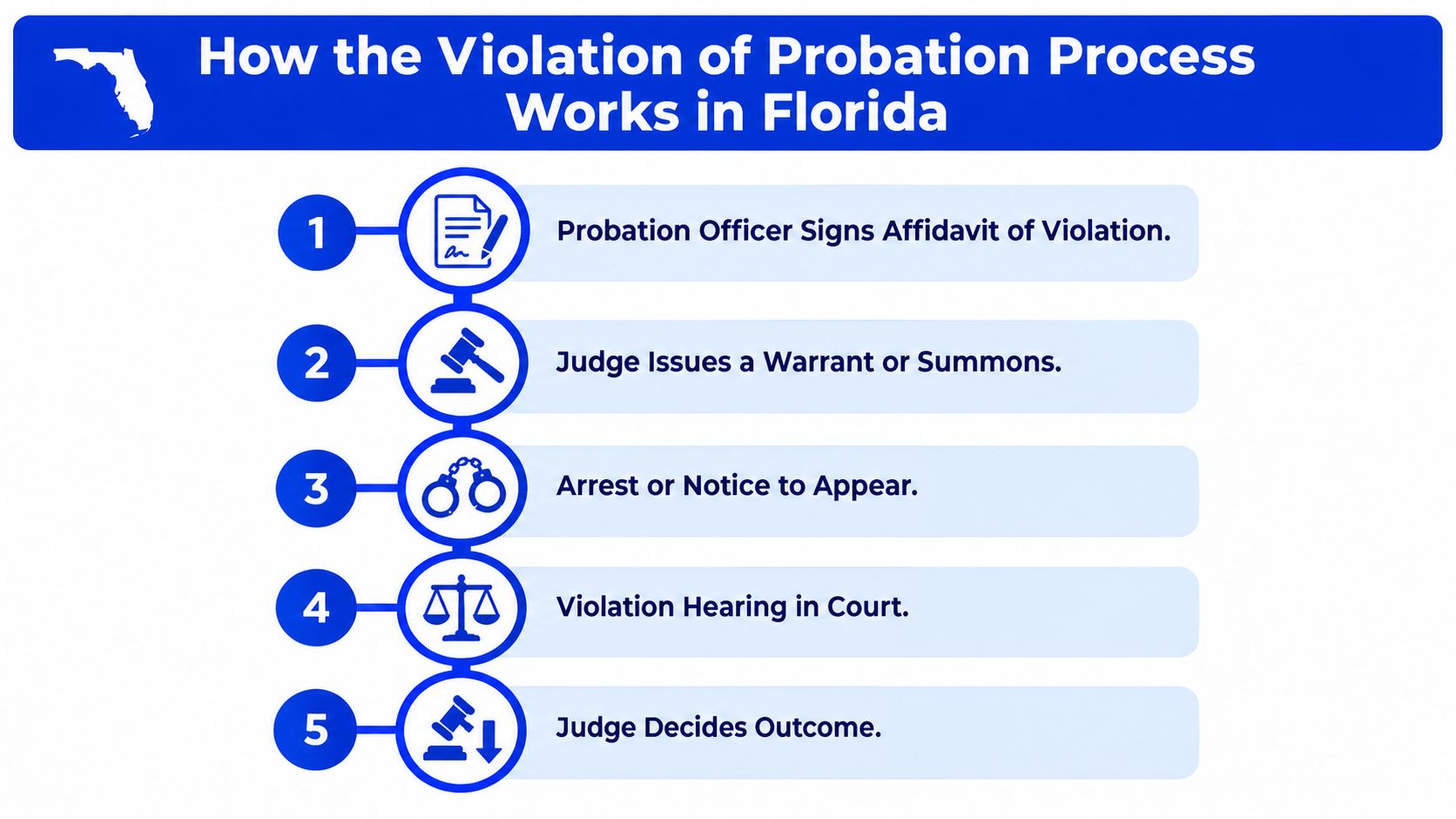
The process often starts before you ever see a judge. A probation officer signs an affidavit describing the alleged breach. The court may then issue a warrant, authorize an arrest, or direct you to appear by notice.
If law enforcement arrests you on a VOP warrant, you may spend time in county jail before the court addresses release. Bond isn't handled the same way as it is in an ordinary new criminal case, and release depends on the court's authority and the facts presented. Don't assume that waiting in custody is the only option. A lawyer may be able to address release, surrender, or the timing of the first hearing.
What happens in court
At the first appearance or arraignment, the judge advises you of the allegation. You generally admit or deny it. An admission can lead to immediate sentencing, while a denial usually results in preparation for a contested violation hearing.
The State typically presents the probation officer first. The defense can cross-examine that witness, challenge the documents, present evidence, and explain why modification or continuation is more appropriate than revocation. The original probation order matters because the State must identify a condition that you were required to follow.
A VOP can also resolve by stipulation. That usually means the defense and prosecution agree on a factual basis or recommendation, while the judge retains authority over the final disposition. A negotiated resolution may avoid the uncertainty and delay of a contested hearing, but you should never admit a violation without understanding the sentencing consequences.
Watch this overview of what a motion hearing in court is to understand why procedural hearings and evidentiary hearings serve different purposes.
A straightforward case may resolve in one or two court dates. A contested case can take several months, particularly when witnesses, records, treatment providers, payment records, or a separate new criminal case must be addressed.
Jail Time, Modification, or Prison After a Violation
After a Florida judge finds a probation violation, the critical question is not only whether jail is possible. The outcome turns on the violation category, your compliance record, and whether the court can use a lesser sanction instead of revoking supervision.
Continuation leaves probation in place. The judge may issue a warning, clarify an existing condition, or require stricter compliance without adding incarceration. This result is more realistic when the violation is isolated, your overall record is strong, and the defense presents a specific, credible explanation.
Modification keeps you on probation while adding consequences or conditions. Under Florida's current statutory framework, a court handling a qualifying low-risk technical violation may impose up to 90 days in county jail as a special condition of probation instead of fully revoking probation. If fewer than 90 days of supervision remain and the statutory requirements are met, the court may impose a maximum of 90 days in county jail under the circumstances described in section 948.06.
That rule matters because a qualifying technical violation gives the defense a concrete argument for a lesser sanction. Your attorney should identify the category, document compliance, and give the judge a practical reason to keep supervision in place.
The serious end of the range
Revocation ends the original probation arrangement. The judge then sentences you based on the underlying offense and applicable legal limits. Depending on the case, that may mean county jail or exposure to state prison. Prison is not automatic after every VOP, but revocation can give the court substantially broader sentencing authority than the alternative available for a qualifying low-risk technical violation.
Outcome | Maximum Jail or Prison Time | When Typically Applied | Burden on Court |
|---|---|---|---|
Continue probation | No new incarceration required | Minor or adequately explained violation with strong compliance history | Court accepts that supervision remains workable |
Modify probation | Up to 90 days in county jail as a special condition in qualifying cases | Court wants a consequence but believes probation can continue | Court must select conditions tied to compliance and risk |
Revoke probation | Sentence tied to the original offense, subject to applicable statutory limits | Serious, repeated, willful, or substantive violation | Court determines probation no longer protects the public or promotes compliance |
Florida data show why “jail time” needs context. The Florida Criminal Justice Data Snapshot reported that 42% of probation violation admissions in 2021 involved technical violations. Its broader revocation analysis found that 33% of revocations resulted in jail time and 31% resulted in state prison time.
The judge will examine the underlying offense, your history on supervision, the nature of the breach, and whether you can safely complete probation. Possession, DUI, theft, and violent-offense cases do not receive identical treatment. The defense must connect the facts to a lawful result, then press for continuation or modification before revocation becomes the court's default.
Defenses That Can Beat a Florida Probation Violation
A VOP defense isn't built around arguing that the original sentence was unfair. The judge usually won't reopen the original conviction, renegotiate the plea, or retry the facts that led to probation.
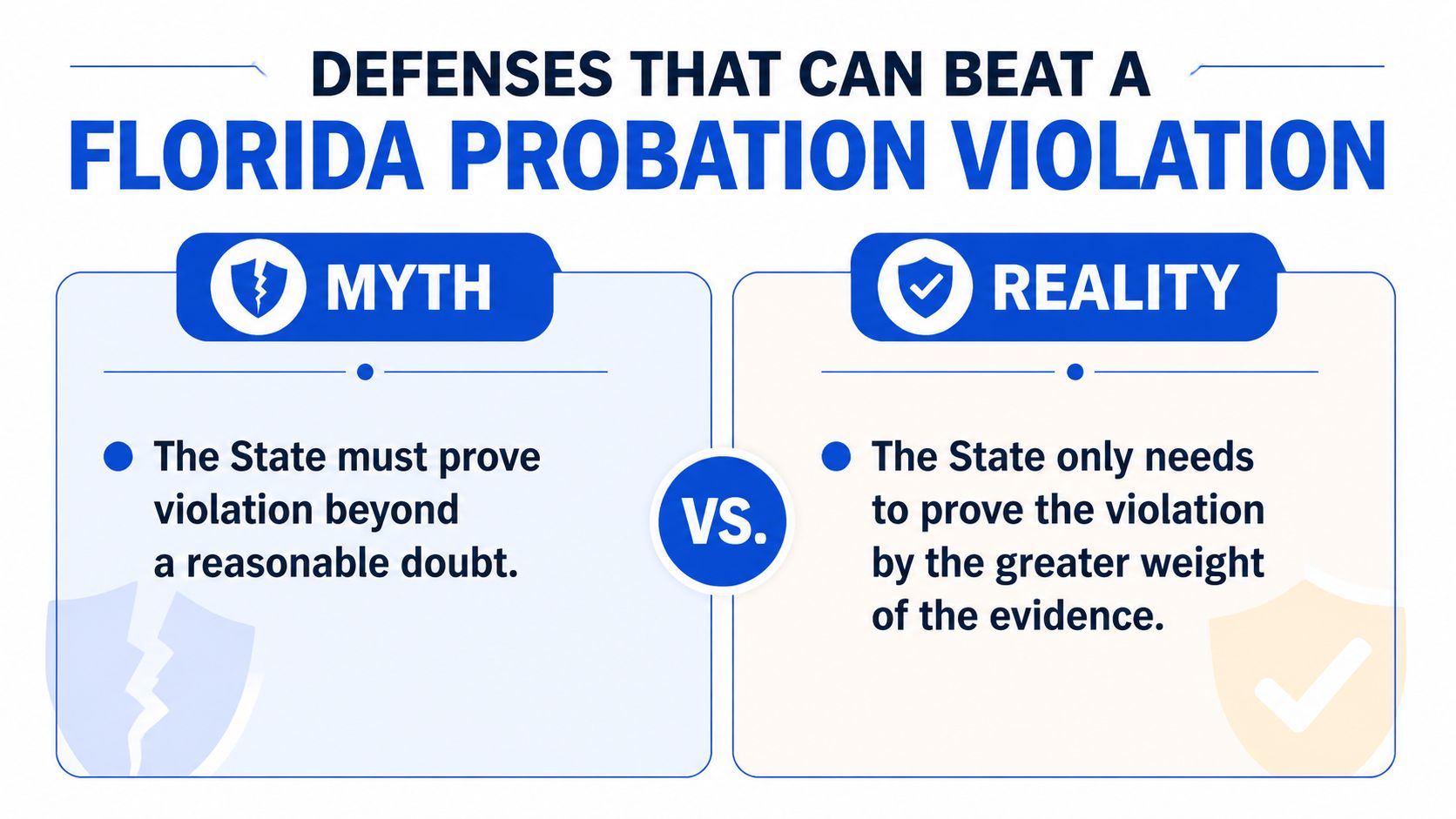
The State has a lower burden than in a new criminal case. It generally must prove the allegation by the greater weight of the evidence, not beyond a reasonable doubt. But the alleged violation still must be legally valid, and a revocation ordinarily requires proof that the violation was willful and substantial.
Real defenses versus losing arguments
Real Defense Move | Myth That Usually Fails |
|---|---|
Show that the alleged conduct didn't violate a written or properly imposed condition | Argue that the original sentence felt excessive |
Prove a medical emergency, employment hardship, or another circumstance that prevented compliance | Relitigate the underlying conviction |
Demonstrate a good-faith effort to comply | Claim that every technical violation is automatically harmless |
Challenge unreliable testimony, missing records, or an unsupported affidavit | Assume dismissal of a new charge automatically dismisses the VOP |
Payment allegations deserve careful attention. If you couldn't pay court costs, restitution, or another financial obligation, the court must examine whether you had the ability to pay before treating the failure as willful. Bring pay records, bank information, employment history, and proof of necessary expenses.
A lawyer can also examine whether the affidavit was filed while the court still had jurisdiction, whether the condition appeared in the probation order, and whether the State's evidence depends only on hearsay. Confidential informant allegations require credibility analysis, not blind acceptance.
A missed appointment caused by a documented medical emergency is a defense problem to investigate, not an admission to make casually.
For additional context on a lower-level allegation, see misdemeanor probation violation defense. The evidence and your explanation must be organized before the hearing, not improvised in front of the judge.
What You Should Do Before Your Violation Hearing
Your conduct between the allegation and the hearing can affect sentencing. It won't erase a proven violation, but it can show the judge that you remain capable of following supervision.
Start with the paperwork. Build a file that answers the probation officer's allegation directly rather than collecting unrelated documents.
Payment records: Gather pay stubs, receipts, payment confirmations, and proof of necessary expenses if money is part of the allegation.
Treatment documentation: Obtain drug test results, class certificates, counseling attendance records, and letters from treatment providers.
Stability evidence: Collect proof of housing, employment, school enrollment, or a structured daily schedule.
Character support: Ask employers, counselors, family members, or other appropriate witnesses for focused letters describing reliability and current commitments.
A factual timeline: Write down dates, appointments, communications, travel, testing, and the reason any requirement was missed.
Stop making the situation worse
Don't use drugs or alcohol if either could affect your compliance or create a new allegation. Don't contact witnesses about what they should say. Don't post about the case online, and don't ignore probation communications unless your lawyer tells you otherwise.
If a warrant exists, discuss surrender with counsel. Voluntary appearance can present better than being arrested unexpectedly, although the right decision depends on the warrant, the allegation, your criminal history, and the local court. A Fort Lauderdale or Broward County VOP defense lawyer can review the docket and coordinate the next step.
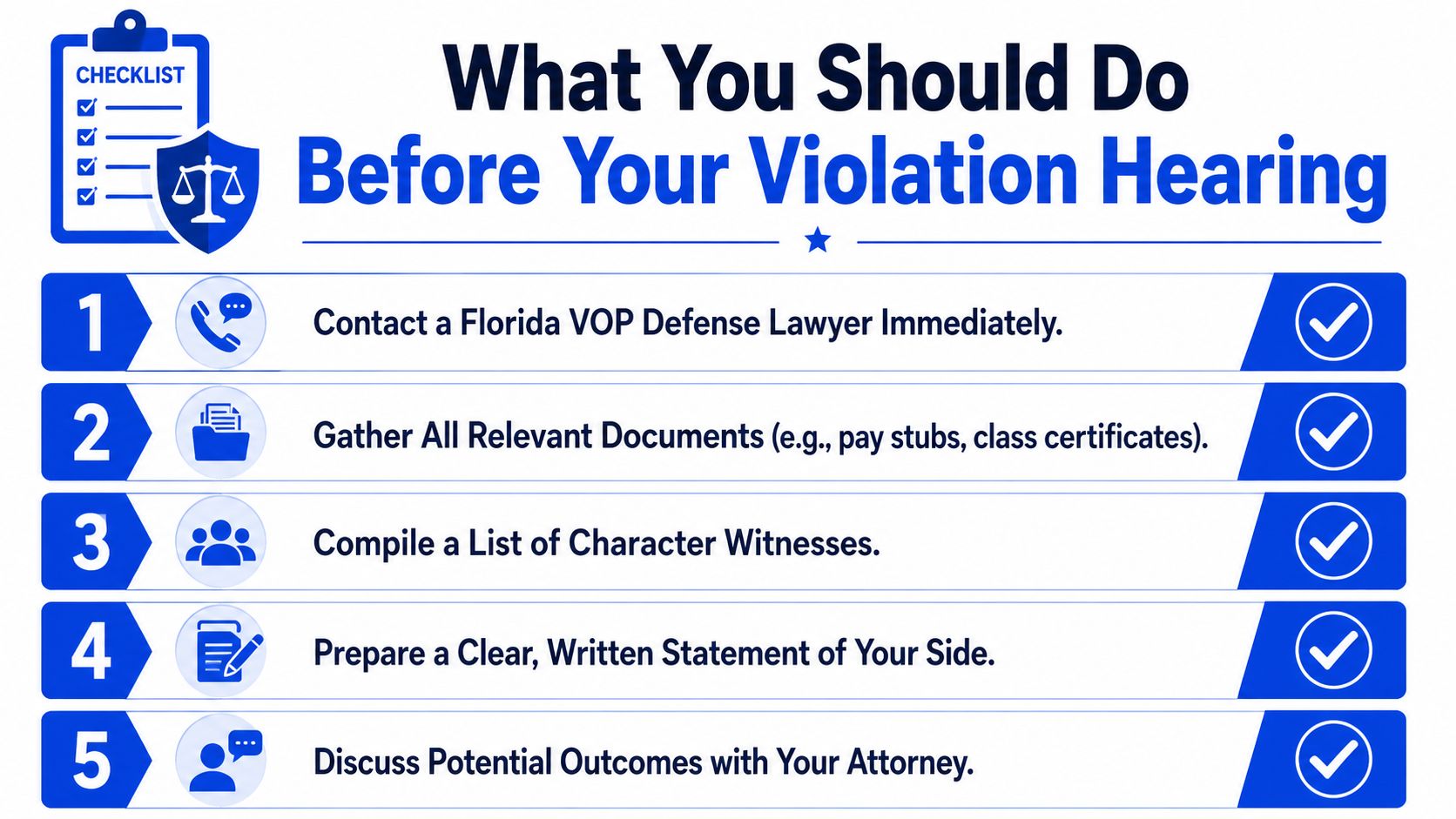
Contact counsel early enough to review the original order, the affidavit, the violation history, and the prosecutor's position. In some cases, the lawyer can negotiate a stipulated resolution with a lesser sanction. In others, the right move is to deny the allegation and prepare for a hearing. Use probation violation lawyer near me as a starting point, but verify that the lawyer handles the county and courtroom where your case is pending.
Protecting Your Freedom and Your Future in South Florida
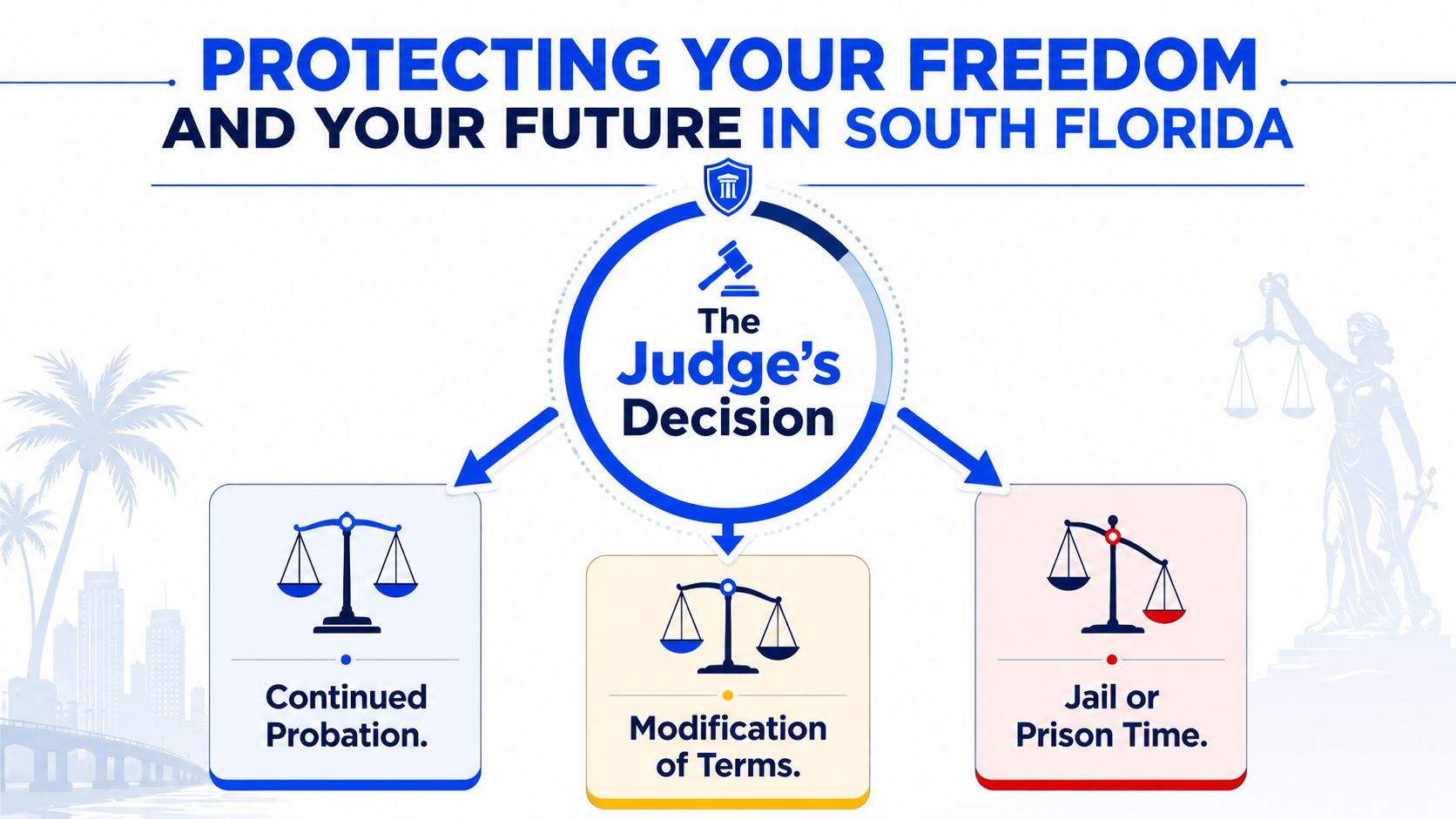
The judge's decision usually comes down to one point: whether probation can still work. The court may continue supervision, modify it with additional conditions or a county-jail sanction, or revoke it and impose a sentence connected to the original offense.
That decision isn't random. The judge looks at the violation category, prior VOP history, performance on supervision, the underlying charge, and the quality of the mitigation presented. A probation officer's recommendation can matter, but it isn't a substitute for a defense strategy that tests the allegation and gives the court a workable alternative.
South Florida realities
Broward County, Fort Lauderdale, Miami-Dade, and Palm Beach courts handle busy criminal dockets and recurring probation matters. Judges see the difference between a person who takes responsibility, documents a solution, and follows instructions after the allegation, and a person who ignores the process until an arrest forces action.
Early intervention gives your lawyer time to locate records, speak with the assigned assistant state attorney, address release, and determine whether the case should be negotiated or litigated. It also protects future options that may depend on how the VOP ends, including possible early termination or record-sealing eligibility.
For a probation violation lawyer, do not wait for the hearing date to start building your defense. Ticket Shield, PLLC offers confidential Florida probation violation consultations and can review the allegation, your probation order, and potential sanctions before the first court appearance. Visit Ticket Shield, PLLC to request a confidential consultation about your South Florida VOP case.