
Field Sobriety Test Refusal: What Happens in Florida
Jason Goldsmith, Esq
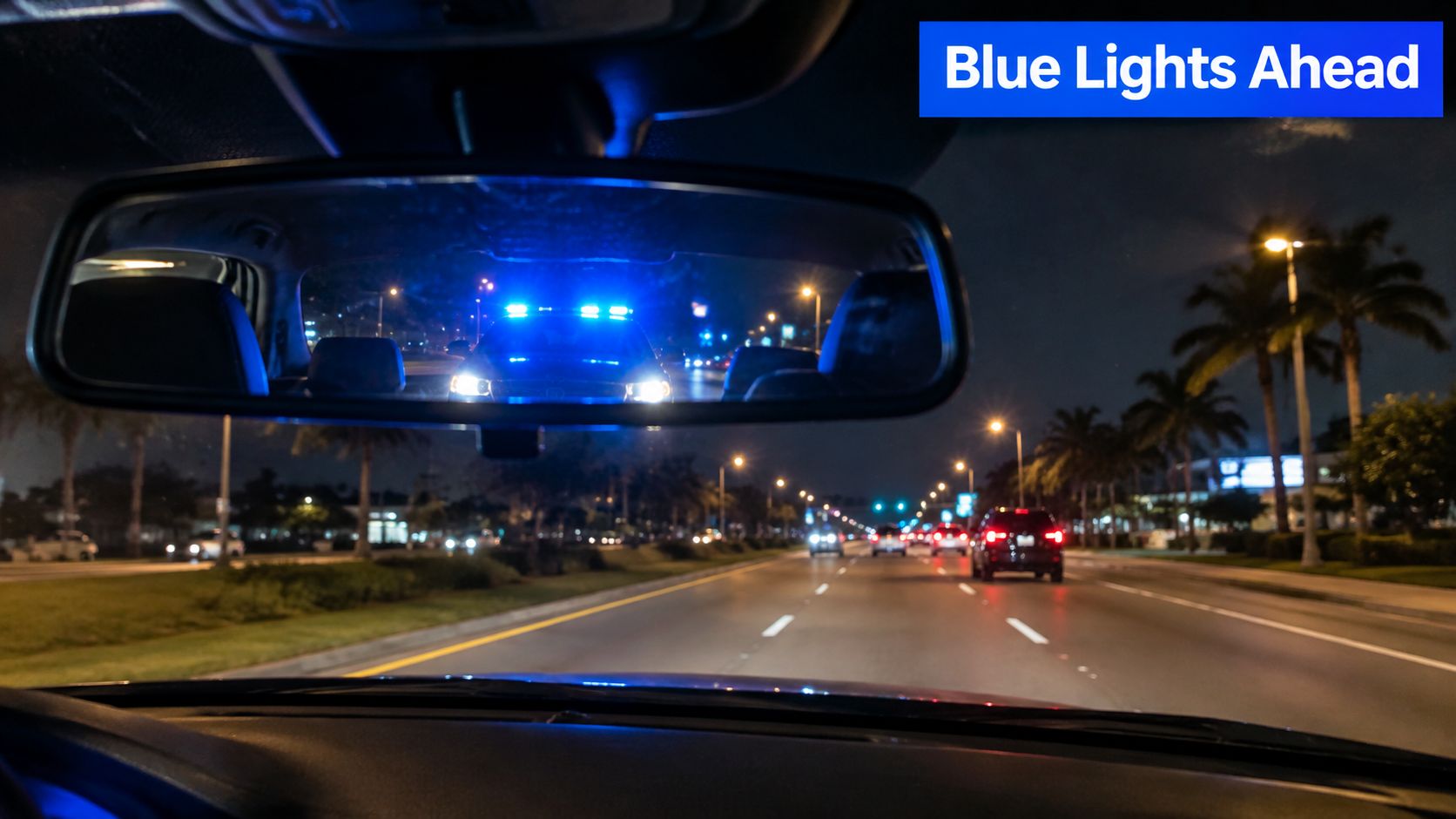
A patrol car's lights appear in your mirror on a Broward County road. Your hands tighten around the steering wheel. After checking your license and registration, the officer asks you to step out and perform a walk-and-turn or stand on one leg. You're worried that refusing will look guilty, but you're equally worried that a nervous or physically difficult performance will become evidence against you.
That decision matters, but many drivers misunderstand what it means. Refusing a roadside field sobriety test is legally different from refusing a post-arrest chemical test, such as a breath, blood, or urine test. Florida treats those events differently, and confusing them can cost you important rights.
The safest approach during a suspected DUI stop is to stay calm, provide required documents, avoid argumentative explanations, and understand what you're being asked to do. You can learn more about the legal basis for a traffic stop in this guide to reasonable suspicion during a traffic stop.
Table of Contents
The Moment Blue Lights Appear in Your Mirror
You may be driving home through Fort Lauderdale, Miami-Dade, Palm Beach, or another South Florida community when an officer signals you to pull over. Maybe the officer says you were weaving, followed too closely, or drove with an equipment problem. Once the officer approaches, the questions often come quickly: Where are you coming from? Have you been drinking? Will you step out and perform some tests?
The pressure is deliberate, even when the officer is acting lawfully. Individuals often want to appear cooperative, and refusing a request from law enforcement can feel like admitting wrongdoing. But a roadside field sobriety exercise isn't a neutral check to confirm that you're safe to drive home. NHTSA materials describe standardized roadside testing as a detection tool used to develop evidence of impairment, not as a direct measurement of driving ability. NHTSA's standardized field sobriety testing materials provide the broader framework officers use for these evaluations.
A driver can be completely sober and still struggle with balance, instructions, nerves, poor lighting, uneven pavement, footwear, fatigue, or a medical condition. The officer may interpret those circumstances as impairment. If you perform poorly, the State can use the officer's observations and recorded test results to support an arrest and later prosecution.
What the officer is trying to establish
The officer is generally collecting observations, not giving you a chance to prove your innocence. The driving pattern, your speech, your eyes, your coordination, any odor of alcohol, your answers, and your performance may all appear in the arrest report.
You aren't required to volunteer an explanation about where you were, what you consumed, or why you think you can drive. Providing your license, registration, and proof of insurance is different from answering incriminating questions or participating in roadside exercises.
Practical rule: Be respectful, comply with lawful identification requests, and don't mistake cooperation with the officer's investigation for protection of your own legal interests.
A polite refusal won't guarantee that the officer will let you leave. An officer may still arrest you based on other observations, and the State may later argue that your refusal reflected consciousness of guilt. The decision is strategic, not a guaranteed way to avoid arrest or a DUI charge.
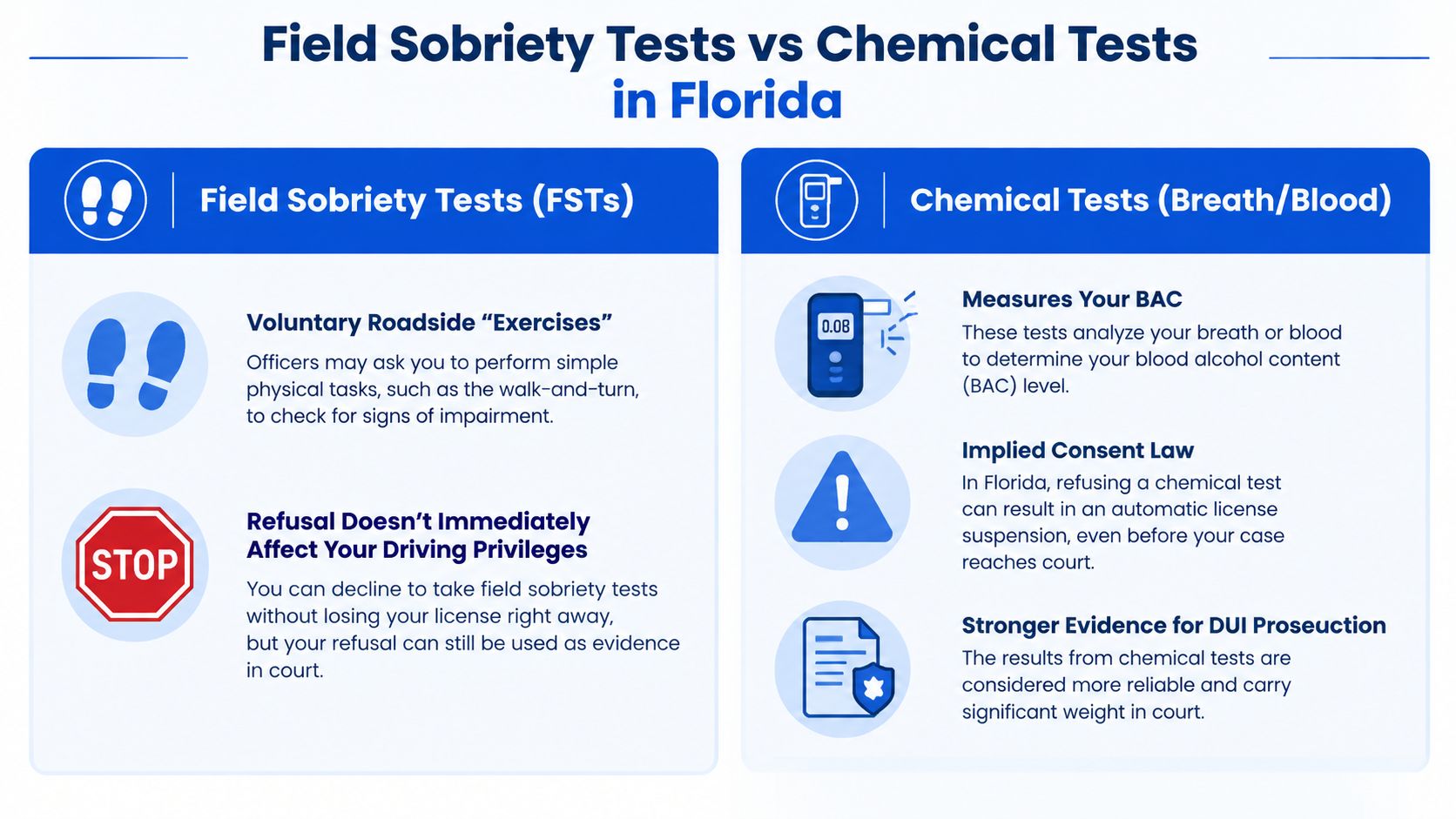
Field Sobriety Tests vs Chemical Tests in Florida
Think of the roadside exercise as an investigative screening and the chemical test as a separate evidentiary procedure after arrest. They may happen during the same encounter, but they don't carry the same legal rules.
Field sobriety tests are roadside exercises such as the walk-and-turn, one-leg stand, eye-movement observations, or other coordination and instruction-based tasks. In Florida, a driver can refuse these roadside exercises. Florida's implied-consent statute distinguishes them from chemical testing, and the statutory license suspension for refusal applies to a lawful breath, blood, or urine test after the required warnings, not to refusing field sobriety exercises. See the Florida implied-consent statute.
Chemical tests seek evidence of alcohol or drugs through breath, blood, or urine. These tests generally arise after an arrest or under circumstances covered by Florida's implied-consent law. Refusal can create separate administrative and evidentiary consequences, including the statutory one-year or 18-month license suspension described in the statute linked above.
The difference in practical terms
Request | Typical setting | Main legal issue |
|---|---|---|
Field sobriety exercise | Roadside, before or around arrest | Refusal can be used as evidence, but the chemical-test suspension doesn't automatically apply |
Breath, blood, or urine test | After arrest or under implied-consent circumstances | Refusal can trigger license consequences and create additional evidence for the State |
A roadside refusal can prevent the officer from recording a poor balance or coordination performance. It doesn't erase the driving conduct, statements, physical observations, or other evidence already gathered.
A chemical-test refusal is different because Florida law attaches administrative consequences to refusing a lawful test after the required warnings. Before making assumptions about the effect of a breath request, review the separate issues discussed in whether you can refuse a breathalyzer in Florida.
Why timing matters
The sequence of events can affect the defense. An officer may ask for field sobriety exercises during the investigation, arrest the driver based on accumulated observations, and then request a chemical test. A driver who treats every request as the same may misunderstand both the right to decline roadside exercises and the consequences attached to chemical-test refusal.
Don't rely on a roadside officer to explain every legal consequence in a way that protects you. Listen carefully to the request and warnings, avoid guessing, and contact a Florida DUI lawyer as soon as you can after the encounter.
Your Right to Politely Refuse Field Sobriety Tests
In Florida, you're generally not legally required to perform standardized field sobriety tests. That means an officer may ask you to walk, stand, follow an object with your eyes, or perform another roadside exercise, but you can decline without an automatic administrative license suspension tied to that specific refusal.
The cleanest response is short and respectful. You don't need to debate the officer, accuse the officer of misconduct, or explain that you know the law. Say, “I respectfully decline to perform field sobriety exercises.” If the officer keeps asking, repeat the same answer without adding admissions or argumentative commentary.
This approach matters because roadside tests are designed to produce observations that may support the State's case. The legal explainer from FindLaw's discussion of field sobriety test refusal also distinguishes voluntary field exercises from chemical-test obligations and explains that refusal may still be used as evidence.
What refusal does and doesn't do
Refusing a field sobriety test does not automatically end the stop. The officer can continue investigating, ask questions, observe your conduct, seek additional information, and make an arrest if the officer believes probable cause exists.
It also doesn't prevent the officer from requesting a chemical test later. The roadside exercises and the post-arrest breath, blood, or urine test occupy separate legal categories.
Refusing roadside exercises | Refusing a chemical test |
|---|---|
No automatic chemical-test suspension based solely on the roadside refusal | Can trigger statutory license consequences after the required warnings |
May be argued as circumstantial evidence | Can create separate administrative and evidentiary issues |
Avoids giving the officer a performance to interpret | Doesn't eliminate the possibility of a warrant or other lawful testing process |
Keep the interaction controlled
You still need to provide requested identification and vehicle documents. You should also avoid sudden movements, arguing about the stop, reaching into the vehicle without permission, or resisting an arrest.
If you have a physical limitation, injury, neurological condition, balance disorder, or medication issue, you don't need to turn the roadside encounter into a medical interview. You can state that you're declining the exercises and later provide relevant information through counsel. For more preparation about questions officers may ask, review these sobriety test questions.
A refusal is a legal decision, not a confrontation. Keep your voice calm, use as few words as possible, and don't consent to an evidentiary performance you don't have to provide.
The Legal Consequences of an FST Refusal
The main risk of field sobriety test refusal is not an automatic license suspension. The risk is evidentiary. In Florida, the state supreme court has held that refusing standardized field sobriety tests can be admitted at trial and treated as evidence of consciousness of guilt. The court's decision in State v. Taylor is central to understanding why refusal can still affect a DUI prosecution.
A prosecutor may argue that you declined because you knew you would perform poorly. That argument doesn't prove impairment by itself, but it gives the State a narrative to present alongside other evidence.
How the State may build the argument
Suppose an officer reports that your vehicle crossed a lane marker, that your speech sounded unusual, and that the officer noticed an odor of alcohol. You decline the walk-and-turn and one-leg stand. The prosecutor may argue that your refusal supports the officer's conclusion that you were impaired.
The defense response focuses on the limits of that inference. People refuse for many reasons unrelated to guilt, including fear of falling, confusion about the request, anxiety, a physical condition, prior negative experiences with law enforcement, or a desire not to create subjective evidence. The State still has to prove impairment through admissible and credible evidence.

Refusal and probable cause
The officer doesn't need field sobriety results if other facts independently support an arrest. Driving behavior, the circumstances of the stop, statements, odor, speech, balance before the test request, and the officer's overall observations may become the foundation for probable cause.
That makes the refusal only one part of the case. A lawyer must examine whether the officer lawfully stopped the vehicle, whether the detention continued longer than permitted, whether the officer accurately described the encounter, and whether the remaining observations support impairment rather than mere suspicion.
Florida drivers should also separate criminal prosecution from administrative license action. The issues can overlap, but they involve different procedures and deadlines. Learn more about administrative license suspension after a DUI arrest.
A refusal can remove potentially damaging test-performance evidence while creating a separate argument for the prosecutor. That tradeoff is why the exact wording used by the officer, your response, the timing of the request, and the video recording all matter.
How a Defense Attorney Fights a DUI After a Refusal
A field sobriety test refusal doesn't decide the case. It changes the evidence the State has available, and the defense should use that change to focus attention on every remaining weakness.
The first question is whether the traffic stop was lawful. An attorney reviews the reason given for the stop, the officer's observations before the stop, the length of the detention, and whether the investigation expanded without adequate legal grounds. If the stop or detention violated constitutional protections, counsel may file a motion to suppress evidence obtained afterward.
The investigation must withstand scrutiny
The arrest report often uses phrases such as bloodshot eyes, slurred speech, odor of alcohol, or poor balance. Those observations may matter, but they aren't self-proving. Counsel should compare the report with body-camera footage, dash-camera footage, dispatch records, witness accounts, and the officer's testimony.
A video may show that speech was clear, that the driver followed instructions, or that the supposed balance problem occurred on an uneven shoulder. It may also reveal that the officer asked confusing questions, changed instructions, or treated ordinary nervousness as an impairment clue.
Common defense targets
The traffic stop: The defense can challenge whether the officer had a lawful basis to stop the vehicle in the first place.
The detention: The State must justify keeping the driver roadside while the investigation develops.
The refusal narrative: Anxiety, medical limitations, physical discomfort, confusing instructions, and fear of falling can provide innocent explanations for declining.
Officer observations: Counsel can test whether descriptions are specific, consistent, and supported by recording evidence.
Chemical testing: The defense can examine warnings, timing, collection procedures, maintenance records, operator qualifications, and whether the requested test complied with legal requirements.
Statements and searches: A lawyer can assess whether questioning, consent, or a vehicle search produced evidence that should be excluded.
The absence of field-test results doesn't leave the defense empty-handed. It gives counsel a narrower record to challenge and forces the State to prove impairment through its other evidence.
Florida DUI cases often involve both criminal and licensing consequences. An attorney may need to address court filings, evidence preservation, administrative deadlines, negotiation, and trial strategy at the same time. The defense should also account for related allegations, such as drug possession, weapons charges, resisting, or probation violations, if the stop produced more than a DUI accusation.
For practical defense considerations after an arrest, review how to fight a DUI charge in Florida. A former prosecutor can evaluate how the arresting agency documents refusals and where the State's theory depends on assumptions rather than reliable proof.
What to Do During a Florida DUI Stop
Blue lights in the mirror require a controlled response. Your priorities are safety, clear communication, and avoiding unnecessary evidence. Roadside exercises and post-arrest chemical testing are separate decisions, with different consequences under Florida law.
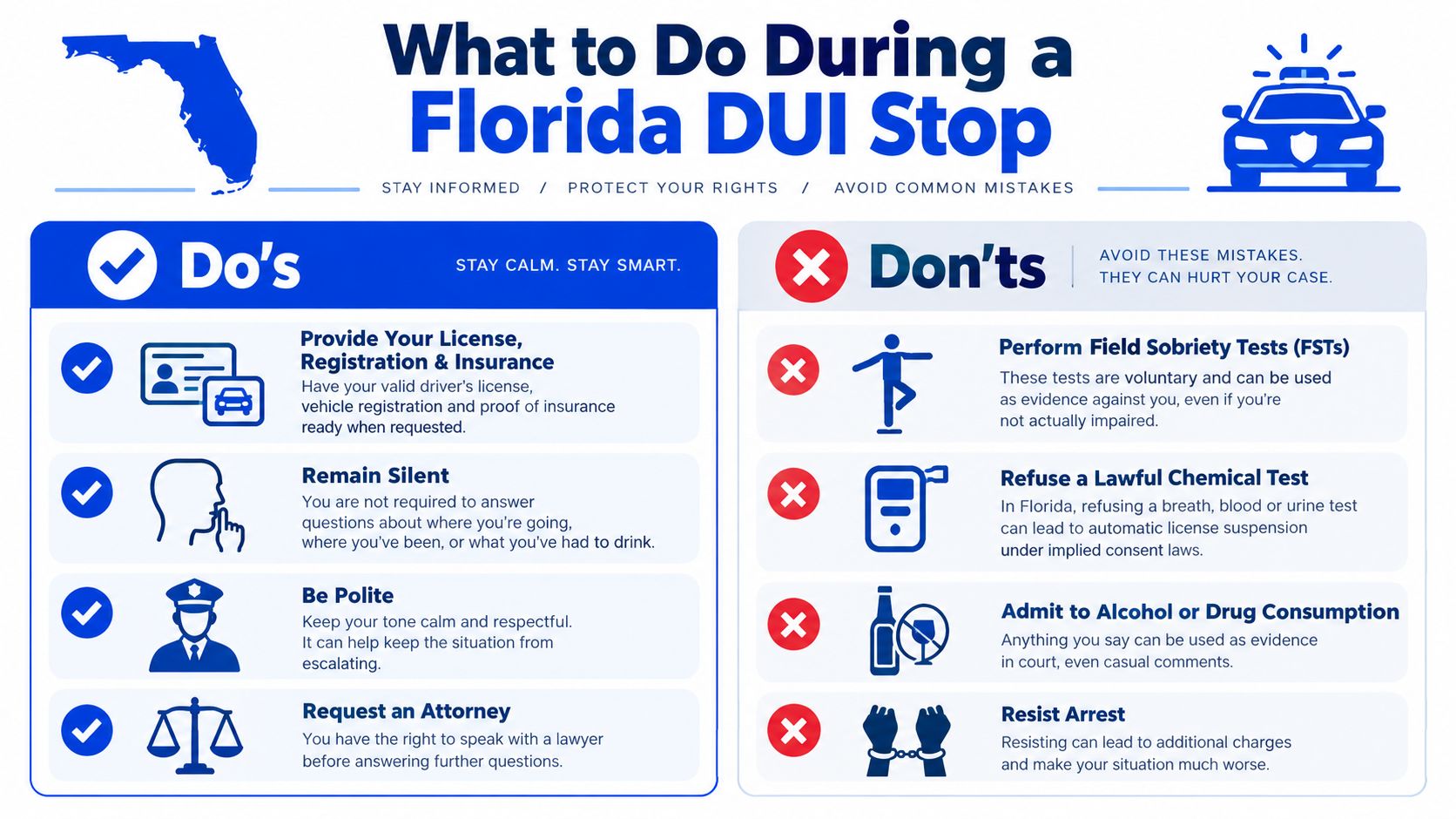
Do
Pull over safely: Signal, stop where practical, and keep your hands visible.
Provide documents: Give the officer your license, registration, and proof of insurance when requested.
Stay polite: Use a calm voice. Do not argue about the officer's conclusions.
Answer identification questions: Provide basic identifying information without volunteering a detailed account of your evening.
Decline roadside exercises clearly: Say, “I respectfully decline field sobriety exercises.” Do not physically resist or argue.
Remain silent about incriminating subjects: State that you want to remain silent and speak with a lawyer.
Request counsel after arrest: Ask to contact an attorney, and do not discuss the facts with other people in custody.
Don't
Don't perform roadside exercises to appear cooperative: These exercises can create subjective evidence about balance, coordination, and divided attention.
Don't treat a chemical test like an FST: A lawful breath, blood, or urine request after arrest can trigger separate implied-consent consequences. Refusing roadside exercises is not the same decision as refusing a station breath test.
Don't admit drinking or drug use: Casual comments can appear in the officer's report and affect the State's theory.
Don't consent to searches: State your objection calmly, but never physically resist.
Don't resist arrest: Challenge the stop, arrest, or search later through counsel and the court process.
Don't delete or alter evidence: Preserve messages, location information, receipts, and relevant medical records.
If you were stopped or arrested in Fort Lauderdale, Broward County, Miami-Dade, Palm Beach, or elsewhere in South Florida, contact Ticket Shield, PLLC promptly for a confidential consultation. The firm can evaluate the stop, refusal, chemical-test request, video evidence, license issues, and potential DUI defenses, with communication available by phone, text, or email.
Ticket Shield, PLLC helps Florida drivers respond to field sobriety test refusal, DUI arrests, chemical-test issues, and related criminal charges with a defense plan based on the evidence. Visit Ticket Shield, PLLC to request a confidential consultation and discuss how to protect your license, freedom, and future.