
Theft Petit
Jason Goldsmith, Esq
Petit theft in Florida is a misdemeanor involving property worth less than $750, split into two tiers: property under $100 carries up to 60 days in jail, while property from $100 to under $750 carries up to 1 year in jail. The maximum fines are $500 for second-degree petit theft and $1,000 for first-degree petit theft.
You may be sitting at home in Broward County with a notice to appear on the kitchen counter, replaying a retail-store encounter that ended with handcuffs or a loss-prevention report. A moment that felt confusing or embarrassing has now created a court date, a criminal case, and questions about your job, housing, license, and future.
I'm going to be candid. A misdemeanor label doesn't make a theft case harmless. The State still has to prove what you took, who owned it, what it was worth, and whether you intended to permanently deprive the owner of it. Those details often matter more than the accusation itself.
Table of Contents
Why a Petit Theft Charge Feels Bigger Than It Sounds
A typical South Florida case can start with an accusation at a Fort Lauderdale store. A loss-prevention officer stops you near the exit, police arrive, and you're asked questions while employees point to surveillance footage or merchandise. Sometimes you're arrested. Sometimes you receive a notice to appear. Either way, the court date suddenly feels like it could affect every part of your life.
Petit theft is one of Florida's most common theft allegations because it covers lower-value property. But “misdemeanor” doesn't mean “minor.” The charge can create a public record, require court appearances, and expose you to incarceration and fines.
The two penalty gates
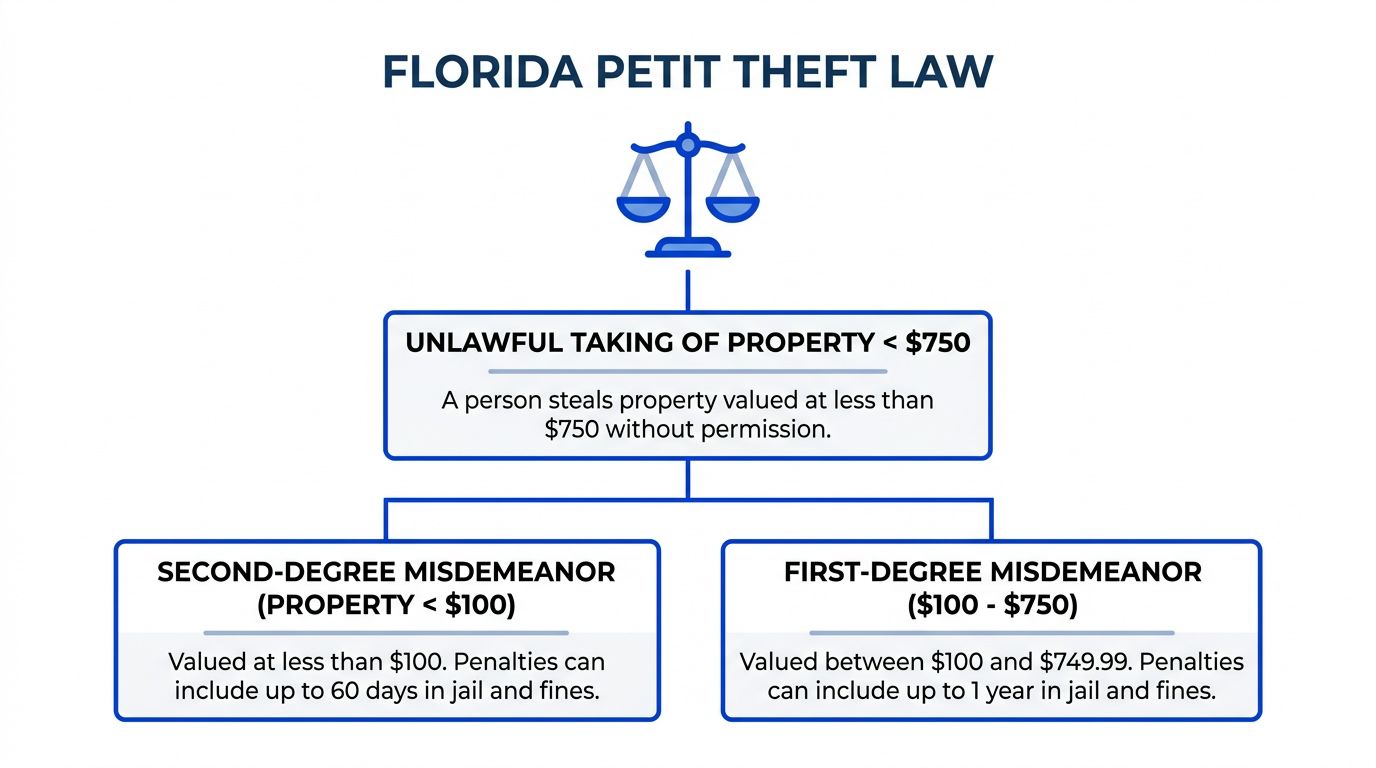
Florida uses the alleged value of the property as a gate. If the State proves the property was under $100, the charge is generally second-degree petit theft, with a maximum of 60 days in jail and a $500 fine. If the State proves the property was from $100 to under $750, it's generally first-degree petit theft, with a maximum of 1 year in jail and a $1,000 fine. The governing theft statute is Florida Statute 812.014.
The maximum penalty isn't an automatic sentence. A first-time accused person may have options involving diversion, dismissal, or a negotiated resolution. But those options become harder to protect when you make statements, sign store paperwork, or plead without understanding the record consequences.
Practical rule: Don't treat a notice to appear as a bill or customer complaint. It's a criminal case, and your statements can become evidence.
This guide focuses on the issues that move real Florida theft cases: proving value, proving intent, challenging surveillance and identification, handling repeat merchant-theft consequences, evaluating diversion, protecting sealing eligibility, and preparing for a confidential consultation with Ticket Shield, PLLC.
What Petit Theft Means Under Florida Law
Florida's theft statute focuses on the unlawful obtaining or use of another person's property with the required intent to deprive the owner. In plain English, prosecutors generally need to establish three connected points:
A taking or use occurred. The State must identify conduct showing that you obtained, used, or exercised control over the property.
The property belonged to someone else. Ownership, possession, or the merchant's right to the merchandise matters.
You intended to permanently deprive the owner. An accident, misunderstanding, or honest belief that you had permission can undermine this element.
The word intent is often the center of a defense. Walking out with an unpaid item doesn't automatically prove why you did it. The State may rely on conduct, statements, surveillance, concealment, checkout activity, timing, and what happened after the store confrontation. The defense examines whether those facts prove criminal intent beyond a reasonable doubt.
Value determines the classification
Think of the value thresholds as gates:
Under $100: Second-degree petit theft, punishable by up to 60 days in jail and a $500 fine.
$100 to under $750: First-degree petit theft, punishable by up to 1 year in jail and a $1,000 fine.
$750 or more: The allegation may become grand theft, a felony, rather than petit theft.
The difference between the first two gates can be small in practical terms but substantial in legal exposure. A disputed item that the State values just above $100 can move the case from the lower misdemeanor tier into first-degree petit theft.
The statute's classification is only the starting point. Prior convictions, the identity of the alleged victim, the type of property, and the specific facts can create additional consequences. That's why you shouldn't assume the store's accusation or a receipt automatically settles the legal value.
For a broader explanation of how Florida treats misdemeanor and felony theft allegations, review this discussion of misdemeanor versus felony theft. Your defense should focus on the State's proof, not just the label printed on the charging document.
How Prosecutors Prove the Value of What Was Taken
The most overlooked issue in a theft petit case is valuation. The question isn't what price appeared on a shelf. The question is what value the State can prove through admissible evidence and a legally defensible theory.
That distinction matters because the value line separates the lower misdemeanor tier from the higher misdemeanor tier, and the felony threshold begins at $750. A prosecutor may present a retail receipt, inventory record, employee testimony, online pricing, or a loss-prevention estimate. The defense should test whether that evidence proves the item's actual value at the relevant time.
Retail price isn't automatically the end of the analysis
Consider a phone the State claims was worth $750 because that was its listed retail price. If the phone was used, damaged, discontinued, heavily discounted, or normally sold through a different market, the defense may argue that the State hasn't established that figure. A resale value under $100 could materially change the classification if the evidence supports it.
The same questions arise with clothing, electronics, tools, cosmetics, and returned merchandise:
Was the item new, used, opened, or damaged?
Was the displayed price a regular price or a temporary promotion?
Did the merchant sell comparable items at that amount?
Does the witness know the item's value, or is the number copied from an inventory system?
Was the merchandise incomplete or missing accessories?
A value opinion unsupported by a competent witness or reliable records can create reasonable doubt. The defense doesn't need to accept a store's internal valuation just because an employee wrote it in a report.
Multiple items require careful review
When several items are involved, the charging decision may depend on how the State treats them. The defense should examine whether the State is treating items as one incident, separate counts, or an aggregate value. That analysis can affect both the classification and negotiation posture.
Defense focus: A small change in proven market value can move a case through an entirely different penalty gate.
Receipts, photographs, product records, discount history, damage documentation, and testimony from someone familiar with the merchandise can all matter. A lawyer handling Florida's retail theft statute should compare the allegation with the evidence instead of accepting the merchant's number as conclusive.
Penalties and Repeat-Offense Consequences
Florida's petit theft penalties are easy to summarize, but the summary doesn't capture the full risk. The court considers the charge, criminal history, facts, and available resolutions. A statutory maximum is exposure, not a prediction.
Florida Petit Theft Penalties by Degree
Degree | Property Value | Maximum Jail | Maximum Fine |
|---|---|---|---|
Second-degree misdemeanor | Under $100 | 60 days | $500 |
First-degree misdemeanor | $100 to under $750 | 1 year | $1,000 |
These figures come from the Florida theft statute cited above. If the value reaches or exceeds the felony threshold, the analysis changes and the case may be treated as grand theft. You can review the distinction in this explanation of grand theft in Florida.
The conviction can outlast the sentence
A theft conviction may appear during employment screening, housing applications, or professional-licensing reviews. Employers and licensing authorities can evaluate dishonesty-related conduct differently from other misdemeanor allegations. A case that ends without jail can still create practical problems if the final disposition is a conviction.
The impact also depends on what appears in the record. An arrest, a dismissal, a diversion completion, a withhold, and an adjudication of guilt don't carry identical consequences. Your lawyer should discuss the record outcome before you agree to a plea.
Repeat merchant theft has a specific consequence
Florida's repeat-conviction rule for petit theft from a merchant, farmer, or transit agency requires attention. After a second or subsequent conviction involving one of those entities, the court must impose a fine of not less than $50 and not more than $1,000, or may require public service in place of the fine. The rule appears in Florida Statute 812.015.
That consequence can apply even when jail isn't imposed. It's one reason I tell first-time clients not to make a rushed decision that creates a conviction without considering future exposure.
Florida law can also impose a driver's-license suspension in connection with theft convictions. The exact effect depends on the disposition and applicable legal provisions, so ask about your license before entering any plea.
How the State Builds a Petit Theft Case Against You
Prosecutors usually receive a package assembled by the merchant and law enforcement. In a Broward County or Miami-Dade case, that package may include a loss-prevention statement, surveillance footage, employee or customer witnesses, an inventory record, and information about whether the merchandise was recovered.
The State's theory often develops from those pieces rather than from one decisive fact. A video may show movement but not intent. An employee may describe what happened but misunderstand the transaction. A report may list a value without explaining how anyone calculated it.
Common pressure points in the evidence
Surveillance footage: The camera angle may not show the entire transaction, selection, concealment, payment attempt, or exit.
Loss-prevention accounts: The officer may have reached a conclusion before reviewing all relevant facts.
Witness identification: Employees may remember a stressful encounter differently, especially when several customers were present.
Recovered merchandise: Recovery can support the State's narrative, but it doesn't by itself prove when intent formed or what value the item had.
Statements: Casual comments to store personnel or officers can become central evidence.
A prosecutor may also rely on the value threshold to file a more serious misdemeanor count, charge multiple items separately, or point to prior retail-theft contacts. Prior arrests aren't convictions, and an arrest alone doesn't prove guilt. The defense should object to any attempt to use an unproven allegation as if it were established criminal conduct.
Why recent trends don't make your case harmless
The Council on Criminal Justice reported that in the first half of 2025, reported shoplifting was 12% lower and larcenies were also down in its review of U.S. cities. At the same time, the U.S. Sentencing Commission reported that theft-property-destruction-fraud cases accounted for 4,804 federal cases in fiscal year 2025, an increase of 13% since fiscal year 2021. Those figures appear in the Council on Criminal Justice crime-trends update and show why falling recent counts don't mean prosecutors ignore theft enforcement.
Florida's repeat-conviction rules add another reason to take an initial case seriously. The State may view a first allegation as part of a larger enforcement history, but the defense must keep the argument tied to admissible proof and actual convictions.
Defenses, Diversion Programs, and Plea Options
There are three realistic strategic paths in many petit theft cases: fight the charge, seek diversion, or negotiate a plea. None is automatically correct. The right choice depends on the surveillance, witnesses, valuation evidence, intent facts, prior record, immigration or licensing concerns, and your long-term goals.
Defenses that can change the case
Lack of intent is often the strongest factual defense. A self-checkout mistake, an item left in a cart, a payment misunderstanding, or an honest belief that someone authorized the taking can undermine the required mental state. The explanation must be supported by the surrounding facts, not just stated after the arrest.
Ownership and permission also matter. If you believed the property was yours, had permission to use it, or reasonably misunderstood a transaction, the State may have difficulty proving that you intended to deprive the owner.
Valuation challenges can reduce the degree of the charge. The defense may question retail pricing, condition, discounts, depreciation, missing parts, and the witness's basis for the claimed value.
Evidence challenges can attack incomplete video, unreliable identification, inconsistent reports, or an unlawful search and seizure. Statements obtained during a custodial interrogation may also require constitutional review.
Comparing the three outcome paths
Path | Main advantage | Main risk or cost |
|---|---|---|
Trial | The State must prove every element beyond a reasonable doubt | You accept the uncertainty of a judge or jury decision |
Pretrial diversion | Successful completion may lead to dismissal and preserve record-clearing options | Conditions can require time, classes, payment, or other compliance, and eligibility isn't automatic |
Negotiated plea | Can limit uncertainty and sometimes reduce the charge or punishment | A plea can create lasting record and licensing consequences |
A Florida pretrial diversion program may be attractive for an eligible first-time accused person, but don't assume diversion is free of consequences. Programs often require you to accept responsibility in some form and complete conditions. The lawyer should confirm the written terms, the dismissal procedure, and future sealing or expungement eligibility.
A trial forces the State to present its case, but it also carries risk. A negotiated plea may be appropriate when the evidence is strong and the disposition protects your priorities, but the decision must be informed. Restitution may help negotiations, yet paying a merchant doesn't automatically end the criminal case.
From Arraignment to Sealing Your Record
A petit theft case commonly moves through a recognizable sequence. You may start with an arrest or notice to appear, followed by arraignment, pretrial conferences, negotiations or motions, and a final resolution. Cases in Broward, Palm Beach, and Miami-Dade can move at different speeds, but many misdemeanor matters resolve within a few months.
The basic court timeline
Arrest or notice to appear: Review every document and avoid discussing the facts with store personnel, police, or others before receiving legal advice.
Arraignment: The court formally addresses the charge and plea. Counsel can often handle routine appearances, depending on the court and case circumstances.
Pretrial conferences: The defense reviews discovery, challenges weaknesses, discusses diversion, and negotiates when appropriate.
Resolution: The case may end through dismissal, diversion, a negotiated plea, or trial.

The most important record-clearing decision often happens at the beginning. A dismissed or diverted case may qualify for sealing or expungement if all legal requirements are satisfied. A conviction generally creates a much more difficult barrier, so don't wait until the final hearing to ask whether a proposed disposition protects your eligibility.
For a practical explanation of record sealing in Florida, review the eligibility rules before accepting any offer. Your goal should be clear from day one: pursue an outcome that protects your future options, not merely one that closes the courtroom file quickly.
This video provides additional context about the process:
Preparing for Your Consultation With Ticket Shield
Bring documents and facts that let a defense lawyer test the State's story quickly:
Charging documents: Bring the arrest paperwork, notice to appear, summons, or any court document.
Police materials: Include the police report if you have it.
Purchase records: Gather receipts, bank records, product information, photographs, or proof of ownership.
Incident timeline: Write down where you went, what happened at checkout, who spoke with you, and when police arrived.
Case history: Prepare a complete list of prior arrests, charges, dismissals, pleas, and convictions. Don't hide unfavorable facts. Your lawyer needs them to evaluate repeat-offense consequences and diversion eligibility.
A confidential consultation with Ticket Shield, PLLC can include a former prosecutor's assessment of the State's evidence, a discussion of possible diversion, and a strategy created to fit your record and goals. The firm handles Florida criminal defense matters involving theft, DUI, drug crimes, domestic violence, weapons charges, violent offenses, probation violations, and related cases.
If you're in Fort Lauderdale, Broward County, Miami-Dade, Palm Beach, or elsewhere in Florida, contact the firm 24/7 by phone, text, or email before speaking further about the allegation.
Ticket Shield, PLLC offers confidential consultations for people facing a Florida petit theft charge, including a focused review of value, intent, surveillance, prior convictions, and record-clearing options. Visit Ticket Shield, PLLC to request a consultation and take the next step toward protecting your record and future.