Retail Theft Statute Florida: Penalties & Defenses
Jason Goldsmith, Esq
You may have walked out of a South Florida store thinking the matter was over, then got a call from loss prevention, a police officer, or a clerk saying a report is being filed. That moment feels small. In Florida, it can turn into a misdemeanor, a felony, or a case that sits open for years under the retail theft statute Florida prosecutors use every day in Broward, Miami-Dade, and Palm Beach.
The part often overlooked is that Florida's statute is not limited to classic shoplifting. It reaches conduct that looks like concealment, tag switching, container swapping, and even moving a shopping cart, so long as the State says you meant to deprive the merchant of possession, use, benefit, or full retail value. That's why the defense has to start with the statute itself, not with what the store manager called the incident. Florida's retail theft statute is broader than many realize, and prosecutors often use that breadth to file charges before the facts are fully sorted out.
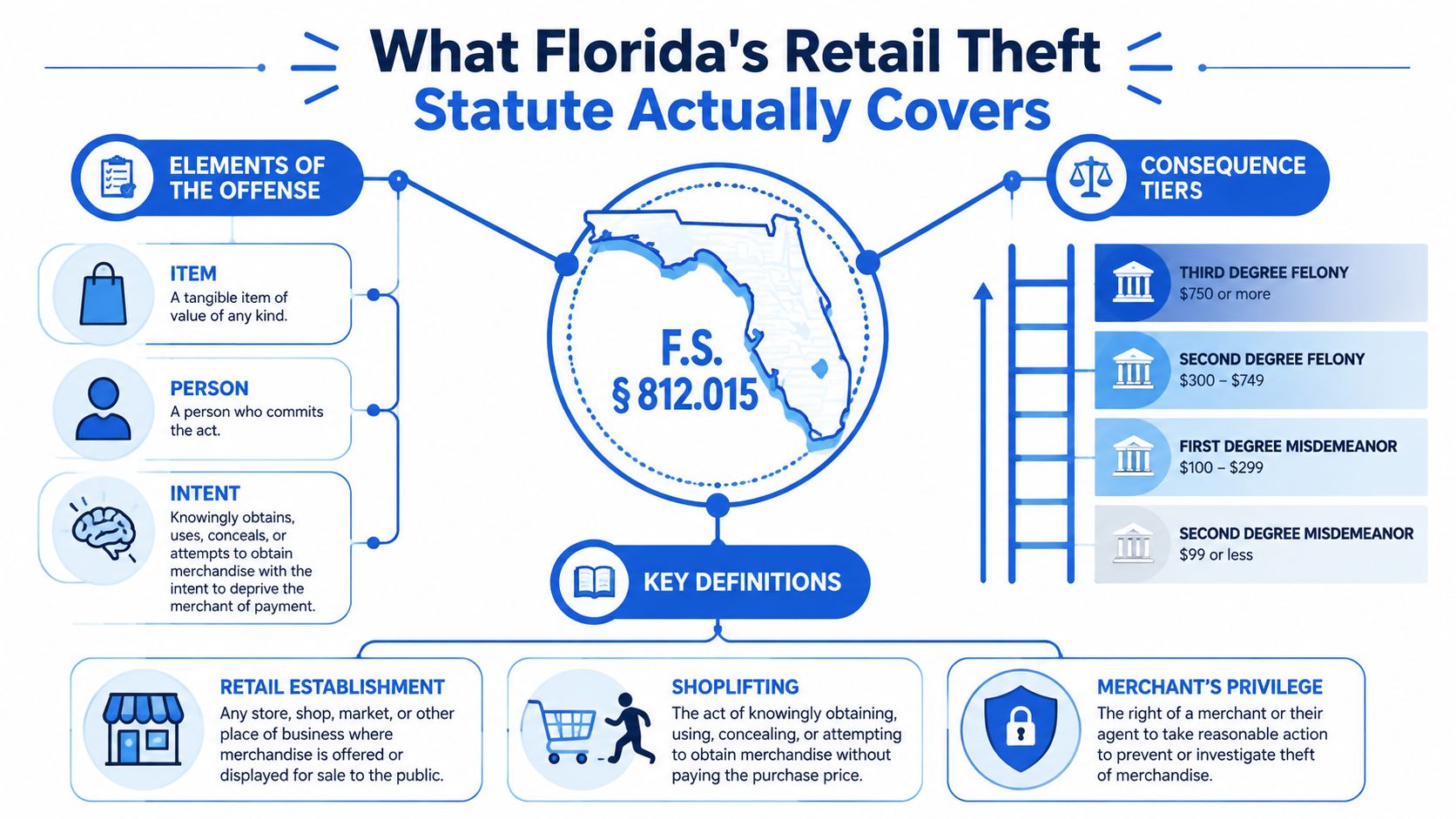
Table of Contents
What Florida's Retail Theft Statute Actually Covers
A lot of people think retail theft means one thing, walking out the door with unpaid merchandise. Florida law is wider than that. The statute covers taking or carrying away merchandise, money, or negotiable documents, but it also covers altering or removing a label, UPC, or price tag, transferring items between containers, and even removing a shopping cart, if the State can show an intent to deprive the merchant of possession, use, benefit, or full retail value.
That matters because the charge can be built on conduct that happened before anyone reached the exit. A Broward store can call law enforcement the moment a loss-prevention officer says the shopper concealed an item or switched packaging. The prosecution does not have to wait until the person is outside the store, because the statute is framed around the prohibited act plus the required intent, not around a completed escape. Florida's codified retail theft language has kept that basic structure consistent across recent versions, which tells you this is a long-standing charging framework, not a temporary enforcement trend.
Retail theft is not the same as general theft
Florida also separately defines general theft in section 812.014 as knowingly obtaining or using another person's property with intent to deprive the owner. That general theft statute helps explain why retail cases often overlap with broader theft charges. In practice, prosecutors look at the same facts through both lenses and decide which charge gives them the cleanest path.
Practical rule: if the report says “shoplifting,” do not assume the actual charge will stay simple. The charging document may rely on concealment, item switching, or another act that the store treated as suspicious long before an exit.
The defense takeaway is straightforward. The State has to prove an act listed in the statute and the intent to deprive. If either piece is weak, the charge is weaker too.
The Elements the State Must Prove at Trial
Florida retail theft cases often look simple on paper and messy in the evidence. The prosecutor still has to prove two things beyond a reasonable doubt. First, the accused committed one of the statute's listed acts. Second, the accused acted with the intent to deprive the merchant of possession, use, benefit, or full retail value.
The act and the intent are separate issues
That split matters more than many expect. A person can handle merchandise, move items around, or stay in the store after suspicion arises, and none of that automatically proves theft. The State has to connect the act to a criminal intent, and that's where surveillance footage, point-of-sale records, witness observations, and store reports get used to fill in the gaps.
Video can help the prosecution, but it can also help the defense. If the footage shows the item was still in the cart, the tag remained intact, or the item was returned to the shelf, those facts can undercut the claim that the person completed the prohibited act. If the store's own records are sloppy, the value proof gets weaker too. In a Fort Lauderdale or Miami courtroom, those gaps often matter more than the accusation itself.
What tends to matter in the file
Surveillance timing: If the video is incomplete, blurry, or missing the key moment, the State may have a harder time proving what happened.
Point-of-sale data: A receipt, return log, or register record can support or weaken the merchant's version of events.
Loss-prevention notes: These reports often describe what staff thought they saw, but they're not the same as proof.
Ownership and value: The prosecution still has to show the item belonged to the merchant and support the alleged value.
The best defense lawyers focus early on the evidence that can disappear. Store video gets overwritten. Employees change jobs. Memory fades. That's why the first review of a retail theft case should not start with pleading guilty or “just paying it off.” It should start with whether the State can prove each element.
Penalties and Felony Thresholds Explained
A retail theft charge can change the entire case the moment the prosecutor files it. Bond conditions, prosecutorial discretion, supervision, and the long-term record consequences all turn on whether the State treats the conduct as a misdemeanor or a felony. Florida's retail theft statute works as a charging layer on top of the general theft law, and the Legislature's organized-retail-theft changes gave prosecutors more room to push a case upward when they believe the conduct was coordinated or repeated. The 2022 legislative text shows that shift, and a good starting point for the charging split is this misdemeanor versus felony theft overview.
Florida retail theft charge levels at a glance
Charge Level | Triggering Facts | Maximum Time | Maximum Fine |
|---|---|---|---|
Petit theft | Generally under $750 | Depends on misdemeanor degree | Depends on misdemeanor degree |
Third-degree felony retail theft | Value at or above $750, or qualifying coordinated conduct | Up to 5 years | Up to $5,000 |
Grand theft, third degree | Theft of $750 or more under the general theft statute | Up to 5 years | Up to $5,000 |
The general theft statute treats theft under $750 as petit theft in most cases, and theft of $750 or more as grand theft. Third-degree grand theft carries up to 5 years in prison and a $5,000 fine under The general theft statute. That is why retail cases turn so hard on value disputes. If the merchant inflates the number, the filing decision can change with it.
The felony side is not just about one item
Retail theft in Florida now carries more risk because prosecutors can treat coordinated conduct as felony exposure even when one isolated act would look minor. Independent reporting tied to Florida data states that if stolen property is valued at $750 or more, the offense can be charged as a third-degree felony punishable by up to 5 years in prison and a $5,000 fine, while lower-value conduct may stay in misdemeanor territory depending on value. That same reporting also described a longer prosecution window, which matters because it gives the State more time than many defendants expect.
A retail theft case is not just about what left the store. It is about how the prosecutor classifies the conduct, how the value is proven, and whether the file reads like a one-time incident or something more organized.
For someone in Broward, Miami-Dade, or Palm Beach, that charging choice can separate a case that looks like a lower-level misdemeanor from one that has to be defended as felony exposure from the start.
Organized Retail Theft and Aggregation Rules
Florida prosecutors don't always charge retail theft as a single isolated event. They often look for patterns, groups, and repeated conduct, then use the statute's aggregation rules to build a stronger case. The clearest example is theft from more than one location within a 120-day period, where the values can be combined if the total reaches $750 or more. The Florida government report on organized retail theft also says that a person acting in concert with others to distract merchants, employees, or law enforcement can face felony exposure if the value threshold is met.
Why two small incidents can become one felony file
Consider a simple two-person scenario. One person takes merchandise from a store in Boca Raton, and a week later both people hit a different location in Fort Lauderdale, with the combined value crossing the statutory threshold. On their own, the incidents may look minor. Together, they can be charged as an aggregated felony case under the rule the Legislature added for coordinated and repeated conduct.
That aggregation theory changes the defense posture. The lawyer has to examine dates, locations, participants, and how the State is tying the acts together. If the prosecutor cannot prove the same person, the same scheme, or the required time window, the enhancement may not hold up.
Group conduct can change the whole case
The statute also treats retail theft committed by five or more individuals as a third-degree felony. That is a separate marker from the usual single-shop incident, and it tells you how seriously Florida now treats organized retail loss. The bill text and the government report together show a framework built to reach repeated and coordinated conduct, not just a lone concealment allegation.
The practical lesson is simple. If the case involves a friend, a lookout, a driver, or multiple stores, don't treat it like a standard shoplifting stop. Those facts can move the charge from misdemeanor territory into a felony file quickly.
Add-On Charges That Travel With Retail Theft
Retail theft cases often bring extra counts with them, and those add-ons can shape the plea offer as much as the theft allegation itself. Florida legal summaries explain that possession of an anti-shoplifting countermeasure device under section 812.015(7) can stand as a third-degree felony on its own. They also note that resistance to a merchant, employee, or law enforcement officer during the stop can lead to a first-degree misdemeanor on top of the theft charge. That summary is a good reminder that one store incident can turn into several separate charges.
The charges that often show up together
Anti-shoplifting device possession: The State may file a third-degree felony if it says the device itself violates section 812.015(7).
Resistance during the stop: A separate first-degree misdemeanor can be added if the person resists a merchant, employee, or officer.
Repeat conviction consequences: A second or later retail theft conviction can trigger a fine between $50 and $1,000 or community service hours, according to the same legal summary.
Those add-ons change plea bargaining in a real way. A prosecutor may be open to talking about the main theft count but far less willing to give ground on a separate device charge or a resistance count. That means the defense has to address the full package, not just the headline allegation. If there is any overlap with a later transfer or possession theory, the lawyer should also compare the facts with Florida receiving stolen property defenses, because prosecutors sometimes stack charges when the same merchandise changes hands.
Red flags that usually deserve immediate review
A bag, box, or liner with hidden compartments
A receipt discrepancy
A staff report of physical resistance
A prior theft case in the client's record
Any allegation that a device was used to defeat store security
If another charge is attached to the theft arrest, the defense should test whether the facts really support that extra count. Sometimes they do. Sometimes the arrest report leaves room for more, and the State uses that space to add pressure. That is where the charging framework matters in Broward, Miami-Dade, and Palm Beach cases, because one count can affect the plea math on the rest.
Common Defenses to a Retail Theft Charge
Retail theft defense starts with the evidence, not the label on the police report. The strongest cases usually fall into one of four buckets. Either the conduct the State claims happened did not happen, the State cannot prove intent, the alleged value does not hold up, or the stop violated the client's rights.
Start with the easiest weaknesses
A lot of cases unravel on factual details. If the item was put back, the label was never altered, or the store's own footage is incomplete, the charge may rest on a shaky foundation. That is especially true when the only proof comes from a hurried loss-prevention observation and a report written after the stop.
Value fights can be just as important. If the merchant used the wrong price, failed to account for a discount, or relied on a number that is not backed by a reliable record, the charge level may be overstated. In Florida retail cases, that can be the difference between a misdemeanor exposure argument and a felony file.
Constitutional issues can change the case completely
Detention by store personnel is not a free pass to cut corners. If the merchant or security team held someone unlawfully, blocked them without proper grounds, or created a flawed identification procedure, the defense may have suppression issues or credibility problems to raise. That matters because a case built on tainted video or unreliable identification often gets weaker fast.
Practical rule: ask for the video, the incident report, the register records, and any written statement immediately. If the store's retention cycle closes before counsel acts, the defense loses leverage it may never get back.
A defense lawyer should also preserve all evidence early. That includes surveillance, point-of-sale records, and any loss-prevention documentation. If the store is part of a national chain, the paper trail can be more valuable than the accusation itself.
For some clients, Ticket Shield, PLLC is one criminal defense option that can review a retail-theft case, assess the charging framework, and look for early evidence problems before the file hardens.
Diversion, Withhold of Adjudication, and Plea Options
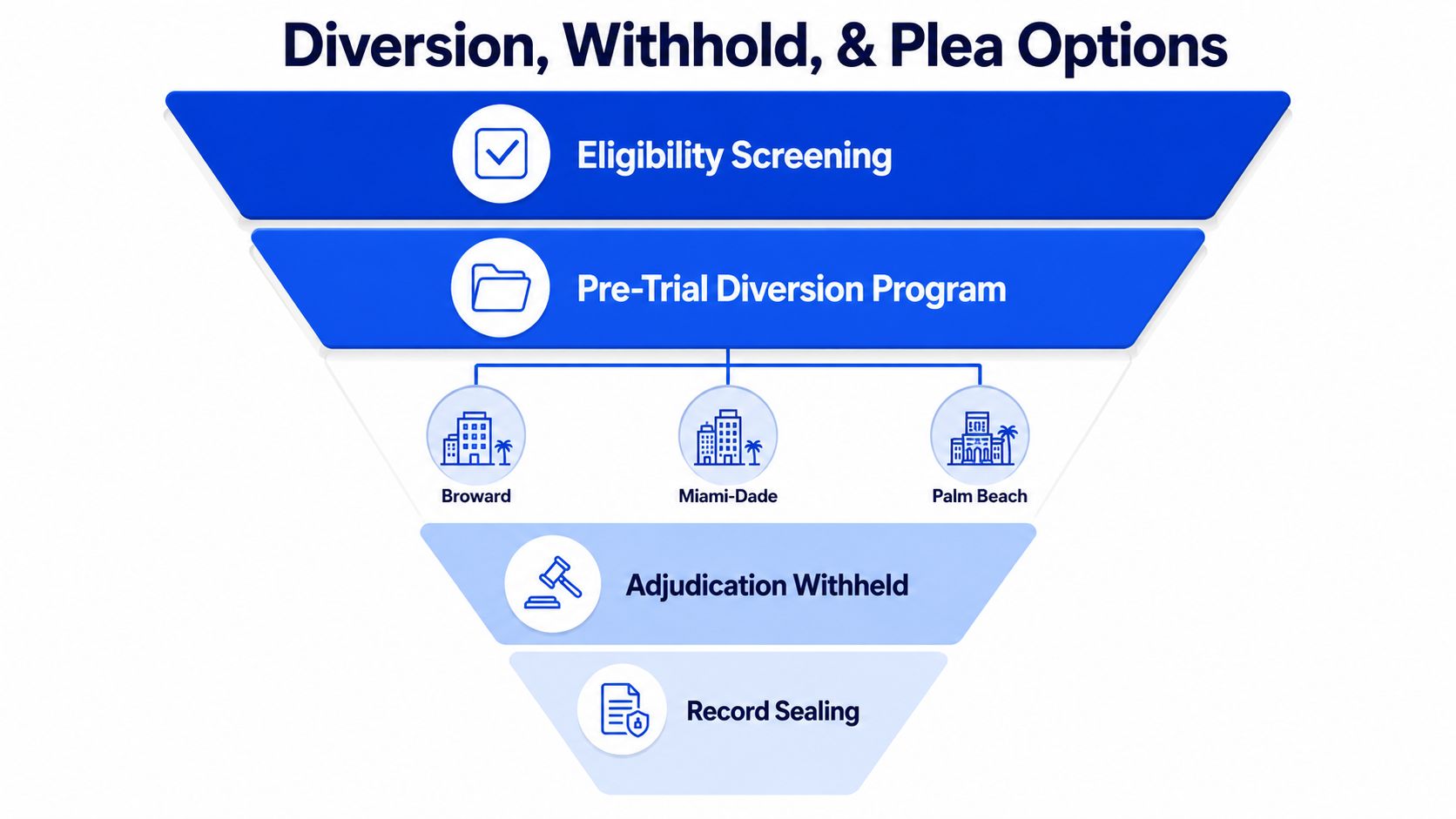
People usually ask the same question first. How do I avoid a conviction on my record? In South Florida, the answer depends on the facts, the county, and the prosecutor's view of the case. Broward, Miami-Dade, and Palm Beach all use diversion and negotiated resolutions, but the available path turns on prior history, the value allegation, and whether the case looks like a one-time mistake or a pattern.
The resolution options are not the same
A pretrial diversion program can keep the case out of a conviction track if the person qualifies and completes the program. Florida pretrial diversion information is worth reviewing because these programs often matter most before formal plea negotiations begin.
A withhold of adjudication is different from a straight guilty plea because it can preserve some later relief options. A guilty plea without a withhold is usually harder to clean up later. A nolo plea has its own consequences and should be evaluated carefully before anything is entered in open court.
What often shows up in negotiated cases
Reduced misdemeanor charges: Common when the value is weak or the facts are limited.
Time-served resolutions: Possible in some lower-level files, depending on local practice and custody history.
Civil demand letter compromises: Sometimes addressed outside the criminal case, but they do not erase the charge by themselves.
Diversion before plea: Often the cleanest result if the client qualifies and acts early.
The county matters because local prosecutors and judges do not all handle retail theft the same way. A first-time defendant in Palm Beach may have a different path than someone in Miami-Dade with a prior theft arrest. The facts control more than the label does.
The goal is not just to “get the case over with.” The goal is to avoid creating a conviction if a non-conviction resolution is still on the table.
Record Sealing and Long-Term Consequences
A retail theft case can follow someone long after the court date is over. Employers, licensing boards, landlords, and background check companies all treat theft allegations as a credibility issue. In some situations, immigration consequences can also become a concern, which is why the end result matters as much as the arrest itself.
The record question starts with the disposition
A formal conviction is the hardest result to unwind. A case resolved with a withhold of adjudication can sometimes keep later sealing options open, depending on the record and the offense history. Florida's record sealing guidance is the right place to start if a client wants to understand what can and cannot be cleaned up later.
Prior theft convictions can block later relief, and that makes the first case especially important. If the criminal history is inaccurate, incomplete, or misclassified, it can create problems long after the arrest. A good defense review should include the actual criminal history, not just the charging paperwork.
Why the result today affects tomorrow
The practical issue is simple. A conviction closes doors that a withhold may leave open. A negotiated misdemeanor with a clean disposal can be far less damaging than an unnecessary guilty plea entered too quickly. That is true whether the case is in Fort Lauderdale, West Palm Beach, or Miami.
The criminal case is only one part of the damage. The record can become the bigger problem if the disposition is handled without thinking about sealing eligibility.
That's why a retail theft case should be evaluated with the long game in mind. A short-term plea might solve one court date but create a permanent background check problem. The right resolution depends on where the client is now, and where the record needs to go later.
What to Do in the First 72 Hours After an Arrest
The first three days after a retail theft arrest are for damage control. Don't keep arguing with the store, and don't call loss prevention hoping to fix it yourself. If police or store security want a statement, you should not give one without counsel, because explanations made under stress can become the State's strongest exhibit.
If you have a court date, calendar it immediately and make sure you know the exact charge level. Get the incident report, ask about any video preservation issues, and write down anything that helps your defense while it's still fresh. That includes whether you had a clean record, whether you were dealing with a medical issue, and whether anyone else was involved.
A defense lawyer can also help you spot the key points early. Those points may include weak value proof, missing footage, diversion eligibility, or a possible withhold of adjudication. The sooner that review happens, the more options usually remain on the table.
If you're facing a retail theft charge in Broward, Miami-Dade, Palm Beach, or anywhere else in South Florida, Ticket Shield, PLLC can evaluate the file, identify the exposure, and map out the next steps before the case hardens. Visit Ticket Shield, PLLC to request a confidential consultation and get help protecting your record, your job, and your future.