Misdemeanor vs Felony Theft: Thresholds & Penalties
Jason Goldsmith, Esq
You got stopped in Broward County, the police said the property wasn't yours, and now you're staring at a theft charge that could be filed as a misdemeanor or a felony. That difference is not paperwork. It can decide whether you're looking at county jail, state prison exposure, a permanent record, and a fight over the rest of your life.
Florida treats theft charges with a harsh, detail-driven lens, and the details matter fast. The value of the item matters, but so does where it was taken from, what it was, and whether the State tries to turn a small loss into a felony by using a hidden trigger. If you're in Fort Lauderdale, Miami-Dade, Palm Beach, or anywhere in South Florida, you need to understand the charge before you make one more move.
Charge Type | What It Usually Means in Florida | Immediate Risk |
|---|---|---|
Petit theft | Property value below $750 | Misdemeanor exposure, county jail, fines, probation |
Grand theft | Property value at or above $750 | Felony exposure, state prison, larger fines, long-term record damage |
Hidden felony trigger | Certain property or locations can raise the charge even at low value | Felony filing can happen without hitting the usual dollar line |
Table of Contents
Why the Misdemeanor vs Felony Theft Distinction Matters in Florida
Florida Theft Classification Thresholds and Hidden Felony Triggers
Comparing Penalties and Sentencing Ranges for Misdemeanor and Felony Theft
Collateral Consequences That Follow You Beyond the Courtroom
Defense Strategies and Negotiation Approaches for Theft Charges
When to Contact a Criminal Defense Attorney and What to Expect
Why the Misdemeanor vs Felony Theft Distinction Matters in Florida
A man leaves a South Florida store with a disputed item in his bag, gets detained, and hears two very different possibilities from different people, a misdemeanor or a felony. That confusion is normal, but it's dangerous. The charge level controls how the State treats the case from the start, and it also shapes the strength of your defense when the prosecutor decides whether to push for jail, prison, or a reduction.
Practical effect on arrest, charging, and sentencing
Florida's theft system is not just about the alleged value. It's about the story the State can tell, and prosecutors look for anything that lets them move a case upward. A low-dollar item taken from the wrong place can become much more serious than the same item taken elsewhere, and that's where people get blindsided. The State is not obligated to grade every case the way a frightened client hopes it will be graded.
A misdemeanor theft case still hurts, but it usually gives you more room to negotiate, challenge the value, or push for a non-conviction resolution. A felony theft case changes the pressure immediately because the stakes spill beyond jail exposure and into employment, housing, and civil rights. If you need a plain-English primer on how a felony charge works in Florida, review this felony charge overview.
Practical rule: don't assume the police label is the final label. In theft cases, the charging decision often turns on the details the defense can still challenge.
For anyone accused in Broward County, Fort Lauderdale, or Miami-Dade, the first goal is simple, force the State to justify the charge level. If the value is shaky, the location is disputed, or the property type doesn't fit the enhancement the prosecutor wants, the case may be weaker than it first looks. That's where a theft defense starts.
Florida Theft Classification Thresholds and Hidden Felony Triggers
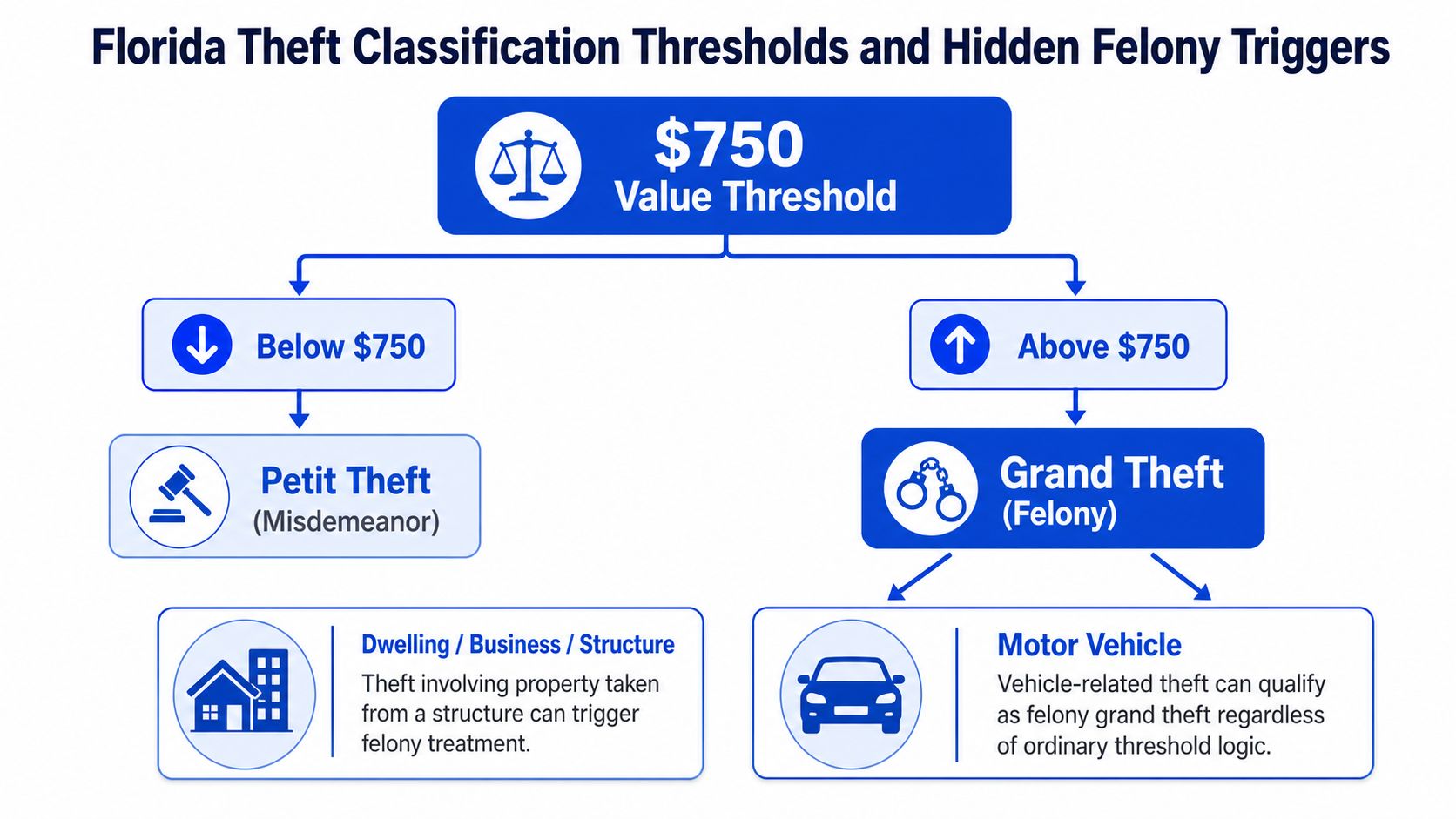
A theft case in Florida can look minor on paper and still turn serious fast. The value line matters, but it does not control every charge decision. The main threshold is $750, because theft below that amount is generally petit theft, while theft at or above that amount is generally grand theft under Florida's overview of the law (OPPAGA Florida report). That line is the starting point, not the finish.
The value line and the exceptions prosecutors use
Florida also breaks petit theft into smaller categories. First-degree petit theft covers property valued from $100 to $750, with up to one year in jail and a $1,000 fine, while second-degree petit theft covers property below $100, with up to 60 days in jail and a $500 fine (Florida theft charge overview). A client who hears “misdemeanor” and relaxes is making a mistake, because even the lower theft tiers still carry real punishment and a record that follows them.
The hidden risk is the felony trigger that individuals may not hear about until they are already charged. Florida uses non-dollar felony triggers. Property valued at $40 or more taken from a dwelling or its unenclosed curtilage can raise the charge, and certain categories, including emergency medical or law-enforcement equipment valued at $300 or more, can also put the case into a felony structure (OPPAGA Florida report). The dollar amount alone does not control the result. The place, the item, and the facts around possession can change the charge level immediately.
That is the defense problem. Prosecutors look for the easiest path to a felony label, and they often use the location of the property or the type of item to do it. A small-value item from the wrong place can create more exposure than a higher-value item taken somewhere else. If you are dealing with a Florida theft allegation, the broader property-crimes page at this theft and property crimes hub gives you the bigger picture before you start discussing strategy.
A quick way to read these cases is simple. Theft classification is a legal sorting exercise, not a simple receipt check. Once the State claims a hidden trigger, the defense has to test that trigger line by line. If the dwelling allegation is weak, or the item does not fit the claimed category, the charge can sometimes come back down to a lower level.
A low-value item can still become a felony case if the State proves the wrong setting or the wrong category. That is where many people lose the first round.
Comparing Penalties and Sentencing Ranges for Misdemeanor and Felony Theft
A theft case turns serious fast when the charge crosses from misdemeanor to felony. In Florida, the line between petit theft and grand theft changes the jail risk, the plea posture, and the pressure on the defense. If the State can prove grand theft, you are no longer dealing with a county-court problem, you are facing a felony case with prison exposure and a far harsher bargaining position. For a closer look at the felony side of that divide, see this Florida grand theft overview.
Charge Type | Property Value | Maximum Jail/Prison | Maximum Fine |
|---|---|---|---|
Second-degree petit theft | Below $100 | Up to 60 days in jail | $500 |
First-degree petit theft | $100 to $750 | Up to 1 year in jail | $1,000 |
Grand theft | At or above $750 | State-prison exposure for more than 1 year | Depends on charge level and case facts |
What the court can impose
That chart is the split clients need to understand. A misdemeanor theft charge can still mean jail, probation, restitution, and a record that keeps showing up in future background checks. A felony theft charge is a different level of trouble because prison exposure is on the table, and prosecutors use that pressure early, often before the first plea offer is even discussed.
The sentencing spread also affects how the case gets handled. In many states, misdemeanor theft commonly carries up to 1 year in county jail and fines around $500 to $1,000, while felony theft can bring prison exposure of multiple years and fines that may reach $10,000 or more (penalty overview). I'm using that comparison only to show the scale of the gap, not to suggest Florida always follows that exact setup. The point is straightforward, felony exposure gives the State more advantage and gives you more to lose.
Bottom line: do not negotiate off the label alone. Negotiate off the proof, the value, and the aggravating facts the State can prove.
Florida also treats theft exposure differently from one jurisdiction to another, which is why clients are often surprised by how fast a charge can move from minor to major. A separate overview of state theft thresholds notes that felony breakpoints can range from about $200 to $2,500, with many states clustering between $750 and $1,500 (jurisdiction comparison). That spread explains why a Florida filing can look harsher than what someone expected based on another state's rules.
The defense move is simple. Fight the charge level early, challenge the value proof, force the prosecutor to justify the classification, and do not let the State lock in a felony theory before the evidence is tested.
Collateral Consequences That Follow You Beyond the Courtroom
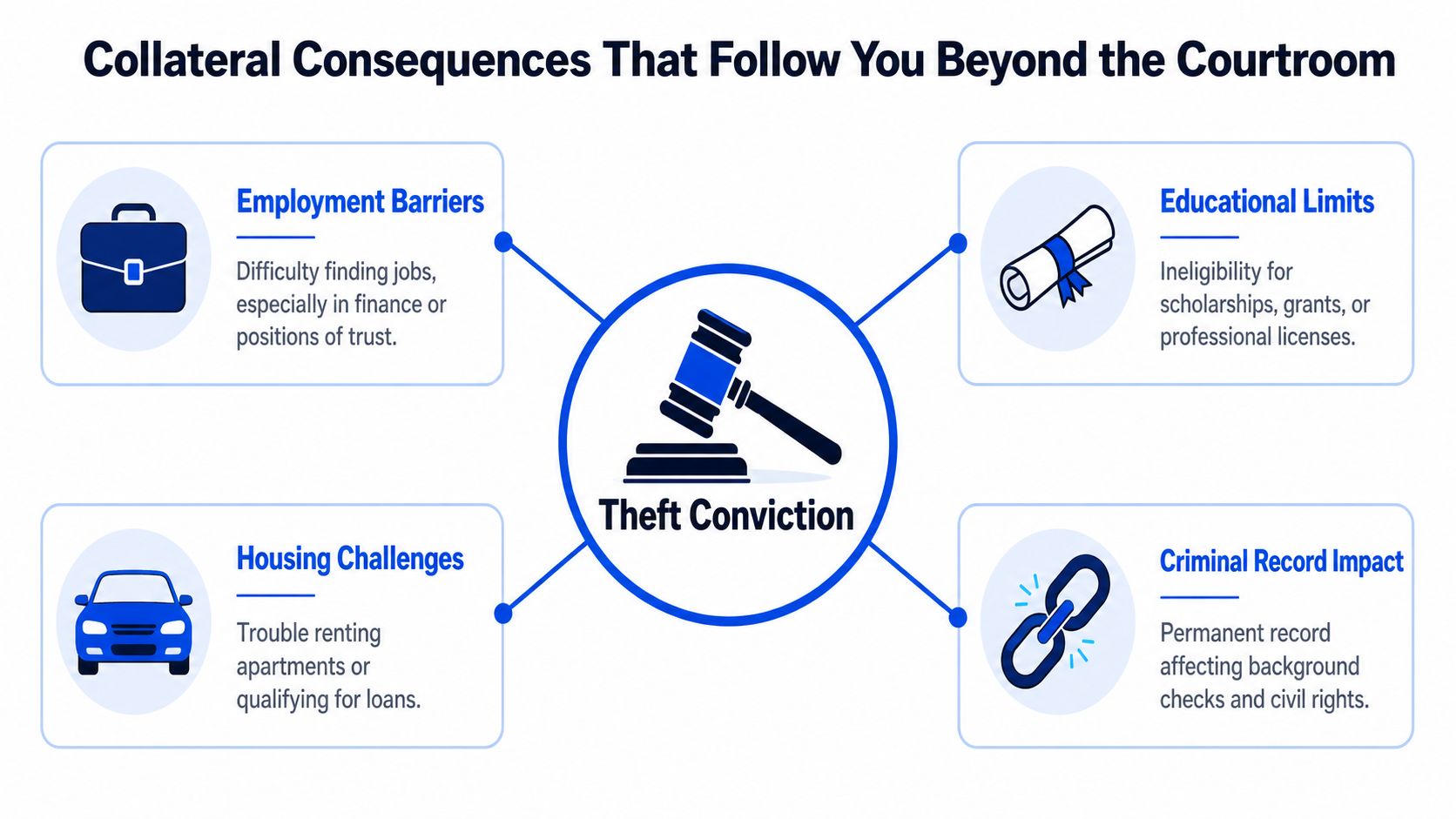
A theft conviction doesn't stop at sentencing. A felony theft record can keep showing up on background checks, and the consequences often outlive the court case by years. That's the part stressed clients underestimate, because they focus on jail and fines and ignore what happens when an employer, landlord, licensing board, or school sees the record.
The record can outlast the sentence
A felony conviction can affect employment, housing, professional licensing, and in some states civil rights like voting and firearm ownership. Florida's collateral consequences are shaped by the conviction itself, not by how embarrassed the accused feels about the incident. For many people, the practical damage starts the day the record becomes searchable.
Even a misdemeanor theft can feel like a felony in daily life. You may still face probation, restitution, court-ordered conditions, and background-check problems that make life harder after the case ends (collateral consequences overview). That's why the question is not just whether you'll avoid prison. It's whether the charge will keep showing up when you apply for work, housing, or a license.
If the charge is eligible, record sealing in Florida can matter later, but don't confuse a sealing conversation with an immediate defense plan. First you have to protect the case itself. Then you think about whether the resolution leaves a path to clean up the record afterward.
The strongest clients ask the right follow-up question early, “If I take this plea, what follows me next year?” That question belongs on the table before the plea, not after it. A good defense strategy treats background-check fallout, restitution terms, and immigration concerns as part of the case, not as afterthoughts.
Practical insight: a resolved case can still create a long shadow. The sentence ends faster than the record does.
Defense Strategies and Negotiation Approaches for Theft Charges
The State has to prove the theft case, not just accuse you of one. That sounds obvious, but prosecutors often lean hard on surveillance, estimates, and assumptions, and those are all attack points. If you want the charge reduced, your lawyer should start by testing the value, the intent, and the way the evidence was collected.
Where the State's case usually breaks
A few defenses come up again and again in theft cases:
Lack of intent: If the State can't prove you meant to steal, the case weakens fast.
Mistaken ownership: People pick up items they believe are theirs or that they're allowed to take.
Consent: If the owner allowed the taking, the theft theory starts to fall apart.
Value dispute: The alleged value may be inflated, especially with used or damaged property.
Suppression issues: If police or store security crossed constitutional lines, the evidence may be vulnerable.
That last point matters because Florida defense work often turns on search and seizure problems, not just the theft allegation itself. If the State got evidence through an unlawful stop, an illegal search, or a bad consent claim, the defense may be able to suppress it and shrink the case dramatically.
The best negotiations happen when the defense forces a realistic valuation and a realistic theory of intent. A felony grand theft case can sometimes be pushed down if the State's proof doesn't support the dollar line or the aggravating factor. A prosecutor is more likely to move when the file is still fresh and the evidence hasn't been polished into something stronger.
The earlier your lawyer gets involved, the better the bargaining position. That's especially true in South Florida courts, where precharge communication and early discovery review can matter a lot. If you wait until the State has locked in its narrative, you've already given up a key advantage.
When to Contact a Criminal Defense Attorney and What to Expect
Call a defense lawyer before you talk to police. Call before your first court date if you've already been charged. Call as soon as you learn you're under investigation, because the earliest decisions in a theft case often shape the rest of it.
The first call changes the case
Your first consultation should be focused and practical. A good attorney should ask about the alleged property, where it was taken from, what the police say happened, whether there was video, whether anyone gave permission, and whether you said anything after contact with law enforcement. That conversation is where the case starts to be sorted into defenses, negotiation points, and risks.
You should not discuss the details with friends, coworkers, or codefendants. You should not guess online about what the State can prove. Attorney-client privilege exists for a reason, and you need it working for you before the facts harden into a statement that gets used against you later.
Here's the basic decision rule:
If police want a statement, stop and call counsel.
If you got a notice to appear or a court date, get legal advice immediately.
If restitution or property return is being discussed, don't improvise.
If the allegation involves a dwelling, emergency equipment, or any item that might trigger a felony, assume the legal consequences are more serious until a lawyer checks it.
A defense lawyer can often identify whether the charge belongs in a lower category, whether the evidence supports a motion to suppress, and whether a negotiation should target dismissal, reduction, diversion, or a plea that avoids the worst downstream damage. You do not want to make those decisions alone.
If you're in Fort Lauderdale, Broward County, Miami-Dade, Palm Beach, or anywhere nearby, the goal is the same. Protect your rights first, then force the State to prove what it thinks it already knows.
Frequently Asked Questions About Florida Theft Charges
Can a misdemeanor theft still hurt me like a felony?
Yes. A misdemeanor can still leave you with probation, restitution, and a record that employers and landlords see. The jail exposure is different, but the practical fallout can still be serious.
Can I seal or expunge a theft charge in Florida?
Sometimes, but eligibility depends on the exact outcome and the type of case. You need to protect the criminal case first, then look at record sealing or expungement options after the resolution is clear.
What if I meant to return the property?
Intent matters a lot. If the State can't prove an intent to permanently deprive the owner, that can weaken the theft theory. That defense has to be presented carefully and supported by the facts.
What if I can't pay restitution?
Restitution is still a serious issue. Courts can impose payment conditions, and failure to handle them can create more problems. Don't ignore it, address it through counsel early.
Do juvenile theft charges work the same way?
No. Juvenile cases are handled differently, but they can still affect school, family, and future opportunities. The right response is still immediate legal help.
Can theft charges affect immigration status?
They can. Non-citizens need to take theft allegations especially seriously because the collateral consequences can extend far beyond the criminal court case.
Ticket Shield, PLLC helps people in Florida fight theft charges, challenge the State's evidence, and protect their future before a bad charge becomes a permanent problem. If you're facing misdemeanor or felony theft in Broward County, Fort Lauderdale, Miami-Dade, Palm Beach, or anywhere in South Florida, visit Ticket Shield, PLLC for a confidential consultation and get a defense strategy built around your case, not a generic script.