Criminal Defense Attorney for Theft Charges in Florida
Jason Goldsmith, Esq
You're sitting at home in Fort Lauderdale, staring at a notice to appear, an arrest document, or a store letter that says you're accused of theft. Maybe loss prevention stopped you at a retailer. Maybe police contacted you about property that allegedly disappeared from a workplace, vehicle, or home. You may be wondering whether paying the store will end the matter, whether the charge will become a felony, and whether an arrest will follow you into employment or housing decisions.
A theft allegation can move quickly through Broward County, Fort Lauderdale, Miami-Dade, Palm Beach, and other South Florida courts. The right response depends on details such as what property was involved, its provable value, who owned it, what you intended, how police identified you, and whether officers searched lawfully. A criminal defense attorney for theft charges can examine those issues before an assumption in a loss-prevention report becomes the foundation of a formal case.
Table of Contents
When You Need a Criminal Defense Attorney for Theft Charges in Florida
Understanding Florida Theft Laws and How Charges Are Classified
What to Expect From the Florida Court Process for Theft Cases
How Ticket Shield PLLC Defends Theft Charges Across South Florida
When You Need a Criminal Defense Attorney for Theft Charges in Florida
After a suspected shoplifting incident, people often try to explain themselves. A first-time client may tell a store employee that the item was missed at self-checkout, that a companion had permission to take it, or that they planned to return it. Those explanations can feel harmless, but statements made under stress may later be presented as proof of intent.
The same concern applies when police call after the incident. You don't have to solve the investigation for them. A calm decision to speak with a lawyer before answering questions can protect your ability to challenge identification, ownership, valuation, and intent.
Why the first call matters
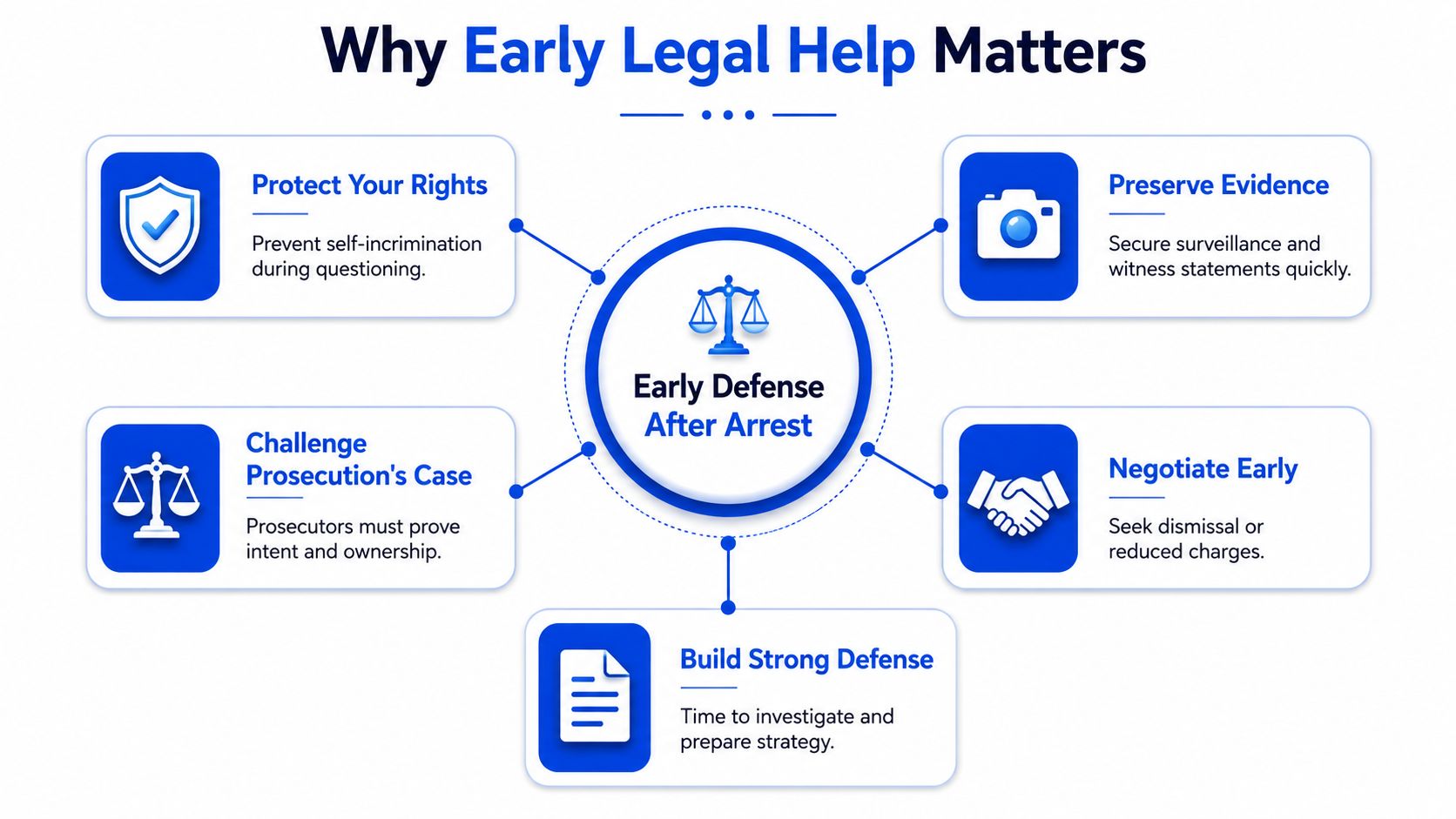
Early representation gives counsel a chance to address the case while evidence and charging decisions are still developing. That may include requesting or preserving surveillance, reviewing receipts and communications, identifying witnesses, examining the store's valuation method, and determining whether police had lawful grounds to detain or search you.
The U.S. Sentencing Commission recorded 4,804 federal theft, property destruction, and fraud cases out of 66,662 total federal cases in fiscal year 2025, and that category was 13% higher than in fiscal year 2021. The U.S. Sentencing Commission's theft, property destruction, and fraud data shows why theft allegations represent a recurring, specialized defense area rather than an unusual event.
That doesn't mean every Florida theft case is federal. It does mean the consequences can extend well beyond jail. Restitution, probation or supervised-release conditions, employment concerns, licensing issues, immigration consequences, and record visibility can shape the best resolution.
Practical rule: Don't contact the alleged victim, store employees, or witnesses to argue your side. Save your documents, avoid discussing the facts online, and arrange a confidential consultation promptly.
Ticket Shield, PLLC approaches theft and other criminal matters with former-prosecutor perspective, direct communication, and availability by phone, text, or email. Its broader Florida criminal defense guidance can help families understand what to do after an accusation, but theft cases still require a fact-specific review.
Understanding Florida Theft Laws and How Charges Are Classified
Florida theft law asks whether someone knowingly took or used another person's property with intent to deprive the owner, either permanently or temporarily. In plain English, prosecutors must connect the property to an owner, the accused person to the taking or use, and the conduct to the required intent. A misunderstanding, mistake, permission dispute, or weak proof of value can change the charge.
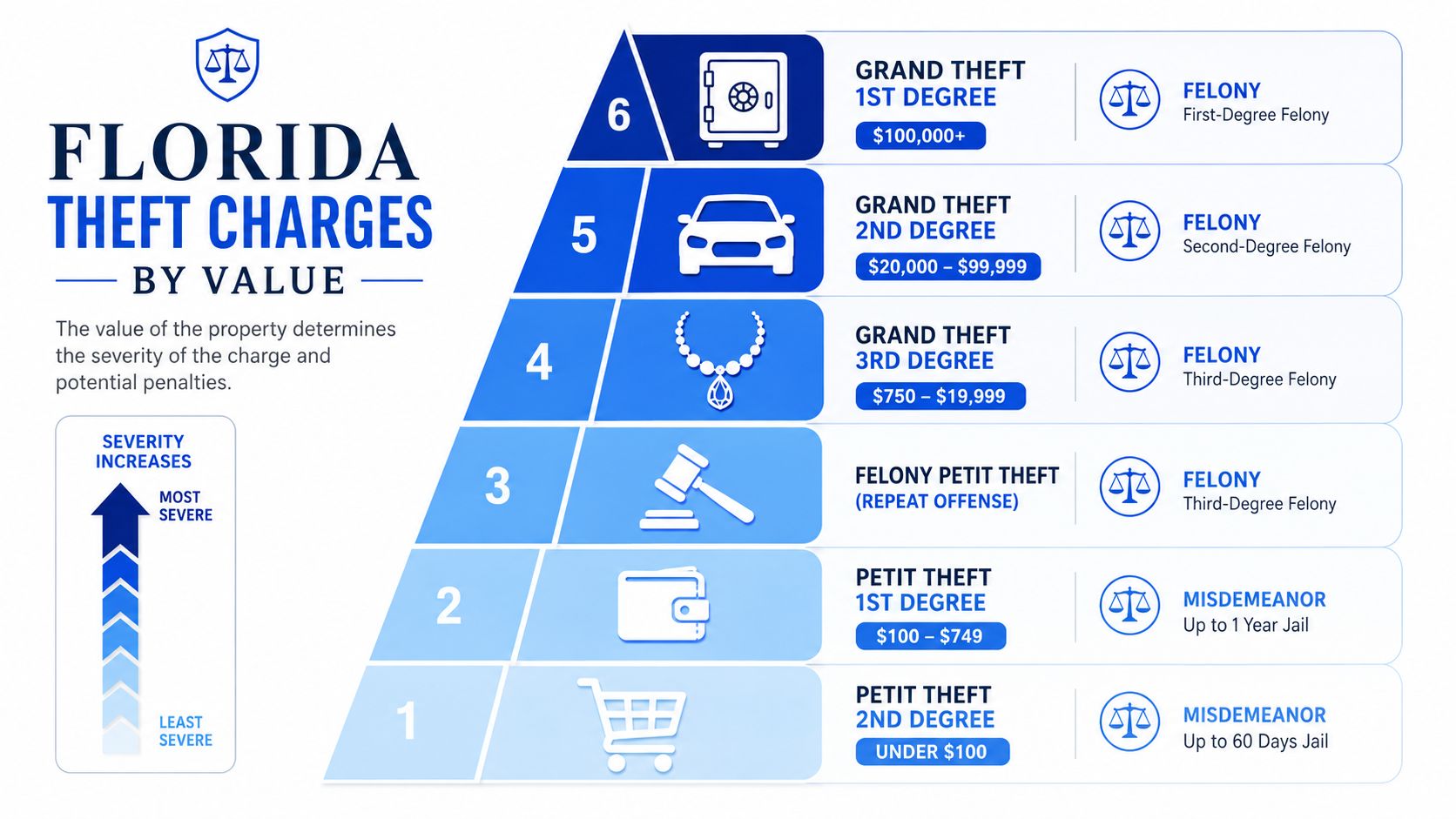
Value often sets the case on its track. Florida law generally classifies theft as follows:
Petit theft of the second degree: Property valued at under $100, generally a second-degree misdemeanor.
Petit theft of the first degree: Property valued at $100 to under $750, generally a first-degree misdemeanor.
Grand theft of the third degree: Property valued at $750 or more, generally a third-degree felony.
These classifications come from Florida's theft statute. The dividing line can work like a gate. A valuation just below or above a threshold may place the same underlying allegation in a different category, with different record consequences.
Why classification changes the case
A felony allegation can affect employment applications, professional licensing, housing, firearm rights, immigration status, and later charging decisions. A misdemeanor theft case can also create trust concerns because employers may view an allegation involving property or honesty differently from other offenses. For a deeper comparison, read our guide to misdemeanor vs. felony theft.
The Florida theft classifications and penalties explain the value-based structure. The claimed price is not automatically the legally proven value. Counsel may examine purchase records, depreciation, condition, comparable prices, ownership, and whether the State can establish value with admissible evidence.
Prior history may also change the analysis. A low-value allegation can become more serious if prosecutors claim a repeat theft offense or additional conduct, such as dealing in stolen property. The charge, criminal history, valuation evidence, intent, and surrounding facts belong in one review.
Federal value rules offer a useful comparison
Federal theft under 18 U.S.C. § 641 provides a separate example of how valuation affects exposure. Congress sets a one-year misdemeanor ceiling when stolen property is worth less than $1,000, as summarized by the Congressional Research Service discussion of federal theft under Section 641. Florida uses different thresholds, but the lesson is the same: valuation can be a central defense issue, not a minor detail.
Why Early Legal Help Matters After a Theft Arrest
A theft case often turns on evidence that looks persuasive at first glance but leaves important questions unanswered. A surveillance video may show a person near merchandise without clearly showing the person taking it. A witness may remember a hurried encounter differently from another witness. A loss-prevention report may describe an apparent concealment but not establish what the person intended.
The National Criminal Justice Reference Service explains that evidence gathering must support a decision to prosecute or release, and it notes that shoplifting cases frequently involve little direct, unambiguous evidence. The NCJRS material on prosecuting shoplifting cases makes surveillance, witness credibility, and circumstantial proof important areas for review.
What counsel can investigate
A criminal defense attorney for theft charges may look at:
Identification: Does the video clearly show the accused person, or only someone with similar clothing or appearance?
Intent: Does the conduct show an intentional effort to deprive the owner, or could it reflect confusion, distraction, an unscanned item, or permission?
Ownership: Who owned the property, and did the accused have consent to possess, borrow, move, or use it?
Valuation: Can the State establish the property's value through reliable records rather than an unsupported estimate?
Procedure: Did officers have lawful grounds for the detention, questioning, search, or seizure?
The timing of this work matters because video, receipts, digital messages, and witness recollections may become harder to obtain or evaluate as time passes. Early counsel can also communicate with prosecutors before the case posture becomes fixed, raising the possibility of a reduction, diversionary resolution, or dismissal when the evidence supports it.
What to do before the consultation
Don't give a detailed statement to police or store personnel. Don't guess about facts, delete messages, alter records, or ask another person to coordinate a story.
Bring the notice to appear, booking paperwork, bond documents, photographs, receipts, bank records, relevant messages, and the names of potential witnesses. Write down your own timeline privately for your lawyer while events are fresh. You should also disclose prior cases openly because record-related options may depend on how a current matter ends and on prior sealing or expungement history.
For a general procedural overview, review what happens after an arrest in Florida, then speak with counsel about the facts of your case.
Common Defense Strategies for Theft Charges in Florida
There isn't one universal theft defense. The strongest approach targets the element the State cannot prove or the procedure that produced unreliable evidence.
Fact Pattern | Defense Focus | Potential Benefit |
|---|---|---|
A self-checkout item wasn't scanned, but the video doesn't show deliberate concealment | Intent and interpretation of the video | Supports dismissal, diversion, or a reduction when the evidence doesn't establish purposeful deprivation |
A person left with property they believed they could borrow or use | Ownership and consent | Undermines the State's claim that the accused knowingly took another person's property without permission |
Store video is incomplete, distant, or obstructed | Identification and witness credibility | Creates reasonable doubt about who handled or removed the item |
The State relies on an estimated or inflated property value | Valuation and admissible proof | May reduce the charge level or weaken sentencing and restitution arguments |
Officers searched a vehicle, bag, phone, or residence without a valid exception | Search and seizure | May support a motion to suppress evidence obtained unlawfully |
Several people were present, but the State cannot show coordinated conduct | Individual role and intent | Separates mere presence from knowing participation in an alleged broader scheme |
Intent is more than possession
Possession alone doesn't automatically prove theft. The prosecution must establish the required mental state. For example, a person who accidentally leaves an item in a shopping bag may still face an accusation, but the defense can examine whether the surrounding conduct proves an intentional decision to deprive the store.
The same reasoning applies to property disputes involving roommates, relatives, coworkers, or acquaintances. A disagreement over permission can become a criminal case when one person reports a taking and the other says the property was borrowed or jointly used.
Value can change leverage
Value challenges deserve careful attention in both petit theft and grand theft cases. Counsel may examine the item's condition, original purchase records, ownership, depreciation, comparable pricing, and whether the State's witness can explain the valuation.
Federal law provides a clear example of this principle. Under 18 U.S.C. § 641, property worth less than $1,000 falls below the federal misdemeanor ceiling described by the Congressional Research Service. Florida uses its own thresholds, but a careful valuation review can still affect whether an allegation is treated as a misdemeanor or felony.
Search issues can remove evidence
Florida courts recognize only narrow exceptions to the warrant requirement, including consent, lawful arrest, hot pursuit, stop-and-frisk, probable cause with exigent circumstances, and plain view. The Florida courts search-and-seizure outline describes those limits.
A lawyer may ask whether you consented, whether officers exceeded the scope of consent, whether the detention became an arrest without sufficient basis, and whether the seized item was in plain view. A successful suppression motion can substantially alter the State's proof.
For a broader explanation of how defenses work, see types of criminal defenses in Florida.
What to Expect From the Florida Court Process for Theft Cases
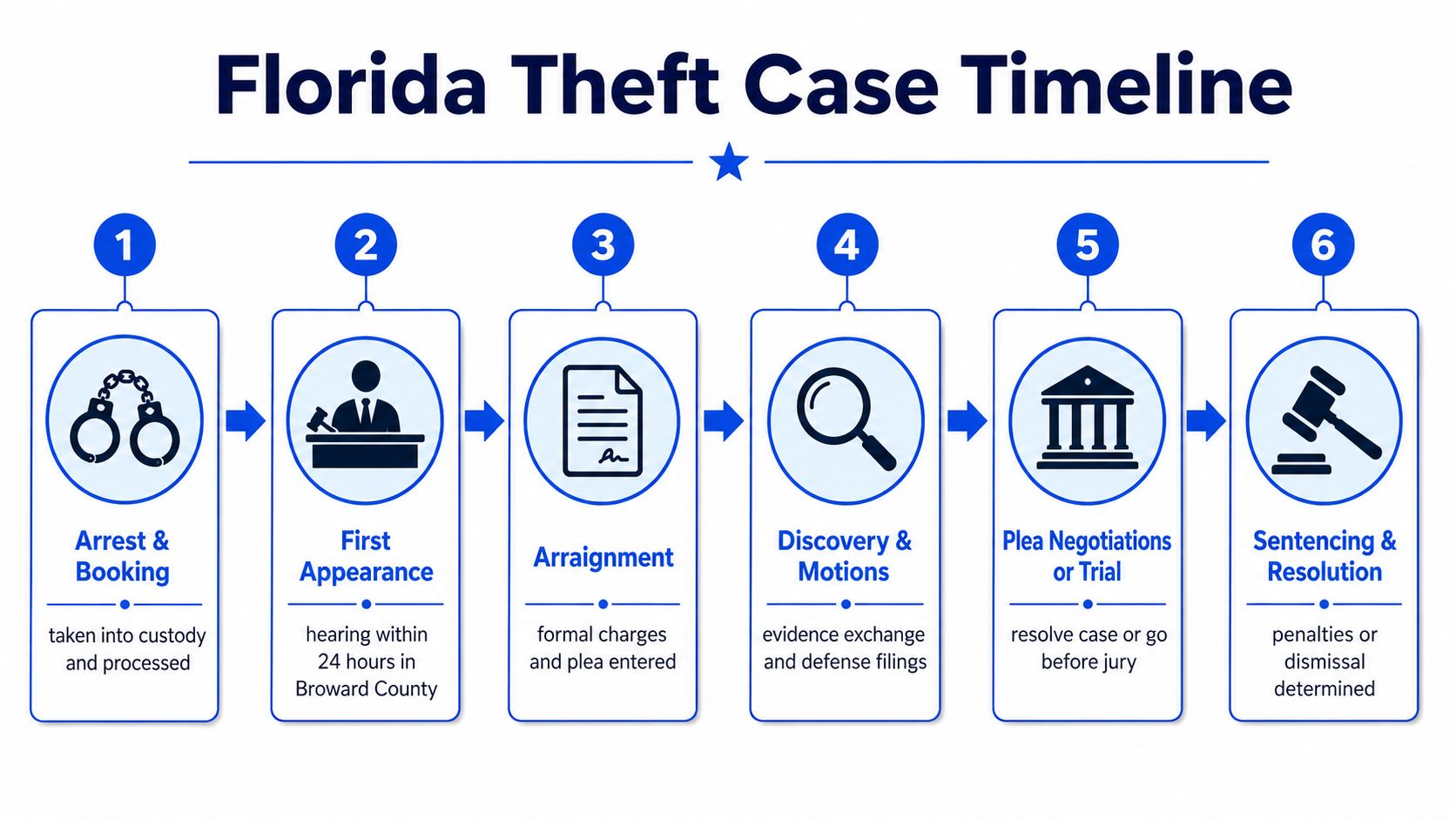
A Florida theft case usually develops through several stages, and each stage serves a different purpose. The schedule depends on the court, the charge, custody status, discovery, motions, and negotiation. Your lawyer should explain what each appearance means and which decisions require your personal attendance.
The usual sequence
Arrest and booking: Police take the accused into custody, document the allegation, and process the person through the jail system.
First appearance: A judge addresses custody and release conditions. In Broward County, the planned timeline identifies this hearing as occurring within 24 hours, but the exact circumstances can vary.
Arraignment: The court addresses the formal charge and records a plea. A not-guilty plea preserves the defense's ability to investigate and litigate the case.
Discovery and motions: The defense obtains reports, video, photographs, witness information, and other available evidence. Counsel may file motions addressing identification, valuation, statements, or searches.
Negotiations or trial: The parties may discuss dismissal, diversion, restitution, a reduced charge, or another resolution. If no acceptable outcome exists, the case may proceed toward trial.
Sentencing and resolution: A conviction or negotiated plea can lead to penalties and conditions. A dismissal or qualifying disposition may create different record-protection possibilities.
The court may also address restitution. Paying money to a store or alleged owner doesn't automatically end the criminal case, and any restitution decision should be coordinated with defense strategy so that communications or payments don't unintentionally create admissions.
Organized retail crime allegations receive a different level of scrutiny than an isolated low-value accusation. Retailers reported an 18% increase in average shoplifting incidents in 2024 compared with 2023, while threats or acts of violence during theft events rose 17% during that period, according to the National Retail Federation's retail theft and violence report. Those figures don't prove an individual defendant committed an offense, but they help explain why prosecutors may react more aggressively when they allege coordinated conduct, repeat targeting, multiple locations, or violence.
A lawyer may handle appropriate court appearances, but clients must follow release conditions, remain available, and attend any hearing where personal attendance is required. The practical meaning of an arraignment is explained in what happens at arraignment.
Penalties Restitution and Long Term Consequences in Florida
After a theft arrest, jail is often the first fear. Jail exposure matters, but a defense plan must also account for probation, restitution, classes, and a theft-related conviction. An outcome that avoids incarceration can still affect work, housing, education, professional licensing, immigration, and future background checks.
Under Florida law, grand theft of the third degree is a third-degree felony, while petit theft of the first degree is a first-degree misdemeanor and petit theft of the second degree is a second-degree misdemeanor. As noted earlier, Florida Statutes Section 812.014 sets out the theft classifications. The charge level can influence sentencing, probation conditions, restitution, and the record associated with the case.
Restitution is part of the practical analysis
Restitution may cover property value, documented damage, or another loss the court finds connected to the offense. The claimed amount should be tested against the evidence. Counsel can examine whether the loss is accurate, legally recoverable, and attributable to the charged conduct. Paying a store or alleged owner does not automatically end the criminal case, so payments and communications should be coordinated with defense strategy.
A court may also impose costs, supervision, restrictions on contact with a store or alleged victim, and conditions intended to prevent new offenses. The record effect of a dismissal, diversion agreement, plea, or adjudication can differ. The short-term result is only one part of the decision.
Florida record protection has strict limits
Record sealing and expungement are not automatic. FDLE states that a person is generally entitled to only one court-ordered sealing or expungement in a lifetime, and an applicant must attest that they have never previously had a record sealed or expunged in Florida. The FDLE certificate of eligibility instructions describe this limitation.
That restriction makes the choice among trial, diversion, dismissal, and a plea more strategic than a question of convenience. A first-time defendant may care less about winning at trial than about obtaining the least damaging lawful outcome while preserving eligibility for future record relief. Eligibility depends on the specific disposition and the person's history, so it requires individualized review.
Retail-theft enforcement also reflects competing concerns. A 2026 industry dataset reported that shoplifting incidents declined 10% in 2025, while total external retail-theft losses remained $47.8 billion, and about half of retailers still reported more incidents than the prior year, according to the National Retail Federation's cited data. Those figures do not establish guilt in an individual case. They help explain why prosecutors may treat alleged organized, repeated, multi-location, or violent conduct more aggressively than a one-off low-value accusation.
How Ticket Shield PLLC Defends Theft Charges Across South Florida
A sound defense begins with the evidence, not a promise about the result. Attorney Jason S. Goldsmith, a former prosecutor, reviews the State's theory and looks for weaknesses in intent, identification, ownership, valuation, witness credibility, and search procedure.
That review may involve surveillance footage, loss-prevention reports, receipts, digital records, police statements, and the circumstances surrounding any detention or search. Where the facts support it, counsel can challenge unlawfully obtained evidence, seek dismissal, negotiate a reduced charge, pursue diversion, or address restitution and record consequences as part of the overall plan.
Ticket Shield, PLLC represents clients facing petit theft, grand theft, dealing in stolen property, and related criminal allegations. The firm serves Fort Lauderdale, Broward County, Miami-Dade, Palm Beach, surrounding South Florida communities, and other Florida jurisdictions, with direct attorney access by phone, text, or email and confidential consultations for people who need to understand their options quickly.
If you're facing a theft accusation, preserve your paperwork and evidence, avoid discussing the facts with police or store personnel, and contact Ticket Shield, PLLC for a confidential consultation. The firm can review the alleged value, intent, identification, search issues, and record consequences, then explain practical next steps for protecting your future.