
False Imprisonment Florida: Laws, Penalties, and Defenses
Jason Goldsmith, Esq
A late-night argument outside a Fort Lauderdale bar can change character in minutes. A bouncer blocks the exit, someone calls 911, officers arrive, and handcuffs follow. By the time a loved one learns that the person was taken to the Broward Sheriff's Office main jail, the original question, “Was anyone assaulted?” may have become, “Is this a false imprisonment Florida charge?”
That escalation is frightening, but the label alone doesn't answer whether the State can prove the offense. The important questions are more specific. Was anyone confined or restrained? Did the person want to leave? Did the accused have lawful authority to detain them? Was the alleged confinement separate from a battery, domestic dispute, or security response?
A former prosecutor turned defense lawyer approaches those questions by testing each required element, not by accepting the first version of events. If you're trying to understand what happens after an arrest in Florida, the immediate priority is to protect your right to remain silent and avoid statements that turn a confusing encounter into a permanent felony case.
Table of Contents
When an Arrest Suddenly Becomes a False Imprisonment Charge in Florida
What Florida Law Actually Requires for a False Imprisonment Charge
False Imprisonment Compared to Kidnapping and Unlawful Restraint in Florida
Criminal Penalties and the Aggravated Child-Victim Enhancement
Real-World Examples and Common Defenses Florida Defense Lawyers Use
Civil False Imprisonment Claims, Damages, and How They Differ
What to Do If You Are Accused and How Ticket Shield, PLLC Can Help
When an Arrest Suddenly Becomes a False Imprisonment Charge in Florida
At the scene, officers often hear competing accounts. A bar patron may say a bouncer grabbed an arm and blocked the doorway. The bouncer may say the patron was threatening staff and was held only until police arrived. Both accounts can contain some truth, yet the legal result depends on whether the detention crossed the line into confinement without lawful authority and against the person's will.
Florida Statute 787.02 addresses more than prolonged captivity. A brief restraint can become the focus of a felony investigation if officers believe force, threats, or secrecy prevented someone from leaving. The State might also file a battery count based on unwanted touching. Those offenses involve different elements, so one short confrontation can produce both a misdemeanor battery allegation and a felony false imprisonment charge.
Why officers and prosecutors look beyond the argument
The first report isn't the final legal analysis. Investigators may collect surveillance footage, 911 recordings, phone messages, witness accounts, and statements made at the scene. In Broward County, Miami-Dade, Palm Beach, and surrounding South Florida courts, prosecutors evaluate whether the evidence supports each part of section 787.02, including the accused person's authority and the alleged victim's ability or freedom to leave.
A defense lawyer asks questions that may not appear in a rushed arrest narrative:
Where was the person positioned? A hand on an arm, a blocked doorway, a locked door, and a threat can have very different legal significance.
How long did the restriction last? Duration matters to the factual analysis, even though the statute doesn't establish a minimum period in the verified statutory language.
What did the accused intend to do? Protecting property, waiting for police, threatening someone, and committing another offense may lead to different arguments.
What evidence exists outside the accusation? Video, texts, independent witnesses, and dispatch records can contradict an incomplete statement.
Practical rule: Don't explain the incident to police, the alleged victim, or friends by text. Your account should first be reviewed by a criminal defense lawyer.
The arrest decision is only the beginning. A defense attorney can challenge the confinement theory, investigate whether the alleged victim remained voluntarily, and determine whether the State has confused an argument or momentary physical contact with the distinct crime of unlawful restraint.
What Florida Law Actually Requires for a False Imprisonment Charge
Florida's statute uses several verbs because confinement doesn't always look like a locked room. Section 787.02 covers forcibly, secretly, or by threat confining, abducting, imprisoning, or restraining another person against that person's will and without lawful authority. The Florida criminal laws reference can provide broader context, but a defense starts with the exact elements of the charged offense.
The Florida Standard Jury Instructions require the State to prove the core elements beyond a reasonable doubt. In practical terms, prosecutors must connect the evidence to both the act of restraint and the absence of legal justification.
The act of confinement or restraint
Physical force is one route, but it isn't the only route. A rideshare driver who locks the vehicle doors and refuses to let a passenger out may create a confinement issue. A person who locks someone in a room may raise secret-confinement questions. A person who stands over an exit and threatens violence may restrain someone without touching them.
The defense examines what prevented departure. If the alleged victim could leave, did leave, or stayed voluntarily, that evidence can undermine the first element. A locked door, a physical hold, or threatening words may be more significant, but the State still has to prove what happened rather than rely on assumptions.
Against the person's will
The phrase means more than discomfort or an unpleasant conversation. A customer who agrees to wait while a store manager checks a receipt may not have been held against their will. A customer who says they want to leave and is then physically kept in a back room presents a different factual dispute.
Consent can change during an encounter. Someone may initially agree to remain, then withdraw that agreement. The timing of the alleged refusal, the response to it, and the available recordings can become central evidence.
Without lawful authority
A store security guard may claim a legitimate reason to detain a suspected shoplifter. A hospital may restrain a patient under circumstances authorized by law and medical necessity. But authority isn't unlimited. The State may argue that the accused went beyond a lawful purpose, used unreasonable force, or continued the restraint after the justification ended.
The final analysis is fact-specific. Prosecutors must prove the absence of lawful authority, while the defense can challenge the legal basis, the duration, the manner of restraint, and the accused's role.
False Imprisonment Compared to Kidnapping and Unlawful Restraint in Florida
False imprisonment and kidnapping share a basic idea, unlawful confinement, but kidnapping requires an additional statutory purpose. Under Florida Statute 787.01, the State must prove confinement or abduction plus an intent to hold the person for ransom, reward, as a shield or hostage, to commit or facilitate a felony or flight, to inflict bodily harm or terrorize, or to interfere with a governmental function.
A domestic argument in which one person blocks a doorway may support a false imprisonment theory if the remaining elements are proven. It doesn't automatically become kidnapping. A hostage situation involving a demand, a planned felony, or terrorizing conduct presents the kind of additional purpose prosecutors examine in a kidnapping case.
The practical dividing line
Consider two different settings. A store employee keeps a suspected thief in a back room for a short period while waiting for police. That may create a false imprisonment dispute focused on authority and reasonableness. An accused person forces someone into a vehicle, holds that person to facilitate another felony, or uses the victim as a shield raises the separate kidnapping analysis.
Florida law ordinarily classifies false imprisonment as a third-degree felony, while kidnapping is a first-degree felony punishable by life under the applicable statutory framework. A child-victim enhancement can make false imprisonment far more serious when the statutory conditions are met.
Offense | Florida Statute | Degree / Max Penalty | Key Trigger That Escalates It |
|---|---|---|---|
False imprisonment | 787.02 | Ordinarily a third-degree felony, up to 5 years under Florida's felony sentencing framework | Unlawful confinement, abduction, imprisonment, or restraint against the person's will |
Kidnapping | 787.01 | First-degree felony, punishable by a term of years not exceeding life | Ransom, hostage conduct, another felony, bodily harm, terror, or governmental interference |
Child restraint | 787.03 | The exact charge and penalty depend on the charged subsection and facts | A parent or lawful custodian's alleged violation of Florida's custody or removal restrictions |
The State's test is not, “Was the victim moved?” Movement may matter, but it isn't the entire distinction. A defense lawyer handling a violent-crime case should examine the purpose alleged by the prosecution, the actual duration and nature of the restraint, and whether the facts support an independent kidnapping theory. Florida violent-crime issues often overlap, and Florida violent crimes defense information can help explain why charge selection matters.
Criminal Penalties and the Aggravated Child-Victim Enhancement
The ordinary false imprisonment charge is a third-degree felony. Florida's felony sentencing framework allows up to 5 years in prison, up to 5 years of probation, and a fine of up to $5,000 for a third-degree felony, as reflected in the statutory structure for this offense and felony sentencing provisions (Florida Statute 787.02).
Those are maximum legal exposures, not an automatic sentence. A judge considers the specific facts, the defendant's record, the injury or disruption alleged, the available sentencing information, and mitigation. A Broward or Palm Beach defendant may face prison exposure, probation exposure, financial obligations, and the long-term consequences of a felony conviction even when the court doesn't impose the maximum.
The child-victim enhancement
Florida created a substantially harsher version for certain cases involving a child under 13. When the statutory conditions are satisfied, false imprisonment committed upon a child under 13 can become a first-degree felony punishable by a term of years not exceeding life. For a child under 13, the statute also treats confinement as against the child's will when it occurs without consent from a parent or legal guardian.
The precise enhancement depends on the statutory facts and accompanying conduct. The charging document, evidence of age, the accused person's role, and the additional offense alleged all require close review. A defense lawyer should not assume that the enhancement applies merely because a child appears in the factual narrative.
What sentencing analysis looks like
Florida sentencing isn't based only on the title printed on the arrest form. The Criminal Punishment Code scoresheet and the facts supporting the offense can influence the permissible sentencing range. Prior record may increase exposure, while documented mitigation can support a non-prison recommendation where legally available.
Statutory Basis | Standard Charge, 787.02 | Aggravated Child-Victim, 787.02(3) |
|---|---|---|
Classification | Ordinarily third-degree felony | First-degree felony when the statutory enhancement applies |
Prison exposure | Up to 5 years | A term of years not exceeding life |
Probation exposure | Up to 5 years under the felony framework | Depends on the charge, score, and sentencing law |
Fine exposure | Up to $5,000 | The applicable first-degree felony framework may impose a higher fine |
Restitution, court costs, mandatory fees, treatment conditions, and no-contact requirements may also affect the outcome. Mitigation can include employment, caregiving responsibilities, mental-health treatment, compliance with release conditions, and evidence that weakens the prosecution's account. None guarantees a result, but each can matter when counsel argues for dismissal, reduction, probation, or another lawful resolution.
Real-World Examples and Common Defenses Florida Defense Lawyers Use
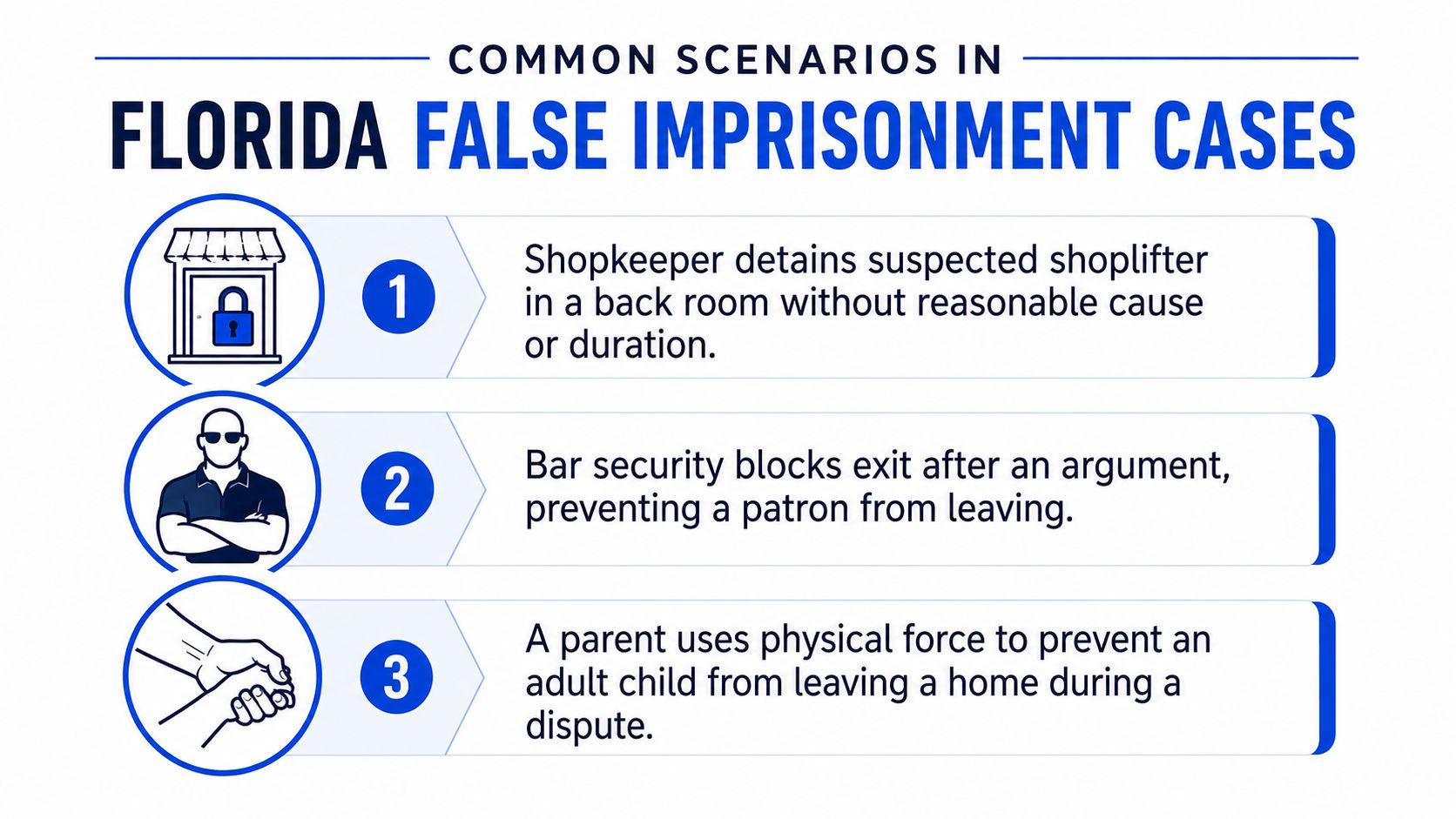
The strongest defense usually begins with the scene itself. A shopkeeper locks a suspected shoplifter in a back office. A bouncer blocks a patron after a bar dispute. A parent uses force during a family argument. A mall security guard holds a customer near a kiosk. Each fact pattern requires a different inquiry into consent, authority, force, duration, and proof.
Consent and lawful authority
If the alleged victim remained voluntarily and was free to leave, the State may have difficulty proving confinement against the person's will. That doesn't mean a defendant should decide the issue alone. Video may show an open exit, a voluntary wait, or a conversation that contradicts the accusation.
Lawful authority creates another defense path. A security employee may have a limited privilege to detain a suspected shoplifter for a reasonable purpose and period. That privilege doesn't authorize every use of force, continued detention, or retaliatory conduct. The defense evaluates what the employee knew, why the detention began, what happened afterward, and whether the response exceeded the lawful purpose.
Weak evidence and competing accounts
A defense lawyer may attack the case through:
Surveillance footage: Video can reveal whether an exit was blocked, whether the alleged victim tried to leave, and whether the physical contact matched the report.
Witness reliability: Differences between the 911 call, police interview, deposition, and trial testimony may affect credibility.
Identity: In a crowded bar or mall, mistaken identification can matter, particularly when lighting and attention were poor.
Statements: Unlawfully obtained statements may be challenged through suppression motions.
Separate conduct: A battery allegation doesn't automatically prove every element of false imprisonment.
The defense may file motions, take depositions, request records, and cross-examine the alleged victim about the exact moment consent ended or the alleged restraint began. Those disputes can create an opportunity for a reduced charge or a dismissal, but the outcome depends on admissible evidence and the assigned prosecutor's evaluation.
For a broader explanation of defense theories, see types of criminal defenses in Florida. The central question remains constant: can the State prove every required element beyond a reasonable doubt?
Civil False Imprisonment Claims, Damages, and How They Differ
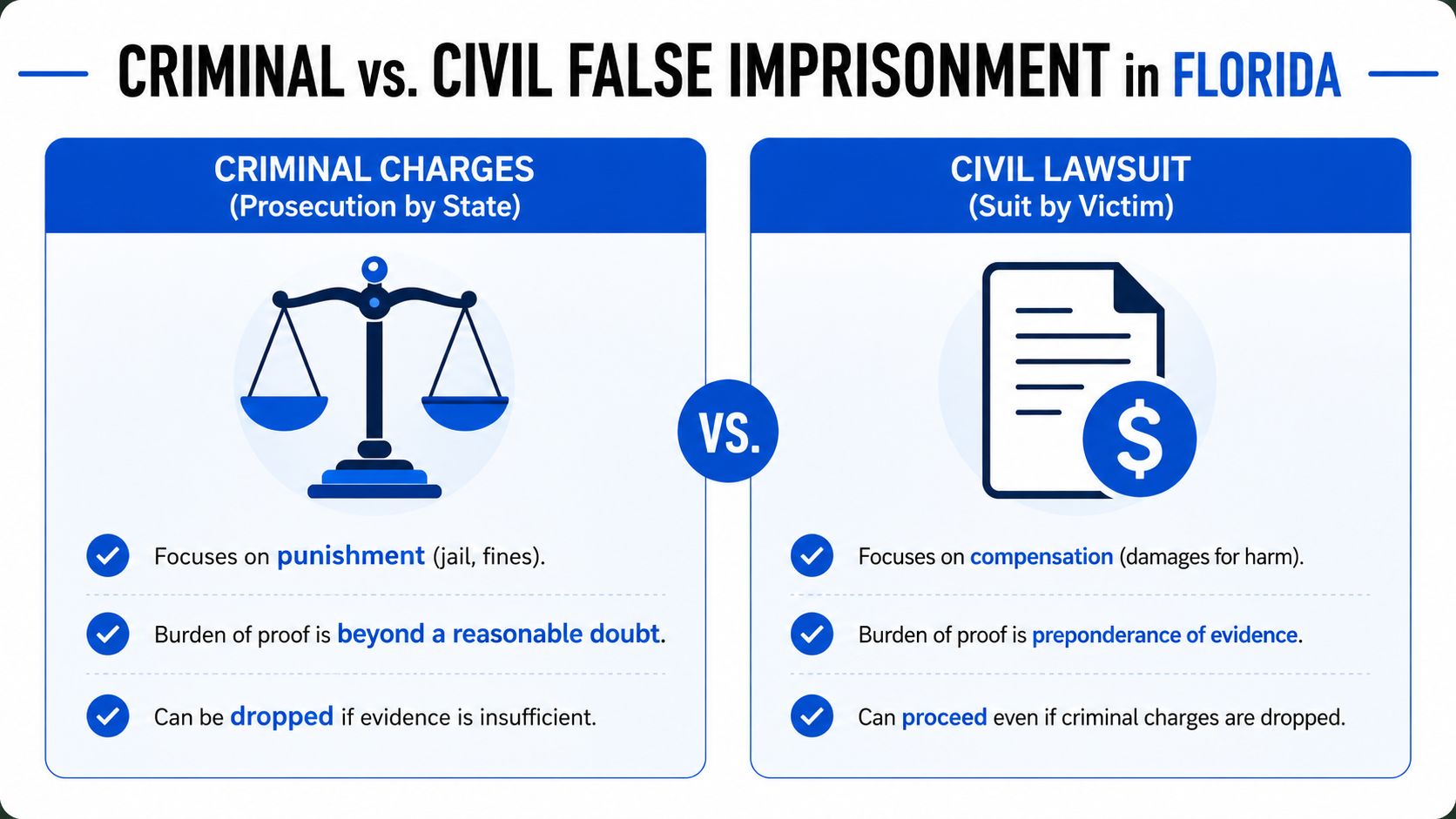
A criminal prosecution is brought by the State and seeks punishment. A civil false imprisonment claim is brought by the person who says they were confined and seeks compensation. The two cases can arise from the same event, but they use different procedures, different burdens of proof, and different objectives.
A civil plaintiff generally must plead and prove intentional confinement, awareness of the confinement or resulting harm, lack of consent, and absence of privilege. A prosecutor's decision not to file charges, a dismissal, or an acquittal doesn't necessarily eliminate a civil claim. Civil litigation asks whether the evidence satisfies the civil standard, not whether the State proved guilt beyond a reasonable doubt.
Who may face a lawsuit
The defendant may be sued personally. A business may also face a claim based on an employee's conduct under respondeat superior, depending on the relationship and the scope of employment. Government defendants raise additional issues involving sovereign immunity, statutory conditions, and limits on available recovery.
Damages can include compensation for emotional distress, lost wages, and other proven harm. Punitive damages may be available when the evidence supports malice or gross negligence. Attorney-fee exposure can also arise under applicable offer-of-judgment rules, so a civil case requires its own litigation strategy.
Florida law provides a four-year statute of limitations for this type of claim under section 95.11. Because civil deadlines and criminal deadlines operate differently, anyone involved in a South Florida incident should preserve records, messages, surveillance requests, medical documentation, and witness information promptly.
Civil exposure may affect criminal strategy. A statement made in a criminal negotiation, a deposition, or a civil demand can influence the parallel matter. Counsel should coordinate the approach without assuming that a favorable result in one case automatically resolves the other.
The Criminal Process From Arraignment to Possible Outcomes
A false imprisonment case normally develops through stages, and decisions made early can affect every later stage. At arraignment, the court addresses the formal charge, and a defendant typically enters a not-guilty plea while counsel reviews the evidence and release conditions.
The pretrial period is where the defense tests the prosecution's theory. Counsel may review reports, recordings, photographs, messages, video, and witness statements. Depositions can expose differences between the initial accusation and later testimony. Motions to dismiss, reduce, or suppress may challenge legal defects or unlawfully obtained evidence.

Negotiation, trial, and sentencing
The State and defense may discuss a plea resolution. Depending on the evidence, criminal history, victim position, and local practice, possible outcomes can include a reduction, diversion, deferred prosecution, probation, or another negotiated disposition. A lawyer should explain the consequences of every offer, including immigration, employment, licensing, firearm, and record-related concerns where applicable.
If the case proceeds to trial, the State presents evidence first and must prove every element beyond a reasonable doubt. The defense may cross-examine witnesses, object to inadmissible evidence, present its own evidence, and argue that the prosecution has not met its burden. The jury's task isn't to decide whether the defendant behaved poorly. It must decide whether the charged offense has been proven.
Sentencing follows a guilty plea or verdict. The judge may consider lawful sentencing alternatives such as probation, county-jail exposure, programs, restrictions, and other conditions permitted by the case and statute. A defense presentation can focus on the scoresheet, mitigation, disputed facts, and the difference between an accusation and proven conduct.
For a plain-language explanation of the first formal court date, review what happens at arraignment in Florida. Possible post-conviction tools include a direct appeal, a motion for new trial, and relief under Florida Rule of Criminal Procedure 3.850, each with its own requirements and deadlines.
What to Do If You Are Accused and How Ticket Shield, PLLC Can Help
The first hours after an accusation are often more important than people realize. Don't try to persuade police at the scene or negotiate directly with the alleged victim. Preserve your rights and preserve the evidence.
A practical first-response checklist
Invoke silence clearly: Say that you want to remain silent and want a lawyer before answering questions.
Refuse consent searches: Don't agree to a search of your phone, vehicle, home, or belongings without legal advice.
Write a timeline: Record where everyone stood, what was said, who touched whom, how the encounter ended, and when police arrived.
Preserve electronic evidence: Keep text messages, call records, photographs, social-media content, and location information in their original form.
Identify witnesses: Write down names and contact information before memories fade, but don't ask anyone to change or coordinate their account.
Avoid contact: Don't call, message, visit, threaten, apologize to, or pressure the alleged victim. Follow every no-contact condition.
Early counsel may be able to investigate before evidence disappears, communicate with the State Attorney's Office before formal charges, seek a pre-file release where available, or present information that affects the charging decision. The lawyer should also examine whether the facts describe confinement at all, whether the alleged victim consented, whether a security or property-related privilege applies, and whether police obtained statements lawfully.
Ticket Shield, PLLC can provide a case-specific review of the alleged restraint, potential exposure under section 787.02, available defense strategies, and fee information. The firm serves clients in Broward County, Fort Lauderdale, Miami-Dade, Palm Beach, and surrounding South Florida communities, with courtroom familiarity across Florida jurisdictions. A consultation should leave you with a clearer understanding of the evidence, the next court date, release conditions, and realistic options, not a guarantee of a particular result.
If you're facing a false imprisonment investigation or charge, contact Ticket Shield, PLLC for a confidential consultation about the alleged confinement, the evidence, and your defense options. Early legal review can help protect your rights and preserve the practical choices available in Broward, Miami-Dade, Palm Beach, and throughout South Florida.