
Can You Refuse a Breathalyzer in Florida? Your 2026 Guide
Jason Goldsmith, Esq
You're driving home through Fort Lauderdale, Broward County, or Miami-Dade after dinner, see flashing lights in the mirror, and within minutes an officer is asking questions about drinking and then asking for a breath test. Most drivers in that moment aren't thinking clearly. They're trying to guess which answer causes the least damage.
That's where people get hurt. They assume refusing a breathalyzer in Florida is a safe middle ground. It isn't. You can refuse, but refusal now carries its own legal consequences, and the damage starts fast. Your license can be taken on the spot. A criminal charge may follow. The refusal can also become evidence the prosecutor tries to use against you in court.
If you're searching can you refuse a breathalyzer in Florida, you need practical answers, not vague summaries. You need to know what happens after arrest, what deadlines matter, and what mistakes to avoid if your case is pending in Fort Lauderdale, Broward County, Palm Beach, Miami-Dade, or anywhere in South Florida. If the stop also involved roadside exercises, this breakdown of Florida field sobriety tests helps explain a separate part of the DUI investigation that drivers often confuse with chemical testing.
Table of Contents
Introduction to Breathalyzer Refusal and Your Rights
The short answer is yes. You can refuse a breathalyzer in Florida.
The better question is whether that refusal helps you. In many cases, it makes the situation worse. Drivers hear “you have a right to refuse” and assume the law treats refusal like a harmless choice. Florida doesn't treat it that way after a lawful DUI arrest.
The question drivers ask at the worst possible moment
At the roadside, people mix up three different things:
Field sobriety exercises, which are different from chemical testing
The arrest itself, which changes the legal stakes
The breath test request after arrest, which triggers implied consent rules
That confusion matters. A driver may refuse because he thinks he's avoiding evidence. Instead, he may be creating a second legal problem on top of the DUI allegation.
Practical rule: Once a DUI arrest happens, every word and every decision matters. Stop trying to “talk your way out” of the case and start protecting the record.
What your rights actually look like
You still have constitutional protections. Police still must make a lawful stop. They still need legal grounds for the arrest. They still must follow the required warning procedure before pursuing a refusal case. In South Florida courts, those details often decide whether the State's case holds up or falls apart.
But rights don't mean there are no consequences. They mean the government has to follow the rules before it punishes you.
If you already refused, focus on what you can still control:
Preserve the timeline
Protect your driver's license quickly
Stop discussing the facts with anyone except your lawyer
Get the reports and video as soon as possible
My direct advice
If you refused after a DUI arrest in Broward County, Fort Lauderdale, Miami-Dade, or Palm Beach, don't sit back and wait for court. That passive approach costs people their licenses and gives prosecutors time to shape the story first.
Treat refusal as a two-front case. One front is criminal. The other is administrative. If you only defend one side, you can still lose badly on the other.
Understanding Implied Consent and Trenton's Law
Florida DUI law starts with implied consent. When you drive in Florida, the law treats that decision as consent to lawful chemical testing after a DUI arrest. That's the basic framework prosecutors rely on in refusal cases.
Then the law changed sharply.

Why Trenton's Law changed the analysis
Under Florida's Trenton's Law (HB 687), effective October 1, 2025, refusing a breathalyzer after a lawful DUI arrest became a standalone criminal offense. A first refusal is now a second-degree misdemeanor punishable by up to 60 days in jail and a $500 fine, while a second or subsequent refusal within five years escalates to a first-degree misdemeanor with up to 1 year in jail and a $1,000 fine, according to this explanation of refusing a breathalyzer in Florida under Trenton's Law.
That single change reshaped DUI defense strategy across Florida courts. Before this shift, many drivers treated a first refusal like a licensing problem. That approach is outdated. Now a refusal can stand as its own criminal count.
For broader context on legislative changes affecting DUI cases, review these new Florida DUI laws.
What implied consent does and does not mean
Implied consent doesn't give police unlimited power. It doesn't erase the need for a lawful arrest. It doesn't excuse bad procedure. And it doesn't automatically make every refusal conviction valid.
What it does mean is simple. Once the arrest is lawful and the warning process is handled correctly, refusing the test can trigger consequences that exist separate from whether the State proves DUI.
Refusal used to be treated by many drivers as a tactical move. Under current Florida law, it's often the start of a second prosecution.
That's why the phrase can you refuse a breathalyzer in Florida needs context. Yes, you can physically say no. No, you should never assume that “no” ends the State's evidence problem. In many cases, it gives the State another argument to use against you.
Criminal Penalties for Breathalyzer Refusal in Florida
A breathalyzer refusal case now carries real criminal exposure. Don't treat it like a traffic ticket. In Fort Lauderdale DUI court, Broward County criminal court, or any South Florida courtroom, the refusal charge has to be defended like any other misdemeanor prosecution.
What changed after October 1, 2025
Under Florida's updated Implied Consent Law (HB 687 / Ch. 2025-121), effective October 1, 2025, a first refusal to submit to a lawful breath or urine test is now classified as a second-degree misdemeanor criminal offense, punishable by up to 60 days in jail and a $500 fine, in addition to an automatic 12-month administrative license suspension, as outlined in this discussion of what happens if you refuse a breathalyzer test in Florida.
That matters because the refusal charge doesn't wait for the DUI case to be proven. The State can pursue the refusal count based on the arrest, the warning, and the alleged refusal itself.
Penalty comparison table
Offense | Misdemeanor Class | Jail Time | Fine | License Suspension |
|---|---|---|---|---|
First refusal | Second-degree misdemeanor | Up to 60 days | $500 | 12 months |
Second or subsequent refusal within five years | First-degree misdemeanor | Up to 1 year | $1,000 | 18 months |
The practical takeaway is ugly but clear. A driver can face a DUI prosecution and a refusal prosecution from the same incident. Even if the prosecutor has no breath result, the refusal itself may still become part of the case theory.
Why this charge can be more damaging than people expect
Drivers often think, “At least they don't have my number.” That's too simplistic.
A refusal case can create problems in several ways:
Separate criminal exposure means you're not only fighting the DUI allegation
License consequences move on a different track
Court consequences can continue even if you're focused only on getting back to work and driving again
If you're charged, the right response isn't panic. It's precision. Your lawyer needs to examine whether the stop was valid, whether the arrest was lawful, whether the warning was properly given, and whether your conduct legally qualified as a refusal.
Administrative License Suspension and Hearing Process
The criminal case gets attention because people fear jail and a record. The administrative side causes just as much damage, sometimes faster. Many drivers lose ground on this front without realizing it.
Start with the timeline.
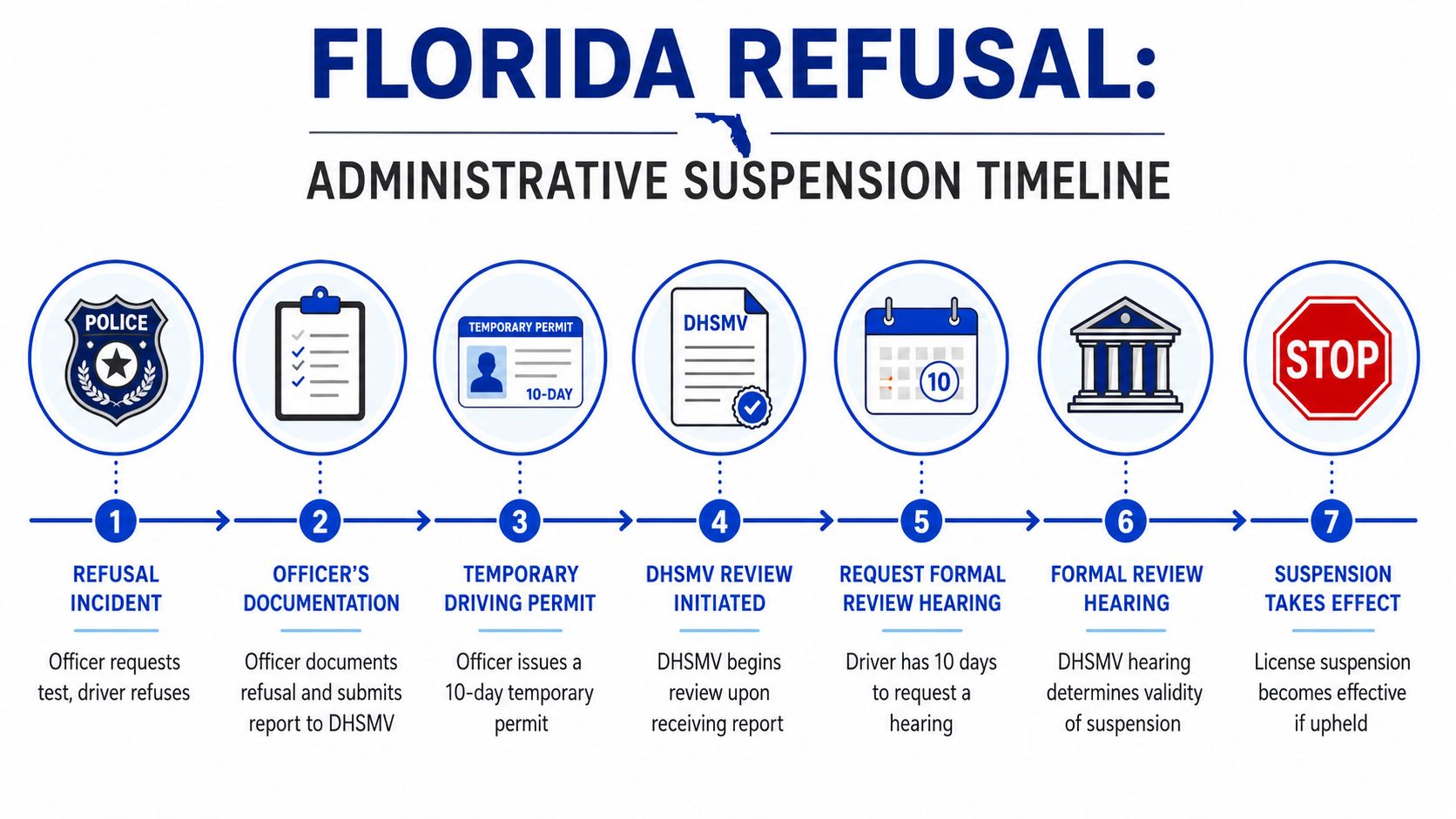
What happens at the roadside
After a refusal, the officer can confiscate your license and issue a 10-day temporary permit. The Department of Highway Safety and Motor Vehicles then moves on the suspension track. For a first refusal, the suspension is 12 months. For a second or subsequent refusal, the suspension is 18 months, as described in this explanation of Florida DUI refusal-to-test penalties.
Most drivers don't appreciate how quickly this starts moving. They think the court date controls everything. It doesn't.
Here's a short walkthrough of the process:
Arrest and refusal
The officer alleges you refused a lawful test.License seizure
Your physical license may be taken.Temporary permit issued
You may receive a short permit tied to a strict deadline.Administrative clock starts
The hearing deadline arrives fast, whether you're ready or not.
A visual summary helps if you're trying to understand the sequence under stress:
How to protect your license quickly
Most content fails to explain the critical 10-day window to request a formal DHSMV hearing to challenge the administrative license suspension, a procedural gap that causes drivers to lose licenses automatically even when the criminal refusal charge is contested or dismissed, as explained in this article about what happens if you refuse a breathalyzer in Florida.
That deadline is the part I'd drill into every client's head. If you miss it, you can lose your ability to challenge the suspension in time.
Don't wait for your arraignment to “deal with the license.” By then, you may already be behind.
If your license is already at risk, review the process for how to reinstate a suspended license. But the smarter move is to fight the suspension before it hardens into a longer problem.
Common Defenses and Pitfalls After Refusal
The biggest myth in DUI defense is that refusal is automatically smart. It isn't. Sometimes it narrows the State's evidence. Other times it hands the State a cleaner story.
Bad assumptions that hurt cases
The first bad assumption is that refusal keeps the case from becoming criminal. That's outdated.
The second bad assumption is that judges can soften the damage if the case is a first offense. Existing coverage largely ignores the strategic nuance that the 2025 law mandates judges cannot withhold adjudication for refusal, meaning a first-time offender now faces a permanent criminal record regardless of other DUI outcomes, and that the refusal itself is now admissible as evidence of guilt in the DUI trial, as discussed in this analysis of Florida's new consequences for refusing a breathalyzer test.
That means two things happen at once. First, the refusal can become its own charge. Second, the prosecutor may argue the refusal showed consciousness of guilt.
Where real defenses usually come from
Strong defenses usually don't come from broad excuses like “I was nervous” or “I didn't trust the machine.” They come from legal defects in the State's process.
Look for issues like these:
The stop was unlawful
If the officer lacked valid grounds to stop the vehicle, later evidence may be vulnerable.The arrest was premature
If police arrested before they had probable cause, the refusal case may weaken.The warning was defective
Refusal charges depend heavily on what was said, when it was said, and whether the request was lawful.The refusal wasn't clear
Confusion, miscommunication, or unclear conduct can matter, depending on the facts.
If your lawyer sees a constitutional problem, a motion to suppress evidence may become a central tool.
The best refusal defenses usually attack police procedure, not your ability to tell a sympathetic story.
That's why people charged with Florida DUI, drug crimes, gun charges, probation violations, domestic violence allegations, or theft offenses need a defense lawyer who looks beyond the arrest affidavit. Paperwork rarely tells the whole story.
Practical Next Steps After a Refusal Arrest
A refusal arrest creates urgency. You need a plan by the time you get home, not a month later.
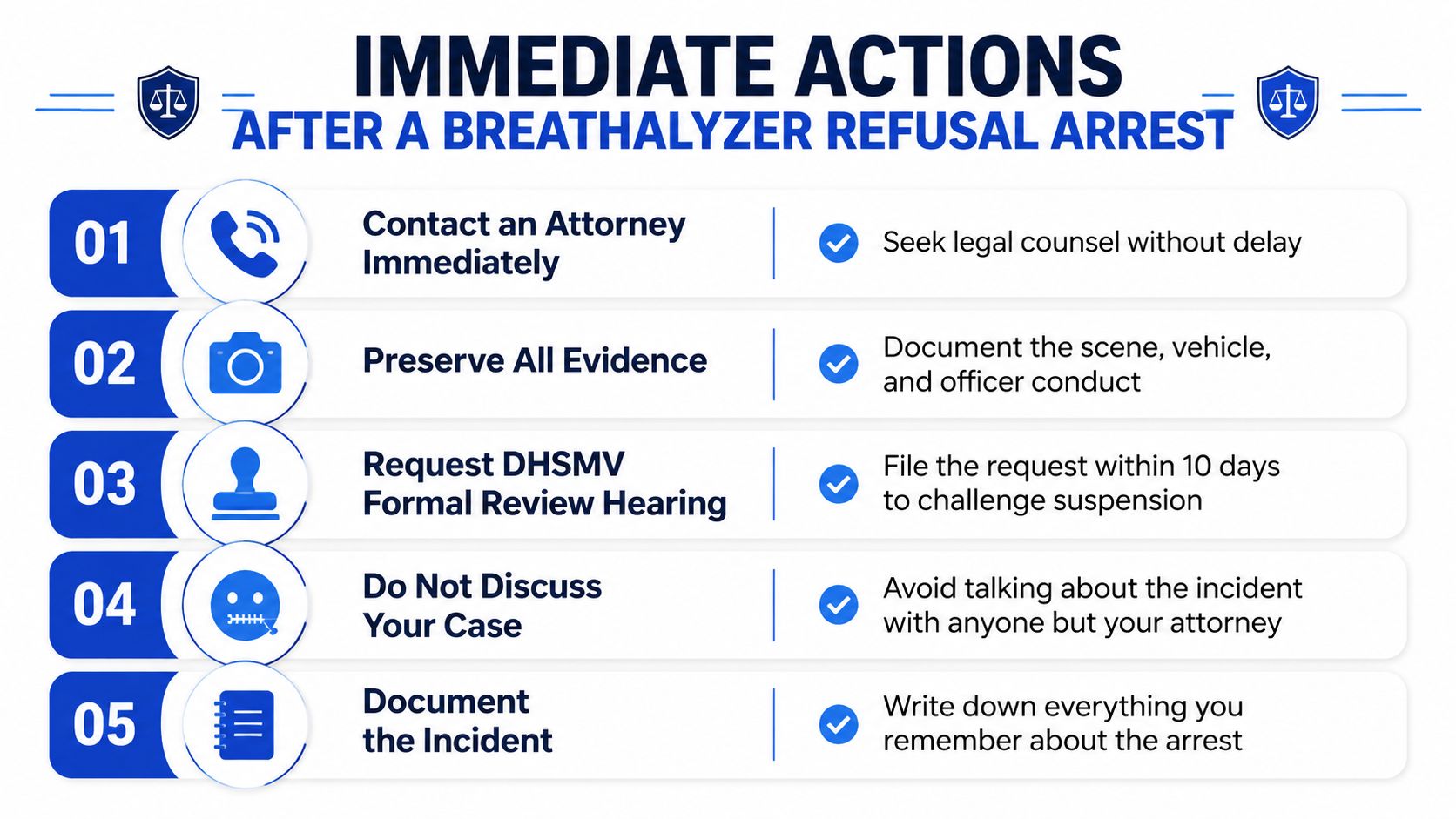
Your first action list
Use this checklist immediately after release:
Write down everything
Record where you were stopped, what the officer said, whether roadside exercises were requested, when the arrest happened, and exactly how the breath test request was presented.Protect the hearing deadline
The administrative side moves fast. Missing the window can cost your license even if your criminal defense is strong.Save documents and digital evidence
Keep the citation, permit, tow paperwork, bond paperwork, call logs, and location history. Small details often help reconstruct timing.Stay off social media
Don't post jokes, explanations, or complaints. Prosecutors love free admissions.
What to gather for your lawyer
Bring more than the ticket. Bring the story and the paper trail.
A useful case file usually includes:
Item | Why it matters |
|---|---|
Temporary permit and citations | Establishes dates and agency information |
Bond papers and court notice | Confirms next required appearance |
Written memory of the stop | Preserves details before they fade |
Witness names and contact information | Helps test the officer's version |
Medical information if relevant | May explain speech, balance, or confusion |
Also do this early:
Get names right
Note every officer, agency, and witness you can identify.Preserve vehicle information
Damage, mechanical issues, or dash alerts may matter.Stop casual conversations
Friends and family aren't protected by attorney-client privilege.
If you're asking can you refuse a breathalyzer in Florida, the legal answer is still yes. The practical answer is that once you've refused, your best move is immediate damage control. Fast action gives your lawyer a chance to challenge the suspension, secure evidence, and shape the defense before the State locks in its version.
Conclusion and Why to Contact Ticket Shield, PLLC
Refusing a breathalyzer in Florida is no longer a minor side issue in a DUI case. It can trigger a criminal charge, create a separate license problem, and give the prosecutor another theme to use in court. That's the reality drivers across Broward County, Fort Lauderdale, Miami-Dade, Palm Beach, and the rest of South Florida need to understand.
The biggest mistake is treating the refusal like a simple yes-or-no decision that ended at the roadside. It didn't. The actual case starts after the arrest. Deadlines matter. Procedure matters. The legality of the stop, arrest, warning, and alleged refusal all matter.
If you're facing a DUI refusal case, take these points seriously:
Handle the criminal case and license case together
Move fast on the administrative deadline
Don't assume refusal helped you
Build the defense around facts, video, procedure, and constitutional issues
This is the same disciplined approach that applies across Florida criminal defense, whether the charge involves DUI, drug crimes, domestic violence, weapons allegations, theft offenses, juvenile accusations, white collar investigations, violent crimes, federal cases, injunction hearings, traffic crimes, or record sealing issues. Good defense work starts with speed, evidence preservation, and a hard look at what police did.
Handling this alone is a bad gamble. The law changed. Prosecutors know it. Judges know it. You need to respond like the stakes are real, because they are.
If you refused a breathalyzer in Broward County, Fort Lauderdale, Miami-Dade, Palm Beach, or anywhere in Florida, contact Ticket Shield, PLLC for a free, confidential consultation. Attorney Jason S. Goldsmith is a former prosecutor who knows how the State builds DUI and refusal cases, and the firm is available 24/7 to help protect your license, your record, and your freedom.