
What Happens After a DUI Arrest in Florida
Jason Goldsmith, Esq
A DUI arrest in Florida is disorienting on purpose. The police take your keys, your license may be gone before you leave the jail, and suddenly you're trying to understand court dates, breath tests, and paperwork while your family is scrambling for answers.
Do not treat this like a normal traffic ticket. What happens after a DUI arrest is two cases at once, and the first one can hit your driver's license faster than the criminal court ever moves. If you're in Fort Lauderdale, Broward County, Miami-Dade, Palm Beach, or anywhere in South Florida, the first mistake is waiting to “see what happens.”
Table of Contents
The First 48 Hours After a DUI Arrest
The arrest itself is only the beginning. In South Florida, that usually means booking, fingerprinting, a chemical test issue, and a fast-moving release process that leaves people confused about what matters most. Many drivers spend those first hours focused on the criminal charge, when the administrative license problem that has already started is often the true emergency.
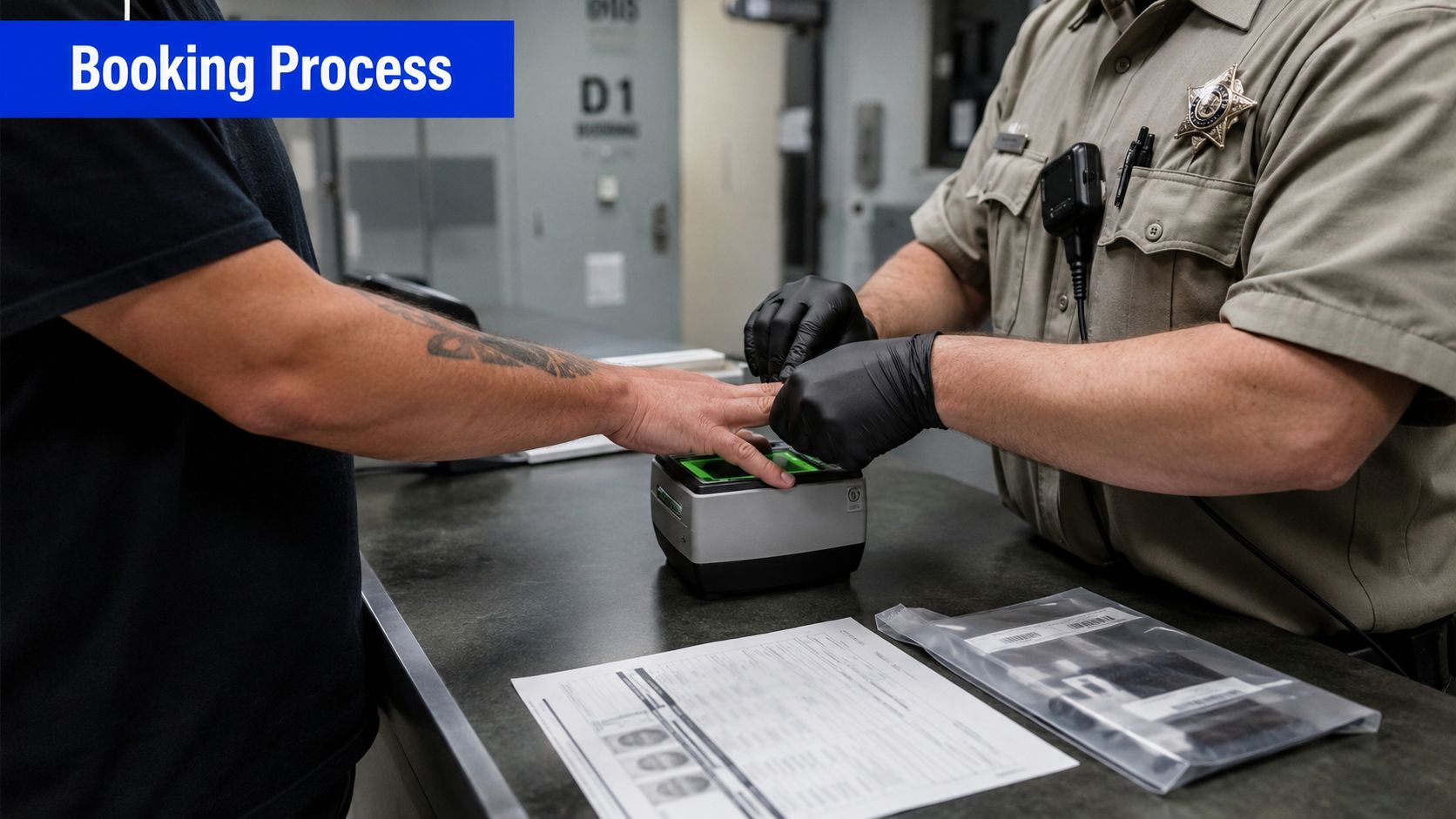
If you were taken to the Broward County Main Jail or Miami-Dade Turner Guilford Knight, the process can feel mechanical. You're processed, your property is inventoried, and the paper trail starts moving before you've had time to make a calm decision. Florida law requires a person arrested and jailed to be brought before a judge for first appearance within 24 hours of arrest, and that is when the court reviews the arrest basis and can address bond and release conditions. Florida DUI procedure overview
What matters right away
Practical rule: the first phone call should be about your license and your release, not about explaining the facts of the stop.
The officer may have confiscated your physical license and issued a temporary permit. That paper does not solve the problem, it just buys a little time. A DUI arrest can trigger an administrative action immediately, which is why the family member handling the aftermath should focus on preserving paperwork and getting a defense lawyer involved fast, not trying to “talk it out” with police or the prosecutor.
Use this early window to keep the situation from getting worse.
Keep every document: Hold onto the arrest packet, the temporary permit, and any test paperwork.
Do not call the officer or the station to argue: Those calls rarely help and can create more confusion.
Get release details in order: If someone needs help understanding bail or jail release, use this local resource on how to bail someone out.
Mark the license deadline immediately: The DMV clock starts running the moment the arrest happens.
The first 48 hours are not about optimism. They're about control. If you act fast, you may preserve the chance to challenge the suspension and keep the case from spiraling into avoidable damage.
Understanding the Dual Track System
A DUI arrest in Florida does not create one case, it creates two separate tracks. One is the criminal case in court. The other is the administrative license action handled through the DMV process. They move in parallel, they follow different rules, and they punish different things.
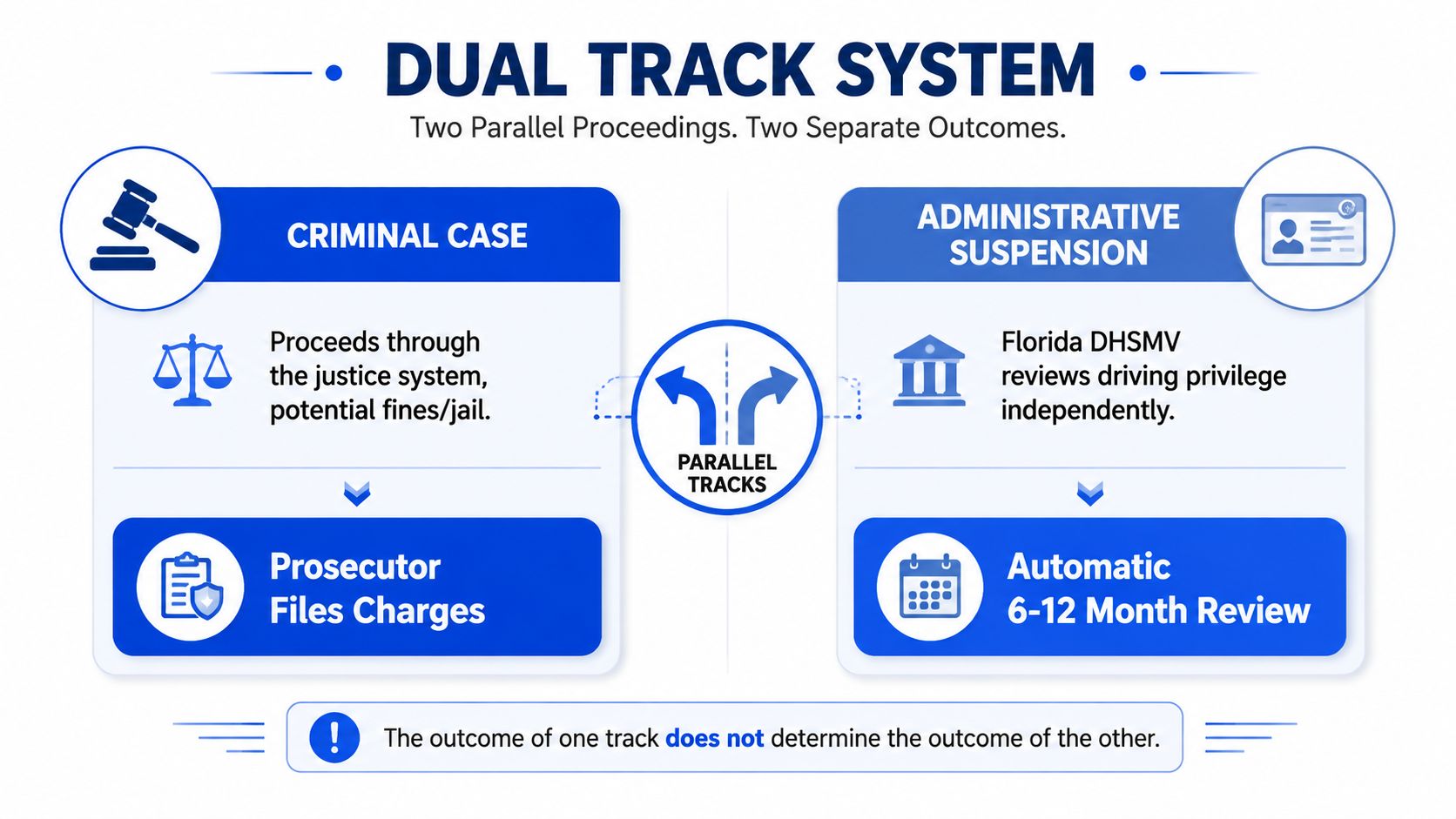
The criminal case is about whether the State can prove the DUI charge in court. The administrative case is about whether your privilege to drive gets suspended based on the arrest record and chemical-test result. California's DMV explains that its review is based on the officer's report, the suspension or revocation order, and test results, while Florida's system works on the same basic idea, immediate review of the driving privilege, separate from the criminal outcome. California DMV DUI action process
Why the two tracks matter
If you win in criminal court, that does not automatically fix the license problem. If the license issue is handled well, it can reduce immediate damage even while the criminal case is still pending. That's why a DUI defense strategy in Fort Lauderdale or Miami has to address both tracks at once, not one at a time.
The license case can move before the criminal case even gets organized.
Florida's administrative process is triggered by the arrest record and test result, not by a conviction. Under Florida law, a DUI arrest can trigger an immediate administrative license suspension if the driver's breath or blood alcohol level is 0.08 or higher, or if the driver refuses a lawful chemical test, and the officer must also issue a temporary driving permit. Florida DUI administrative suspension rules
For a lawyer, this means the first job is not just courtroom defense. It's damage control.
If you want a plain-English overview of how Florida criminal cases proceed after arrest, see Florida criminal laws. The point is simple, the State is already working on one track, and your defense has to keep pace on both.
What you should not do
Do not assume the charge disappears if you get released: The suspension issue can still be active.
Do not ignore the paperwork: The deadlines are short and easy to miss.
Do not explain the stop to friends, family, or social media: Those details can come back later.
Do not wait for a court date to deal with the license: That delay is exactly how people lose driving privileges unnecessarily.
The dual-track system is the reason people get blindsided. They think the “case” starts in court. It doesn't. It starts the moment the officer hands over the notice and the clock begins.
The 10-Day Rule and Your DMV Hearing
You do not get long to react after a Florida DUI arrest. The 10-day rule is the deadline that decides whether you can ask for a formal review of the license suspension. Miss it, and the suspension can move forward without the hearing fight you needed. A 4-step infographic explaining the 10-day rule for requesting a formal review after a DUI arrest.
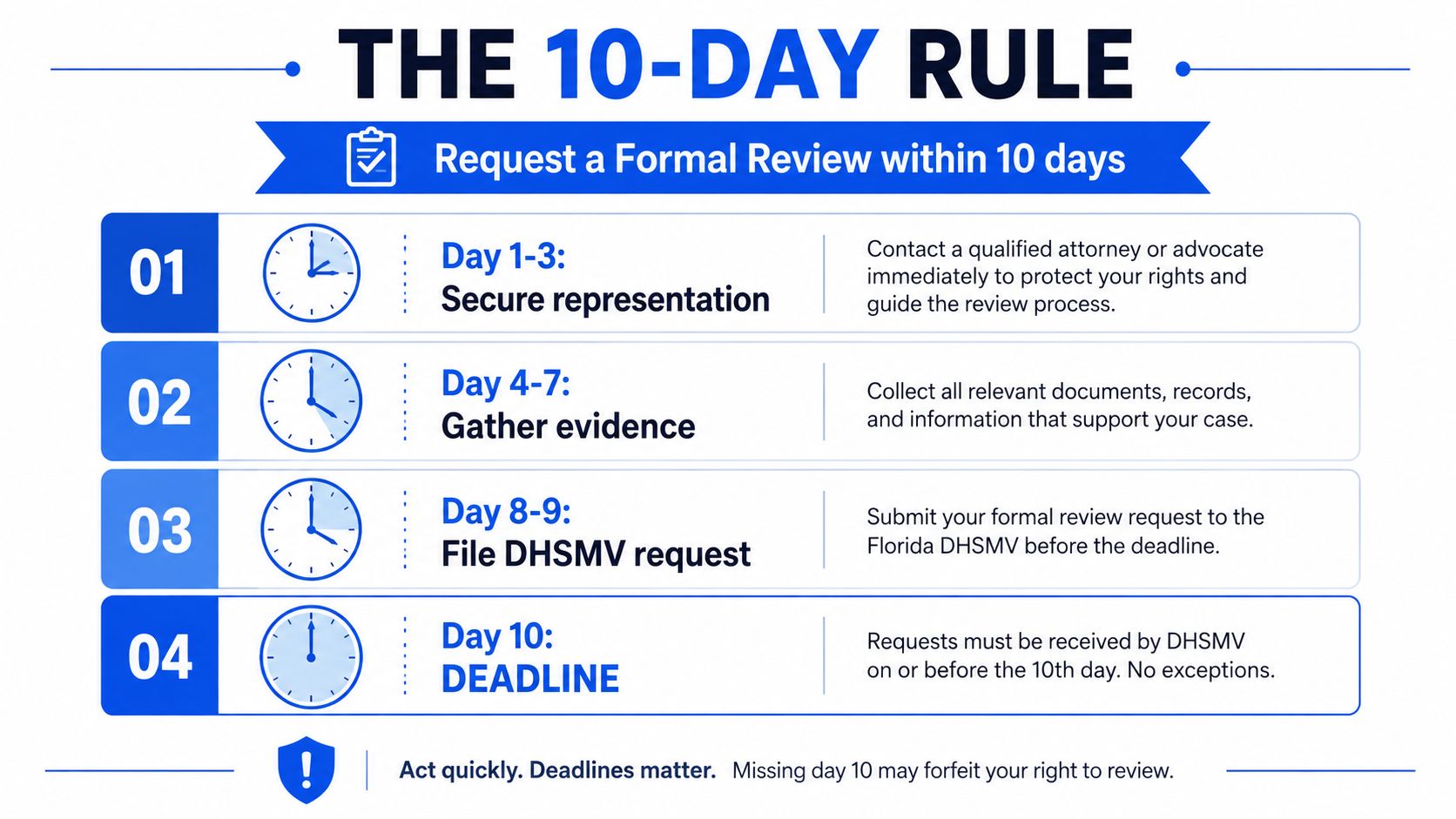
Florida treats the license issue as an administrative case right away. The officer may issue a temporary permit, but that paper does not stop the suspension by itself. To protect the right to contest it, the formal review request must be filed on time under Florida's DUI administrative suspension rules. Florida administrative suspension rules
How the deadline works
The hearing request is the move that keeps the license fight alive. If you wait for the criminal case to develop first, you are already behind.
Florida's process starts at the roadside or jail release. The officer can confiscate the license, hand over the temporary permit, and start the clock for a formal review. If the request is filed on time, the defense can challenge the stop, the arrest paperwork, and the test issues. If it is not filed on time, the state usually moves ahead without that challenge.
A formal review hearing is not a courtesy hearing. It forces the agency to justify the suspension. That is why a lawyer should handle it immediately, not after the first court date. For a closer look at how the process works, see administrative license suspension hearing.
What evidence matters
Arrest documents: These show what the officer recorded.
Temporary permit paperwork: This confirms the administrative timeline.
Chemical-test results: Breath, blood, or urine results can drive the suspension.
Refusal information: Refusal carries separate consequences and can become the central issue later.
The first 10 days are the emergency. That is when the license battle is won or lost. The criminal case matters, but the DMV deadline hits first, and it hits hard.
Florida DUI Penalties and Consequences
A DUI arrest does not end with one court date. In Florida, the punishment often starts with the license fight, then spreads into fines, jail exposure, insurance trouble, work problems, and the cost of getting your life back in order. If you are trying to measure the risk, look at the whole stack, not just the charge on the paper.
Florida's implied consent law hits hard on refusal. Refusing a lawful breath test after a DUI arrest can lead to a 1-year license suspension for a first refusal and an 18-month suspension for a second or later refusal, and the statute says refusal can be charged as a second-degree misdemeanor. Florida implied consent statute
Florida DUI penalty matrix
Offense | Max Fine | Max Jail Time | License Revocation |
|---|---|---|---|
First DUI | Up to $1,000 | Up to 6 months | 180 days to 1 year |
Second DUI | Up to $2,000 | Up to 9 months | 5 years if the second conviction is within 5 years of the prior conviction |
Third or later DUI | Up to $5,000 | Up to 5 years | 10 years if the third conviction is within 10 years of the prior conviction |
Florida sentencing depends on the facts, prior record, and whether the case includes aggravating circumstances. If you want a deeper Florida-specific breakdown, review Florida DUI penalties.
The consequences people underestimate
The courtroom penalty is only part of the problem. A DUI can limit driving, interfere with work and school, make child transport harder, and create immediate family stress. The practical fallout often starts before the case is resolved and stays around long after the first court appearance.
Refusal makes that harder. Florida law lets the State treat refusal as a separate issue, so a driver who thought refusing would help may have created another path to punishment. Florida implied consent statute
A DUI case triggers a chain reaction of penalties.
The record also matters. Even when the case does not end in the worst possible outcome, background checks, insurance consequences, and job concerns can keep causing problems. That is why early defense work matters in South Florida courts. The goal is to reduce exposure before the case hardens into a longer-term problem.
When the stakes go up
Felony exposure can arise in serious cases, especially when injuries or other aggravating facts are involved. I am not listing every felony scenario here because the facts vary, but the point is simple, once the case stops looking like a routine traffic matter, the defense has to become more aggressive.
Do not fixate on jail alone. Focus on the full picture, including refusal penalties, the license revocation, and the ripple effects on work and family. That is how Florida DUI defense should be handled.
How a Defense Attorney Challenges the Evidence
The State's case is only as strong as the stop, the testing, and the paperwork behind it. That's where a real defense starts. A Fort Lauderdale or Miami DUI lawyer does not accept the police report at face value, because police reports leave out mistakes, assumptions, and weak points that matter in court.
The stop is the first target
If the officer lacked a lawful reason to pull the driver over, the case can be attacked at the foundation. That is where a motion to suppress comes in. For a plain-English explanation, see what is a motion to suppress evidence. If the stop was weak, the rest of the case may be weaker than the State realizes.
The same goes for the chemical evidence. The post-arrest test is not the same thing as a roadside screening test. The evidentiary breath, blood, or urine test is the one used to establish BAC or drug presence for administrative and criminal proceedings. Refusal can also become evidence in some jurisdictions, and that makes the testing record even more important. Chemical test distinction and refusal consequences
What experienced counsel looks for
A defense lawyer should be checking the following:
Reasonable suspicion: Did the officer have a real basis for the traffic stop?
Testing reliability: Was the breath machine properly used and maintained?
Timing issues: Did the BAC reading reflect the driving time, or a later, rising number?
Video evidence: Do body-cam or dash-cam recordings contradict the report?
Refusal context: Was the alleged refusal clear, lawful, and documented correctly?
A lot of DUI cases are not won by dramatic arguments. They are won by exposing gaps. One officer writes “odor of alcohol,” another video shows slurred assumptions, and suddenly the case is not as clean as the arrest report suggested.
Why video matters
Body-camera footage and dash-cam footage often tell a different story than the written report. The report might describe bad balance, but the video may show a slippery shoulder, poor lighting, or a rushed interaction. Those details matter because they can create reasonable doubt or force a better resolution from the prosecutor.
Strong defense work is patient work. It starts with the stop, then moves to the test, then to the video, then to the paper trail.
This is also where local knowledge matters in Broward County and Miami-Dade. Prosecutors know which cases are weak, and they know when the defense is ready to press the issue. A lawyer who understands the evidence can often make the State explain more than it wants to explain.
Immediate Next Steps for You and Your Family
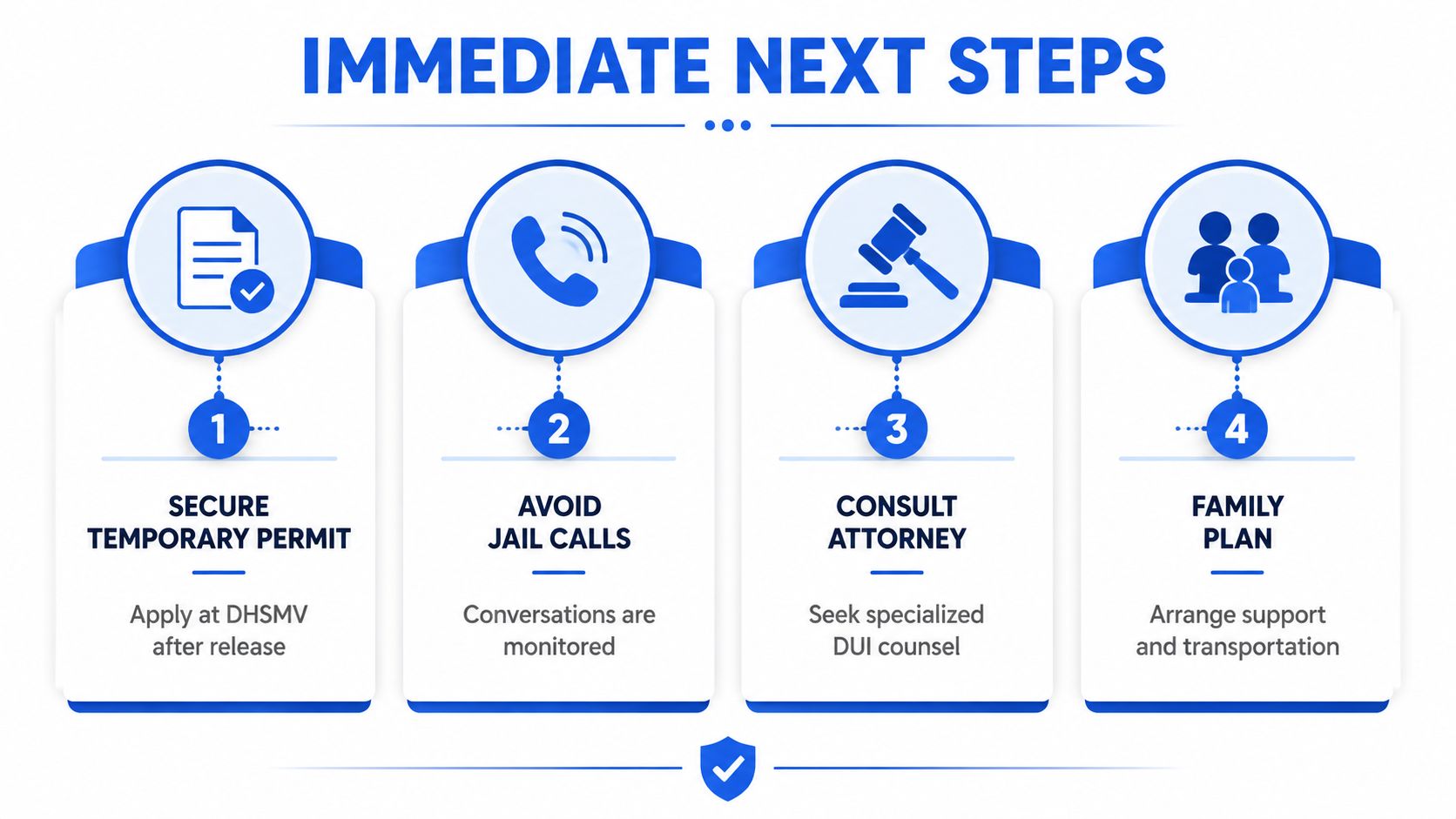
The first week after a DUI arrest should be organized, not emotional. If you're the accused, protect the case. If you're a family member, help with logistics and stay out of the evidence stream. This is the time when bad conversations, missed paperwork, and delay do the most damage.
Your first moves
Secure the temporary permit: Keep it with you and don't lose the paperwork attached to it.
Stay off jail calls for case facts: Those conversations are monitored and can hurt you later.
Gather support documents: Character references, employment records, and proof of responsibilities can matter later in the case.
Get a lawyer involved quickly: A DUI lawyer should handle the deadlines before they pass.
Family members should help with transportation, work coverage, and document gathering, not with debating the facts of the stop. The more people talk about the case informally, the more chances there are for something careless to get repeated. Silence is usually safer than improvisation.
What to bring to a consultation
Bring the arrest paperwork, the temporary permit, any release paperwork, and a list of every deadline you were given. If the arrest happened in Fort Lauderdale, Hollywood, Pembroke Pines, Miami, or West Palm Beach, a defense lawyer can use those documents to identify the first procedural problems fast.
Ticket Shield, PLLC handles DUI defense and related Florida criminal matters, including license-suspension issues, so this is the point to get legal guidance before the case hardens. That early review can make a real difference in what happens next.
Do the simple things right. Preserve papers, preserve silence, and preserve the deadline.
Frequently Asked Questions About DUI Arrests
Can I get a hardship license? In Florida, that question usually depends on the license action, the timing, and whether the administrative process was handled correctly. You need to deal with the suspension process quickly if you want any chance of limited driving relief.
Will a DUI show up on a background check in Florida? Yes, a DUI arrest and case can affect your record and your employment opportunities. The practical impact often lasts longer than people expect.
What if I was arrested in Broward County but live out of state? The Florida case still follows Florida rules, and the license issue can still follow you into your home state. Out-of-state drivers should not assume they can ignore a Florida notice.
Can my DUI record be sealed or expunged? Sometimes post-conviction relief is possible in Florida criminal matters, but it depends on the outcome of the case and the specific record. Get legal advice before assuming the record can be cleaned up later.
If you were arrested for DUI in South Florida, don't sit on the 10-day deadline and hope it works itself out. Contact Ticket Shield, PLLC for a confidential consultation and get a defense team working on your license, your court case, and your next move before the deadlines close in.