
Florida DUI Defense: Understanding Horizontal Gaze Nystagmus
Jason Goldsmith, Esq
You're probably here because an officer stood on the side of the road, held out a pen or finger, and told you to follow it with your eyes. Later, you heard a technical phrase that sounded far more scientific than it felt in the moment: horizontal gaze nystagmus, often shortened to HGN.
That moment matters in many Florida DUI cases. Prosecutors in Broward County, Fort Lauderdale, Miami-Dade, Palm Beach, and across South Florida often use HGN as part of the story they tell about impairment. But the test is not magic, and it's not beyond challenge. In court, the details matter. How the officer gave the test matters. What else could explain the eye movement matters. What Florida law allows the jury to hear matters.
If you're facing a DUI charge, understanding HGN can take some of the fear out of the process. Once you know what the officer was supposed to do, and where the weak spots are, the test becomes much less mysterious.
Table of Contents
What Is Horizontal Gaze Nystagmus (HGN)
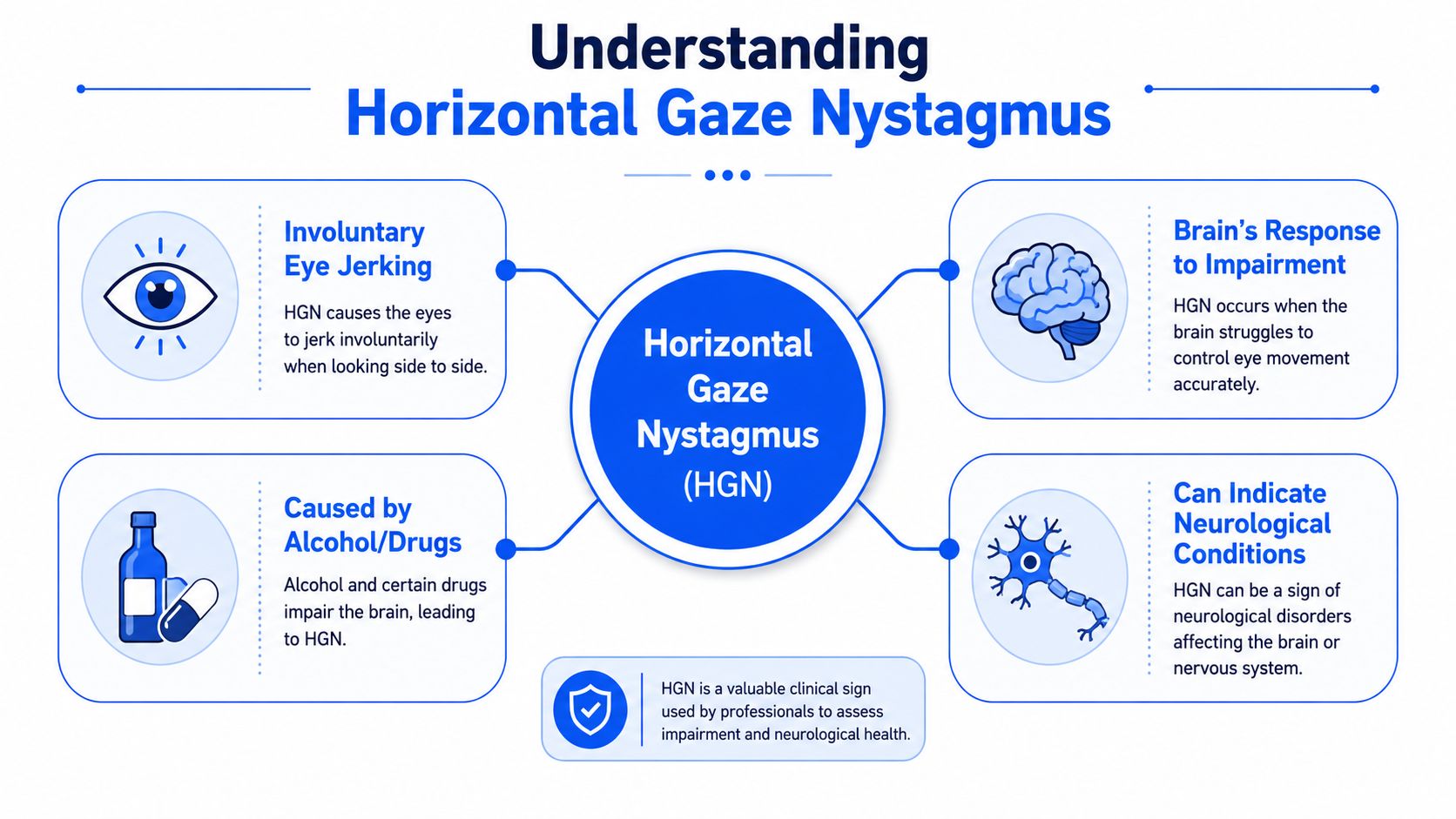
Nystagmus means an involuntary jerking or bouncing of the eyes. Horizontal gaze nystagmus means that movement is observed as the eyes look side to side.
A simple way to think about it is this. Your brain normally acts like the image stabilization system in a camera. It helps your eyes move smoothly and stay steady. When that system is disrupted, eye movement can become less smooth and more jerky. An officer performing an HGN test is looking for that kind of involuntary motion.
Alcohol is one reason eye movement may change. However, people often get confused on this point. HGN is not the same thing as “proof of drunk driving.” It's a physical sign the officer claims to observe. That's different from a direct chemical measurement, and it's one reason HGN becomes a frequent target in DUI defense.
A plain-English way to understand it
If you move your eyes all the way to one side, you may feel strain even when you're completely sober. That matters because the farther the eye moves, the more room there is for normal variation from person to person.
Some people hear “the officer saw nystagmus” and assume the result is objective like a thermometer reading. It isn't. The officer is observing eye behavior in real time, often on the roadside, often at night, often with traffic, headlights, and stress in the background. That leaves room for human error and for disagreement about what was seen.
Practical rule: HGN is best understood as an observation-based roadside test, not a courtroom shortcut to guilt.
Why the term sounds more intimidating than it is
The phrase sounds clinical, and prosecutors often rely on that. But once you break it down, the concept is manageable:
Horizontal means side to side.
Gaze means where the eyes are looking.
Nystagmus means jerking eye movement.
That's it. The science may be technical, but the legal fight often turns on simpler questions. Did the officer administer the test correctly? Did the officer rule out other causes? Did the officer overstate what the test can prove?
Those are the questions a Florida DUI defense attorney asks in court.
How Police Administer the HGN Field Sobriety Test
The HGN test is supposed to be standardized. That word is important. It means the officer is expected to follow a specific method, not improvise.
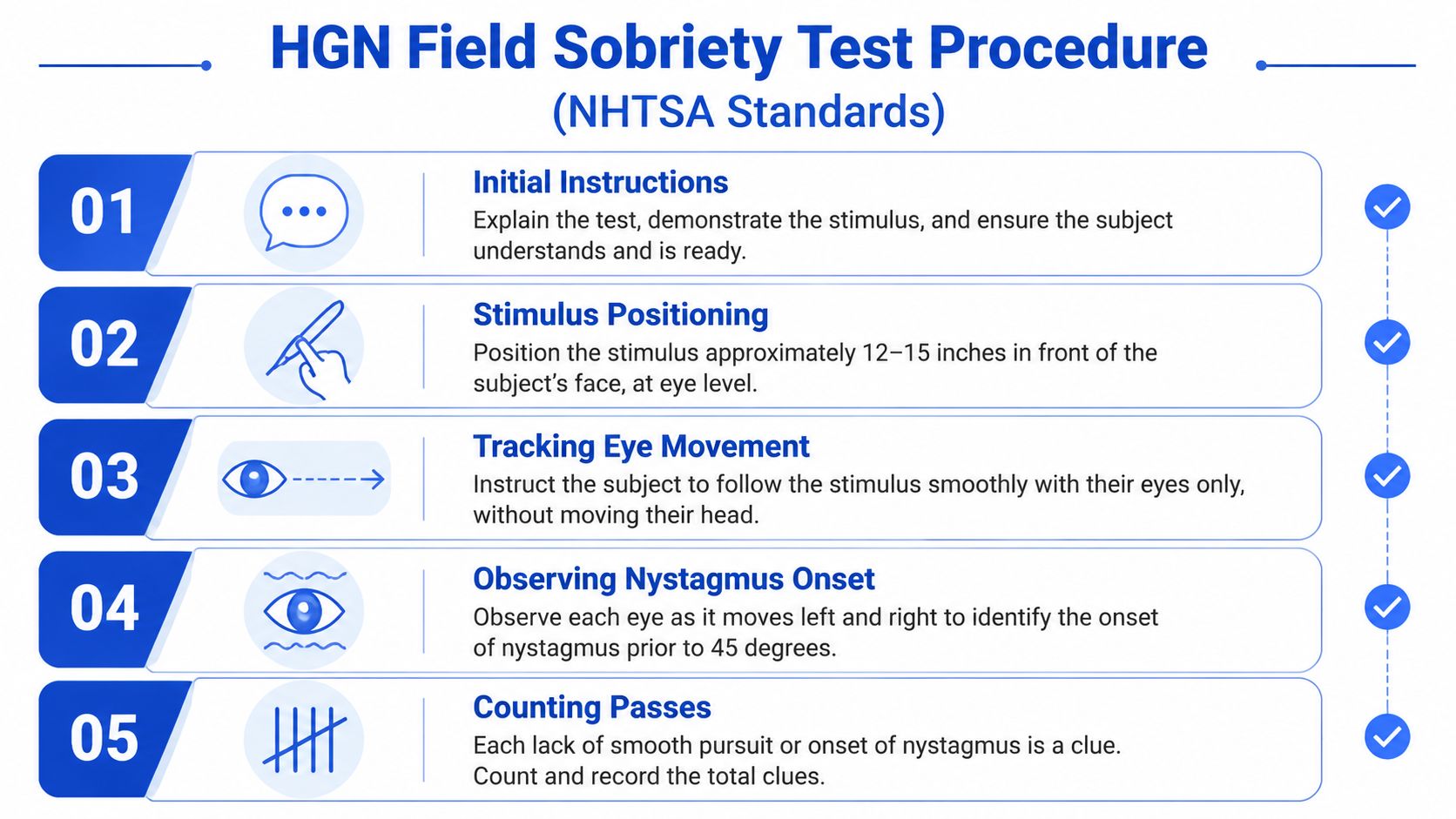
According to the California Highway Patrol field sobriety testing materials used to describe standardized administration, HGN is scored using six total clues, three per eye: lack of smooth pursuit, distinct and sustained nystagmus at maximum deviation, and onset of nystagmus prior to 45 degrees; officers are instructed to hold the stimulus about 12 to 15 inches from the nose, keep the head still, and hold maximum deviation for at least 4 seconds to reduce false positives from transient eye movement in the CHP SFST training reference.
What the officer is looking for
The officer is trained to check for six clues total. There are three clues in each eye.
Lack of smooth pursuit. The eye should follow the stimulus smoothly. If the movement looks jumpy instead of fluid, the officer may count a clue.
Distinct and sustained nystagmus at maximum deviation. The officer moves the stimulus to the side and holds it there. The training materials say maximum deviation should be held for at least 4 seconds.
Onset of nystagmus prior to 45 degrees. The officer watches for when the jerking begins as the eye moves outward.
People often think the officer is checking whether your eyes twitch. That's too simplistic. The test depends on timing, angle, distance, and whether the officer follows the sequence correctly.
Here's a demonstration of the type of procedure officers are taught to use:
Why the setup matters
This part is where many DUI cases become defensible. A roadside HGN test can go wrong in ways that are easy to miss in the moment.
For example, the officer is supposed to:
Position the stimulus properly so it's about 12 to 15 inches from the nose.
Keep your head still and make sure you're using only your eyes.
Hold maximum deviation long enough to avoid mistaking temporary eye behavior for a true clue.
If the officer rushes, moves the stimulus unevenly, or performs the test in distracting conditions, the result becomes less trustworthy.
Officers are trained to follow a script because small deviations can change what they think they see.
That's why a defense lawyer in a Fort Lauderdale or Broward County DUI case will often compare the officer's report, body camera footage, dash camera footage, and testimony against the standardized method. HGN is only as good as the way it was administered.
Scientific Reliability and Common Test Flaws
A prosecutor may present HGN as if it works like a lab instrument. On the roadside, it does not. It is a field test built on observation, and observation can go wrong in quiet ways that matter in court.
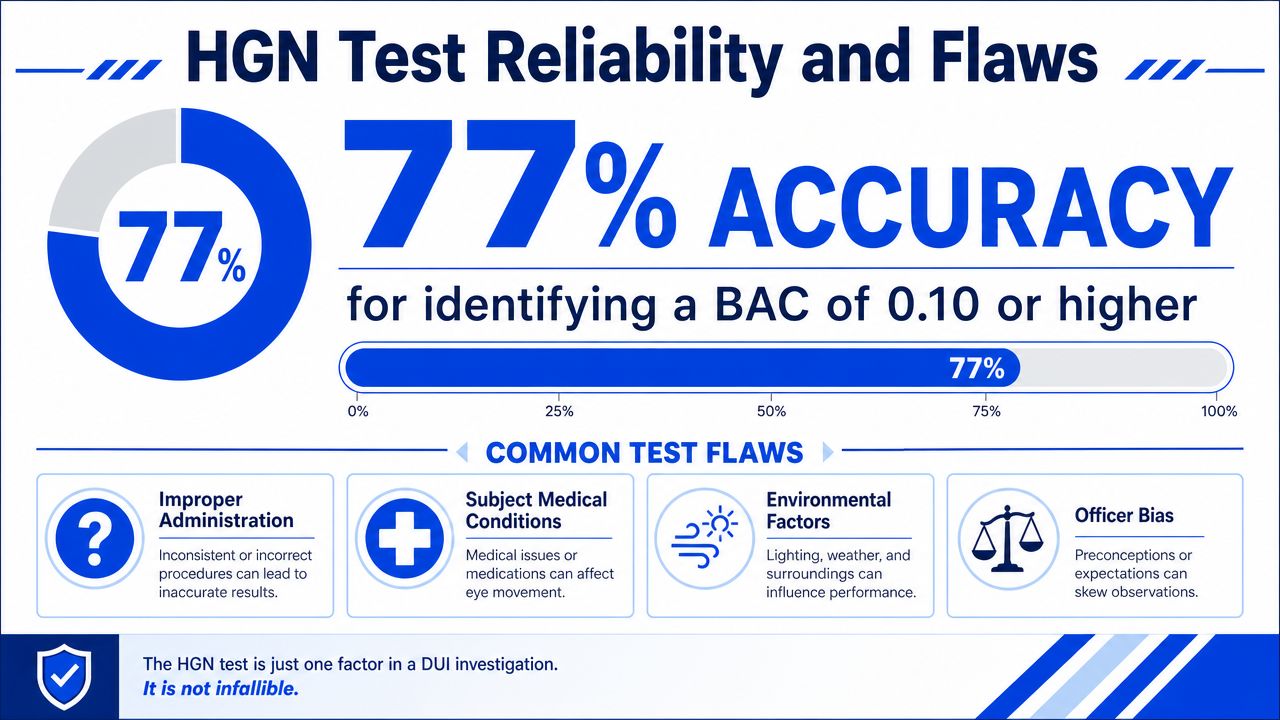
NHTSA research from the late 1970s and early 1980s reported that HGN was 77% accurate at detecting whether a subject's BAC was 0.10 or higher, the walk-and-turn was 68% accurate, combining HGN with walk-and-turn rose to 80%, and the full three-test battery was 83% accurate for identifying BAC at or above 0.10, as described in NHTSA's HGN science and law publication.
Those numbers sound strong until you ask the question a defense lawyer asks in Broward, Miami-Dade, or Palm Beach. Accurate under controlled conditions, or accurate on a dark roadside with traffic, flashing lights, fatigue, and an officer making split-second judgments?
Why the science sounds stronger than it often is
HGN sounds technical because it deals with eye movement, angles, and neurological language. That vocabulary can make the test feel objective. In practice, the officer still has to notice subtle eye behavior, judge when it starts, and decide whether what he saw counts as a clue. A ruler gives the same measurement every time. HGN does not work that way on the roadside.
One of the biggest points of confusion is this: nystagmus is not limited to drunk drivers. Research discussed in the literature on HGN has noted that end-gaze nystagmus can appear in sober people. That means the presence of eye jerking, by itself, does not neatly separate impaired drivers from unimpaired ones.
The practical problem is overlap. If sober and impaired people can both show some degree of nystagmus, the test becomes less like a switch that flips from “no alcohol” to “alcohol” and more like a blurry line that requires careful interpretation. Blurry lines are exactly where cross-examination matters.
Where false positives can enter the picture
Florida DUI defense lawyers often challenge HGN by showing how many variables can distort the result before the officer ever writes the report.
Common trouble spots include:
Natural eye variation. Some people have eye movement patterns that can look suspicious even without alcohol.
Fatigue, illness, or physical condition. Tiredness, inner-ear issues, neurological differences, and certain medical conditions can affect tracking.
Roadside environment. Patrol lights, passing headlights, wind, noise, and nighttime conditions can pull attention away from the stimulus.
Officer judgment. The officer must decide whether the eye moved smoothly, whether jerking was distinct, and when onset occurred. Two officers may not describe the same performance the same way.
Poor documentation. Many reports contain conclusions without the detail needed to verify exactly what the officer did, saw, and timed.
That last point matters more than people realize.
In court, HGN often gains force from confidence, not from precision. An officer may say he observed six clues, but the video may not clearly show the eye movements, the report may leave out timing, and the testing conditions may have been far from ideal. In that setting, the defense is not arguing magic. The defense is asking whether the conclusion was earned.
For many clients, the larger DUI defense strategy often begins to clarify. HGN is rarely attacked in isolation. It is challenged as part of the state's overall impairment theory, which is why it helps to understand how it fits into a broader Florida DUI defense strategy.
HGN can help an officer form suspicion. That does not make it a clean or mistake-proof measure of impairment.
In Florida courtrooms, especially in busy county courts, effective cross-examination usually focuses on specifics. What was the lighting? How far was the stimulus from the face? Was the head kept still? How long was maximum deviation held? Did the body camera confirm the officer's description, or only the officer's confidence? Those questions often do more work than abstract debates about science because they expose the gap between textbook administration and what happened on the roadside.
How HGN Evidence Is Used in Florida DUI Prosecutions
In Florida DUI cases, HGN usually appears as one piece of a larger impairment narrative. The officer may say your eyes showed clues. The prosecutor may combine that with driving pattern allegations, odor of alcohol, speech, admissions, balance issues, and any breath or blood evidence that exists.
That doesn't mean HGN decides the case. It usually doesn't.
What prosecutors try to do with HGN
The state often uses HGN in two ways. First, to justify the arrest by arguing the officer had probable cause. Second, to persuade a judge or jury that the officer observed signs consistent with impairment.
In courthouse practice across Broward County, Miami-Dade, and Palm Beach County, the test can carry rhetorical force because it sounds technical. Jurors may think, “Eyes don't lie.” But lawyers know the central question is narrower. What did the officer observe, and how carefully can that observation be trusted?
If you're dealing with a broader DUI charge, it helps to understand how HGN fits within the larger defense picture discussed in this Florida DUI crimes overview.
What Florida defense lawyers focus on
A Florida DUI defense attorney typically tries to limit the weight of HGN, not just argue about the science in the abstract. The defense looks at whether the officer exaggerated the significance of the test, whether the procedure was standardized, and whether the testimony drifts from “clue of possible impairment” into “proof of intoxication.”
A useful way to think about HGN is this. It's like a smoke alarm. It may alert someone to investigate further, but it doesn't tell you exactly what caused the smoke, how serious the problem is, or whether there even was a fire.
That's why “failing” HGN doesn't automatically equal a DUI conviction in Florida courts. The state still has to prove its case, and the defense still has room to challenge the observation, the officer's training, the testing conditions, and the legal limits on what the result really means.
Challenging the HGN Test in Your DUI Defense
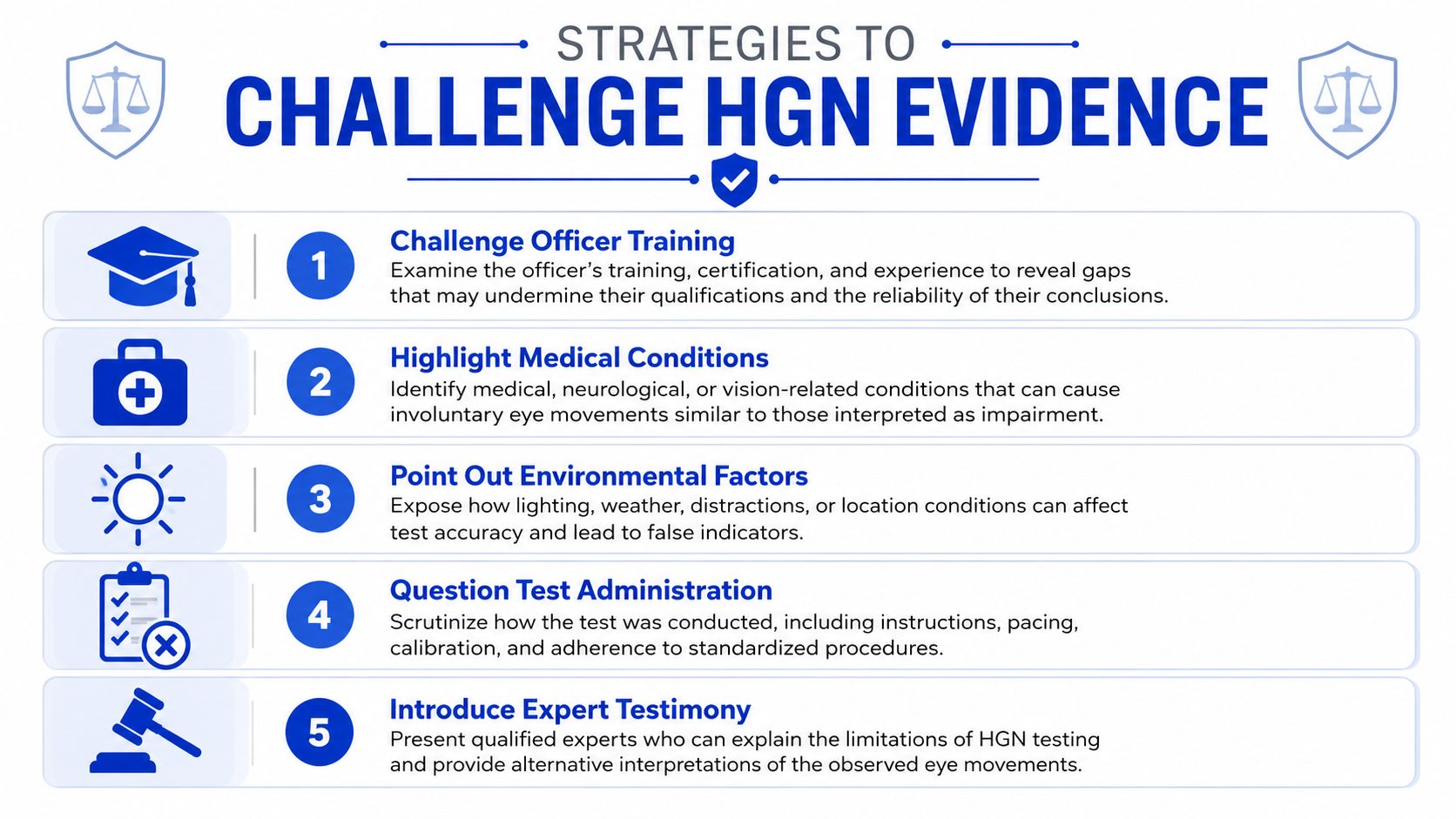
However, HGN often starts to lose its shine. In court, a defense attorney doesn't just ask whether the officer saw eye movement. Key questions are more precise. Was the officer trained well enough to recognize what mattered? Did the officer follow the required method? Did the officer rule out obvious alternative explanations? Did the officer turn a general neurologic sign into a claim of alcohol impairment without enough foundation?
Modern guidance matters here. The Michigan State Police's 2024 handout explains that nystagmus can arise from disturbances in the neurological control of the eye or the vestibular system, can appear in different forms, and should be understood as a general neurologic sign rather than a stand-alone intoxication test, as stated in the Michigan State Police HGN handout.
Cross-examination starts with procedure
A good cross-examination often sounds simple because it focuses on concrete steps.
Questions may include:
Training details. When were you trained? How often do you refresh that training? What exactly were you taught about screening for medical issues?
Stimulus placement. How far was the pen or finger from the driver's face? Was it level? Did you measure, or estimate?
Timing. Did you hold maximum deviation long enough?
Environment. Were emergency lights flashing nearby? Was traffic moving? Was the driver standing on uneven ground while trying to keep the head still?
Those questions matter because HGN is a procedure-driven test. If the procedure slips, the conclusion becomes shakier.
Defense focus: When a test claims to be standardized, any shortcut by the officer becomes legally important.
The medical context can change everything
One of the strongest defense themes is that HGN isn't specific to alcohol. That doesn't mean every case involves a medical explanation. It means the officer cannot safely assume alcohol is the only explanation just because eye movement was observed.
A defense lawyer may explore whether the officer asked about:
Eye conditions
Neurologic history
Vestibular problems
Recent fatigue
Head injury
Medication or other non-alcohol causes
If the answer is no, that omission can be powerful. The officer may have skipped the very screening that would have added needed context.
How this plays out in South Florida courtrooms
In Broward, Fort Lauderdale, Miami-Dade, and Palm Beach DUI cases, HGN challenges often become a combination of science, procedure, and credibility. The defense may use body cam video. It may compare the police report to testimony. It may highlight missing details that a properly administered test should include.
An experienced attorney also looks at how HGN fits the rest of the case. Sometimes the officer claims strong HGN clues, but the video shows the driver speaking clearly, producing documents without trouble, and standing steadily. That mismatch can create reasonable doubt.
For a broader look at DUI defenses and case strategy, this Florida DUI defense hub is a useful starting point.
The bottom line is straightforward. HGN can be challenged because it is not self-proving. It depends on the skill of the officer, the conditions of the stop, and whether the officer respected the difference between a clue and a conclusion.
What to Do After a DUI Arrest Involving an HGN Test
After a DUI arrest, individuals often make one of two mistakes. They either assume the case is hopeless because they “failed” the eye test, or they talk too much in an effort to explain themselves. Neither helps.
A better approach is calm and methodical.
Protect the facts early
Write down what you remember as soon as you can do it safely and privately. Details fade fast.
Include points like:
Where the stop happened
Whether emergency lights were flashing directly in your face
Whether you were tired, ill, dizzy, or wearing contacts
What the officer told you to do
Whether the officer moved the stimulus quickly or slowly
Whether body camera or dash camera appeared to be recording
These facts may seem minor. In a DUI defense, they often aren't.
Get legal advice before you explain too much
Don't assume the police report tells the whole story. Officers often summarize HGN in a few short lines, but the actual roadside event may be far messier than the report suggests.
If your case also involves an alleged refusal, it's important to understand how roadside testing and chemical testing issues can overlap. This page on refusal to submit to a breath test in Florida explains part of that bigger picture.
A lawyer can review:
The stop itself for constitutional issues
The field sobriety testing for procedural flaws
The officer's observations for exaggeration or inconsistency
The video evidence for contradictions
The medical context that may have been ignored
One DUI arrest in South Florida can affect your license, record, employment, and reputation. But an HGN allegation is not the end of the case. It's one part of the evidence, and in many cases, it's a part that can be attacked effectively when the defense moves quickly.
Frequently Asked Questions About HGN Tests
Can I refuse the HGN test in Florida
That question often comes up after the fact because drivers don't realize the eye test is part of field sobriety testing. The practical issue is that officers may still describe your refusal as part of the encounter, and they may continue building a DUI case through other observations. If this is part of your situation, you should discuss the exact facts with counsel quickly.
If I failed the HGN test, will I automatically be convicted of DUI
No. HGN is not an automatic conviction. A prosecutor still has to prove impairment or prove the charged theory through admissible evidence. The defense can challenge the officer's training, the way the test was administered, the conditions of the stop, and whether the officer ignored other explanations for what was seen.
How is HGN used if I refused the breath test
In refusal cases, prosecutors often try to lean harder on officer observations and field sobriety testing. That can make HGN more prominent in the case narrative. It can also make flaws in the test more important to expose. If you're trying to understand the broader legal context, this update on new Florida DUI laws can help you frame the issue.
Can medical issues matter even if the officer never asked about them
Yes. That can become part of the defense. If the officer treated HGN like stand-alone proof without considering medical or neurologic context, that may weaken the value of the observation.
Is HGN the same as a breath test
No. HGN is an officer-observed field sobriety test. A breath test is a chemical test. They are different kinds of evidence, and they are challenged in different ways.
If you were arrested after an officer claimed you showed horizontal gaze nystagmus, don't assume the science is settled or that the case is unwinnable. Ticket Shield, PLLC defends DUI cases throughout Broward County, Fort Lauderdale, Miami-Dade, Palm Beach, and across Florida. Attorney Jason S. Goldsmith is a former prosecutor who knows how the state builds these cases and where roadside testing often breaks down. If you need clear answers and a confidential consultation, reach out now to start protecting your license, your record, and your future.
The horizontal gaze nystagmus test is a key piece of DUI evidence in Florida — and it's often flawed. Learn how it works and how to challenge it.