
Florida Field Sobriety Test: Know Your Rights 2026
Jason Goldsmith, Esq
You're driving home in Fort Lauderdale, Miami-Dade, or somewhere else in South Florida. Lights hit your mirror. You pull over. The officer asks a few questions, then comes the line that catches many drivers off guard: would you step out and do a few exercises?
That's the moment a routine stop becomes a DUI investigation.
A Florida field sobriety test is often presented as simple, fair, and scientific. In real life, it's none of those things. It's a roadside investigation tool. It's subjective. It's stressful. And every movement, every stumble, every refusal, and even your nervousness can become part of the State's case.
From the driver's seat, the biggest mistake is treating this like a chance to “clear things up.” Drivers often fail to recognize the officer is usually not trying to prove innocence. The officer is building probable cause.
If you've been stopped or arrested in Broward County, Fort Lauderdale, Palm Beach, or anywhere in Florida, you need to understand what these tests are, whether you have to take them, and how a defense lawyer can attack them later.
Table of Contents
The Moment of Truth A Florida DUI Traffic Stop
It usually unfolds fast. You may have had dinner in Fort Lauderdale, left a friend's house in Broward County, or been driving home from work late in Palm Beach County. The officer says you drifted, rolled a stop sign, or had a tag light issue. Then the conversation turns.
The officer asks whether you've had anything to drink. Maybe you answer. Maybe you try to sound calm. Then you hear, “Step out of the car for me.”
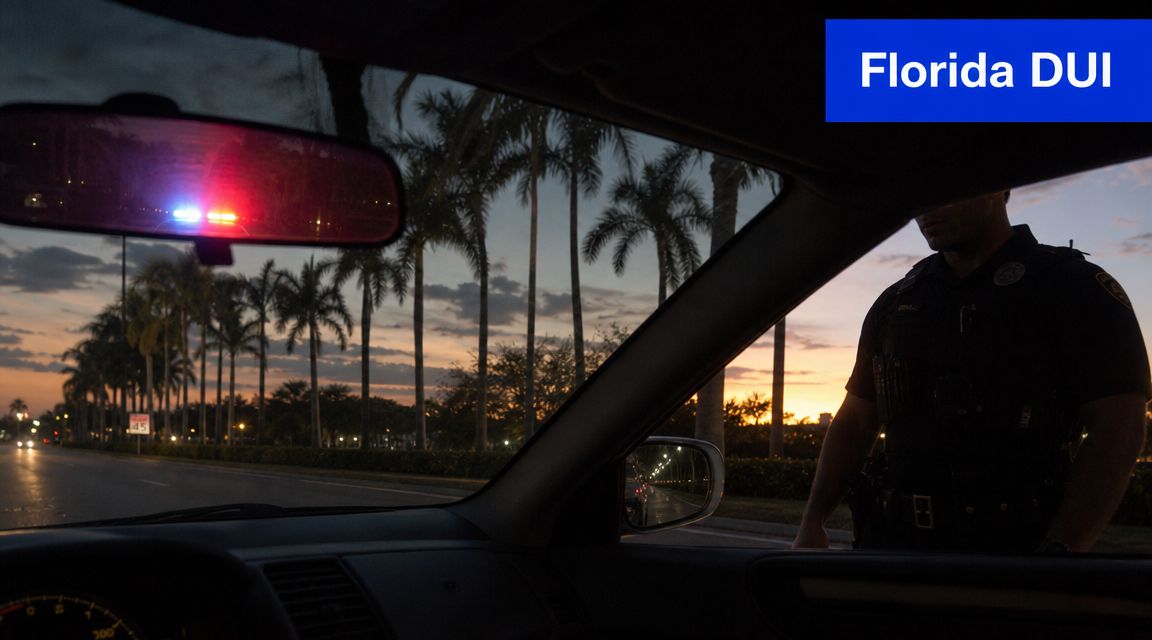
At that point, many drivers think they're being given a chance to prove they're okay. That's usually the wrong way to view it. By the time field exercises come up, the officer often already suspects impairment and is trying to gather more evidence. If you're dealing with a DUI investigation, it helps to understand the broader process of Florida DUI charges and defenses.
What the officer is really doing
A roadside DUI investigation is part observation, part paperwork, and part testimony-building. The officer is noting:
Your speech: Whether it sounds slurred, delayed, confused, or inconsistent.
Your movements: How you open the door, step out, stand, and walk.
Your statements: Whether you admit drinking, explain where you were, or contradict yourself.
Your reaction to instructions: Whether you seem confused, hesitant, angry, anxious, or unsteady.
None of that means you're impaired. It means the officer is collecting impressions.
Practical rule: Once roadside exercises are requested, you should assume you are the focus of a criminal investigation, not a casual traffic encounter.
Why this moment matters so much
What happens in the next few minutes can affect your arrest, your license, and how the prosecutor frames your case later. A driver who tries to “cooperate” often gives the State more evidence to work with. A driver who refuses may still be arrested, but refusal changes what evidence exists and what your lawyer can challenge.
That distinction matters in South Florida courtrooms. I've seen many cases where the key issue wasn't whether the client looked perfect on video. It was whether the officer followed the rules, whether the conditions were fair, and whether the State could turn roadside impressions into proof beyond a reasonable doubt.
What Are Field Sobriety Tests Anyway
Field sobriety tests are roadside exercises officers use to build a DUI case in real time. In Florida, they help the officer decide whether to arrest you, what to write in the report, and how to explain that decision later in court.
From the driver's seat, that matters more than many people realize. These exercises are designed to produce observations the State can argue show impairment, even when the result is far less clear in real life.
The request is often framed like an order
Many drivers hear, “Step out and perform some exercises,” and assume they have no choice. Under Florida DUI practice, the legal standard for requesting roadside exercises is lower than probable cause, and the exercises are generally treated as voluntary. According to this Florida field sobriety discussion, officers may request field sobriety exercises based on reasonable suspicion, and refusing them does not carry the same direct license suspension consequence that applies to certain breath, blood, or urine refusals.
That does not mean refusal ends the investigation. It does mean the decision has strategic consequences. If you perform the exercises, the officer gains more material to describe as clues of impairment. If you decline, the officer may still arrest you, but the State has less roadside performance evidence to use against you.
Standardized versus non-standardized tests
Officers use two different kinds of roadside exercises, and the distinction matters in a DUI defense.
Type | What it includes | Why it matters |
|---|---|---|
Standardized tests | HGN, Walk-and-Turn, One-Leg Stand | These are the three tests tied to the NHTSA model used in Florida DUI enforcement |
Non-standardized exercises | Alphabet tasks, counting tricks, finger dexterity, time estimation | These are more subjective and easier to challenge because they are not part of the standardized three-test battery |
The standardized tests carry more weight with prosecutors because officers are trained to score them in a set way. Even then, they are only useful to the State if the officer gave proper instructions, used suitable conditions, and interpreted what happened correctly. The eye test creates its own set of issues, which you can read about in this overview of Horizontal Gaze Nystagmus in DUI cases.
Non-standardized exercises are different. They often show up in reports because they sound persuasive on paper, but they are far more vulnerable to challenge. Nervousness, age, injuries, fatigue, language barriers, bad footwear, and uneven pavement can affect performance long before alcohol is the significant factor.
A Florida field sobriety test usually serves one purpose for the officer: to create observations that support an arrest report.
Why participation helps the State
Once you start the exercises, the officer is scoring more than balance. The officer is watching whether you interrupt instructions, start too soon, sway, raise your arms, miss heel-to-toe, hop, turn incorrectly, or say anything that can be quoted later. Body camera footage may capture all of it, but camera angles rarely show the full picture, and reports often emphasize the parts that look bad.
That is why these tests are not simple pass-or-fail events. They are evidence-generation tools. A strong defense begins with understanding that every choice at roadside, including silence, compliance, hesitation, or refusal, can become part of the State's narrative or part of your lawyer's challenge to it.
The Three Standardized Florida Sobriety Tests Explained
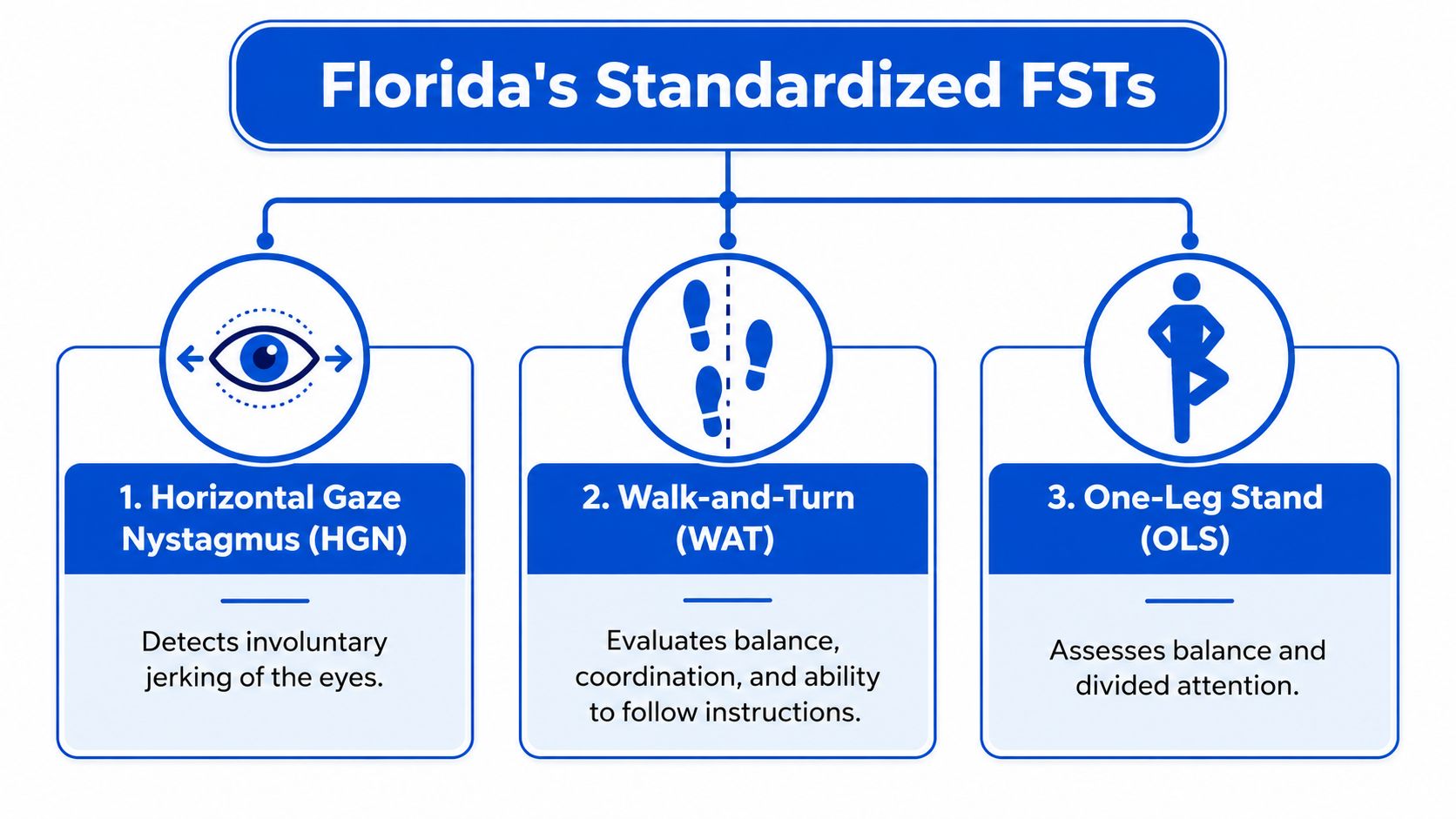
On the roadside, the officer is usually trying to build a DUI case around three standardized exercises: Horizontal Gaze Nystagmus, Walk-and-Turn, and One-Leg Stand. If you understand what each test is designed to capture, you are in a better position to understand what the officer is looking for, what can go wrong, and what your lawyer will examine later.
For a closer look at the eye test and the issues that come up in real cases, see this overview of Horizontal Gaze Nystagmus in DUI cases.
What counts as a standardized test
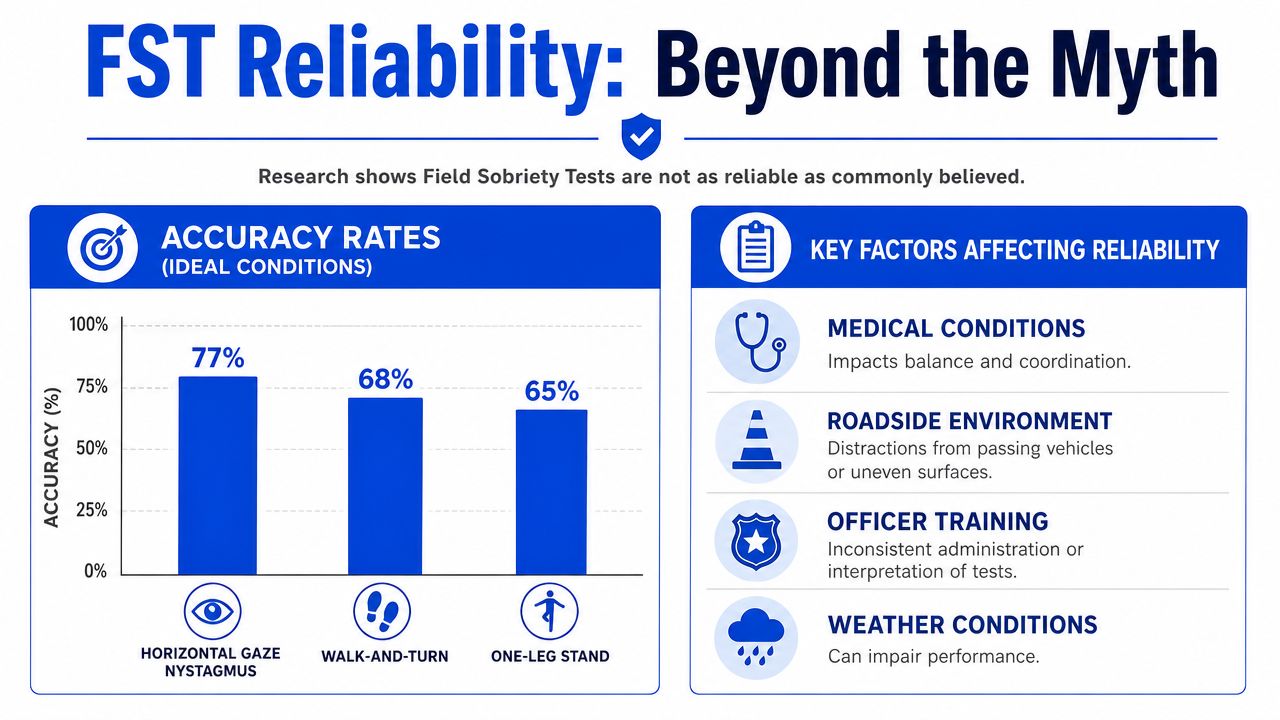
Florida's standardized battery is limited to HGN, Walk-and-Turn, and One-Leg Stand. As discussed in Monroe Law's article on how Florida field sobriety tests are administered, NHTSA says these tests, when properly administered, identify alcohol impairment with accuracy figures in the 65% to 77% range, and Monroe Law also notes that injuries, medications, age, anxiety, weather, and uneven pavement can affect performance.
That qualifier matters. Properly administered is doing a lot of work there.
From a defense standpoint, the test itself is only part of the story. I look at where it happened, how the instructions were given, whether the person had footwear or medical issues, whether traffic and flashing lights affected concentration, and whether the officer followed the standardized method instead of a rough version done from memory.
How each test works on the roadside
HGN is the eye test. The officer moves a stimulus across your field of vision and looks for involuntary jerking. Officers often describe it as objective, but the result still depends on distance, angle, speed, lighting, and training.
Walk-and-Turn is a divided-attention test. You are asked to stand in a starting position, listen to a sequence of instructions, walk heel-to-toe for a set number of steps, turn in a specific manner, and return the same way. A person can be marked down before the walking even starts if the officer says the driver could not keep balance during instructions.
One-Leg Stand is simpler in appearance and harder in practice. The driver must raise one foot, count as directed, keep arms in the proper position, and maintain balance long enough for the officer to score the exercise. On a dark roadside shoulder, many sober people do not look polished doing that.
The scoring is based on cues, not on whether a driver “passes” in any ordinary sense. Simko Law Group explains in its article on field sobriety test scoring cues that as little as two cues on either the Walk-and-Turn or One-Leg Stand can be treated as an indicator of impairment. Those cues can include starting too soon, missing heel-to-toe, stepping off line, using arms for balance, swaying, hopping, or putting a foot down.
That is why these tests create problems fast. A driver does not need to fall, slur, or collapse for the report to read badly.
Here is the practical reality from the driver's seat:
Walk-and-Turn: The officer is scoring listening, balance, foot placement, and turning technique.
One-Leg Stand: Normal swaying, fatigue, age, or a bad surface can become “clues.”
HGN: If the method is off, the observation becomes much easier to challenge.
For many clients, the surprise comes later. They remember trying to cooperate. The report frames the same moment as evidence of impairment. That gap between what happened and how it gets written is often where the defense starts.
How Reliable Are Field Sobriety Tests
On the side of the road, reliability is not an abstract issue. It affects the officer's arrest decision, what goes into the report, what the jury sees on video, and what your defense lawyer can attack later.
The State often presents field sobriety exercises as objective proof. In practice, they are officer-scored roadside tasks that depend on proper instructions, proper conditions, and proper interpretation. If any part of that chain breaks down, the value of the test drops fast.
Reliability depends on how the test was given
The National Highway Traffic Safety Administration explains in its DWI Detection and Standardized Field Sobriety Testing materials that the standardized tests are meant to be administered in a specific way. That matters. These exercises were not designed as free-form roadside impressions. They were built around a script, scoring rules, and testing conditions.
That is the first point many drivers miss in the moment. The issue is not only whether you looked unsteady. The issue is whether the officer followed the method closely enough for the result to mean much at all.
A defense case often starts there.
The real problem is the gap between training conditions and roadside conditions
Even under training standards, these tests are not perfect indicators of impairment. When performed in live settings, they become more vulnerable to error because live settings are messy. Florida stops happen on sloped shoulders, in bad shoes, in heat, humidity, rain, traffic noise, and flashing lights. People are tired. People are scared. People have old injuries they do not think to mention until after the arrest.
Common reliability problems include:
Medical conditions: Inner-ear issues, knee and back injuries, neurological conditions, and some medications can affect balance, coordination, or eye movement.
Roadside surface problems: Gravel, broken pavement, slope, debris, and poor lighting can change performance.
Instruction issues: If the officer talks too fast, demonstrates poorly, interrupts, or scores before the instructions are complete, the exercise becomes easier to challenge.
Ordinary human factors: Anxiety, age, fatigue, weight, footwear, and stiffness can look like impairment on camera.
Those are not technicalities. They are facts that can turn a weak stop into an arrest.
From the driver's seat, "voluntary" does not mean risk-free
The importance of strategy manifests in real time. A driver may agree to the exercises thinking cooperation will help. Sometimes it does not. A poor performance gives the officer more observations to write down and gives the prosecutor more phrases to repeat later: swayed, missed heel-to-toe, used arms for balance, started too soon, failed to follow instructions.
A refusal also carries risk. The State may argue it shows consciousness of guilt, even though roadside exercises are generally voluntary. That is why these cases are rarely about one perfect choice at the scene. They are about trade-offs, and about what your lawyer can do with the record afterward. Separate rules apply to breath testing, and those consequences are different from roadside exercises. If that issue is part of your case, review Florida breath test refusal consequences and defenses.
How we evaluate whether the tests were reliable enough to matter
I do not take the arrest report at face value. I compare the officer's wording to the body camera, dash camera, dispatch timeline, weather, lighting, roadway, and my client's physical condition. I want to know whether the officer demonstrated the test correctly, whether the instructions were cut short, whether the surface was level, and whether the alleged clues are visible on video.
That review often exposes the underlying issue. The report may sound clean and standardized. The video may show confusion, interruptions, a poor testing location, or scoring that starts before the driver even has a fair chance to perform.
Jurors understand that point once it is shown clearly. Field sobriety exercises can support an arrest. They are not infallible, and they are often much less reliable than the State suggests.
Should You Take the Florida Field Sobriety Test
A Florida DUI stop often turns on a decision made in less than a minute. The officer asks you to step out and perform a few roadside exercises. At that point, many drivers assume they have to comply. In most cases, they do not.
My practical advice is usually simple. Do not volunteer to perform field sobriety exercises.
That is not because refusal makes the case disappear. It does not. An officer can still arrest you based on driving pattern, odor of alcohol, your speech, your balance getting out of the car, your answers to questions, and anything captured on body camera. But from the driver's seat, the question is not whether the stop becomes risk free. The question is which choice gives the State less evidence to work with later.
Voluntary does not mean harmless
Roadside exercises are generally voluntary in Florida, but voluntary does not mean consequence free.
If you refuse, the prosecutor may argue the refusal showed fear of failing. If you agree, the prosecutor will use your performance, your pauses, your sway, your missed heel-to-toe steps, and even your confusion about the instructions as proof of impairment. That is the fundamental trade-off.
As noted earlier, the recognized standardized tests are limited in number and limited in reliability. They are screening tools scored by an officer on the side of the road, not medical exams. In practice, they often give the State more room to argue than they give you room to help yourself.
That is why many defense lawyers view these exercises as a poor bet for the driver.
What to do in real time
The goal is to stay calm and avoid making the stop worse.
A respectful, clear refusal usually puts you in the best position later. Do not argue about the law on the shoulder of the road. Do not try to talk your way out of it. Do not start listing medical conditions, old injuries, or how little you had to drink unless your lawyer has advised you otherwise. Those statements often show up in the report as admissions.
A better approach is straightforward:
Be polite: Keep your tone calm and controlled.
Be clear: Say you do not wish to perform field sobriety exercises.
Say less: Small talk and explanations can become evidence.
Know the separate issue: Roadside exercises are different from chemical testing. If you are dealing with that question too, review the consequences of refusing a breath test in Florida.
One point matters here. You are not trying to win the case on the roadside. You are trying to avoid giving the State a cleaner presentation at trial.
I have seen many reports where the officer describes the exercises as clear proof of impairment, then the video tells a very different story. I have also seen cases where the driver politely declined, and the case later turned on weaker observations that were far easier to challenge. Every stop is different, but the strategic question stays the same. If the test is voluntary, ask whether helping create more evidence serves you. In most cases, it does not.
How We Challenge FST Evidence to Defend Your Case
If you performed the tests, don't assume the case is over. It isn't. Field sobriety evidence is often the part of the case that looks strongest in the arrest report and weakest after close review.
That's because reports tend to compress the scene into neat conclusions. Video, body mechanics, lighting, surface conditions, and instruction errors tell a more complicated story.
Where roadside testing usually breaks down
A Florida validation study reported that more than 90% of officers' arrest decisions were confirmed later by breath or blood analysis, which helped reinforce the use of standardized roadside testing, but the same historical discussion also notes that validation studies have limits, that the law does not treat field sobriety tests as infallible scientific proof, and that false positives can occur, according to the Florida validation material available through the ROSAP transportation archive.
That tension is exactly where a defense is built.
Common pressure points include:
Bad instructions: The officer rushed, omitted, or mixed up the directions.
Unsafe testing area: The exercises happened on a poor surface or in distracting conditions.
Medical alternatives: Prior injuries, age-related limitations, medication effects, or anxiety explain what the officer called impairment.
Subjective scoring: The report overstates clues or ignores what the video shows.
How a defense is actually built
A serious DUI defense starts by obtaining every piece of evidence. That usually includes bodycam, dashcam, dispatch records, reports, and any chemical test records. Then the roadside testing gets reconstructed in detail.
I look for whether the officer followed the standardized sequence, whether the demonstration matched the instructions, and whether the client's physical condition was ever considered. If the officer claimed a clue that the camera does not support, that becomes a cross-examination point. If the scene itself was unfair, that becomes part of the defense theme.
For clients facing a DUI anywhere in Florida, including Broward County and Fort Lauderdale, our Florida DUI defense hub outlines how these issues fit into the larger strategy. Ticket Shield, PLLC handles DUI defense cases involving roadside exercises, license concerns, and challenges to officer observations.
A strong defense doesn't argue that field sobriety tests never matter. It shows why they don't prove enough in your case.
That's the difference between reading a police report and litigating one.
Florida FST FAQs and Your Next Steps
The drive home from a DUI arrest is usually replaced by a much worse ride. You are sitting there replaying every answer, every step, and the moment the officer asked you to do roadside exercises. Clients ask me the same question all the time. Did I make the case unwinnable by taking the tests, or by refusing them?
Usually, no single moment decides the case by itself. What matters now is identifying what happened, what the officer can prove, and what parts of the stop can still be challenged.
Common questions after a DUI arrest
Can I be arrested even if I think I did fine on the tests?
Yes. Drivers often judge the encounter by whether they stayed upright or followed along. Officers write reports in terms of "clues," divided attention, and overall impairment. A person can feel like they performed reasonably well and still get arrested because the officer had already decided there was probable cause.
That is one reason these tests create litigation issues. They are presented as objective, but the scoring and the officer's interpretation still matter a great deal.
What if I have a physical limitation or old injury?
Say so clearly and early. Then tell your lawyer the same thing in detail.
Old knee injuries, back problems, vertigo, neurological conditions, bad footwear, anxiety, and even fatigue can affect roadside performance. If that applies to you, gather the records, prescription information, surgery history, and anything else that helps show there was another explanation besides impairment.
Are alphabet or counting tests valid?
They may appear in the report, but they are not part of the standardized three-test battery officers are trained to use. That does not make them automatically inadmissible. It does make them easier to attack as subjective, inconsistently administered, and less useful than the State will claim.
Can refusal be used against me?
Yes. The prosecutor may argue that refusal showed consciousness of guilt. But there is a real trade-off here. Refusing roadside exercises can limit the officer's ability to collect more observations and more video that the State would later use in court.
That issue is often misunderstood. Field sobriety exercises in Florida are generally treated as voluntary. A refusal is not the same thing as refusing a lawful breath test after arrest under implied consent rules. Those are different decisions with different consequences, and a defense strategy has to keep that distinction front and center.
What to do right away
Start building the timeline while your memory is fresh.
Write down the stop in detail: Note where you were, what the officer said, whether you were asked or told to perform the exercises, the lighting, traffic, weather, road surface, shoes, and any pain or medical issue you had.
Preserve anything that fixes the timeline: Save receipts, bar tabs, text messages, rideshare records, call logs, and photos.
Do not fill gaps with guesses: Small inaccuracies can hurt later if the video tells a different story.
Get the case reviewed early: A lawyer can assess the stop, the basis for arrest, the wording around any "voluntary" exercises, and whether the officer's report matches the video.
A Florida field sobriety test case is often won or lost on details the driver did not realize mattered at the time. The exact words used by the officer. Whether you were given a real choice. Whether the camera supports the claimed clues. Whether a medical issue was ignored.
If you were arrested after a Florida field sobriety test, contact Ticket Shield, PLLC for a confidential consultation. An early review can identify problems with the stop, the officer's instructions, the testing conditions, and the evidence the State is trying to use.
Field sobriety tests are voluntary in Florida — and frequently inaccurate. Here's what to know before, during, and after a roadside stop.