
What Is a Pretext Traffic Stop: A Florida Driver's Guide
Jason Goldsmith, Esq
A pretext traffic stop is a lawful traffic stop used as a cover to investigate a separate suspected crime. It isn't automatically illegal, and that's the first thing most drivers want to know when the blue lights come on.
If you've ever been pulled over in Broward County, Miami-Dade, or anywhere else in South Florida for something small, then suddenly faced questions about where you're going, what's in the car, or whether you've had anything to drink, you already understand why this matters. The stop may have started with a minor violation, but the legal fight often begins with what the officer did next.
Table of Contents
A Plain-English Definition of a Pretext Traffic Stop
A driver headed home on I-95 or US-1 sees flashing lights after a dim taillight, an expired tag, or a quick failure to signal. The officer's first words are about the stop, but the next questions sound like a drug case, a DUI case, or a weapons case.
That's the basic shape of a pretext traffic stop. The stop is legally justified by a minor traffic or equipment violation, but the officer's real purpose is to investigate something unrelated, like DUI, drug possession, or a gun charge. The definition matters because it tells a defense lawyer where to look, the traffic violation, the questioning, the length of detention, and any search that followed.
This isn't a rare edge case. The Policing Project says officers make more than 20 million traffic stops each year in the United States, and RAND estimates that about 4% are pretext stops, which means the tactic reaches a very large number of drivers nationwide. That scale is why a small stop can become a major criminal case fast. The Policing Project's overview of pretextual traffic stops explains the national scope and the basic legal definition.
Why the label matters
The label is not a moral judgment. It's a legal category. A driver can be fully cooperative and still be stopped in a way that raises Fourth Amendment questions later, especially if the officer turns a simple citation stop into a fishing expedition.
Practical rule: the pretext question is about the officer's hidden purpose, not whether the car actually got pulled over.
California's Attorney General describes the concept the same way, a lawful traffic stop made with the intent to investigate an unrelated offense. Legal summaries also note that an officer usually needs only one traffic violation to justify the stop, which is why tiny defects matter so much. The San Diego presentation on pretext stops uses that same objective framing.
For a worried driver, the key takeaway is simple. The stop itself and what happened after the stop are not the same issue. A stop can be lawful at the roadside and still lead to a challenge in court if the officer stretched the detention, asked for consent the wrong way, or searched without a valid basis.
How Whren v. United States Shapes the Constitutional Test
The rule that controls most pretext-stop fights comes from Whren v. United States. Under that decision, a traffic stop is reasonable under the Fourth Amendment when an officer has probable cause to believe a traffic violation occurred, and the officer's subjective motive does not invalidate the stop. The Whren analysis in legal scholarship is the backbone of modern pretext-stop law.
The objective test in plain English
Think of the officer's motive as the paint on the walls. The constitution looks at the foundation. If the officer can point to a real traffic violation, the stop usually survives even if the officer was hoping to investigate drugs, DUI, or weapons.
That's why so many drivers are surprised when a judge doesn't throw out the stop just because it felt targeted. The court usually asks a narrower question, was there an actual traffic basis for the detention? If the answer is yes, the officer's hidden reason usually doesn't matter at that first stage.
The hard truth is that motive rarely wins the motion by itself. The defense has to test the traffic basis, then test the search, the detention, and every step that came after.
Where defense strategy shifts
Once Whren closes the door on motive alone, the case often turns to the details that followed. That includes whether the officer kept the stop going longer than needed, whether the driver really consented to a search, and whether the officer had enough facts to expand the encounter into a DUI or drug investigation. For readers trying to separate those concepts, reasonable suspicion versus probable cause is the next legal distinction that usually matters.
This is why pretext stops are so often fought in pieces. The officer may have a lawful reason to initiate the stop, but still lose on what happened after the lights came on. In practice, that means a Florida defense lawyer often stops arguing about the motive and starts arguing about the mission of the stop, the duration, and the search.
That's also why a pretext stop isn't the same thing as a conviction. A lawful stop can still produce weak, suppressible, or unreliable evidence. In DUI, drug, and weapons cases, that gap is often where the defense is built.
Common Minor Violations Officers Use as a Cover
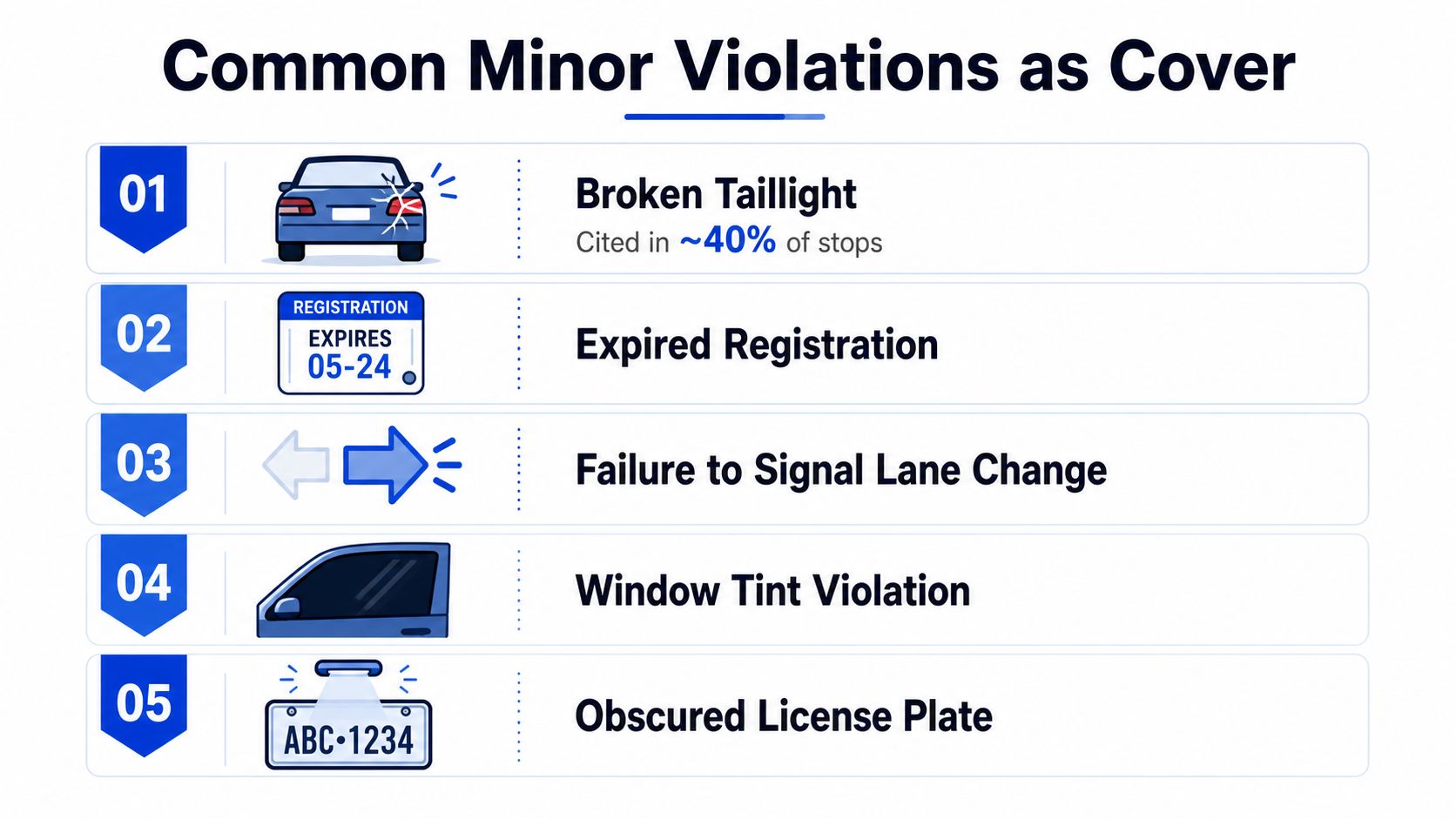
On local roads in Fort Lauderdale, Hollywood, Pembroke Pines, and across Broward County, the stated reason for a stop is often something tiny and easy to spot. A broken taillight. An expired registration sticker. A failure to signal a lane change. A window tint issue. Sometimes even an item hanging from the rearview mirror or a cracked windshield gets attention.
These violations are popular because they're visible from a moving patrol car and because almost every vehicle has some small defect eventually. Once the officer has that foothold, the next step is easy, ask for the license, registration, and insurance, then keep the conversation going to see whether the driver says something useful.
Why the pattern matters
The numbers help explain why drivers and defense lawyers stay skeptical. In a Louisville study covering 9.5 years of traffic citations, failure-to-signal stops produced an arrest rate of 0.42, compared with 0.01 to 0.09 for other similarly common moving violations. When failure to signal was the only cited violation, the arrest rate was 0.52, and adding other traffic violations reduced the chance of arrest by 55%. The American Economic Association conference paper on traffic citations discusses those findings.
That same line of research has been cited for a broader point, low-level traffic stops lead to discovery of contraband only 1% to 2% of the time. That's why so many civil-liberties advocates treat the tactic as a civil-rights issue, not a high-yield enforcement tool. The numbers don't prove misconduct in an individual stop, but they do show why minor infractions can function as a gateway to a much bigger encounter.
What drivers should notice
Broken lighting: Easy to spot, easy to write up, and often enough to justify the initial detention.
Expired tags: Common, objective, and useful for turning a routine stop into a document check.
Failure to signal: A classic pretext because it's brief, observable, and frequently disputed after the fact.
Window tint: Often used because it gives the officer a reason to stop and then look inside.
Obstructed visibility or plate issues: These are minor on paper, but they create the lawful opening for further questioning.
A sloppy or exaggerated traffic explanation doesn't prove innocence by itself, but it does give the defense a place to dig. If the cited violation is shaky, the whole encounter can start to look less like routine traffic enforcement and more like an investigatory stop looking for a case.
Florida-Specific Rules and How Stops Unfold on the Ground
Florida follows the federal objective standard from Whren, so the officer's hidden motive usually doesn't control the legality of the stop. What matters in Florida practice is whether the officer stayed within the mission of the traffic stop, whether the detention was prolonged without new justification, and whether any consent to search was voluntary.
How a stop often escalates
The encounter usually starts with the stop itself, then the request for license, registration, and proof of insurance. From there, the officer may start making second-by-second decisions, whether to call a K-9 unit, whether to ask the driver to step out, whether to begin field sobriety exercises after noticing signs of possible DUI, or whether to ask for permission to search the car based on some claimed odor or inconsistency.
That's where the legal line often moves. A DUI investigation is typically built around cues like odor of alcohol, slurred speech, and red eyes. A drug interdiction stop often leans on different cues, inconsistent travel stories, nervous behavior, unusual items in the car, or what the officer describes as air freshener overload.
For drivers in Florida, field sobriety test procedures and defenses become relevant the moment the stop shifts from traffic enforcement to impairment investigation.
Florida's implied consent pressure
Florida's implied-consent law makes the decision about a breath, blood, or urine test one of the most important choices of the night. Drivers often feel rushed into answering before they understand the consequences. That decision can affect both the criminal case and the driver's license case, so it deserves immediate attention from counsel.
Practical rule: a lawful stop doesn't give police unlimited authority. What happens after the stop still has to stay inside constitutional limits.
Florida is a Whren state, but it's also a state with aggressive local enforcement. That combination means a traffic stop can move quickly from a citation issue to a DUI, drug, or firearm case. Even when the initial pull-over is lawful, evidence gathered after the stop can still be challenged if officers overstep.
A helpful way to think about it is this. The stop may begin with a traffic infraction, but the courtroom fight often centers on what came after the blue lights, the questions, the search, and the tests.
What You Should Do During and After the Stop
The best move at the roadside is calm, limited, and deliberate. You do not need to volunteer a story, and you do not need to turn a simple stop into a conversation about where you've been, who you were with, or what's in the car.
During the stop
Keep your hands visible, follow basic instructions, and answer only what's necessary. If the officer asks for a search, you can decline politely without arguing. If the officer asks you to explain your travel plans or your recent evening, a short answer is usually safer than a long one.
A few practical choices matter right away:
Window position: Roll it down enough to communicate clearly, but you don't need to overexpose yourself to questioning.
Roadside questions: Keep answers brief and accurate. Extra details usually help the officer, not you.
Search requests: Say no respectfully if you don't want to consent.
Field exercises: Know that these are often designed to build a DUI case, not to help you.
Refusing field sobriety exercises can limit the State's evidence, but it can also become part of the prosecutor's story in a DUI case. That's why the decision is context-driven, not one-size-fits-all. Can you refuse a breathalyzer in Florida is another issue that can carry major consequences, especially when implied consent comes into play.
After the stop
Write down everything while it's fresh, the time, location, road, officer name if you saw it, what was said, and what the officer claimed was the reason for the stop. Photograph the vehicle and the alleged defect if you can do so safely. Save dashcam footage, passenger videos, and any texts that help pin down your timeline.
The details that seem small at the roadside often become the details that matter in court.
Also, be careful with post-arrest communication. Don't text about the stop, don't explain it on a recorded jail line, and don't try to “clear things up” with investigators without legal advice. If your vehicle was searched, if a K-9 was called, or if the encounter seemed to drift away from traffic enforcement, those facts need to be preserved early.
In situations like this, Ticket Shield, PLLC is one of the firms that handles traffic-stop defense, preservation of body-worn camera footage, and early review of the officer's stated basis for the stop. That kind of early work can matter before memories fade and recordings get harder to obtain.
Filing a Motion to Suppress and Beating the Charges
A motion to suppress is a written request asking a judge to throw out evidence because police violated the Fourth Amendment or Article I, Section 12 of the Florida Constitution. In a pretext-stop case, that evidence might be drugs, a firearm, a statement, a breath-test result, or even observations the officer used to justify an arrest.
What happens at the hearing
The officer testifies. The defense cross-examines. Body-worn camera footage is played. The judge then decides whether the stop was lawful and whether the search fit within an exception like consent, plain view, or the automobile exception.
The defense attack usually focuses on a few pressure points. Was the traffic violation real? Was the stop stretched longer than necessary? Was the K-9 alert reliable? Did the driver consent to a search, or did the officer pressure the driver into saying yes? The motion to suppress process is the courtroom mechanism that turns those questions into a ruling.
How this changes the case
If the key evidence gets suppressed, the State's case can change fast. That's especially true in borderline DUI, marijuana, prescription-drug, and weapons cases, where the prosecution often depends heavily on what police found after the stop. Once the evidence is gone, the State may have to reduce the charge, rework the case, or dismiss it.
The suppression fight isn't magic. It's technical, and the judge will care about details. That's why a strong motion often combines courtroom arguments with negotiation and trial preparation. A defense lawyer who can cross-examine the officer cleanly and read the body-cam against the report has a much better shot at exposing weak points in the State's timeline.
Suppression is often where the case is won or lost, but it only works if the facts are preserved early. That's why the first call matters as much as the hearing.
When to Call a Florida Criminal Defense Attorney
The warning signs are usually easy to spot. The officer stops talking about the traffic issue and starts asking about drinks, drugs, weapons, or travel plans. A K-9 unit shows up. You're asked to step out for exercises. The officer asks to search the car or says it's being inventoried.
That is the point where self-help stops being enough.
Why early contact helps
Calling a lawyer early can protect evidence, prevent damaging statements, and create a record before video or witness memories fade. It can also help with license issues and release decisions while the case is still unfolding. If the stop was the doorway to something bigger, the defense should start building immediately.
A call to Ticket Shield, PLLC does not mean you're admitting guilt. It means you're treating the stop like the beginning of a criminal case, which is often exactly what it becomes. Attorney Jason S. Goldsmith brings former prosecutor perspective, and the firm offers direct contact by phone, text, or email, along with 24/7 availability for people facing DUI, drug, weapons, theft, or probation matters anywhere from Broward County to the Panhandle.
If a Florida traffic stop has turned into anything more than a citation, the next move should be a confidential call to Ticket Shield, PLLC.
If you were pulled over for a minor traffic issue and the stop turned into questions, testing, or a search, Ticket Shield, PLLC can review the traffic basis, preserve the video, and look for suppression issues before the State gets ahead of the facts. Visit Ticket Shield, PLLC to request a confidential consultation and get a defense team involved while the details are still fresh.