Florida Felony Weapons Charge: Defense Strategies 2026
Jason Goldsmith, Esq
In Florida, a felony weapons charge most often means a second-degree felony under section 790.23 carrying up to 15 years in prison, with separate 10-year, 20-year, or 25-years-to-life mandatory minimums possible under section 775.087 if a firearm was used during another felony. If you're reading this after an arrest, don't explain the gun, the vehicle, or your prior record to investigators before speaking with a defense lawyer.
A traffic stop in Broward County can begin with a routine allegation and end with handcuffs. The officer sees a firearm in the vehicle, asks who it belongs to, checks your record, and suddenly the case is no longer about the original traffic issue. A borrowed car, a shared apartment, or a gun found under a seat can create a felony weapons charge even when nobody was injured and nobody claims you fired the weapon.
The charge on the arrest paperwork matters, but the facts behind it matter more. Florida prosecutors usually build these cases around possession by a prohibited person, firearm use during another felony, or weapons possession in a protected location. Each category requires a different defense plan. If you're facing a gun or weapons allegation in Fort Lauderdale, Broward County, Miami-Dade, Palm Beach, or elsewhere in South Florida, the first job is to identify which theory the State is pursuing.
Table of Contents
What a Felony Weapons Charge Actually Means in Florida
A felony weapons charge isn't one single offense. It's a label people use for several Florida crimes involving firearms or other weapons, and the difference can determine whether the case turns on a search, possession, location, or alleged use.
Consider a common South Florida scenario. A driver with a prior felony conviction is stopped for a traffic violation. The officer sees a firearm in the center console or asks for permission to search the vehicle. The driver may not have touched the weapon, may not own the vehicle, and may not have threatened anyone. Still, prosecutors may claim the driver knowingly possessed or controlled the firearm.
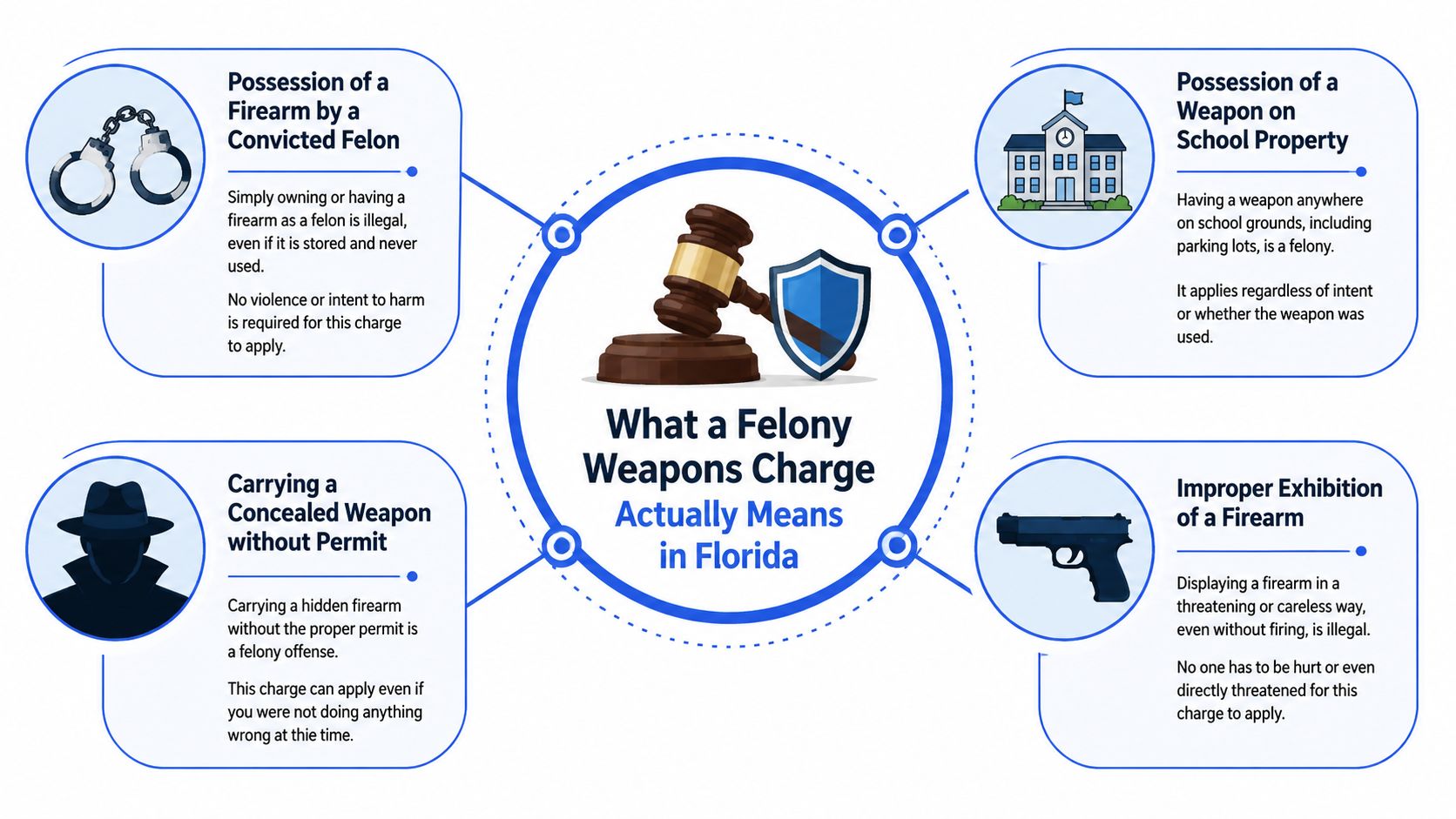
Florida's main categories include:
Possession by a convicted felon: Section 790.23 generally prohibits a person convicted of a felony from owning, possessing, or controlling a firearm, ammunition, or electric weapon or device. The State must connect the person to the item, not merely show that the item existed nearby.
Firearm use during another felony: Section 775.087 can add mandatory prison terms when a firearm or destructive device is possessed, discharged, or discharged with specified serious consequences during a qualifying felony.
Weapons in protected locations: Section 790.115 addresses certain weapon conduct on school property, inside a school, or on a school bus. Location and the alleged manner of use become central issues.
Other firearm allegations: Florida cases can also involve concealed-firearm allegations, improper exhibition, or related charges. The exact statute, factual allegations, and criminal history determine the available defenses and sentencing exposure.
The practical point is simple. The State doesn't have to prove violence to pursue every felony weapons case. A possession theory may be enough, but possession still has legal elements and the prosecution still carries the burden of proof. The charge should be analyzed from the initial stop or search outward, not accepted as an automatic conviction. You can review the firm's Florida weapons crime defense information for more context, but your own arrest report and evidence require individualized analysis.
How Florida Prosecutors Build the State's Case
The State starts with evidence, not the title printed on the charging document. In a typical felon-in-possession case, prosecutors must establish that the defendant had a qualifying felony conviction and then prove the required connection between that person and the firearm or ammunition.
Florida section 790.23 makes it unlawful for a person convicted of a felony to own, possess, or control a firearm, ammunition, or electric weapon or device. The offense is generally a second-degree felony punishable by up to 15 years in prison, as stated in the Florida statute governing possession by prohibited persons.
The possession question
Actual possession is the State's easier theory. The firearm is found on the person, or the evidence suggests the person physically held it. But even then, the defense should examine how officers found it, whether the item was properly identified, and whether the search was lawful.
Constructive possession is more contested. The State may argue that a person knew the firearm was present and exercised control over it, even though the weapon wasn't in that person's hand. A gun in a vehicle with multiple occupants, a bedroom shared by several people, or a residence occupied by relatives can create a proof problem. Mere proximity isn't automatically the same as knowing possession.
The prior conviction also matters. Counsel should verify the judgment, the offense classification, the date, and whether the State has correctly alleged a qualifying conviction. A prosecutor may have a strong firearm fact but still face a defect in proving the predicate felony.
The enhancement question
Section 775.087 addresses a different theory. It can impose a 10-year minimum when a firearm or destructive device was possessed during certain qualifying felonies, a 20-year minimum when the firearm was discharged, and 25 years to life when the discharge caused death or great bodily harm. A narrower 3-year minimum can apply in some felon-in-possession or burglary-of-a-conveyance cases when actual possession is proven, as set out in the Florida firearm enhancement statute.
That means the prosecutor must identify the underlying felony, prove the firearm connection, and establish the specific fact that triggers the enhancement. A defense lawyer should test the stop, search, witness accounts, body-camera footage, forensic evidence, and the wording of the charging document. If probable cause is missing at the beginning, the meaning of probable cause can become decisive long before trial.
Penalties You Are Actually Facing
The number printed next to the statute doesn't always reveal the sentencing risk. A base felony, a mandatory enhancement, and a separate protected-location allegation can create very different outcomes from facts that may look similar in an arrest report.
Statute | Felony Degree | Maximum Prison Time | Typical Trigger |
|---|---|---|---|
Section 790.23 | Second-degree felony | Up to 15 years | Felon allegedly owns, possesses, or controls a firearm, ammunition, or electric weapon or device |
Section 775.087 | Enhancement applied to a qualifying felony | Mandatory minimum of 3, 10, 20, or 25 years to life, depending on the allegation | Firearm or destructive device allegedly possessed, discharged, or discharged with death or great bodily harm |
Section 790.115 | Third-degree felony for specified conduct | Up to 5 years and a fine of up to $5,000 | Brandishing or using certain weapons in a dangerous manner on or near school property, or inside a school or school bus |
The statutory penalty for section 790.23 is separate from the enhancement analysis. A person charged with possession by a convicted felon may face up to 15 years, while the State may also allege facts supporting a mandatory minimum under a different statute. The Florida illegal firearm possession explanation can help you understand the basic charge, but it shouldn't replace review of the information or indictment.
Mandatory minimums change negotiations
A mandatory minimum limits the judge's discretion if the enhancement applies and the defendant is convicted. The difference between mere alleged possession and actual possession, or between possession and discharge, can change the negotiation posture dramatically.
The State may focus on:
The firearm's location: A weapon found on the person creates a different dispute than one found in a shared vehicle.
The alleged conduct: Possession, discharge, and injury are not interchangeable allegations.
The underlying felony: Section 775.087 depends on the qualifying offense and the statutory facts.
The evidence supporting the enhancement: Reports, video, witnesses, ballistic evidence, and medical proof can matter.
A school-zone allegation creates another distinct problem. Section 790.115 treats brandishing or using certain weapons in a dangerous manner within 1,000 feet of school property, or inside a school or school bus, as a third-degree felony punishable by up to 5 years and a fine of up to $5,000, according to the Florida school-property weapons provision. The location must be established, and the alleged conduct must fit the statute.
From Arrest to Sentencing in a Florida Weapons Case
A Florida weapons case moves through several decision points. Missing one can make the defense harder, especially when the initial search or the first interview creates evidence the State later uses.

Arrest and first appearance
After arrest and booking, the court addresses custody, release conditions, and the defendant's immediate status. Do not treat first appearance as a formality. The judge may impose conditions affecting travel, contact with witnesses, weapons possession, and court attendance.
A lawyer should obtain the arrest affidavit, identify the asserted basis for the stop or search, and make sure you understand every release condition. Family members should avoid discussing the facts with investigators without counsel.
Arraignment and discovery
At arraignment, the court addresses the formal charge and plea. The defense then begins evaluating discovery, including reports, recordings, photographs, dispatch information, witness statements, laboratory material, and the physical firearm.
The important question isn't just whether discovery exists. It's whether the evidence proves each element and whether officers obtained it lawfully. A motion to suppress may target the traffic stop, consent, a frisk, a vehicle search, a residence search, or the seizure itself.
Motions, negotiation, and trial
Motion practice can change the value of the case. If a judge excludes the firearm or a critical statement, the State may lose the evidence needed to prove possession. If the motion fails, the defense still needs to assess witness credibility, chain of custody, identification, and whether the prosecutor can prove the required mental and physical connection.
Plea discussions may address the charge, an enhancement, prison exposure, probation, or adjudication. A defendant should understand the consequences before accepting any offer. If no acceptable resolution exists, trial preparation begins, including cross-examination strategy and jury instructions.
Sentencing follows a plea or verdict. The court considers the conviction, statutory requirements, and applicable sentencing rules. Prior record can affect the range, but counsel should never assume the State's calculation is correct without checking the underlying documents.
Defense Strategies That Move the Needle
A strong defense attacks the part of the State's case that is weakest. In a Florida felony weapons case, that usually means examining the government's entry into the evidence, the defendant's connection to the weapon, the legal effect of the prior conviction, or the circumstances surrounding alleged use.
Challenge the stop, search, or seizure
If an officer stopped the vehicle without a lawful basis, expanded the encounter without proper justification, or searched beyond the permitted scope, the firearm may be vulnerable to suppression. Consent must also be examined. Officers often ask for permission in a way that feels routine, but the defense should determine what was said, what the person understood, and whether the search exceeded the consent given.
A motion to suppress can require testimony and records. Body-camera footage, dispatch logs, vehicle video, photographs, and the exact wording of the report may expose inconsistencies. Read more about motions to suppress evidence before assuming the search is untouchable.
Practical rule: Never decide that a search was legal just because an officer found a weapon. The legality of the search is a separate question.
Attack possession and knowledge
A gun in a borrowed car is not automatically the driver's gun. A firearm in a shared bedroom is not automatically controlled by every person who sleeps there. The State must prove the required connection, and the defense should identify other occupants, fingerprints or DNA issues, ownership records, statements, and the precise location where the item was recovered.
The case may turn on a single factual detail. Was the weapon visible? Was it inside a closed container? Did another person have access? Did the defendant know it was there? Those questions can create reasonable doubt even when the firearm itself is genuine.
Examine restoration and the predicate felony
A defense lawyer should investigate whether the prior conviction disqualified the client under the charged statute. That includes reviewing the judgment, any reduction or pardon, restoration documents, and the legal status of the conviction. Do not rely on a client's memory of what happened years ago, and do not rely on the prosecutor's summary without checking the record.
Evaluate self-defense and immunity
When the State alleges that the firearm was used during a confrontation, the defense may need to examine self-defense and Florida's stand-your-ground framework. The facts matter, including who initiated the confrontation, whether the threat was imminent, whether the force was necessary, and what witnesses or video show.
Self-defense isn't a slogan that ends the case. It can affect immunity litigation, evidentiary motions, negotiations, and trial presentation. Counsel must develop the facts early, before witnesses disappear or recordings are overwritten.
Your First 72 Hours After a Florida Weapons Arrest
The first three days are about preventing avoidable damage. You don't need to solve the case overnight, but you do need to stop making statements and preserve information that may later matter.
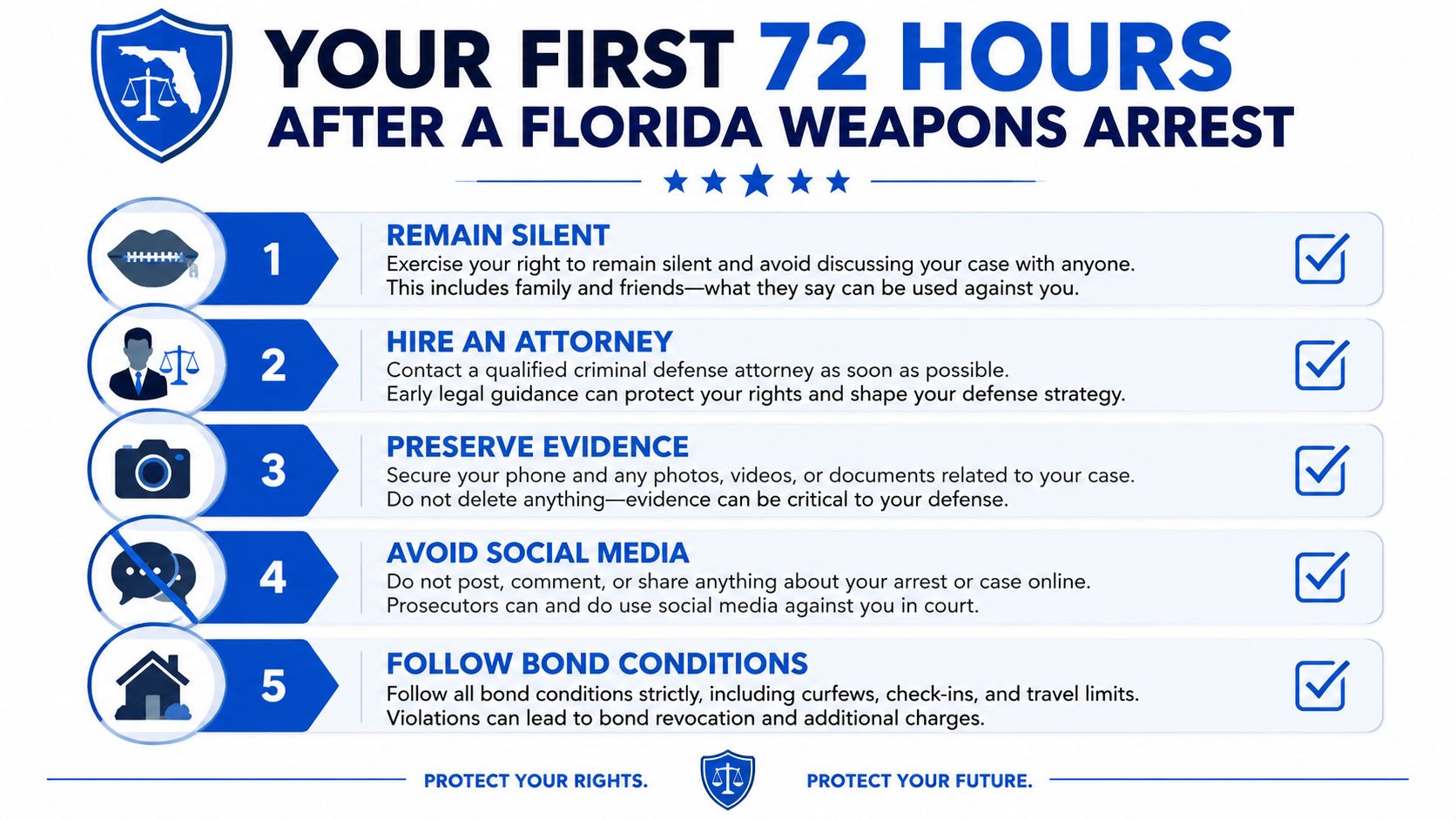
Remain silent: Tell officers you want a lawyer and stop answering substantive questions. Ask family members and friends not to discuss the facts with investigators.
Contact counsel quickly: A Florida criminal defense lawyer can address first appearance, release conditions, evidence preservation, and the charging documents.
Preserve evidence: Keep texts, photographs, location information, doorbell video, vehicle footage, and witness contact details. Don't delete, edit, forward, or alter anything.
Stay off social media: Don't post explanations, photographs, opinions, or indirect messages about the arrest. Friends should avoid posting about it too.
Follow every bond condition: Attend court, obey no-contact or travel restrictions, and comply with every instruction. A new violation can complicate the weapons case.
Do not consent to another search because an officer asks. Do not call witnesses to coordinate stories, and don't handle or move the firearm involved in the investigation. Preserve the device or account where relevant evidence exists, then let counsel decide how to obtain it properly.
If you're in Broward, Miami-Dade, Palm Beach, Fort Lauderdale, or another South Florida jurisdiction, gather the arrest paperwork and contact information for the officer, jail, and court. Those details help a lawyer begin with facts instead of guesses.
How Ticket Shield, PLLC Builds Your Defense
Ticket Shield, PLLC is led by Attorney Jason S. Goldsmith, a former Florida prosecutor. That background informs the review of a felony weapons charge because the defense starts by asking how the State expects to prove the case, not merely what the defendant says happened.
The initial review should focus on the charging affidavit, the alleged predicate felony, the location of the firearm, the basis for the stop, and every statement attributed to the accused. From there, counsel can identify whether the pressure point is suppression, constructive possession, witness credibility, an enhancement allegation, or a failure to prove the required elements.
A consultation should also cover practical issues. Clients need to know who will communicate with them, how phone, text, or email access works, what hearings require attendance, and which court documents must be collected. The firm handles court appearances in many Florida jurisdictions, which can reduce unnecessary travel and work disruption, while the client remains responsible for following court orders and bond conditions.
A Broward or Palm Beach case may begin with a vehicle search and a firearm found near several occupants. Counsel can compare the report to video, investigate who controlled the vehicle, review the prior conviction, and determine whether a suppression motion is appropriate. Depending on the evidence, the case may be negotiated, litigated through motions, or prepared for trial.
You can review the firm's Florida weapons and firearm offenses practice information and contact the office for a confidential consultation. The useful first conversation is the one that identifies the exact statute, the evidence supporting it, and the defense decision that should happen next.
Common Questions Florida Defendants Ask Next
Can firearm rights be restored after a Florida felony conviction?
Don't assume they can. A felony conviction can create serious and lasting firearm restrictions, and restoration depends on the conviction, the person's legal status, and applicable state and federal law. Have counsel review the exact judgment and any restoration or clemency history before possessing a firearm.
Can a state weapons case become federal?
It can. Federal law separately prohibits firearm possession by certain prohibited persons under 18 U.S.C. § 922(g)(1). Federal cases under that provision are generally punishable by up to 10 years, while the Armed Career Criminal Act can create a 15-year mandatory minimum for a defendant with three qualifying prior violent felony or serious drug convictions, according to the U.S. Department of Justice federal sentencing materials.
How can a conviction affect immigration status?
A weapons conviction can create immigration consequences for a noncitizen, including risks involving detention, removal, or future applications. The criminal defense lawyer should coordinate with qualified immigration counsel before any plea is entered.
Can a first-offense case end without a conviction?
Sometimes a non-conviction resolution may be legally or practically possible, but no one should promise it from the label “first offense.” The evidence, prior record, enhancement allegations, prosecutor's position, and judge's authority all matter.
Federal enforcement remains significant. The U.S. Sentencing Commission reported 7,245 convictions under section 922(g) in fiscal year 2025, and 89% involved a prior felony conviction, as shown in its section 922(g) quick facts. That federal data doesn't decide a Florida case, but it reinforces why state and federal exposure should be assessed separately.
Ticket Shield, PLLC can review the stop, search, firearm location, prior conviction, and any enhancement allegation in your Florida felony weapons case. Contact Ticket Shield, PLLC for a confidential consultation and a clear defense plan before you speak with investigators or make decisions about a plea.