Second Degree Misdemeanor in Florida: Penalties and Defense
Jason Goldsmith, Esq
You're standing outside a Broward County courtroom after a retail dispute, a roadside refusal, or an argument that ended with police involvement. The citation says second-degree misdemeanor, and someone has told you it's “only” a misdemeanor. That label may sound reassuring, but it can still affect your freedom, driving privileges, probation status, employment, housing, and future criminal cases.
Florida's second-degree misdemeanor classification is often the starting point for evaluating the charge. The next questions are more important than the label itself: What must the State prove? Was the arrest lawful? Does another administrative case exist? Can the charge be reduced, dismissed, diverted, or resolved without an adjudication of guilt? Those questions matter in Broward, Fort Lauderdale, Miami-Dade, Palm Beach, and other South Florida courts.
Table of Contents
What a Second Degree Misdemeanor Means Under Florida Law
A retail confrontation in Fort Lauderdale can escalate quickly. An employee reports unwanted touching, police respond, and the accused leaves with a notice to appear. In a Broward case involving a missed court date, the clerk may issue an arrest warrant. Someone who was never arrested for the original allegation can then face an avoidable arrest risk.
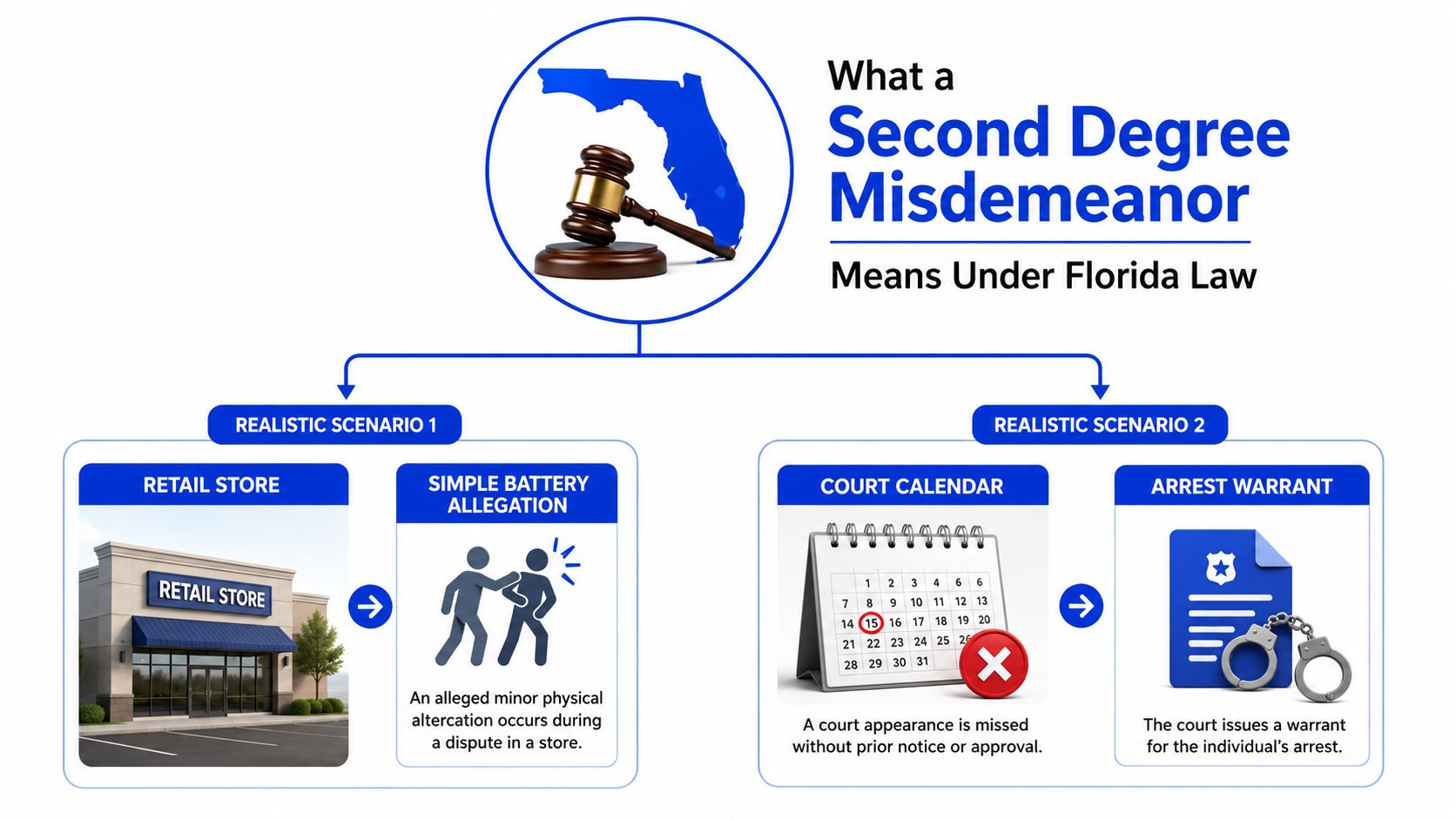
Florida has two misdemeanor levels, first degree and second degree. Florida's second-degree misdemeanor classification is the default level when a statute does not specify one. That rule appears in Florida Statutes section 775.081. The classification can affect sentencing and other consequences provided by law.
The label does not establish guilt. The State must still prove every required element beyond a reasonable doubt. The specific offense statute controls the alleged conduct, required intent, available defenses, and any enhancement. A second-degree misdemeanor in Florida is therefore a starting point for reviewing the charge, not a conclusion about the case.
Why the charge label matters
A case may involve battery, petit theft, disorderly conduct, resisting an officer without violence, or a first refusal to submit to a lawful DUI test. Those allegations raise different factual and legal questions. Identity, intent, lawful justification, police procedure, ownership, video evidence, and witness credibility may determine whether prosecutors can prove the charge.
The default classification can also shape plea discussions. Prosecutors may use the charge as the baseline for negotiating diversion, a reduction, or an adjudication that avoids harsher consequences. The practical value of each option depends on the evidence, the alleged victim, the defendant's record, and the court's usual practices. A technically minor charge can still create pressure if a missed hearing leads to a warrant or if another case is pending.
Prior convictions and probation violations may increase the stakes. A domestic-violence designation can affect release conditions and contact with an alleged victim. Later conduct may be charged more seriously when the law recognizes prior offenses or aggravating facts. Counsel should confirm the exact statute, degree, factual allegations, court obligations, and criminal record before discussing a plea.
For a broader explanation of related offenses, review Florida misdemeanor charges and defense issues. Correct classification helps determine defenses, diversion options, plea strategy, and whether record sealing or expungement may remain available.
Maximum Penalties Florida Courts Can Impose
A second-degree misdemeanor in Florida may look minor on paper, yet its maximum exposure can affect plea discussions from the first court date. The statutory ceiling is up to 60 days in jail under section 775.082, plus a fine of up to $500 under section 775.083.
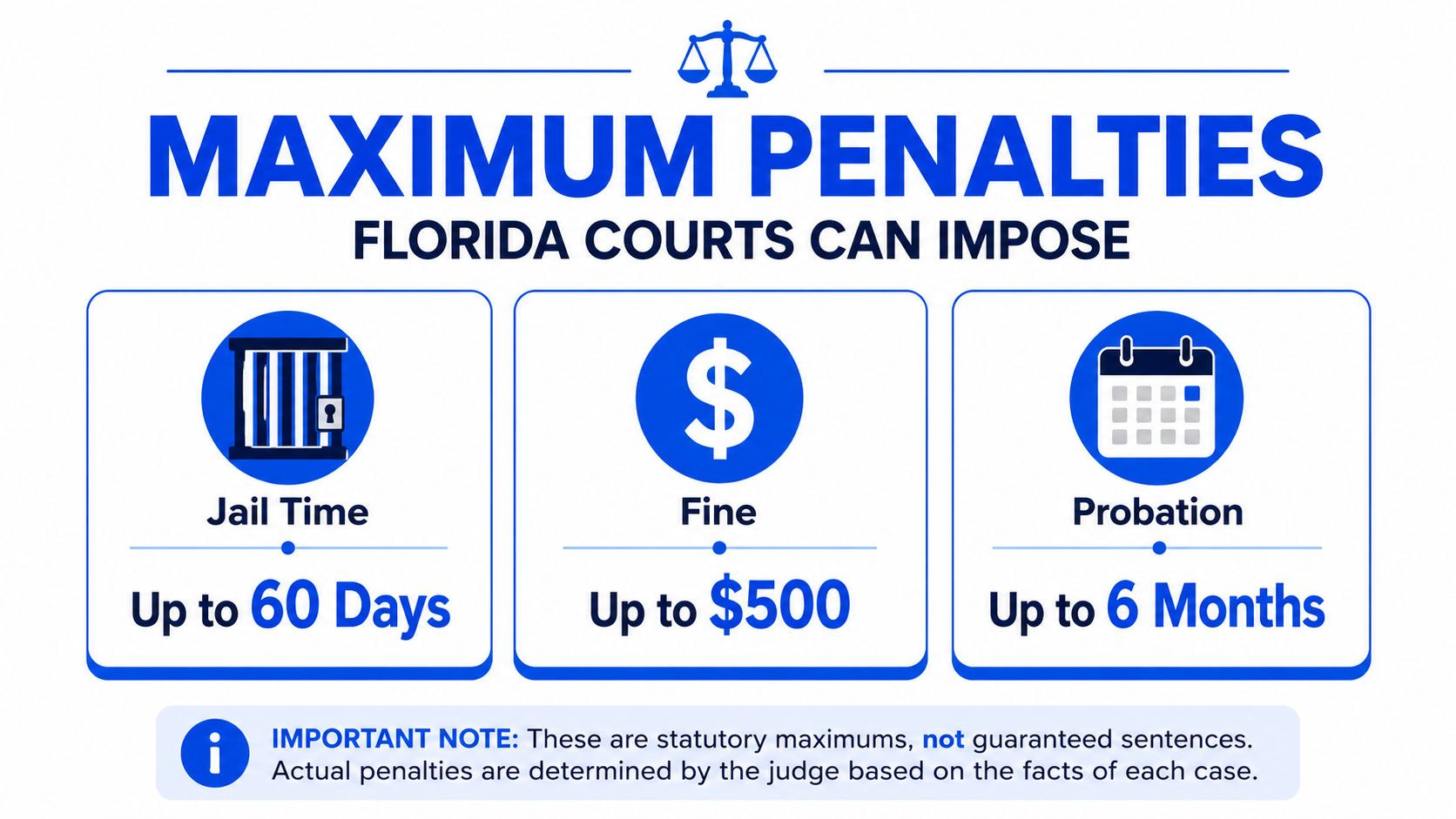
Those figures define the court's authority, not the sentence every defendant receives. Depending on the offense and facts, a judge may order jail, a fine, probation, restitution, court costs, or another lawful disposition. A first-time defendant with weak evidence may have meaningful options, while prior convictions, probation history, or aggravating facts can make the same classification more difficult to resolve.
The prosecution deadline
Florida generally gives the State one year to begin prosecution of a second-degree misdemeanor. The deadline comes from the criminal statute of limitations, but counsel must verify the precise offense, filing date, tolling provisions, and statutory exceptions before relying on it.
The deadline does not justify ignoring a citation, notice, investigation, or court date. A filed case or warrant can create immediate problems while the underlying allegations remain disputed. Reviewing dates early can preserve an issue that becomes harder to establish after records disappear, memories fade, or a hearing is missed.
Probation may also be available as a misdemeanor sanction, with a general maximum of 6 months for this level unless another statute applies. That can make supervision and conditions more significant than the jail headline. Depending on the case, conditions may include reporting, classes, treatment, or restitution. These terms can affect work, travel, family contact, and a defendant's ability to resolve the case without a conviction.
Common Examples of Second Degree Misdemeanors in Florida
A second-degree misdemeanor can begin with a brief encounter but still create serious plea pressure. A bar dispute, family argument, or alleged push may lead to a battery accusation. The State must prove intentional, unlawful contact or a threat under the applicable law. The defense may challenge identity, intent, witness reliability, or the State's account of self-defense or defense of another.
Petit theft cases turn on ownership, intent, identification, and property value. Store video, receipts, payment records, return history, and witness statements can change how prosecutors assess the case. The firm's discussion of Florida petit theft defense explains why a low-dollar allegation still requires careful evidence review. A weak identification or disputed intent may affect whether the State can prove the charge and whether a negotiated resolution is appropriate.
A first refusal to submit to a lawful DUI test presents a separate issue. Florida classifies a first refusal as a second-degree misdemeanor, while a second or subsequent refusal is a first-degree misdemeanor under Florida's refusal statute. The criminal prosecution and the administrative license suspension are separate proceedings, so resolving one does not automatically resolve the other.
Common allegations in practice
Simple battery: Was the contact intentional and unlawful? Did the alleged victim's account change, or do video and witnesses support another explanation?
Petit theft: Can the State prove intent to permanently deprive, ownership, value, and identity?
First refusal to submit to a DUI test: Was the stop and arrest lawful, was the implied-consent warning given properly, and did the conduct legally constitute a refusal?
Disorderly conduct: What specific behavior occurred? An unpleasant or loud interaction alone is not automatically criminal.
Resisting an officer without violence: Do the evidence and officer's duties satisfy every statutory element?
Certain prostitution-related offenses: What communication, conduct, intent, and investigative methods support the allegation?
Common Florida Second-Degree Misdemeanor Examples | Typical Fact Pattern | Defense-Focused Questions |
|---|---|---|
Simple battery | Alleged push or unwanted touching | Was the contact intentional and unlawful? |
Petit theft | Alleged taking of merchandise or property | Can the State prove intent, ownership, value, and identity? |
First refusal | Refusal after a DUI-related arrest | Was the warning proper, and was the request lawful? |
Disorderly conduct | Disruptive conduct in public | What exactly did witnesses and video show? |
The classification can change when injuries, protected victims, prior convictions, property value, or other aggravating facts are involved. Those details also influence plea discussions in South Florida courts. Police reports, body-camera footage, store video, messages, medical records, and witness accounts should be reviewed before treating a plea as the obvious solution. A default classification may look minor on paper while the evidence determines whether the case is defensible, negotiable, or likely to produce collateral problems.
Real-World Consequences Beyond the Statutory Maximum
A second-degree misdemeanor may end without jail and still impose up to 6 months of probation under Florida's general misdemeanor framework. Probation can require regular reporting, treatment, classes, community service, restitution, no-contact orders, and other court-ordered conditions. Those requirements affect work schedules, transportation, family relationships, and the ability to travel.
A violation creates a separate legal problem. The court may impose additional sanctions, and a negotiated resolution can become harder to preserve. Read every condition before accepting probation, especially where treatment appointments, restricted contact, or payment obligations are involved.
License and record consequences
DUI-related cases can produce two proceedings: the criminal prosecution and a separate administrative license action. In a first refusal case, Florida law provides for an administrative suspension of one year. A second or subsequent refusal carries 18 months. Resolving the criminal charge does not automatically cancel the administrative suspension, so both matters require attention.
This split creates practical pressure in South Florida courts. A person may focus on avoiding a conviction while also needing to protect the ability to drive to work, treatment, or court. The license issue can affect plea decisions even when the misdemeanor jail and fine limits appear manageable.
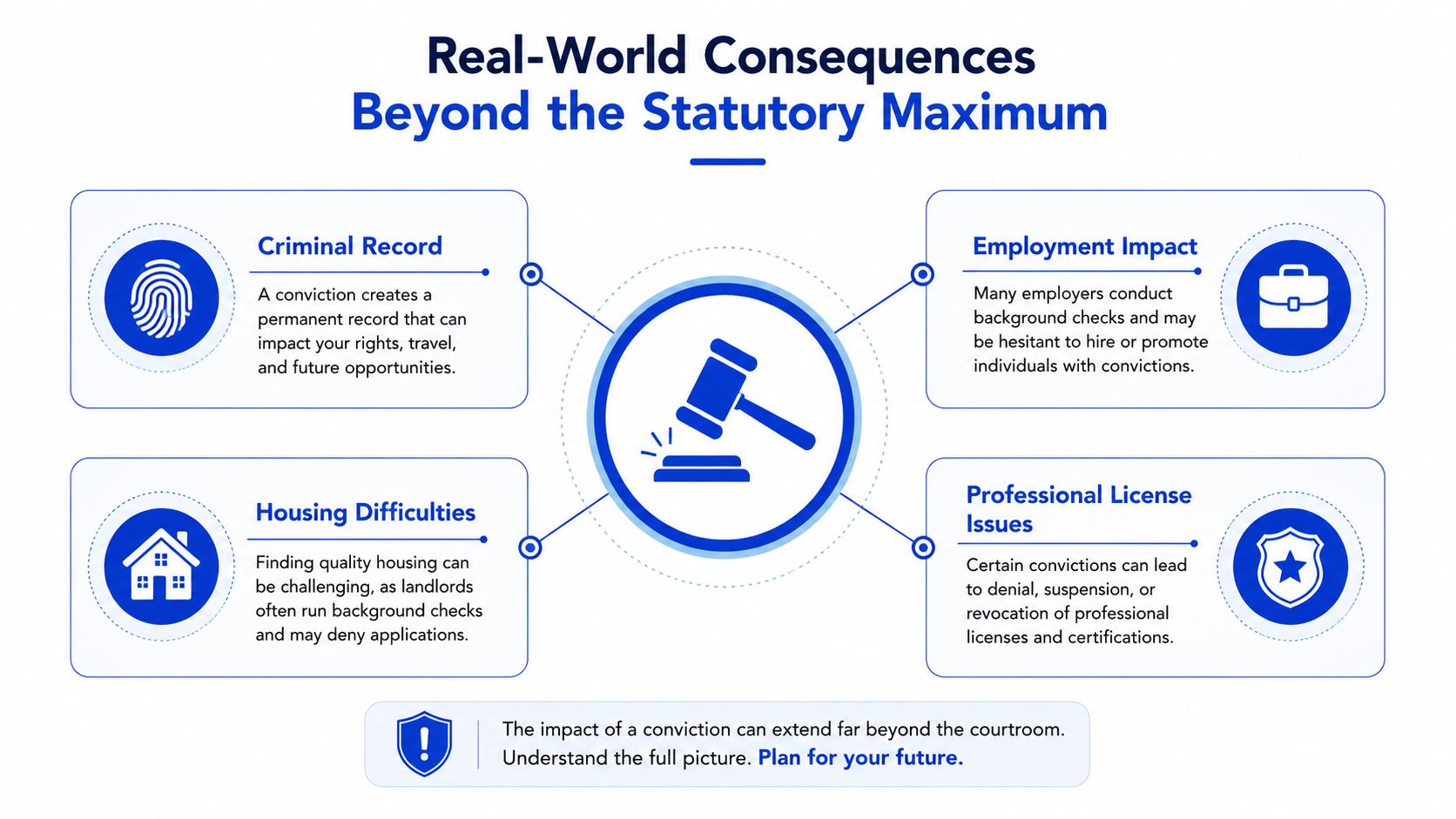
A criminal record can also affect employment, housing, education, professional licensing, and immigration review. Driving-based work, security approvals, and regulated occupations may create consequences unrelated to incarceration. Diversion or a withhold may reduce some effects, but no result guarantees identical treatment by every agency, database, licensing authority, or immigration decision-maker.
Area of Impact | Possible Consequence | Important Caveat |
|---|---|---|
Driver's license | Separate administrative suspension | The criminal case and license case may proceed independently |
Employment | Background-check complications | Employer policies and applicable law vary |
Housing | Additional screening questions | A favorable criminal resolution may not remove every record |
Professional license | Disciplinary or disclosure concerns | The licensing agency's rules control |
Finances | Costs, restitution, treatment, or supervision expenses | Payment obligations can continue after court |
For anyone seeking a future clean record, review Florida record sealing options before accepting a resolution. Adjudication, diversion terms, and prior record can affect eligibility. That decision should be addressed before signing a plea or probation agreement.
How a Second Degree Misdemeanor Compares to Other Florida Charges
Florida's misdemeanor system has a clear dividing line. A second-degree misdemeanor is one level below a first-degree misdemeanor. The statutory maximum for the second-degree level is 60 days in jail and a $500 fine, while a first-degree misdemeanor can carry 1 year in jail and a $1,000 fine, as reflected in Florida's misdemeanor sentencing statute.
That difference affects bargaining position. A prosecutor evaluating a first-degree battery allegation, for example, considers greater jail exposure than when the same conduct is charged at the second-degree level. The classification can influence whether a negotiated reduction, diversion, probationary resolution, or trial strategy makes sense.
Where misdemeanor cases become felonies
A charge can cross into felony territory because of the conduct, alleged property value, protected victim, weapon allegation, injury, or qualifying prior record. Petit theft may be charged more seriously when the facts meet a higher statutory threshold or when prior theft convictions trigger an enhancement. Simple battery may also become more serious when the alleged victim or circumstances fall within a protected category.
A first refusal begins at the second-degree level, but later refusals move to the first-degree level under the refusal statute. The administrative license consequences can exist alongside the criminal case, so comparing only jail terms misses a major part of the risk.
Charge Level | Maximum Jail | Maximum Fine | Typical Examples |
|---|---|---|---|
Second-degree misdemeanor | Up to 60 days | Up to $500 | Certain lower-level misdemeanor allegations |
First-degree misdemeanor | Up to 1 year | Up to $1,000 | More serious misdemeanor conduct or enhancements |
Felony | Depends on degree and statute | Depends on degree and statute | Conduct, value, injury, weapon, or record-based enhancements |
The exact statute controls. A visitor from another state, a person with an old theft case, or someone already on probation may face consequences that aren't apparent from the new charge's title. Counsel should compare the charging document with the police narrative, prior cases, and any administrative proceeding before estimating realistic risk.
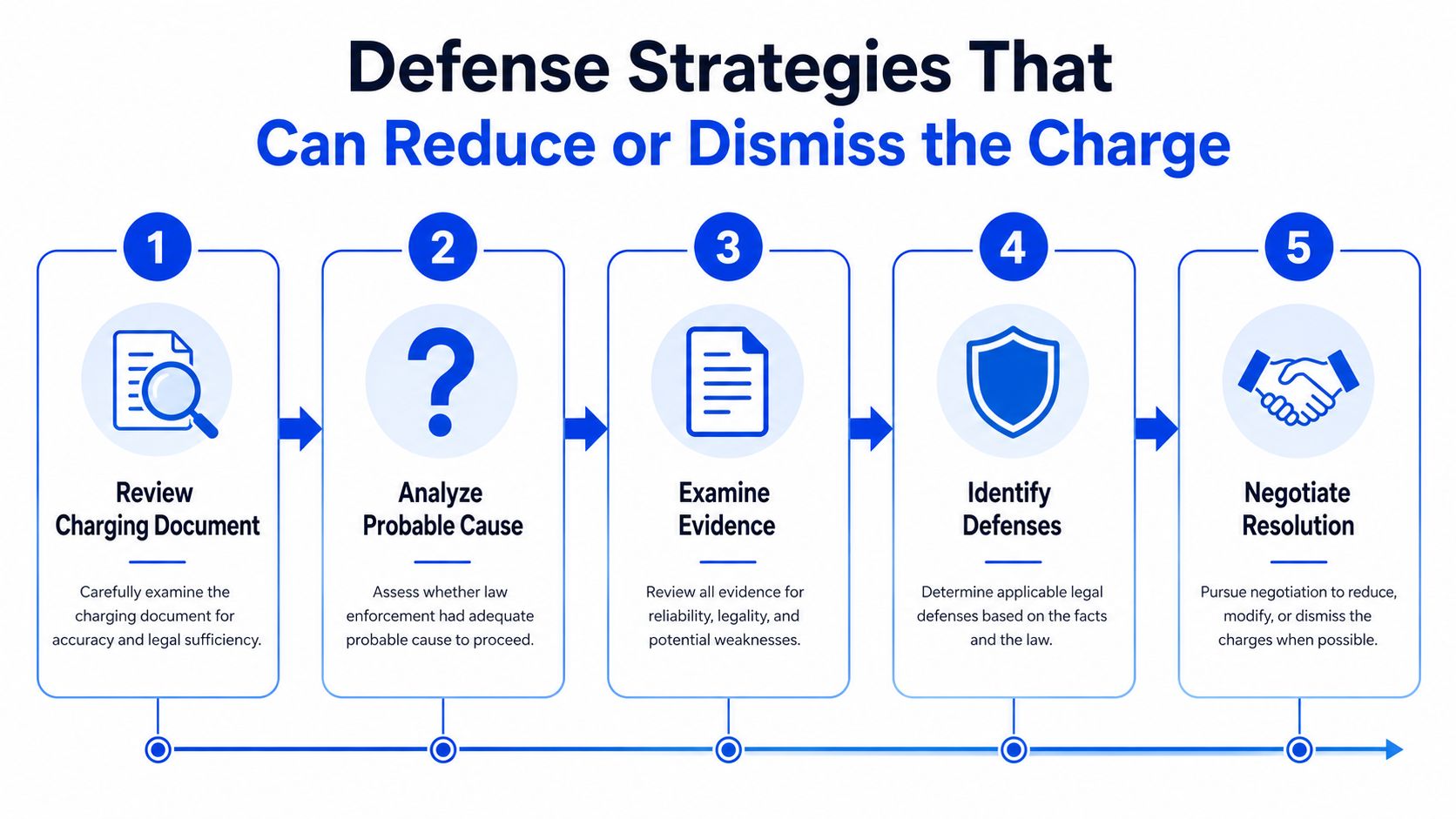
Defense Strategies That Can Reduce or Dismiss the Charge
The best defense work usually starts before a plea is entered. In a South Florida case, counsel should obtain the charging document, review the probable-cause basis, examine police reports, preserve body-camera and surveillance footage, identify witnesses, and check the client's prior record. Those steps reveal whether the State has a provable case or merely an accusation supported by assumptions.
A constitutional challenge may matter more than a favorable-sounding negotiation. An unlawful stop, search, seizure, or interrogation can affect whether the State may use key evidence. In theft cases, the central issue may be intent. In battery cases, self-defense, defense of another, or reasonable force may provide the legal explanation for conduct that a witness described incompletely.
Practical rule: Don't sign a diversion contract or make an explanatory statement until counsel has checked what the agreement requires and what it may do to your record.
The defense levers that matter
Evidence preservation: Video systems overwrite footage, witnesses become harder to locate, and messages can disappear. Early requests protect evidence that may support the defense.
Element-by-element review: The attorney tests identity, intent, ownership, lawful justification, police authority, and every other required element.
Suppression litigation: A motion can challenge evidence obtained through an unlawful stop, search, seizure, or statement.
Negotiation: Depending on the facts, counsel may pursue dismissal, a lesser offense, diversion, a withhold of adjudication, or a sentence that avoids incarceration.
Administrative strategy: In DUI refusal cases, the criminal defense must account for the separate driver's-license proceeding.
For a broader explanation of defenses, see common types of criminal defenses in Florida. A promise to “get it dismissed” isn't a defense plan. The meaningful question is what the lawyer found in the evidence and which legal or factual pressure point supports the proposed outcome.
A consultation can also clarify whether a pretrial intervention or treatment-based resolution fits the case. These options may protect a person from a conviction, but eligibility and conditions depend on the offense, jurisdiction, prosecutor, and record.
Defense Strategy Flow | Attorney's Work | Possible Goal |
|---|---|---|
Review charging document | Confirm statute, degree, and allegations | Identify defects or incorrect classification |
Analyze probable cause | Test the arrest and supporting facts | Challenge weak or unlawful initiation |
Examine evidence | Review video, reports, records, and witnesses | Find contradictions and missing proof |
Identify defenses | Match facts to legal defenses | Support dismissal, suppression, or trial |
Negotiate resolution | Present mitigation and legal weaknesses | Seek diversion, reduction, or favorable sentence |
Questions Clients Ask After Being Charged
Can a second-degree misdemeanor be sealed or expunged?
Florida law provides record-sealing and expungement procedures under section 943.0585, but eligibility depends on the final disposition, prior record, and statutory requirements. When a case doesn't result in a conviction, a lawyer can evaluate whether a withhold, dismissal, diversion, or other outcome preserves a later application. Don't assume that a favorable plea automatically makes the record invisible.
Is a DUI test refusal only a traffic matter?
No. A first refusal can be charged separately as a second-degree misdemeanor under section 316.1939. The criminal case and the administrative license suspension are separate proceedings, so defeating one doesn't automatically resolve the other. The warning, the legality of the request, the timing of the arrest, and the accused's words or conduct all deserve review.
Should I hire a lawyer before arraignment?
Early advice can prevent avoidable mistakes. A lawyer may be able to address release issues, obtain records, communicate with the prosecutor, preserve video, and identify diversion or suppression issues before the case gains momentum. Self-representation can also create hidden costs when a defendant waives rights, accepts conditions, or answers a clerk's question without understanding the effect.
Can an out-of-state conviction follow me home?
It can affect how Florida authorities, prosecutors, employers, licensing agencies, or courts view a later matter. The legal effect depends on the conviction, jurisdiction, record, and applicable Florida rules. A Florida defense attorney should review both the pending case and any prior out-of-state disposition.
Don't answer substantive questions, sign a diversion agreement, or assume the State will drop the charge without a confidential intake. Bring the citation, arrest paperwork, court date, and any communications to counsel.
Taking the Next Step With a Florida Defense Attorney
The 60-day jail ceiling and $500 fine ceiling don't describe the full exposure in Broward, Miami-Dade, Palm Beach, or other Florida courts. Probation, license action, restitution, background checks, immigration concerns, and future charging decisions can matter more than the sentence imposed at the first hearing.
A same-day consultation should produce concrete answers. Counsel can screen the facts, pull available records, assess bond or release planning, identify motion issues, preserve video and witness information, and determine whether diversion or pretrial intervention is realistic. Florida law also recognizes misdemeanor diversion provisions, including the misdemeanor diversion program addressed in section 910.04, but eligibility and availability must be confirmed for the particular case and jurisdiction.
What to bring to the consultation
Case documents: Bring the citation, notice to appear, arrest affidavit, charging document, and every court paper.
Evidence leads: Provide witness names, messages, receipts, photographs, and information about body-camera or store video.
Timeline: Write down where you were, who was present, what police asked, and what you said before memories become less clear.
Prior case information: Disclose prior Florida and out-of-state cases, probation terms, and any pending license suspension.
Immediate concerns: Explain work, driving, housing, family-contact, licensing, and immigration issues so counsel can prioritize them.
A lawyer who handles Florida criminal defense matters can help you decide whether to challenge the case, negotiate, seek diversion, or prepare for trial. The right strategy depends on the evidence, not the comforting assumption that a misdemeanor is too small to defend.
Ticket Shield, PLLC evaluates second-degree misdemeanor cases involving DUI-related refusals, theft, battery, traffic crimes, probation issues, and other Florida allegations, with attention to both the criminal charge and practical consequences such as licensing and records. Visit Ticket Shield, PLLC to request a confidential case review with a South Florida defense attorney before your first court decision.