
Indicted vs Arrested: What Florida Defendants Must Know
Jason Goldsmith, Esq
You get a late-night call from a family member in Broward County. Someone says you've been indicted, but you haven't been handcuffed, booked, or taken to jail. Another person says you were arrested, even though no indictment has been filed. The legal terms sound similar, but they describe different events, and the distinction can affect what happens next.
In Florida, an arrest means law enforcement has taken you into physical custody. An indictment is a formal accusation returned by a grand jury. One can happen before the other, and neither term means you've been convicted. If you're dealing with a DUI, drug crime, domestic violence allegation, theft offense, weapons charge, violent crime, sex crime, juvenile matter, white collar case, federal charge, probation violation, or traffic crime, your immediate decisions matter.
Table of Contents
How Arrest and Indictment Affect Record Sealing and Expungement
Protecting Your Rights with Experienced Florida Criminal Defense
Why the Difference Between Indicted and Arrested Matters
Suppose you're told that a grand jury indicted you for a felony, but you're still at home in Fort Lauderdale. You haven't been arrested yet, but the indictment may lead to a warrant or summons. If you assume nothing is happening because you're not in custody, you could miss a court notice or make statements that complicate your defense.
Now consider the opposite situation. Police arrest you after investigating a complaint, but a grand jury hasn't reviewed the case. Your custody began before the formal grand jury charging decision. These sequences are legally different, even though both can lead to felony court proceedings in Florida.
The Department of Justice explains that an indictment is formal notice that the government believes a person committed a crime, while an arrest is the physical act of taking that person into custody. The DOJ also makes clear that “indicted” and “arrested” aren't interchangeable legal events. You can review the DOJ's explanation of federal criminal charging and indictments.
The practical consequences
The distinction affects several urgent questions:
Custody: An indictment doesn't automatically mean police have already arrested you.
Warrants: An indictment can support an arrest warrant before the accused is taken into custody.
Bail: Bail and release conditions become immediate concerns once custody begins or a court schedules an appearance.
Court dates: A summons, warrant, first appearance, and arraignment can occur in different sequences.
Defense strategy: Your lawyer may need to address an ongoing investigation, a warrant, charging defects, search issues, witness statements, or release conditions.
Public records: Florida grand jury secrecy can delay public disclosure of an indictment in some circumstances.
Practical rule: Treat an indictment notice, subpoena, summons, or report of an active warrant as an emergency legal issue, even if you haven't been arrested.
People in Broward County, Miami-Dade, Palm Beach, and nearby South Florida communities often search “indicted vs arrested” because they want one simple answer. The accurate answer is that an indictment is a charging milestone, while an arrest is a custody event. Your lawyer needs to determine which occurred, whether a warrant exists, and what the court expects you to do next.
Defining Arrest and Indictment Under Florida Law
An arrest occurs when law enforcement takes a person into custody. Police may arrest based on a warrant, or they may make a warrantless arrest when they have the legally required probable cause at the time of custody. Booking, identification procedures, detention decisions, and an initial court appearance generally follow.
An arrest doesn't establish guilt. It starts or advances a criminal case, but the State still must prove the charge beyond a reasonable doubt. A Florida DUI arrest, drug arrest, or arrest for a violent offense can involve separate questions about the legality of the stop, search, seizure, statements, identification, and evidence collection.
An indictment is different. It's a formal charging document returned by a grand jury. In Florida, a felony indictment requires the concurrence of 12 grand jurors, according to the Florida statutes governing grand jury proceedings and indictments. The indictment alleges that the accused committed an offense. It isn't a conviction, and it doesn't replace the State's burden at trial.

The legal thresholds are not identical
The grand jury's role is to decide whether the State has enough probable cause to issue the formal accusation. The accused and defense lawyer generally aren't present to cross-examine witnesses during the grand jury presentation. That makes post-indictment review, discovery, motion practice, and investigation especially important.
Federal Rule of Criminal Procedure 9 recognizes that an indictment can support the issuance of a warrant or summons for a named defendant. The rule also reflects the difference between the charging document and the later custody event. Read the rule governing warrants and summonses after indictment for the federal procedural framework.
A warrantless arrest presents a different question. Officers must have probable cause at the moment they take the person into custody. If the arrest followed an unlawful traffic stop, an improper search, unreliable identification, or unsupported police assumption, a Florida criminal defense attorney may challenge the evidence or the arrest through appropriate motions.
For a practical explanation of how probable cause connects to custody, review this guide to probable cause for an arrest warrant.
Florida secrecy changes what the public may know
Florida's grand jury process can remain confidential. Under Florida Statutes § 905.26, an indictment generally can't be disclosed until the accused has been arrested if that person isn't already in custody or under recognizance. The statute therefore contemplates an indictment existing before a public arrest and process being issued or executed afterward. See the Florida grand jury and indictment statute.
That rule explains why a person may hear that an indictment exists only when authorities execute a warrant, arrange a surrender, or bring the person before a judge. Don't treat the absence of public information as proof that no case exists.
Key Differences Between Arrest and Indictment
The clearest way to understand indicted vs arrested is to compare the events directly. The following table focuses on the legal function of each event, not on whether the accused is guilty.
Arrest vs Indictment Comparison
Criteria | Arrest | Indictment |
|---|---|---|
What it is | The physical taking of a person into law-enforcement custody | A formal accusation returned by a grand jury |
Who initiates it | Police or another authorized law-enforcement officer, usually based on probable cause or a warrant | A prosecutor presents evidence to a grand jury, which returns the charging document |
When it can occur | Before or after an indictment | Before or after an arrest |
Primary legal question | Whether officers had lawful grounds to take the person into custody | Whether the grand jury found sufficient probable cause to formally charge the person |
Immediate consequence | Booking, detention review, release conditions, and an initial appearance may follow | A court may issue a warrant or summons, and the case proceeds toward arraignment |
Does it prove guilt | No | No |
Public visibility | The custody event is usually apparent once booking or court records are created | Florida secrecy rules can delay disclosure when the accused isn't already in custody |
Defense focus | Stop, search, seizure, probable cause, statements, identification, and release | Charging language, grand jury issues, discovery, evidence, warrant status, and defense preparation |
An arrest is usually the event people feel most directly. Officers take the person's freedom, transport the person for booking, and create immediate concerns about release and communication. An indictment may happen without the defendant knowing it, particularly when Florida secrecy rules apply.
A grand jury indictment can support an arrest warrant under federal procedure, but the indictment itself isn't the handcuffing. The arrest occurs when authorities take custody. That distinction matters if you're deciding whether to contact counsel, arrange a surrender, check for a warrant, or respond to a summons.
Timing changes the defense response
If police arrested you first, your lawyer should investigate what officers knew before custody and whether they followed constitutional requirements. If a grand jury indicted you first, counsel should determine whether a warrant or summons exists, whether the indictment has been disclosed, and whether a voluntary surrender can avoid an unexpected encounter.
The charging decision also involves prosecutorial judgment. A lawyer who understands prosecutorial discretion in criminal cases can evaluate whether intervention, negotiation, or targeted investigation may affect how the State handles the case.
Don't assume an indictment makes an arrest inevitable in the same way in every Florida case. Don't assume an arrest means an indictment already exists. The paperwork, court docket, warrant status, and jurisdiction control the answer.
What Happens After an Indictment or Arrest in Florida
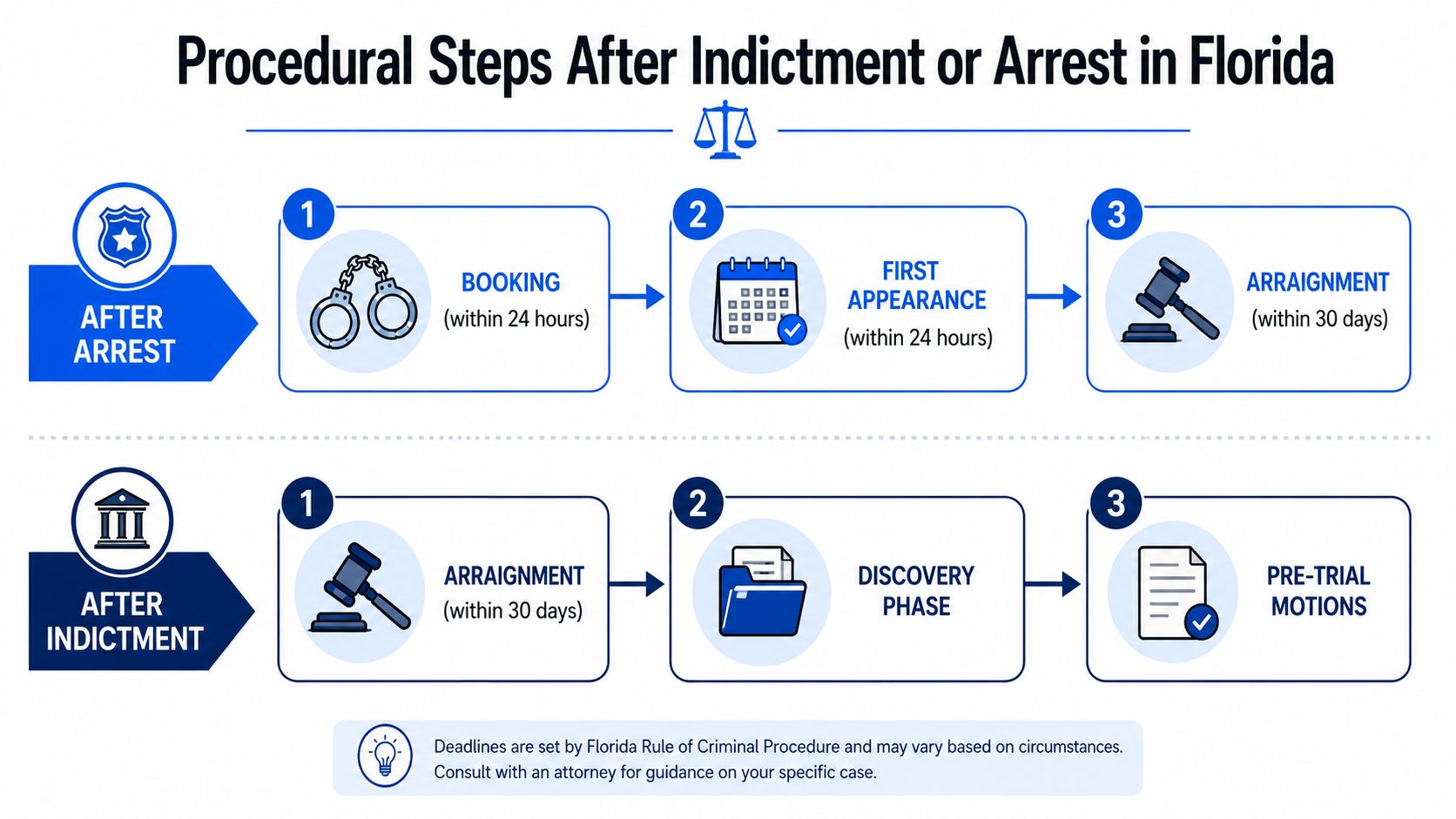
The procedural timeline changes based on what happened first. An arrest puts the accused in custody, followed by booking and an initial court appearance. An indictment formally accuses the defendant, then the court must arrange an appearance through a warrant or summons unless the defendant is already detained. That difference determines whether counsel must address an immediate release decision or arrange a controlled response to the charging document.
Federal procedure provides a useful framework. A person may be arrested first based on complaint-based probable cause. If a grand jury has already returned an indictment, the court issues a warrant or summons for each named defendant. A defendant in custody may proceed toward an arraignment or initial appearance. Someone outside custody may face a later warrant and arrest. Review the federal criminal justice process for that framework.
The sequence can look different
A simplified Florida timeline looks like this:
Investigation: Police, prosecutors, or investigators collect information and evidence.
Arrest first: Officers take the accused into custody, followed by booking and an initial court appearance.
Indictment first: A grand jury returns the formal accusation, then the court addresses a warrant, summons, or voluntary surrender.
First appearance or arraignment: The judge addresses the charge, counsel, release conditions, and the defendant's plea posture.
Discovery and motions: Defense counsel obtains available evidence and challenges unlawful searches, statements, identifications, or defective charging allegations.
Resolution: The case may proceed through negotiation, dismissal litigation, trial preparation, or trial.
If an indictment comes before arrest, the first appearance and arraignment may occur together. That can leave little time to address release, travel, employment, family obligations, and evidence preservation. Secrecy rules can also prevent a defendant from learning about the indictment before a warrant is executed. A lawyer should check the docket, warrant status, and court division immediately rather than waiting for an unexpected arrest.
For a step-by-step walkthrough of booking and first appearance, see this guide to what happens after an arrest.
What the timing data shows
The Bureau of Justice Statistics study of felony case processing found that felony cases that were indicted and bound over took 4.9 months on average from arrest to disposition, compared with 3.5 months for all filed felony cases in that study.
Those figures do not predict the result or schedule of a particular Florida case. They show that indicted or bound-over cases represented a later charging milestone and took longer on average in that dataset. The actual schedule depends on the charge, court, custody status, discovery, motions, witness availability, and whether the State negotiates.
Obtain the exact case number, court division, next hearing date, warrant status, and release conditions. A missed appearance can create a separate crisis, especially if the judge issues a warrant.
Immediate Steps to Take If You Are Indicted or Arrested
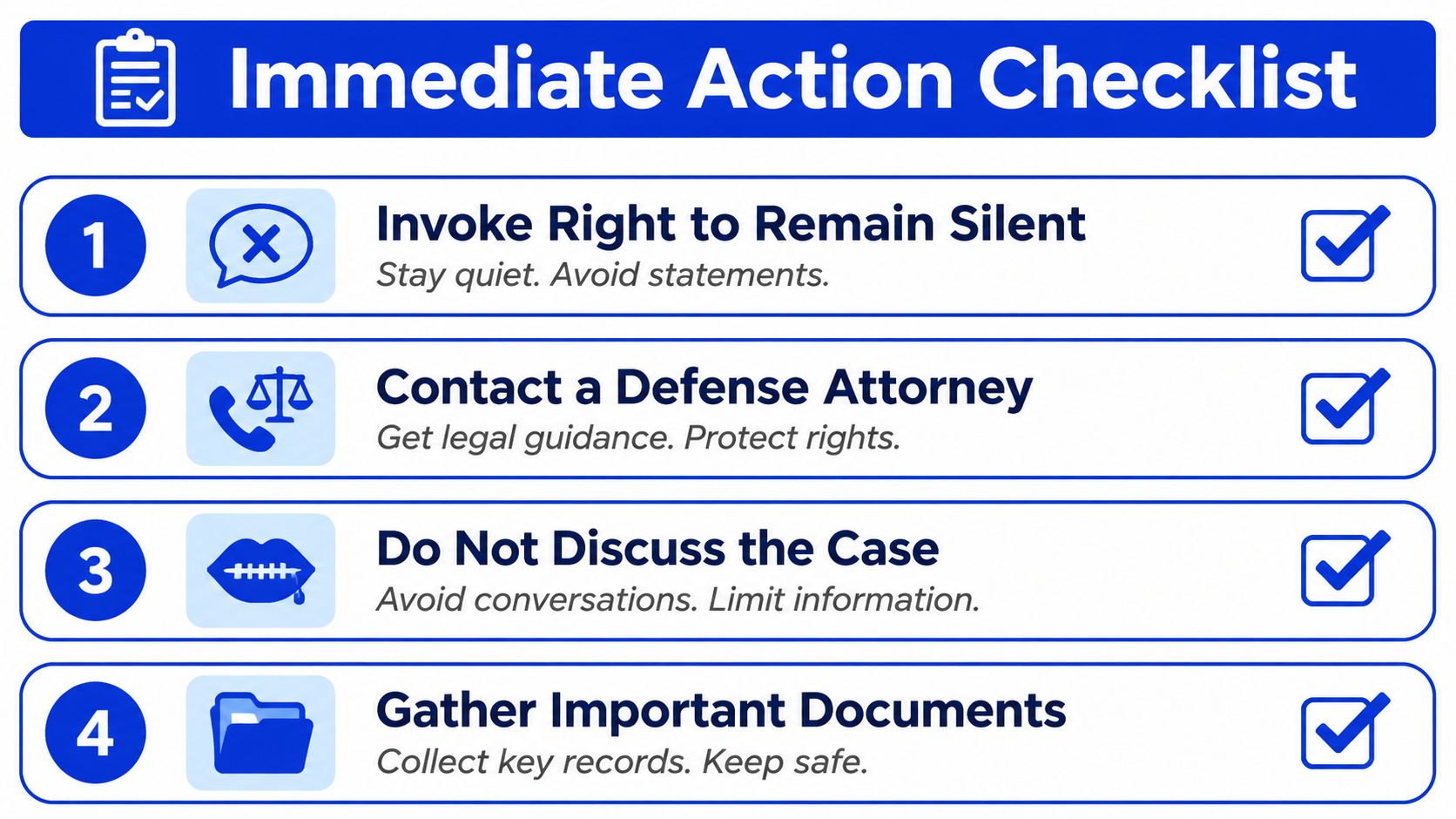
Your first response should be controlled and practical. Don't post about the accusation, explain the facts to police, or send emotional messages to alleged victims or witnesses. Preserve paperwork and get legal advice before making decisions about surrender, interviews, travel, or plea discussions.
Use this first-day checklist
Invoke your rights: Tell officers clearly that you want to remain silent and want a lawyer. Don't try to talk your way out of the situation.
Contact defense counsel: Call a Florida criminal defense attorney promptly. If you're in Fort Lauderdale, Broward County, Miami-Dade, Palm Beach, or another South Florida jurisdiction, counsel can identify the court, warrant, and appearance status.
Stop informal discussions: Don't discuss the facts with friends, relatives, coworkers, cellmates, alleged victims, witnesses, or anyone online. People may repeat statements, misunderstand them, or become witnesses.
Gather documents: Save the indictment, summons, notice, booking records, release paperwork, police correspondence, search documents, subpoenas, and court notices.
Confirm the next required appearance: Ask counsel to verify whether you must appear, whether a warrant exists, and whether the court has imposed conditions involving contact, travel, weapons, alcohol, or reporting.
Protect evidence: Preserve texts, emails, photographs, location data, medical records, receipts, and names of witnesses. Don't delete, edit, or conceal anything.
Tell only the people who need to know: If an employer or family member asks, say you're handling a legal matter and are working with counsel. You don't owe coworkers a factual explanation.
Bail and surrender require strategy
If you're not in custody, don't walk into a courthouse or police station without understanding the warrant and release situation. Depending on the case, counsel may be able to coordinate a surrender, address conditions, and reduce the chance of avoidable confusion. If you're already detained, your lawyer should focus on the earliest available opportunity to address release and the conditions that affect your daily life.
A probation violation lawyer may need to address both the alleged violation and any new criminal charge. Likewise, a Fort Lauderdale DUI lawyer may need to protect your driving privileges while defending the underlying accusation. A Florida gun charge defense may focus on possession, search legality, knowledge, and authorization, while a domestic violence defense may require immediate attention to injunctions and no-contact restrictions.
Don't mistake silence for passivity. Silence protects the case while your lawyer investigates.
How Arrest and Indictment Affect Record Sealing and Expungement
An arrest record can create lasting problems even when the State doesn't obtain a conviction. Florida law treats sealing and expungement as limited remedies, not automatic consequences of a dismissal or acquittal.
Under Florida Statutes § 943.0585, expungement may be available when the case didn't result in a conviction and the person hasn't previously obtained sealing or expungement under Florida law. The statute also requires that no charging document was filed, or that the charge was later dismissed, nolle prossed, or ended in an acquittal. Review the Florida expungement statute before assuming a case qualifies.
An indictment that ends in dismissal or acquittal may therefore have a different long-term path from an arrest that ends in conviction. The key questions are the case outcome, the charging record, prior relief, and statutory eligibility. The mere fact that an indictment occurred doesn't answer those questions.
Sealing has separate conditions
Florida Statutes § 943.059 imposes its own restrictions. The applicant must not have been adjudicated guilty of any criminal offense in Florida before applying, must not have an adjudication in the case to be sealed, must be off court supervision, and must not have previously obtained sealing or expungement. The Florida record-sealing statute contains the controlling requirements.
FDLE also states that a person is entitled to only one court-ordered sealing or expungement in a lifetime, and its sealing and expungement eligibility guidance emphasizes that an applicant must attest to having no prior Florida sealing or expungement.
That limitation makes plea decisions and case strategy more important. Before accepting a resolution in a Florida theft case, drug case, DUI matter, or weapons case, ask counsel how the outcome may affect future record relief. For an overview of the process, see this guide to record sealing in Florida.
Protecting Your Rights with Experienced Florida Criminal Defense
Whether you're indicted first or arrested first, the State's accusation deserves a careful legal response. The right defense may involve challenging probable cause, suppressing illegally obtained evidence, contesting an identification, negotiating reduced charges, seeking dismissal, or preparing for trial. Early action also helps protect release conditions, employment, driving privileges, and future eligibility for Florida record relief.
Attorney Jason S. Goldsmith is a former prosecutor who represents clients facing DUI, drug, domestic violence, theft, violent crime, gun and weapons charges, sex crimes, federal crimes, juvenile matters, and probation violations. You can learn more about Florida criminal defense representation.
Contact Ticket Shield, PLLC for a free, confidential consultation. The firm is available 24/7 and handles cases throughout Broward County, Fort Lauderdale, Miami-Dade, Palm Beach, and surrounding South Florida communities.
If you've been indicted, arrested, served with a summons, or told that a warrant may exist, contact Ticket Shield, PLLC for a confidential review of your charging documents, custody status, court date, and immediate defense options. The firm can help you understand what happens next and protect your rights before you speak with investigators or make a surrender decision.