
Probable Cause for Arrest Warrant in Florida
Jason Goldsmith, Esq
Probable cause for an arrest warrant requires a fair-probability showing that a specific person committed a specific crime. It does not require proof beyond a reasonable doubt.
You may be reading this because a police officer contacted you, a court notice arrived, or someone told you an arrest warrant might exist in Broward County, Fort Lauderdale, Miami-Dade, Palm Beach, or another Florida jurisdiction. The uncertainty can be stressful, especially when you don't know what evidence the police presented or whether a judge reviewed it.
An arrest warrant doesn't mean you're guilty. It means a neutral judge found enough information, usually in a sworn affidavit, to authorize taking a named person into custody for an identified offense. The affidavit's wording matters immediately because it can influence the arrest, bond, later litigation, and the defense strategy.
Table of Contents
What an Arrest Warrant Means
A neighbor reports a suspected burglary in Broward County. An officer investigates, prepares a sworn complaint describing the alleged offense and suspected person, and submits it to a county court judge. The judge reviews the affidavit, decides whether its facts establish probable cause, and, if the warrant identifies the person and offense with sufficient particularity, signs an order officers may execute.
An arrest warrant is a written directive from a neutral magistrate authorizing officers to take a named person into custody for a specifically alleged crime. Its function is limited to deciding whether the sworn facts justify an arrest at that point. It does not resolve the merits of the case or determine what the State can prove later.
The Fourth Amendment requires the warrant to rest on probable cause, an oath or affirmation, and a particular description of the person or place involved. The judge's review generally stays within the four corners of the affidavit, meaning the written material submitted for approval. Specific observations, dates, locations, identification details, and corroborating information give the magistrate facts to evaluate. Conclusions, stale information, or an unsupported guess about identity may leave a weaker basis for the order.
Practical rule: A warrant authorizes custody. It does not decide guilt, trial credibility, admissibility of evidence, or the case's final outcome.
The warrant also creates a procedural record. Defense counsel can seek the signed warrant and affidavit, compare the stated facts with records, messages, video, witness accounts, and other evidence, and assess whether the magistrate received enough concrete information. That review differs from an unexpected street detention, where an officer's immediate observations may control the initial arrest.
If you suspect an outstanding warrant, do not ignore it or assume silence means the matter disappeared. It may create additional complications, including a failure-to-appear issue, explained in this guide to failure to appear warrants. Speak with counsel before contacting investigators, the alleged victim, or potential witnesses.
The Constitutional Standard for Probable Cause
The Fourth Amendment requires a neutral magistrate to find a fair probability that a crime occurred and that the identified person committed it before issuing an arrest warrant. The application must rest on an oath or affirmation and describe the person with sufficient particularity. Probable cause is a practical, probability-based judgment, not a numerical formula. The Fourth Amendment warrant analysis summarizes these requirements.

The magistrate should be able to identify the facts supporting both parts of the inquiry. A witness who describes what happened, when and where it occurred, how the suspect was recognized, and what information confirms that identification gives the court material to assess. A statement such as “the defendant committed burglary” is a conclusion. It does not explain why the facts connect that person to that offense.
The standard differs from other stages of a criminal case:
Reasonable suspicion can support a brief investigative stop, but an arrest warrant requires a stronger factual showing. The distinctions are explained in this guide to reasonable suspicion versus probable cause.
Probable cause permits an arrest when the written facts establish a fair probability of the offense and the person's involvement.
Proof beyond a reasonable doubt is the higher standard the State must meet to obtain a conviction at trial.
Probable cause does not require the affidavit to prove the case. It may be sufficient even when witnesses, records, or physical evidence would still face credibility, admissibility, or completeness disputes before a jury. The magistrate is deciding whether the facts justify the arrest process, not whether the State will ultimately win.
The four-corners review
Courts generally assess the warrant application from the four corners of the sworn affidavit. The issuing authority ordinarily considers the affidavit and materials properly incorporated into it, rather than information an officer could have included but left outside the written submission. The probable-cause overview from Justia describes the need for facts and circumstances connecting a specific person to a crime.
That focus makes wording and timing important. Specific, corroborated facts carry more weight than an unsupported identity guess, a stale report, or an officer's bare conclusion. A later defense challenge examines whether the material presented to the magistrate supplied a lawful basis for the seizure. The judge's training or confidence in the officer cannot replace facts in the affidavit.
How Florida Affidavits Reach a Magistrate
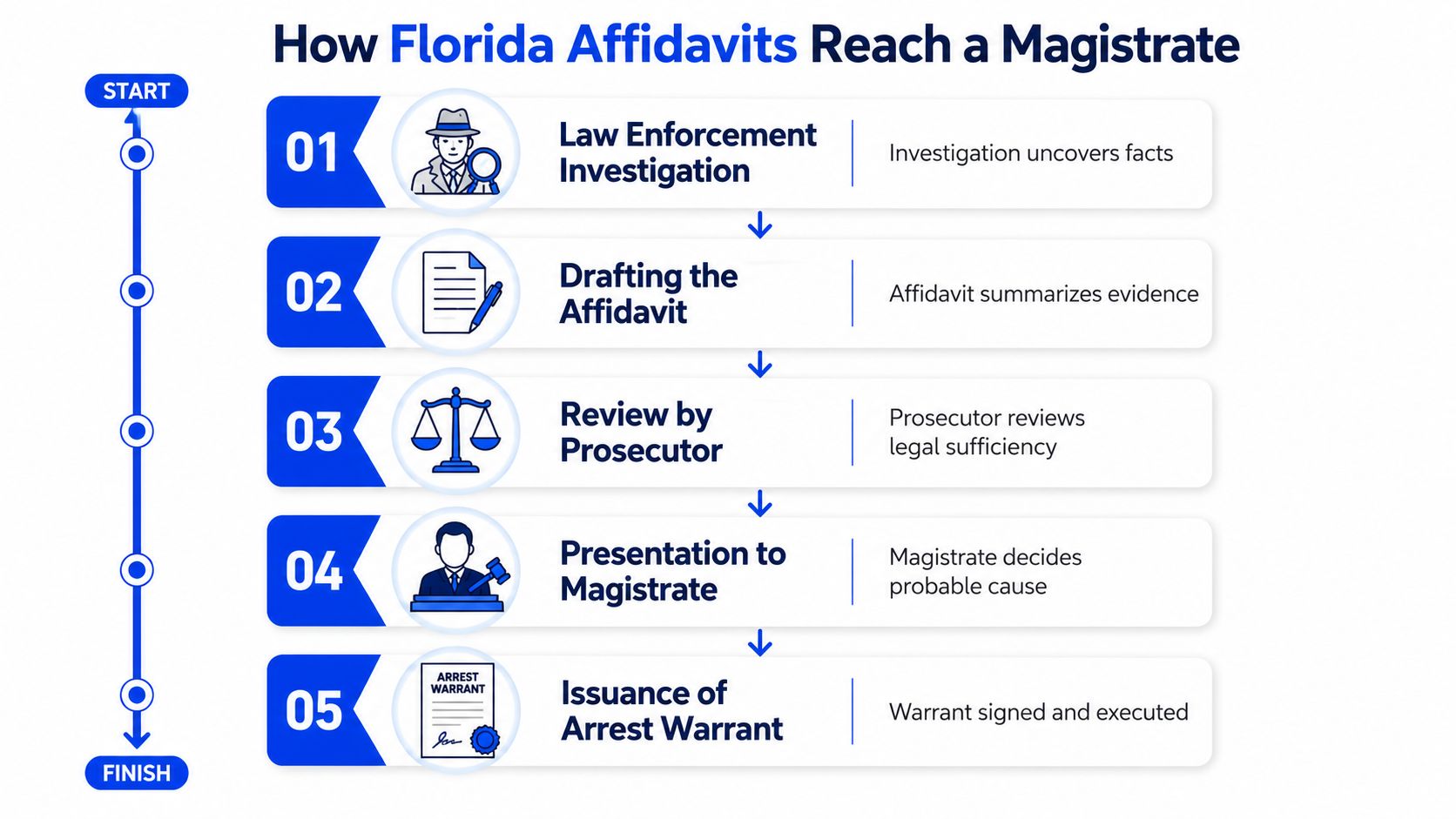
A Florida warrant usually begins with an investigation, not with the judge. Officers collect reports, interview witnesses, review records, examine physical or digital evidence, and determine what offense they believe the facts support. They then prepare a complaint or affidavit that is sworn, signed, and submitted for judicial review.
Florida Rule of Criminal Procedure 3.120 governs the complaint and warrant process. The application should give the magistrate enough factual material to evaluate three practical questions:
Did a specific crime probably occur?
Does the named person probably have responsibility for it?
Are the facts sufficiently current and connected to justify an arrest now?
The magistrate may review the application without the accused present. That ex parte procedure is common because advance notice could interfere with an investigation or allow a suspect to leave. It also means the defense usually doesn't get to correct an inaccurate description before the warrant is signed.
What the judge can actually consider
The practical limit is important. The judge reviews the sworn complaint, affidavit, and materials properly incorporated into the application. An officer may know additional facts from conversations or investigative work, but information not presented to the magistrate generally can't rescue an affidavit that fails on its face.
Florida law reflects the requirement for judicial review. Under Florida Statutes section 901.02, the judge must review the complaint and supporting proofs and issue an arrest warrant only if satisfied that probable cause exists. The warrant must be signed and concern a crime committed within the judge's jurisdiction.
After the judge signs, the warrant becomes an order law enforcement can execute. The decision may occur during ordinary court operations or after hours, but the legal question remains the same. The paper must provide facts, not merely a label for the charge.
This process differs from every warrantless arrest. Florida Statutes section 901.15 identifies circumstances allowing an officer to arrest without a warrant, including certain offenses committed in the officer's presence and situations involving a felony and a reasonable belief that the person committed it. The Florida warrantless-arrest statute supplies the statutory framework.
Sufficient and Insufficient Warrant Examples
A magistrate evaluates the facts placed in the sworn affidavit, not the officer's unrecorded suspicions. The following hypothetical examples show how specific facts, corroboration, timing, and identity information can support or weaken an arrest-warrant application. They do not predict how any particular Florida judge must rule.
Hypothetical sufficient affidavit
Assume a burglary affidavit states that a named witness identified the suspect entering a particular residence at a stated time. It describes the person's conduct, identifies the property allegedly taken, and explains that surveillance video shows the suspect arriving in a vehicle connected to that person. The affidavit also describes how the witness recognized the suspect and how investigators verified the vehicle or another identifying detail.
Those facts give the magistrate more than a charge label or accusation. They identify a specific offense, person, place, and time. They also describe conduct that relates to the alleged burglary and include independent information supporting the identity connection.
Hypothetical insufficient affidavit
Now consider an affidavit stating only that an unknown person with a general description was seen near a residence. An unnamed informant says the defendant “probably did it,” but the affidavit does not explain the informant's basis of knowledge, when the information was received, or whether investigators confirmed any material detail.
That showing may establish suspicion without providing enough support for the required inference. A general appearance, uncertain vehicle description, remote allegation, or unsupported conclusion does not by itself connect the named person to the specific crime.
Element | Sufficient Affidavit | Insufficient Affidavit |
|---|---|---|
Identity | Names the suspect and explains how a witness or records connect that person to the event | Relies on a general description or uncertain guess |
Timing | States when the conduct occurred and why the information remains current | Gives no meaningful time frame or relies on remote information |
Conduct | Describes what the suspect allegedly did and how those acts fit the charged offense | Uses a legal conclusion without describing the acts |
Corroboration | Includes surveillance, records, identified witnesses, or other confirming facts | Repeats an unverified tip without explaining its basis |
Magistrate review | Gives the judge facts to evaluate independently | Asks the judge to accept the officer's conclusion |
How the judge evaluates the affidavit
Florida courts do not require a lengthy narrative for its own sake. The affidavit must contain enough factual content to support a practical inference that the person committed the identified offense. The magistrate may distinguish firsthand observations and verified records from conclusions, stale information, or guesses about identity. The probable-cause discussion from Cornell's Legal Information Institute describes probable cause as a practical probability inquiry rather than proof beyond a reasonable doubt.
Probable Cause Across Florida Criminal Cases
The legal threshold remains the same across Florida criminal cases, but the facts that establish it depend on the alleged offense. A DUI affidavit won't look like a drug-possession affidavit, and neither should be evaluated with a generic checklist.
For a DUI investigation, the written showing may address driving behavior, field observations, statements, video, and breath or blood evidence. Each fact has a role. The affidavit still must connect the facts to the specific person and the alleged impairment or unlawful alcohol concentration, rather than state that the driver appeared intoxicated.
A drug case may turn on the location of the substance, the defendant's access or control, the surrounding circumstances, observed conduct, and testing or other identification of the substance. Physical proximity alone may not answer the possession question. The affidavit needs facts supporting the required connection between the person and the item.
Offense-specific evidence
The same principle applies to theft and fraud. Documentary records, surveillance, account activity, communications, and identified transactions may help connect a person to the alleged taking or deception. In a violent-crime case, witness observations, medical records, video, physical evidence, and statements may carry different weight depending on the charge.
Weapons cases can involve possession, location, ownership, fingerprints, admissions, or eyewitness information. Sex-crime allegations often require careful attention to chronology, identity, consent-related facts, communications, and the source of each allegation. Juvenile, white-collar, federal, probation, and traffic-crime cases also require offense-specific analysis, even though the constitutional question remains whether the affidavit establishes a fair probability.
A probable-cause finding is a low threshold compared with conviction. That doesn't make the warrant automatic. It means a defense lawyer should separate two questions: whether the affidavit justified the arrest, and whether the State can later prove every element admissibly at a hearing or trial.
For a related Florida traffic-stop issue, review probable cause during a traffic stop. The same distinction matters in DUI defense, license-related cases, drug charges, theft offenses, violent crimes, gun allegations, and other South Florida prosecutions.
How Defense Counsel Reviews a Warrant
A defense review starts with documents, not assumptions. Counsel should obtain the signed warrant and the supporting affidavit from the clerk or the court file, including materials the affidavit expressly incorporates. The objective is to identify exactly what the magistrate saw before authorizing the arrest.
The initial document review
The lawyer reads the affidavit from its four corners and marks each factual assertion. The review usually asks:
Offense: What specific crime does the affidavit describe?
Identity: What facts connect this defendant to the alleged conduct?
Source: Who supplied each fact, and how did that person know it?
Timing: When did the conduct occur, and when did the officer receive the information?
Corroboration: Did investigators verify important details independently?
Particularity: Does the warrant identify the person and offense clearly enough?
The next step is comparison. Counsel may examine phone records, surveillance, location evidence, receipts, photographs, medical records, witness communications, dispatch information, and police reports. The goal isn't to rewrite the affidavit with defense evidence. It's to determine whether the affidavit's material statements are accurate and whether omitted context changes the probable-cause analysis.
An affidavit can contain hearsay. Hearsay isn't automatically disqualifying if the circumstances provide a reasonable basis to assess reliability and the information connects the person to the offense. The question is how the magistrate could evaluate the source, basis of knowledge, and corroboration from the written application.
Facial review and a Franks challenge
A facial challenge argues that the affidavit doesn't establish probable cause even if every statement is accepted as written. A different type of challenge examines intentional or reckless falsehoods or omissions.
Under Franks v. Delaware, a materially false statement can undermine probable cause when it was made knowingly, intentionally, or with reckless disregard for the truth, and when the statement was necessary to the judge's finding. The Supreme Court's decision is available in Franks v. Delaware.
That process requires more than showing a mistake or minor inconsistency. Counsel must develop the factual record and demonstrate why the disputed information mattered. A weak affidavit may support a motion, further investigation, negotiation, or a broader suppression strategy, but it doesn't guarantee dismissal.
For evidence obtained after an arrest or related search, the analysis may extend beyond the warrant itself. A motion to suppress can raise separate constitutional issues, as explained in this guide to motions to suppress evidence.
Common Challenges and Their Limits
A warrant challenge is a decision about strength, not a promise of a particular result. Courts often give issuing magistrates substantial deference, and probable cause is not a demanding trial standard. The strongest arguments usually show that several defects work together.
Common issues include:
Conclusory language: The affidavit labels conduct criminal but supplies no meaningful dates, places, acts, or property descriptions.
Staleness: The information is remote, and the application doesn't describe continuing conduct or explain why the old facts still support an arrest.
Misidentification: The suspected person is selected from a general clothing description, vehicle, or appearance without a reliable identification process.
Material omissions: The application leaves out important facts that bear directly on identity, an offense element, an exception, or the reliability of a source.
Internal conflict: The chronology changes within the affidavit, or the stated facts don't support the legal conclusion.
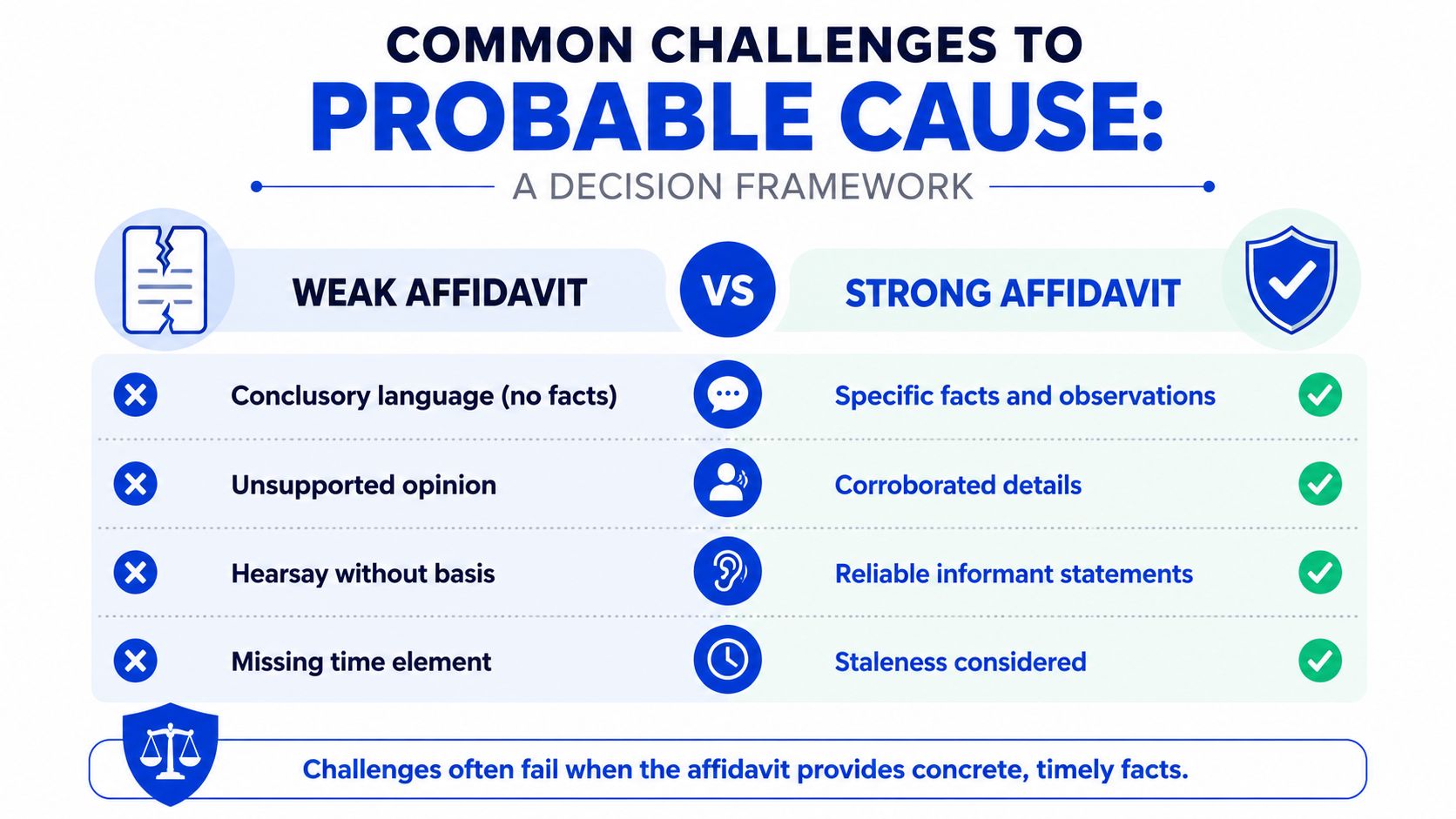
A single weakness may not defeat probable cause. A vague description could matter more when paired with an unverified tip and an unexplained delay. An omission may matter more when the omitted fact directly negates an offense element or substantially changes the identity analysis.
Even a successful warrant challenge doesn't always end the prosecution. The State may attempt to correct an application, rely on another lawful basis for the arrest, or proceed with charges supported by admissible evidence. Consequences vary by facts, county, judge, offense, and the relationship between the warrant and later searches or statements.
What to Do and Questions to Ask
If you suspect a Florida arrest warrant exists, don't call the investigator, alleged victim, or witness to explain yourself. Preserve paperwork, court notices, messages, and prior communications with officers. Through counsel, request the signed warrant and supporting affidavit promptly, then evaluate the document's facts, sources, timing, and identity connections.
Can hearsay support probable cause? Yes, when the affidavit gives the magistrate reliability indicators and a basis to evaluate the information.
Can a false affidavit invalidate a warrant? Potentially. Under Franks v. Delaware, a knowingly or recklessly false material statement can matter if it was necessary to the probable-cause finding.
What does the 48-hour rule mean? Florida Rule of Criminal Procedure 3.133 requires a nonadversary probable-cause determination within 48 hours after a custody arrest without a warrant. That hearing isn't required when a judge already found probable cause and issued an arrest warrant for the specific offense charged. The rule is available through Florida criminal procedure materials.
Does a weak warrant end the case? Often, no. The State may cure a defect or proceed on a different lawful basis. Read about what happens after an arrest, then get advice specific to the actual court file.
Ticket Shield, PLLC helps Florida clients review arrest warrants, affidavits, charging decisions, and related search or seizure issues, with representation available in Broward County, Fort Lauderdale, Miami-Dade, Palm Beach, and surrounding South Florida courts. Visit Ticket Shield, PLLC to request a confidential consultation about the facts and documents in your case.