
Petit Theft in Florida: Charges, Penalties, and Your Defense
Jason Goldsmith, Esq
In Florida, petit theft covers property valued at less than $750, charged as a second-degree misdemeanor for property under $100 or a first-degree misdemeanor for property valued at $100 to under $750. However, two or more prior theft convictions can turn a new low-value allegation into a third-degree felony, regardless of the item's value.
You may be reading this after a loss-prevention employee stopped you at a Broward County store, after police issued a citation in Fort Lauderdale, or after a court notice arrived at your home. Maybe the merchandise was worth only a small amount. You may believe the incident was a mistake, an unpaid self-checkout item, or a misunderstanding about ownership.
Florida prosecutors and courts don't evaluate the situation only by the price tag. They examine intent, valuation, criminal history, evidence, and the final disposition. A case that looks minor at the store can affect employment, housing, licensing, immigration, and future background checks. The immediate objective isn't only to avoid jail. It's to protect your record and preserve every lawful defense.
Table of Contents
Why a Petit Theft Charge Demands Immediate Attention
A Fort Lauderdale resident leaves a store after an employee claims an item wasn't paid for. The person explains that the item was buried in a bag and that payment was intended. Instead of treating the incident as a private dispute, the store contacts law enforcement, and the person receives a criminal citation.
That sequence is common enough to understand the practical lesson. Returning merchandise or explaining an accident doesn't automatically end a criminal case. The State still has to prove the required elements, but an early statement can give prosecutors evidence they otherwise might not have.
Practical rule: Don't try to talk your way out of a theft allegation after police or loss prevention has become involved. A lawyer can assess the facts without creating new admissions.
The consequences can extend beyond the statutory jail and fine exposure. Employers may question a theft-related record, landlords may review it during an application, and licensing authorities may treat an offense involving dishonesty seriously. Immigration consequences can also depend on the precise charge, plea, and factual basis, so noncitizens should obtain advice before entering any plea.
The value of an early defense review
A defense lawyer should examine the citation, arrest paperwork, surveillance, witness accounts, receipts, and the State's valuation theory. That review can reveal a lack of intent, an unreliable identification, an improper detention, or a charge level unsupported by the evidence.
The final outcome matters as much as the initial accusation. A dismissal, diversion resolution, or other disposition may preserve record-relief options that a conviction can eliminate. Waiting can allow surveillance footage to disappear, witnesses to become harder to locate, and charging decisions to solidify.
How Florida Law Defines Petit Theft and Sets Penalty Levels
Florida's theft framework uses two separate questions. What was the alleged value of the property? And does the accused have qualifying prior theft convictions? The first question determines the ordinary misdemeanor degree. The second can create felony exposure even when the value is low.
Property valued at less than $100 is petit theft in the second degree. That offense carries up to 60 days in jail and a $500 fine, as provided by Florida's theft statute and penalty provisions. Property valued at $100 or more but less than $750 is petit theft in the first degree, carrying up to 1 year in jail and a $1,000 fine. The statutory framework appears in Florida Statutes Section 812.014.

A valuation dispute can therefore change the charge degree and negotiation power. Counsel should investigate receipts, item condition, depreciation, actual ownership, and whether the State is improperly combining items or incidents. For a broader explanation of charge grading, see misdemeanor versus felony theft in Florida.
The repeat-offender escalator
The most important issue many summaries omit is criminal history. If the State proves two or more prior theft convictions, Florida law permits a new petit theft to be charged as a third-degree felony regardless of value. Under Florida felony sentencing rules, that exposure can reach up to 5 years in prison and a $5,000 fine, as explained in this Florida petit theft repeat-offender analysis.
That means a $50 allegation isn't automatically a misdemeanor for every defendant. The defense must review the alleged priors, determine whether they qualify, and challenge inaccurate or legally insufficient criminal-history proof.
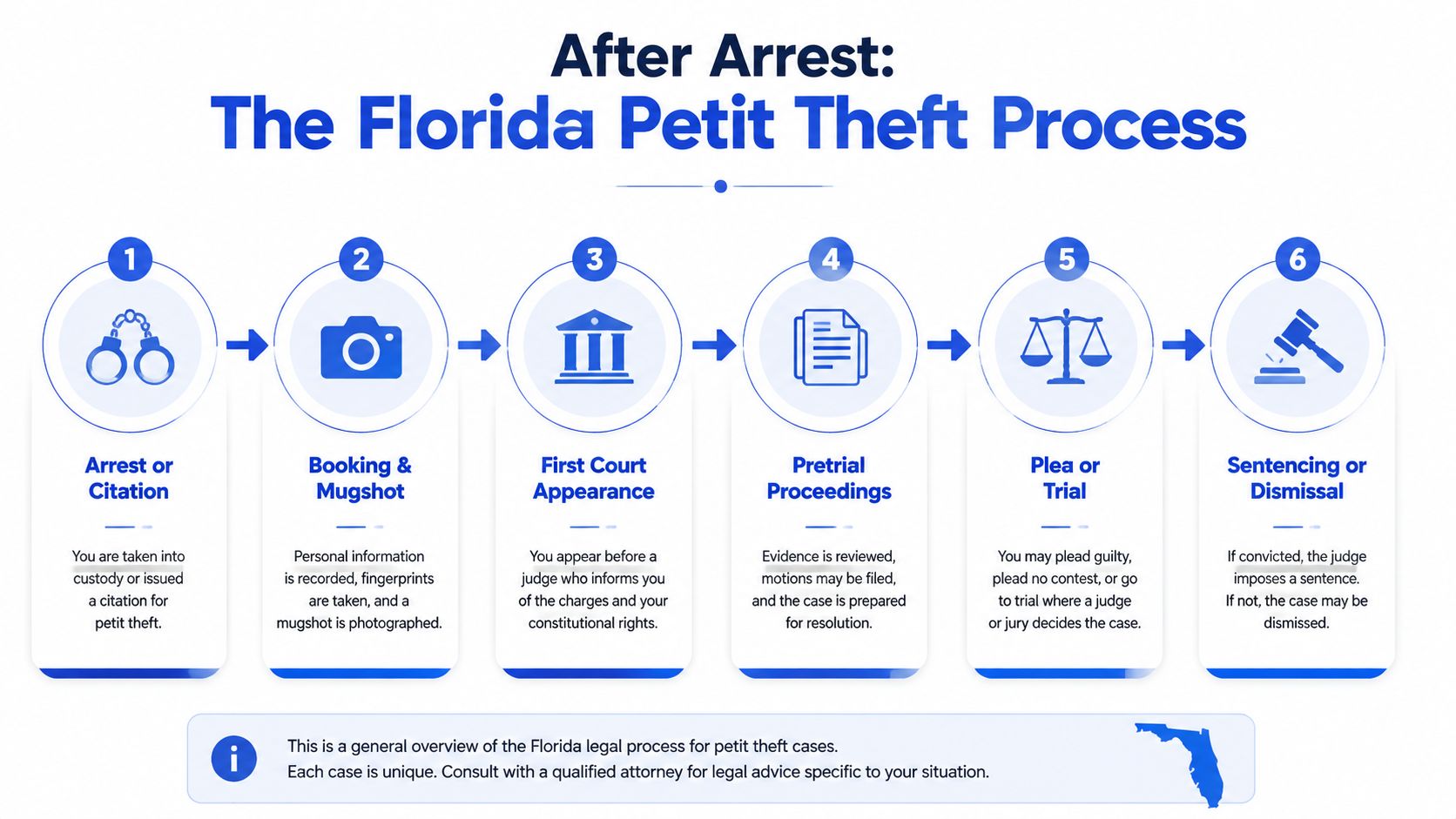
What Happens After Arrest, The Florida Petit Theft Procedure
The process may begin with an arrest, a notice to appear, or a retail investigation followed by formal filing. Once the case enters the Florida court system, deadlines and strategic decisions start accumulating.
Early custody and court decisions
After booking, a person may appear before a judge for release conditions. In Broward, Miami-Dade, and Palm Beach County courts, the court can address identity, the charge, release status, and conditions designed to address appearance and community-safety concerns. The exact procedure depends on the circumstances, but the first appearance is not the time to explain the entire incident.
The right to remain silent applies during police questioning. Statements to loss prevention personnel can also become evidence, even when the speaker believes the conversation is informal. A lawyer can address release conditions and communicate with the State Attorney's Office without sacrificing the defense position.
Charging, discovery, and pretrial litigation
The State Attorney's Office reviews reports, videos, witness statements, valuation material, and criminal-history information before proceeding. The defense should request and analyze discovery, then identify whether the evidence proves intent and the correct property value.
A formal arraignment addresses the plea and case posture. You can review what happens at arraignment in Florida, but the practical point is simple: don't enter a plea without understanding the charge, available defenses, and record consequences.
Pretrial conferences may involve negotiations, diversion discussions, motions, and scheduling. A suppression motion can matter if police obtained evidence through an unlawful search, detention, or interrogation. It may not win every case, but filing the right motion can remove critical evidence or improve the defense's negotiating position.
Defenses and Evidence Challenges in Petit Theft Cases
Petit theft cases often look simple because a store report may contain a short narrative and video footage. That doesn't mean the State has proved every element. Florida prosecutors must establish beyond a reasonable doubt that the accused knowingly obtained or used another person's property with the intent to deprive the owner of it.
Intent is usually the central dispute
A person can leave a store with unpaid merchandise without intending to steal it. An item may remain in a cart, a self-checkout transaction may fail, or the person may sincerely believe payment occurred. The defense must connect that explanation to objective evidence rather than relying only on a later denial.
Receipts, bank records, checkout logs, phone messages, store policies, and witness testimony can help establish what the person believed at the time. The State may argue that conduct after leaving the store proves intent, but the defense should test whether the video shows the relevant actions and context.
The key question isn't whether the item left the store. It's whether the evidence proves a knowing, intentional deprivation.
Valuation and identification problems
The alleged value must support the degree charged. Loss-prevention personnel may use a retail price, an estimate, or a report that doesn't account for condition or ownership. Counsel should demand documentation and determine whether the State has treated separate property or incidents as one event without a lawful basis.
Surveillance footage also requires careful review. A video may show movement but not intent. It may omit the approach to the register, fail to show who handled the item, or contain gaps that make identification uncertain. A witness's confidence doesn't eliminate the need to prove identity reliably.
Police and merchant conduct
A defense lawyer should examine how the detention occurred, what questions were asked, whether officers had lawful grounds to search, and whether the accused received required warnings before custodial interrogation. Chain-of-custody issues can matter when physical evidence, transaction records, or stored video are introduced.
Learn more about motions to suppress evidence in Florida criminal cases. Suppression is not a magic phrase. It works when a specific constitutional or evidentiary defect connects to evidence the State needs.
Immediate Steps to Take If You Are Charged with Petit Theft
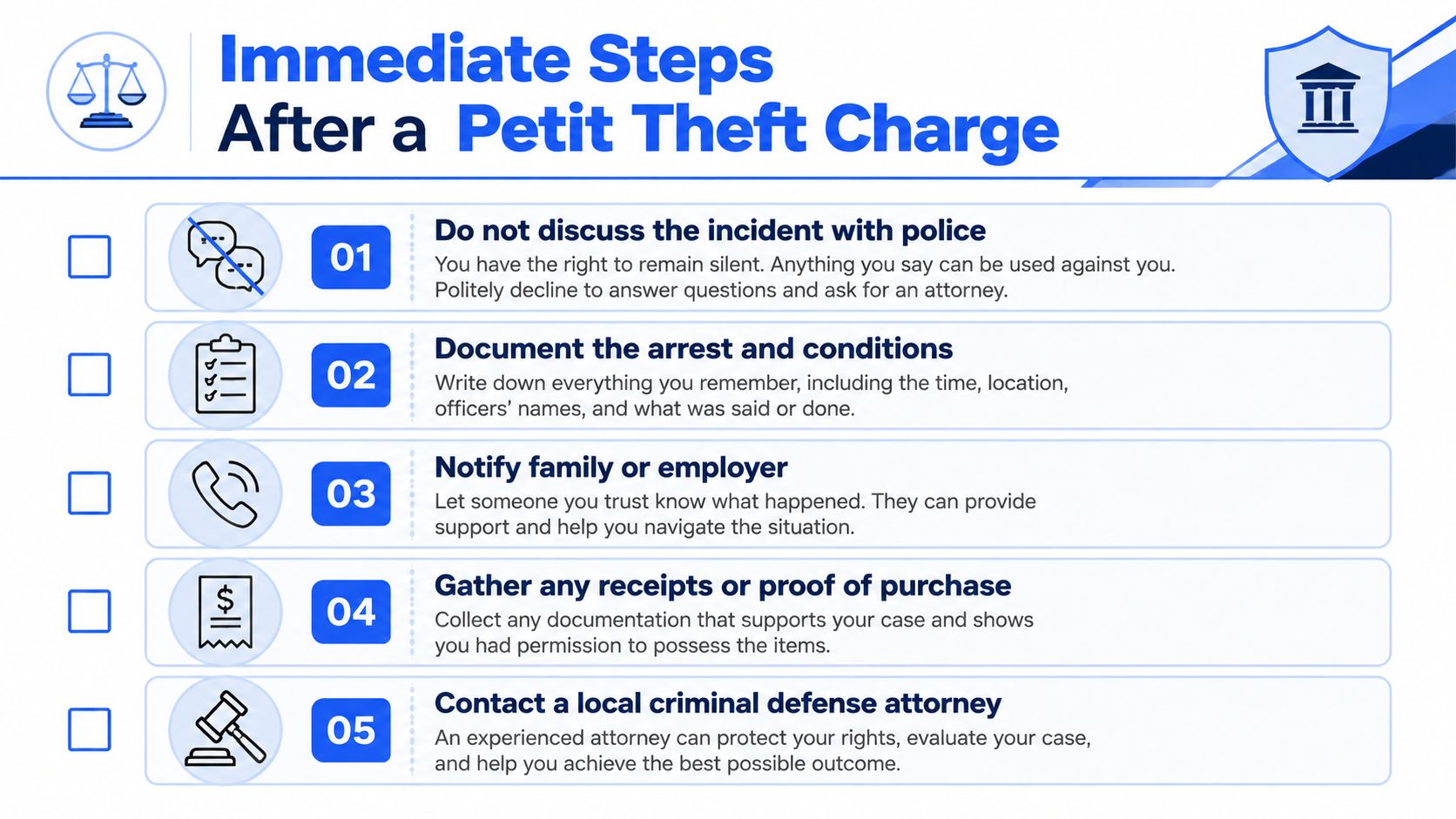
The first day after an arrest or citation is a poor time for improvisation. Take deliberate steps that preserve evidence and avoid unnecessary statements.
Invoke silence clearly. Tell police and loss prevention that you want to remain silent and speak with counsel. Don't fill the silence with explanations, apologies, or guesses.
Don't sign documents casually. Store statements, civil demand paperwork, written admissions, and other forms may affect the case. Have counsel review anything that asks you to describe the incident or accept responsibility.
Preserve the timeline. Write down where you were, who was present, what happened at checkout, what employees said, and when police arrived. Memory fades, and a contemporaneous account can help counsel test later reports.
Collect records. Save receipts, bank statements, purchase confirmations, texts, emails, and photographs of the merchandise or transaction. Don't alter, delete, or post them.
Avoid public discussion. Social-media posts, direct messages to the store, and conversations with potential witnesses can be obtained or misunderstood. Don't contact an alleged victim to pressure them to drop the case.
Contact counsel before making strategic choices
A local criminal defense lawyer can confirm the next court date, address release conditions, request discovery, and evaluate diversion or dismissal options. Don't assume that missing a court date, appearing without counsel, or negotiating directly with the prosecutor is harmless.
South Florida courts have different calendars and administrative practices. Early legal review gives counsel time to preserve video, investigate valuation, and protect a disposition that may support future record sealing.
Possible Case Outcomes and Record-Sealing Options
A petit theft case can end through dismissal, diversion, a negotiated plea, a not-guilty verdict, or a conviction after trial or plea. Those outcomes don't carry the same future consequences, even when the original accusation is identical.
For a first-time client, diversion may require conditions such as classes, community service, restitution, or compliance with court supervision. Successful completion can create a path toward dismissal, but the exact program and eligibility depend on the county, prosecutor, court, and facts. A negotiated withhold may avoid an adjudication of guilt in appropriate circumstances, yet it still requires careful review because the plea and underlying charge can affect later relief.
Record impact deserves attention from the beginning
Florida's record-sealing rules expressly identify petit theft as potentially eligible for sealing in appropriate cases. FDLE guidance also requires an applicant to attest that they have never previously had a Florida record sealed or expunged. Adjudication, prior record relief, and the precise disposition can determine whether sealing or expungement remains available.
The safest strategy is to discuss record relief before accepting an offer. A resolution that appears convenient today may permanently damage eligibility tomorrow. Review Florida record sealing and expungement options before making a final decision.
Outcome | Jail or fine exposure | Record-sealing eligibility |
|---|---|---|
Dismissal | No sentence on the dismissed charge | May support sealing or expungement, subject to eligibility |
Diversion completed successfully | Program conditions control the immediate consequences | May preserve a path to record relief, depending on the disposition |
Withhold of adjudication | Negotiated conditions and statutory exposure still matter | May permit sealing in an eligible case |
Not-guilty verdict | No criminal sentence for the acquitted charge | May support record relief, subject to Florida requirements |
Adjudication of guilt | Misdemeanor or felony consequences depend on the charge | Can restrict or eliminate available relief |
A record-clearing application isn't automatic after dismissal or withholding. Counsel must verify eligibility, obtain the required documentation, and account for any prior sealing or expungement history.
Why Experienced Local Counsel Changes the Outcome
Local experience matters because criminal cases are handled by people operating within particular court systems. A lawyer who has worked as a prosecutor understands how charging decisions are made, what evidence intake lawyers tend to value, and which weaknesses deserve attention before negotiations harden.
In Broward County, Miami-Dade, and Palm Beach County, counsel must also manage different dockets, courtroom procedures, prosecutors, and judicial expectations. That familiarity doesn't guarantee a result. It does help a lawyer identify the correct decision-maker, obtain discovery efficiently, and present a focused explanation of why the charge, evidence, or disposition should change.
What early intervention can accomplish
A defense lawyer can begin with the practical questions:
Is the alleged value supported by records?
Does the video show intent, or only movement?
Did police or store personnel exceed lawful detention limits?
Does the State have proof of two qualifying prior theft convictions?
Would a proposed plea preserve record-sealing eligibility?
Those questions shape motions and negotiations. They also prevent a client from making an uninformed admission because the charge appears minor.
A low dollar amount can reduce the charge, but it doesn't replace a defense strategy.
Former prosecutorial experience can be useful when counsel evaluates how the State is likely to frame the report. The defense still has to test that framing against admissible evidence and the legal burden of proof.
The cost of treating the case as insignificant
Representation protects more than liberty. It can affect employment, housing, licensing, immigration advice, and the possibility of sealing a record later. A defense lawyer should explain the trade-offs of dismissal efforts, diversion, a withhold, trial, and any restitution request rather than pushing a client toward a single outcome without context.
You can learn more about selecting counsel for a Florida criminal case through this Florida criminal defense lawyer resource. The right approach depends on the facts, not on a promise of a particular result.
Frequently Asked Questions About Petit Theft in Florida
Can a first-time defendant avoid jail?
Jail is legally possible, but the statutory maximum isn't an automatic sentence. Counsel should investigate diversion, dismissal, a withhold, restitution terms, and other outcomes based on the evidence and the client's record.
Do prior adjudications count toward felony escalation?
The State must establish qualifying prior theft convictions. A lawyer should review the actual records, the offense descriptions, and the final dispositions rather than accepting a criminal-history summary at face value.
Does returning the property end the case?
No. Returning merchandise may help negotiations or restitution discussions, but it doesn't automatically dismiss a criminal charge. Don't contact the store or make a payment without understanding how the action could affect the defense.
How long will the case take?
There isn't one fixed timeline for Broward, Miami-Dade, or Palm Beach County. The schedule depends on filing, discovery, court availability, negotiations, motions, and whether the case proceeds toward trial.
Can the charge affect licensing or immigration?
It can. Theft-related allegations may create professional and immigration concerns that depend on the charge, plea language, factual basis, and final disposition. Noncitizens and licensed professionals should obtain advice before resolving the case.
What should I ask a lawyer?
Ask whether the evidence proves intent, how the State calculated value, whether prior convictions create felony exposure, what diversion or dismissal paths may exist, and whether the proposed resolution preserves record-sealing options.
Ticket Shield, PLLC offers confidential consultations for people facing petit theft and other Florida criminal charges, including DUI, drug crimes, domestic violence, weapons offenses, and probation violations. Contact Ticket Shield, PLLC to discuss the evidence, court process, and record-protection strategy with a former prosecutor serving Broward County, Fort Lauderdale, Miami-Dade, Palm Beach, and surrounding Florida communities.