Protect Your Rights: Criminal Defense Lawyer Florida
Jason Goldsmith, Esq
An arrest in Florida can make the next few hours feel unreal. One phone call, a trip to jail, a bond question, a court date, and suddenly your job, license, immigration status, reputation, and freedom all feel exposed at once.
When seeking a criminal defense lawyer in Florida, you probably don't need legal theory. You need a clear explanation of what happens next, what mistakes to avoid, and where a strong defense achieves an advantage in Broward County, Fort Lauderdale, Miami-Dade, Palm Beach, and surrounding South Florida courts. A former prosecutor's perspective matters here because it helps you understand not just what the State is doing, but why prosecutors push certain charges, which facts they care about most, and where a case is weaker than it looks on paper.
Table of Contents
The Florida Criminal Case Timeline From Arrest to Resolution
You Have Been Arrested in Florida What Happens Now
Most clients call during the most disorienting part of the case. They were stopped on I-95, arrested after an argument at home, accused of theft at work, or picked up on a probation violation in Broward County or Miami-Dade. They want to know the same thing. "What happens now, and how bad is this?"
The first answer is practical. The arrest is only the beginning of the case, not the end of it. What you say, what conditions of release the court imposes, whether evidence gets preserved, and whether a lawyer gets involved early can change the direction of the entire matter.
That matters even more in misdemeanor cases because many people assume the court will assign them a lawyer automatically. In Florida, that often doesn't happen. The vast majority of Florida misdemeanor defendants, approximately 87%, proceed through the court system without private representation, often leading to unfavorable outcomes because the state doesn't guarantee appointed counsel when jail isn't being sought, as explained by the Equal Justice Initiative's report on misdemeanor representation in Florida.
The first priorities after an arrest
Stay silent about the facts. Don't try to explain your way out after arrest. Explanations often become evidence.
Find out your next court date and release status. If you're dealing with bond or conditions, this overview of Florida pretrial release helps explain the basics.
Preserve evidence immediately. Save texts, call logs, photos, GPS data, receipts, and names of witnesses before they disappear.
Get legal advice before talking to anyone else about the case. That includes police, alleged victims, coworkers, and sometimes even family on recorded jail calls.
Practical rule: Early action doesn't just reduce panic. It protects facts that may never be recoverable later.
A Florida criminal case moves fast at the beginning. Prosecutors make early judgments from reports, witness statements, videos, and your own words. A defense lawyer's job starts before trial. It starts with stopping avoidable damage.
The True Role of Your Criminal Defense Lawyer
A criminal defense lawyer doesn't just "show up in court." In a real Florida case, especially in Fort Lauderdale, Broward County, and the South Florida circuit courts, defense work starts with control. Control over statements, over evidence, over deadlines, and over the narrative the State wants the judge to accept.

Guardian of your rights
Police and prosecutors are allowed to investigate. They aren't allowed to ignore the Constitution while doing it. A defense lawyer looks at the stop, the search, the questioning, the identification procedure, the warrant, and the seizure of phones, cars, homes, or weapons.
That review matters in DUI, drug, gun, and domestic violence cases alike. If an officer lacked legal grounds for a stop or searched beyond lawful authority, the issue isn't technical. It can decide whether key evidence comes in at all.
Strategic investigator
The State's version of events is usually built from paperwork first. Arrest reports, probable cause affidavits, witness statements, body camera clips, lab submissions, and dispatch logs tell prosecutors what they think happened. They don't always tell the whole story.
A lawyer with former prosecutor experience reads those materials differently. The question isn't just "What evidence exists?" It's "What is missing, inconsistent, or overstated?" Timing gaps, vague witness language, poor chain of custody, suggestive identifications, and overcharged counts often create pressure points the defense can use.
Prosecutors usually make early decisions from incomplete information. Good defense counsel corrects the record before that first impression hardens.
Skilled negotiator with trial credibility
Negotiation in criminal court isn't about charm. It's about advantage. Prosecutors negotiate differently when they know defense counsel has identified legal problems, preserved witnesses, and is prepared to litigate motions or try the case if necessary.
That is where local court experience matters. A lawyer who regularly appears in Broward, Fort Lauderdale, Miami-Dade, and Palm Beach courts understands how certain dockets move, what conditions judges commonly impose, and which cases need immediate mitigation versus aggressive challenge. If you're looking at attorney background and courtroom approach, reviewing a firm's about page and case philosophy can help you understand how they practice.
In practical terms, your lawyer's role is to protect your rights, test the State's proof, and push for the best lawful outcome available. That can mean dismissal, a reduction, a diversion option, suppression of evidence, a negotiated resolution, or trial. It depends on the facts, not slogans.
Common Criminal Charges We Defend in South Florida
South Florida courts see a wide range of criminal allegations. Some begin with a traffic stop. Others come from a breakup, a neighborhood dispute, a workplace accusation, or a search warrant. The charge on the booking sheet rarely tells you the whole risk.
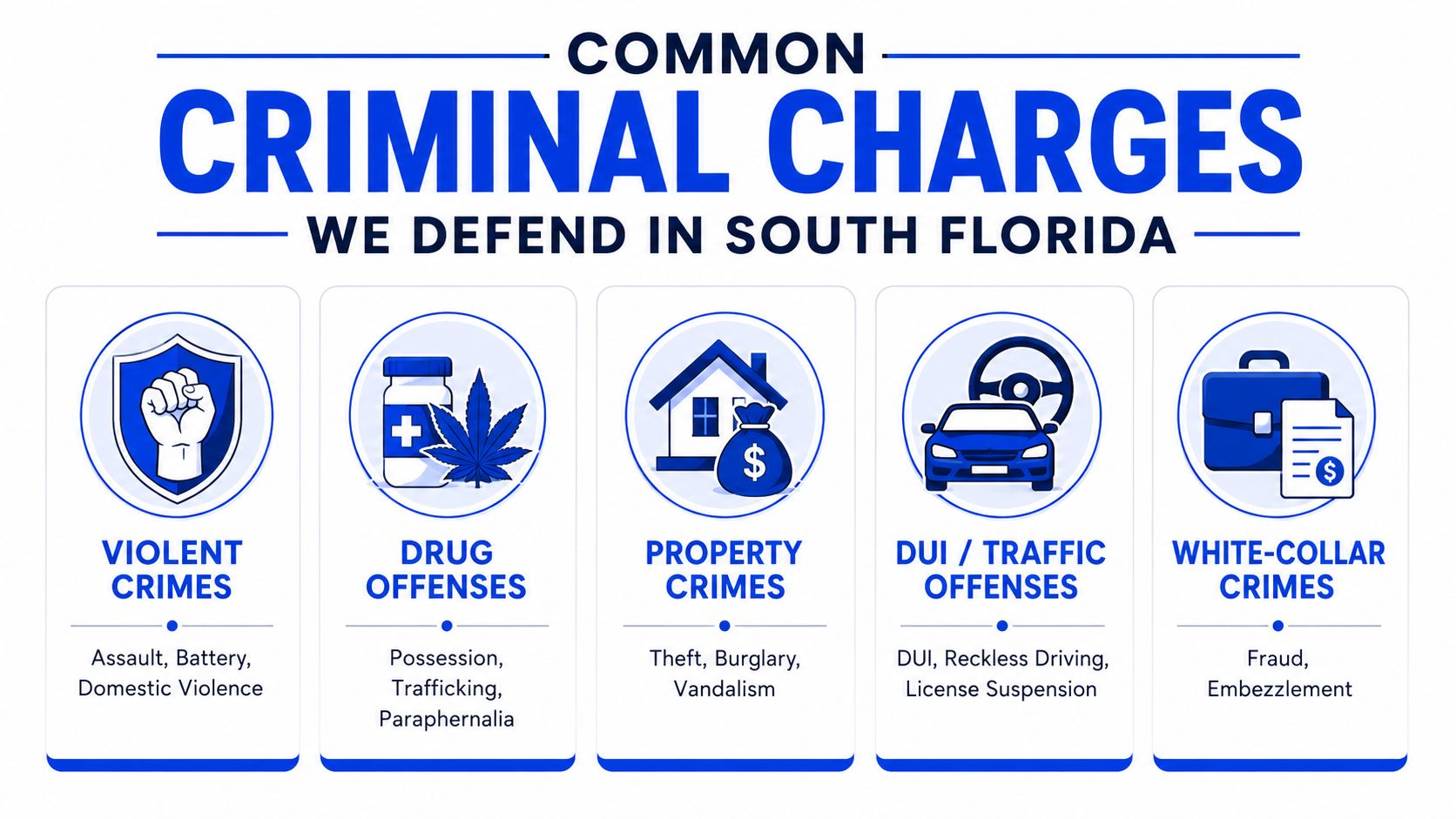
DUI and Traffic Crimes
A Fort Lauderdale DUI lawyer doesn't just look at whether alcohol was alleged. The defense starts with why you were stopped, what the officer observed, how field sobriety exercises were administered, whether breath testing procedures were followed, and what happened to your driver's license.
Florida DUI penalties show why details matter. A first-time DUI with a BAC below 0.15 carries a fine of $500 to $1,000 and up to 6 months in jail, while a BAC of 0.15 or higher raises the fine to $1,000 to $2,000 and jail exposure to 9 months, with a mandatory ignition interlock device, according to this Florida DUI penalty summary for high-BAC and first-offense cases.
Traffic-related criminal matters also include:
Reckless driving allegations involving speed, swerving, or crashes
Driving while license suspended cases that can become criminal quickly
Leaving the scene accusations where identity and knowledge become central issues
Habitual traffic matters that threaten your ability to work and drive legally
Drug Charges and Search Issues
A Broward County drug crime attorney often wins ground by challenging how police found the evidence in the first place. Drug cases turn on possession, knowledge, control, and lawful police conduct. If the search was improper, the case may weaken sharply.
Drug allegations can include:
Simple possession
Possession with intent
Trafficking accusations
Paraphernalia charges
Prescription-related offenses
For clients dealing with controlled substance allegations, a focused Florida drug crimes resource center can help you understand how these cases are commonly charged and defended.
Theft Fraud and White Collar Allegations
Theft cases aren't always simple shoplifting cases. They include retail theft, employee theft, fraud-related accusations, organized schemes, and allegations involving business records or electronic transfers. In many of these cases, the fight is over intent.
A person may admit taking property but deny criminal intent. Another may have had permission, believed they had a right to the property, or be facing an identification problem based on video quality or witness assumptions. White collar cases add document review, financial tracing, and communication history to the mix.
A theft charge often looks stronger in a police report than it does after receipts, timelines, surveillance angles, and text messages are lined up carefully.
Violent Crimes Domestic Violence and Weapons Cases
Florida domestic violence defense requires fast action because the accusation alone can affect housing, family contact, employment, and firearm rights. Violent crime charges can include battery, aggravated battery, assault-related allegations, robbery, and homicide offenses. Weapons cases often rise or fall on possession, lawful ownership, vehicle access, and search issues.
These cases usually require immediate attention to:
No-contact conditions
Witness statements that may change over time
Self-defense or defense-of-others claims
Medical records and injury interpretation
Search and seizure questions involving homes or vehicles
Juvenile Cases Record Sealing and Related Matters
Juvenile cases require a different approach because the long-term goal is often broader than avoiding immediate punishment. School consequences, diversion eligibility, family stability, and future record issues all matter. The same is true for record sealing Florida matters and expungement analysis after the criminal case ends.
Other matters commonly tied to criminal defense include probation violations, injunctions or restraining orders, sex crime investigations, and federal cases. Each has its own procedural traps. The right defense begins by identifying which facts matter to the prosecutor and which assumptions can be challenged.
The Florida Criminal Case Timeline From Arrest to Resolution
The criminal process feels chaotic when you're living through it. In reality, most Florida cases follow a sequence. Once you understand the sequence, you can see where defense decisions matter.
A visual overview helps first.

The early stages
After arrest, booking comes first. That means fingerprinting, photographs, data entry, and holding while the case gets queued for court review. Then comes first appearance or a bond hearing, where the judge reviews the allegation, considers release conditions, and addresses custody issues.
Arraignment comes later. That's the formal hearing where the charge is announced and a plea is entered. If you want a closer look at what that hearing usually involves, this guide on what happens at arraignment in Florida gives a useful overview.
Here is the basic flow:
Stage | What it usually means for you |
|---|---|
Arrest and booking | The State creates the official case record |
First appearance | Release conditions, bond, and restrictions can be imposed |
Charging decision | Prosecutors decide what counts to file and how aggressively |
Arraignment | Formal notice of the charges and your plea |
Discovery | The defense obtains reports, videos, witness material, and other evidence |
Motions | Legal challenges to searches, statements, identifications, or procedures |
Negotiation or trial | The case resolves by agreement or proceeds to court |
Sentencing if needed | The court imposes penalties after a plea or conviction |
This short video also gives a useful overview of the process:
How the case gets built or broken
Discovery is where many clients first realize the police report is not the whole case. Body camera footage may help or hurt. Witnesses may be stronger than expected, or much less certain than the report suggests. In DUI and drug cases, technical records matter. In theft and domestic violence matters, digital communications often become central.
Then come pretrial motions. These are targeted legal attacks on the State's evidence. A motion to suppress may challenge a stop, a search, a confession, or an identification procedure. A motion in limine may limit what the jury gets to hear. In some cases, motions force the prosecutor to re-evaluate the file.
Good defense work follows the timeline, but it doesn't passively wait for the next court date. It uses each stage to improve the next one.
Many cases resolve without trial. That doesn't mean they resolve casually. The strongest negotiated outcomes usually come after the defense has shown the prosecution why the case is riskier than it first appeared.
How to Evaluate and Hire the Right Florida Defense Lawyer
Hiring counsel is one of the few decisions in a criminal case that is fully yours. It deserves more than a quick search result and a rushed phone call. The right lawyer for your case should understand the charge, the local court, the evidence problems, and the strategic choices that matter in Florida.
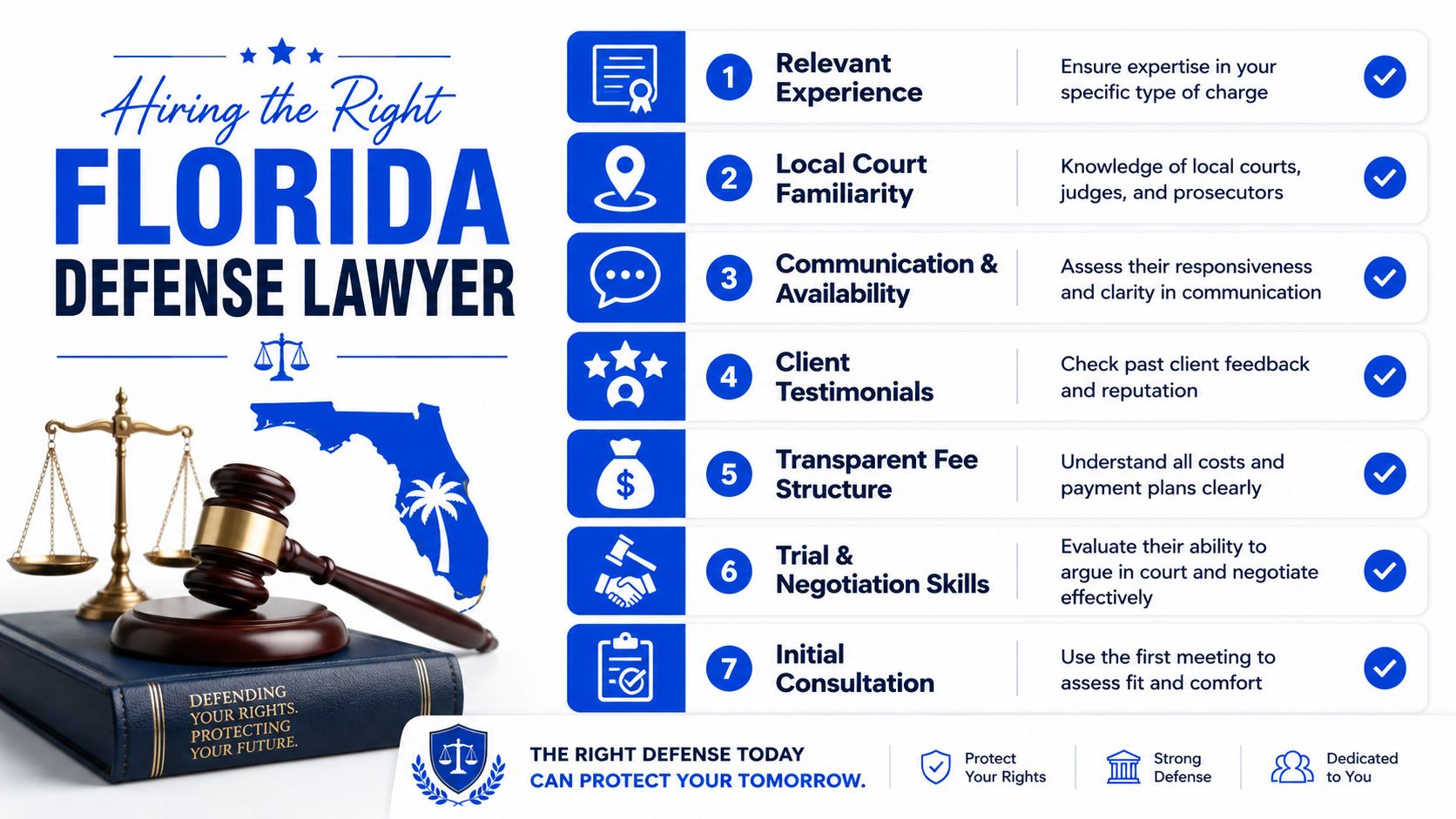
Questions worth asking in the first consultation
Ask questions that reveal how the lawyer thinks, not just how they market. A useful consultation should sound like case analysis, not a sales script.
Consider asking:
What weaknesses do you see in the State's case right now
This shows whether the lawyer can identify legal and factual pressure points early.How often do you handle this type of charge in South Florida courts
Local familiarity matters in Broward County, Fort Lauderdale, Miami-Dade, and Palm Beach.Will you personally handle my hearings and communication
You need clarity about who is responsible for your case.What is your approach to plea negotiations versus trial preparation In Florida practice, real trial readiness often improves one's negotiating position.
What should I do today to help my defense
Strong lawyers give immediate, practical advice about evidence preservation, contact restrictions, and silence.
A former prosecutor's perspective can be especially useful here. It helps your lawyer predict how charging decisions are made, what arguments a prosecutor is likely to reject, and what facts may move the conversation.
What fees and public defender options really look like
Criminal defense fees in Florida depend heavily on the charge. According to this overview of Florida criminal defense fee ranges, a first-offense DUI resolved without trial averages about $3,500, minor misdemeanors often range from $1,000 to $3,500, standard misdemeanors commonly fall between $2,000 and $5,000, third-degree felonies may require $5,000 to $10,000, serious felonies can exceed $20,000, and the most severe charges often start at $35,000 and can rise into six figures. The same source notes that hourly rates in Florida generally fall between $300 and $400.
That doesn't mean hourly billing is always used. Many firms quote flat fees for misdemeanor and routine felony matters. Others use retainers, especially for cases likely to involve extensive motion practice or trial work.
Public defender eligibility is another area people misunderstand. Florida Statute 938.29 provides for appointment of a public defender when income is at or below 200% of federal poverty guidelines, and a judge may also appoint one if hiring private counsel would create "substantial hardship" for the family, as explained in this discussion of Florida indigency and substantial hardship standards. Many people assume they won't qualify when they should apply.
A practical comparison helps:
Option | Best for | Key trade-off |
|---|---|---|
Private counsel | Cases needing intensive strategy, expert review, or fast communication | Higher out-of-pocket cost |
Public defender | Qualified defendants who need representation but can't afford private counsel | Caseload realities can limit personalized attention |
If you're evaluating private counsel, one option in this market is Ticket Shield, PLLC, which handles Florida traffic, DUI, and criminal defense matters statewide and emphasizes direct attorney communication and individualized defense planning. The key point is to choose counsel based on fit for your case, not slogans.
Key Defense Strategies to Protect Your Freedom
No ethical lawyer can promise a result. Florida lawyers are prohibited from guaranteeing outcomes, and that rule exists for a reason. Criminal cases turn on facts, witnesses, judges, legal rulings, and sometimes evidence that isn't available on day one.
Still, defense strategy is not guesswork. It follows a disciplined pattern. The lawyer identifies what the State must prove, what evidence may be excluded, what facts can be reframed, and when negotiation makes sense versus when litigation is the better path.
Suppress weak or illegal evidence
One of the most powerful tools in criminal defense is the motion to suppress. If police obtained evidence through an unlawful stop, search, seizure, or interrogation, the defense can ask the court to exclude it.
That matters in many kinds of cases:
Drug cases often turn on vehicle or body searches
Gun charges may depend on who had actual control over the weapon
DUI arrests can involve stop validity, field exercise issues, and breath test procedures
White collar and phone-search cases may raise warrant-scope questions
The defense also tests witness reliability. Was the identification rushed? Was the witness influenced by another person's account? Did body camera footage contradict the written report? These aren't side issues. They often determine whether the prosecution can prove the case beyond a reasonable doubt.
Use trial readiness as real leverage
A lawyer who is prepared to try the case changes the negotiation dynamic. Prosecutors can tell the difference between a file that is being processed and a file that is being challenged. Trial readiness means subpoenas are considered, evidentiary objections are developed, witnesses are evaluated, and the defense is prepared to force the State to prove every required element.
That matters because Florida lawyers often advise clients about the significant risk of the trial tax. As noted in this explanation of Florida ethics rules and the trial tax phenomenon, attorneys can't guarantee results, but they do counsel clients about the reality that sentences after trial loss are often harsher than pretrial offers.
Trial readiness isn't about recklessness. It's about creating enough pressure that the State has to evaluate the case honestly.
A sound strategy weighs three things at once:
Legal risk. Can key evidence be excluded?
Factual risk. How credible are the witnesses and documents?
Outcome risk. Is the proposed plea better or worse than the realistic trial exposure?
What doesn't work is panic pleading, talking freely to investigators, or hiring a lawyer based only on price. In South Florida criminal practice, advantage comes from preparation.
Frequently Asked Questions About Florida Criminal Defense
Should I talk to the police if they want to question me
Usually, no. If police want a statement, it's because they believe it may help their case. Even truthful statements can lock you into details before the defense has reviewed the evidence. Ask for a lawyer and stop talking about the facts.
What's the difference between sealing and expunging a record in Florida
Both are tools to limit public access to a criminal record, but they aren't the same remedy and not every case qualifies. Eligibility depends on the charge, the case outcome, and your prior history. If avoiding a permanent public record is part of your goal, ask that question early, not after the case is closed.
My loved one was just arrested in Broward County. What should I do first
Get the booking information, find out where the person is being held, confirm the next court date, and stop them from discussing facts on recorded calls. Then gather documents, screenshots, videos, witness names, and any timeline details while they're still fresh.
How does a probation violation case work
Probation violation cases are different from new criminal charges because the court focuses on whether a condition was violated, not just whether a new offense can be proven. Technical violations and new law violations carry different defense considerations. Fast action matters because release issues and hearing strategy often move quickly.
Can a criminal defense lawyer help with license problems after a DUI or traffic arrest
Yes. In many Florida DUI and traffic-related criminal matters, the driver's license issue moves on a separate but connected track. A defense plan should account for both the criminal court consequences and the driving consequences.
If you're facing charges in Fort Lauderdale, Broward County, Miami-Dade, Palm Beach, or elsewhere in Florida, don't wait for the system to become clearer on its own. It won't.
Ticket Shield, PLLC helps people facing DUI, drug, theft, violent crime, weapons, traffic, and probation-related charges across Florida. If you need confidential guidance now, contact Ticket Shield, PLLC to discuss your case, protect your rights early, and make informed decisions before the State's version of events takes control.
From the moment of arrest, your choices matter. Learn how a Florida criminal defense lawyer protects your rights at every stage.