Florida Misdemeanor Charges: Classes, Penalties, and Defense
Jason Goldsmith, Esq
You just got the call, or maybe the citation is still folded in your hand. The charge feels small on paper, but in a Broward, Miami-Dade, or Palm Beach courtroom, a misdemeanor can move fast, resolve fast, and still leave a lasting mark if the early decisions are wrong.
Florida handles misdemeanor cases at a volume that surprises many. A widely cited analysis found that nearly 500,000 people are charged with misdemeanor offenses in Florida each year, and many of those cases are processed in a matter of minutes at arraignment, often without counsel present (Florida misdemeanor arraignment statistics). That speed is the reason the first days matter so much. If you wait, you can miss advantages that exist before the court starts pushing toward a plea.
The better way to think about Florida misdemeanor charges is as a timeline, not just a penalty box. The State has to charge the case, prove the right elements, and move it through deadlines that can create real defense opportunities. Some cases can be challenged on the stop, the search, the identification, or the paperwork. Others turn on whether the accused has counsel early enough to spot a reduction, diversion, or dismissal path before the case hardens.
Table of Contents
Common Florida Misdemeanor Categories and Their Real Consequences
Defenses and Mitigation Strategies That Actually Move Florida Misdemeanor Cases
Why So Many Florida Misdemeanor Defendants Appear Without Counsel
Next Steps After a Florida Misdemeanor Charge and How an Attorney Helps
What to Do When You Are Facing Florida Misdemeanor Charges
A man in Fort Lauderdale gets stopped on the way home from dinner, leaves with a citation, and assumes it can wait until next month. A woman in Miami-Dade gets booked overnight on a simple battery allegation and spends the next morning trying to figure out whether she needs to plead, fight, or post bond. In both situations, the case feels chaotic, but the courtroom process is much more structured than it looks from the outside.
Move before the case settles into the court's rhythm
Florida misdemeanor cases often resolve quickly at arraignment, which is why early review matters. Arraignment data from Florida misdemeanor cases shows that 70% were resolved at arraignment, 85% of arraignments lasted less than 3 minutes, and 65% of people at arraignment did not have an attorney (Florida misdemeanor arraignment statistics). That is not a setting where you want to be learning the basics for the first time.
Practical rule: the first court date is often a pressure point, not a finish line.
The first moves are simple, but they matter. Keep every paper you were given, write down what happened while it is still fresh, and do not talk about the facts with friends, family, or on social media. If there was a stop, search, video, text exchange, or witness, preserve it now. That evidence can disappear before anyone files a formal motion.
A defense lawyer can also look for timing problems immediately. In custody cases, formal misdemeanor charges must be filed within 30 days under the Florida Rules of Criminal Procedure. If the State misses that deadline, or if the limitations period has already run, the charge may be vulnerable before it ever becomes a real plea discussion.
Do not treat a misdemeanor as a paperwork issue. Treat it as a clock that starts running the moment the officer writes the ticket or makes the arrest. In Broward, Miami-Dade, and Palm Beach courtrooms, that early window often shapes whether the case is resolved by quick plea, reduction, dismissal, or a fight over whether the State can prove the charge at all. A good early assessment can protect your record, your license, and your ability to negotiate from a position of strength.
How Florida Law Defines a Misdemeanor and Its Two Degrees
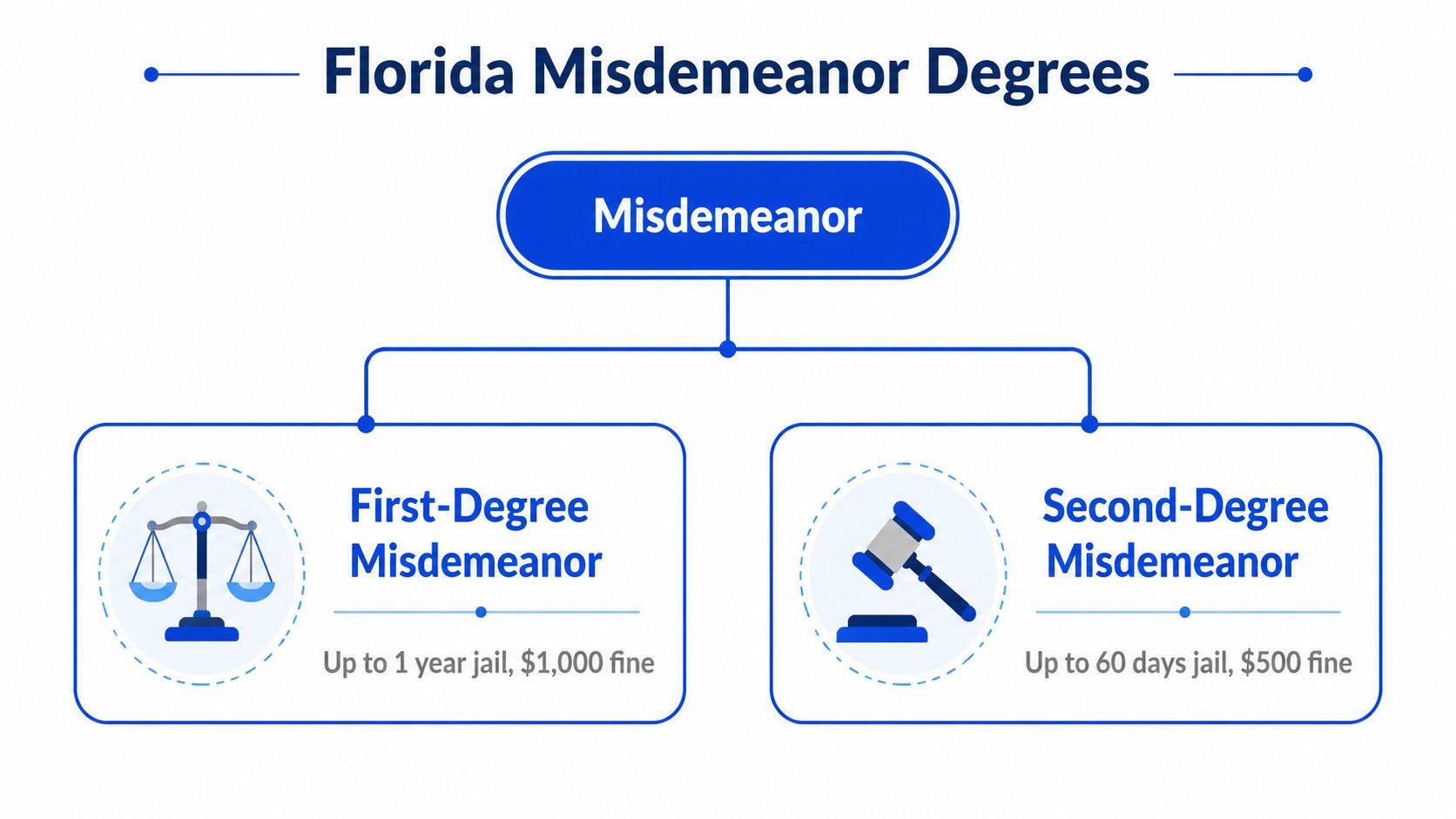
A Florida misdemeanor is not a loose label. State law defines it as any offense punishable by imprisonment in a county correctional facility for no more than 1 year (Florida Statutes section 775.08). That line matters because it separates misdemeanor exposure from felony exposure, and it is the first thing I check when I read a citation, arrest affidavit, or information.
Read the degree before you read the narrative
Florida divides misdemeanor charges into two degrees. A first-degree misdemeanor carries exposure to up to 1 year in county jail and a $1,000 fine (Florida sentencing primer, Florida misdemeanor penalty overview). A second-degree misdemeanor is capped at 60 days in county jail and a $500 fine. The same penalty framework is also summarized in the Florida sentencing primer and the Florida misdemeanor penalty overview.
The degree drives the case in practical ways. It affects plea bargaining, the pressure a prosecutor can put on a defendant, and how a judge reads the file during arraignment and later status conferences. It also tells you whether the State is treating the conduct as a lower-level criminal offense or as something serious enough to justify misdemeanor prosecution instead of a civil citation or ordinance matter.
Florida law draws another line that matters just as much. The definition excludes noncriminal traffic violations under chapter 316 and municipal or county ordinances. Those matters may still create headaches, fines, court appearances, and license problems, but they are not the same thing as a criminal misdemeanor under the statute.
That distinction shows up fast in real courtrooms. In Broward, Miami-Dade, and Palm Beach, the State's charging decision often turns on what can be proved, what can be filed on time, and whether the case has enough strength to justify a plea offer or a reduction. The prosecutorial discretion process in Florida often decides how hard the case will be fought before anyone ever reaches trial.
If you are looking at an arrest report or an information, start with the degree. Once that is clear, the rest follows more cleanly, the maximum jail exposure, the fine range, and the procedural rights attached to the charge.
How Often Florida Misdemeanor Cases End in Conviction
A Broward clerk calls a misdemeanor case, the defendant is standing there alone, and the offer on the table looks final before the person has even spoken to a lawyer. That scene is common enough to matter. Statewide outcome data covering 4,273,369 charges showed an overall conviction rate of 84.4%, while only 4.7% were dismissed and 7.4% were diverted (Florida prosecution outcomes dataset). The practical lesson is simple, a weak case can turn into a conviction quickly when nobody forces the State to justify it early.
Charge type changes the risk picture
The same Florida dataset shows how different misdemeanor-adjacent charges play out. DUI accounted for 69,311 cases and carried a reported 91.9% guilty rate. Trespassing was reported at 76.7%, and resisting officer at 70.8% (Florida prosecution outcomes dataset). Those numbers reflect how prosecutors evaluate proof, how often defendants accept a plea before the State has to prove every element, and how quickly a case can move when the defense does not press the weak spots.
Charge Category | Reported Florida Case Volume | Reported Guilty Rate |
|---|---|---|
DUI | 69,311 | 91.9% |
Traffic offenses | 403,226 | Not provided |
Drug possession | 253,254 | Not provided |
Battery | 102,245 | Not provided |
Resisting officer | 88,455 | 70.8% |
Trespassing | 75,693 | 76.7% |
Traffic offenses, drug possession, battery, and resisting officer all show up in Florida court files at substantial volume (Florida prosecution outcomes dataset). That matters because volume shapes practice. Prosecutors see these files every day, and judges do too. In Broward, Miami-Dade, and Palm Beach, that steady flow often pushes cases toward early resolution unless the defense identifies a real problem with the stop, the witness, the paperwork, or the charging deadline.
The gap between a headline maximum and what happens in court is where defense work pays off. A dismissal, a diversion, a negotiated reduction, or a withhold of adjudication can change how the case affects a driver's license, employment screening, and future background checks. The penalty range is only the starting point. What matters is whether the State can prove the charge and whether it has enough room to keep pushing after the first court date.
If prosecutorial pressure is driving the case more than the facts, it helps to understand how discretion works in the charging process. A useful breakdown is available in this discussion of prosecutorial discretion in Florida cases.
The Misdemeanor Court Process from Citation to Sentencing
A Florida misdemeanor case can move fast, and the first court date often matters more than people realize. In Broward, Miami-Dade, and Palm Beach, a citation or arrest is usually followed by booking if the person is taken into custody, first appearance for jailed defendants, formal filing, arraignment, discovery, pretrial negotiation, and then either trial or sentencing. The order matters because each step shows whether the State still has work to do, and whether the defense still has room to press for a better result.
The deadlines that actually matter
For a person in custody, the State must file formal misdemeanor charges within 30 days. The statute of limitations is 2 years for a first-degree misdemeanor and 1 year for a second-degree misdemeanor or noncriminal violation. Those limits create real defense issues when the filing is late or the charge is stale, because timing can limit what the State can still pursue.
Florida also gives different trial rights depending on the degree of the case. A first-degree misdemeanor defendant has an absolute right to a jury trial, and the jury is made up of 6 jurors who must be unanimous to convict. A second-degree misdemeanor defendant does not have a jury-trial right and the case may be decided by a judge (Florida misdemeanor jury trial guidance).
A working courtroom timeline
Citation or arrest. The case starts here, and the wording on the report can shape the rest of the file.
Booking and fingerprints. If the person is arrested, the State creates the first official record.
First appearance. Custody, bond, and immediate release questions get addressed here. In practice, this can be the first point where the court and the prosecutor show their hand, especially if the defendant appears without counsel.
Arraignment. The court reads the charge and a plea is entered. A practical explanation of that hearing is available in this discussion of what happens at arraignment in Florida criminal cases.
Pretrial motions. Discovery, suppression issues, and defects in the charging document are raised.
Trial or plea. The defense either tests the case or works the best available resolution.
Sentencing. If the case ends in a conviction or withhold, the court imposes the final terms.
Arraignment is often treated like a routine calendar event, but that is where a rushed plea can lock in consequences before the evidence has even been reviewed. In misdemeanor court, especially in busy dockets, the State often expects quick movement, and that expectation can create an advantage for the defense if counsel is prepared and the charging papers are weak. That is why timing, the filing deadline, and the quality of the initial charge matter as much as the stated maximum penalty.
Common Florida Misdemeanor Categories and Their Real Consequences
The offenses people see in Broward, Miami-Dade, and Palm Beach courtrooms are usually the ones that follow ordinary traffic stops, bar fights, apartment complaints, or low-level drug calls. DUI, battery, drug possession, trespassing, resisting an officer, and traffic-related offenses move through Florida dockets in high numbers, but the charge label never tells the full story. The direct penalty is only part of what a defendant has to worry about.
Why the category changes the defense
A DUI case often turns on whether the stop was lawful, whether the field sobriety exercises were administered fairly, whether the breath test was reliable, or whether the officer can prove actual physical control. Battery cases usually turn on contact, injury, self-defense, or whether both sides were part of the confrontation. Drug possession cases can rise or fall on search-and-seizure issues, ownership, and whether the State can connect the substance to the accused. Trespassing and resisting officer cases often hinge on notice, a lawful command, and what happened before the arrest.
The category also affects the long-term fallout. A plea to a DUI-related charge can affect driving privileges and insurance costs. A battery or domestic-related plea can create problems with employment, housing, school, and family court matters. For noncitizens, even a misdemeanor plea can create immigration problems that reach far beyond the criminal case. That is why the exact wording of the plea matters so much in real courtrooms.
The most significant consequences often appear after the plea is entered.
Even a second-degree misdemeanor is not a throwaway case. The jail exposure is lower, but the court can still impose probation, treatment, and financial conditions that last longer than the short sentence itself. If the charge can be reduced, narrowed, or resolved without an adjudication of guilt, that can change the defendant's record, future options, and how the case is treated later by employers, licensing boards, and other courts.
A plea that looks harmless on paper can still carry weight in practice. In misdemeanor court, I have seen that happen fast, especially when a defendant appears without counsel and the State is pushing for an early resolution. The issue is rarely just whether the conduct happened, it is what the State can prove, how the charge is drafted, and whether the defense uses the available pressure points before a rushed plea closes them off.
Defenses and Mitigation Strategies That Actually Move Florida Misdemeanor Cases
The best misdemeanor defense rarely starts with a dramatic courtroom speech. It starts with pressure on the State's proof. If the stop was illegal, the search was unlawful, the witness is unreliable, or the paperwork is defective, the defense has something real to work with. Those issues matter more than the label on the arrest report.
The strongest moves are usually practical, not theatrical
Fourth Amendment issues come up often in Florida misdemeanor work. If the officer lacked a lawful basis for the stop or search, evidence can be excluded. In DUI and drug cases, that can collapse the prosecution's position. In theft, battery, or trespass cases, the same kind of challenge can weaken the key facts the prosecutor planned to rely on.
Mitigation also matters. Pretrial diversion, negotiated reductions, and withhold of adjudication can be better outcomes than a straight plea to the charged offense. Florida diversion programs are often used to steer a case away from a conviction when the facts, the record, and the local office's policy line up. A practical overview of one such path appears in this discussion of the PTI program in Florida.

What good mitigation usually looks like
Challenge the stop early. If the encounter was illegal, the case may lose its evidentiary core.
Test the identification. Mistaken identity and unreliable witnesses still show up in misdemeanor files.
Look for intent problems. Some charges require a state of mind the State still has to prove.
Check the dates. Deadline defects can end a stale prosecution before it matures.
Push for resolution terms that protect the record. Not every plea is equal.
One additional option, depending on the result, is record relief. Florida's sealing and expungement rules can matter after a misdemeanor ends, especially when the person avoided an adjudication of guilt or qualifies under another pathway. A useful starting point is this guide to record sealing in Florida.
A former prosecutor understands where the State tends to overreach and where it tends to fold. That's the value of early intervention. You are not just reacting to the charge. You are trying to shape the case before it locks into a bad outcome.
Why So Many Florida Misdemeanor Defendants Appear Without Counsel
A Florida misdemeanor case can move from arrest to plea discussion before the defendant has time to understand what is at stake. That speed explains a lot of the counsel gap. A widely cited analysis reported that only 45% of Florida misdemeanor cases had a public defender present and only 13% had a private attorney present, while 65% of people at arraignment did not have an attorney (Florida misdemeanor counsel data). The earlier arraignment data points to the same reality, many people are standing in front of the court without legal help when the case is already moving.
Counsel changes the pressure in the room
A lawyer can evaluate bond, preserve motions, push back on rushed pleas, and explain collateral consequences before the client signs anything. A person standing alone usually gets the charge read, hears the State's position, and is told to make a choice. Those are very different situations.
In Broward, Miami-Dade, and Palm Beach, that difference shows up fast. Judges want cases moving, prosecutors want early resolutions, and defendants who do not have counsel often do not know what defenses exist yet. The State still has to prove the charge, but unrepresented people often miss the chance to challenge the stop, the identification, the complaint, or the timing before the file hardens into a plea posture.
Public defender eligibility also creates practical friction. Florida uses an application process, and there is a $50 non-waivable application fee to determine public-defender eligibility, along with broader criminal-justice fees that can weigh heavily on low-income defendants (Florida public defender fee discussion). Some people delay getting help because they think counsel is out of reach, or because they assume the first court date is only procedural.
Here is the practical comparison.
Public defender. Often available quickly, but the office can be overloaded and eligibility has to be established.
Private counsel. Usually more direct communication and more flexibility on case review and strategy.
Self-representation. The riskiest path, especially in a courtroom that expects you to know the rules already.
The primary issue is the first plea discussion. When a defendant appears without counsel, the case can move toward a resolution before anyone has reviewed the stop, the complaint, the witnesses, or the deadline issues. In misdemeanor court, that means bargaining power gets lost early. A lawyer can also think about the end of the case from the start, including whether a result may support later record sealing in Florida, which matters when the charge itself does not disappear just because the courtroom moved quickly.
Next Steps After a Florida Misdemeanor Charge and How an Attorney Helps
The first 48 hours after a charge are about control. Save the citation, notice, bond paperwork, and any court date information. Photograph anything relevant, collect witness names and phone numbers, and avoid talking about the facts with anyone except your lawyer. Social media posts can become evidence, even when they were written casually and in the heat of the moment.
A short checklist that actually helps
Keep every document. The charge sheet, release form, and court notice can all matter later.
Write down the timeline. Details fade fast, especially after an arrest or stressful stop.
Preserve physical and digital evidence. Photos, texts, location data, and video can all help.
Do not discuss the case publicly. Friends and family are not a privilege against disclosure.
Act before arraignment. Early review can uncover advantages the court will not find for you.
An attorney's job is to pressure-test the case before the State gets comfortable. That means reviewing the stop, the arrest report, the charging document, and any discovery for suppression issues, witness problems, and deadline issues. It also means looking for negotiated reductions, diversion, or a resolution that keeps the record cleaner if the facts support it. For people worried about the long tail of a conviction, record relief becomes part of the strategy too, and Florida record sealing is often worth evaluating after the case is resolved.
Ticket Shield, PLLC handles Florida misdemeanor defense, including DUI, drug charges, theft, domestic violence, probation violations, and other criminal cases that can affect your license, record, and future. If you're facing a charge in Broward, Miami-Dade, Palm Beach, or anywhere else in South Florida, visit Ticket Shield, PLLC for a confidential consultation and get a clear plan before the next court date.