
Reasonable Suspicion Traffic Stop: Your Rights Explained
Jason Goldsmith, Esq
You're driving home through South Florida when red and blue lights flare in your rearview mirror. Your hands tighten around the steering wheel. You replay the last few minutes in your head. Did you drift over a line? Was a light out? Did the officer mistake your vehicle for someone else's?
You pull over, but the questions keep coming. Can the officer legally stop you? Why did the officer choose your car? How long can the detention last? What happens if the officer asks to search? Those questions matter in DUI, drug, weapons, and traffic-crime cases because evidence collected during an unlawful detention may be challenged in court.
A reasonable suspicion traffic stop isn't automatically valid just because an officer says the words “reasonable suspicion.” The officer must be able to identify specific facts observed before the stop and explain the rational inferences connecting those facts to a suspected traffic violation or criminal activity. The Florida defense roadmap begins with that fact-by-fact review.
Table of Contents
The Moment the Lights Come On
The tires hum against the pavement as you head down a Broward County road. Then the lights appear. You check the rearview mirror, slow down, and pull toward the shoulder while your mind races through possibilities.
Maybe the officer saw you touch your phone. Maybe a taillight is broken. Maybe the officer is investigating something that happened nearby. You don't know whether you're dealing with a routine citation, a DUI investigation, or a more serious allegation involving drugs or a weapon.
The officer approaches and asks for your license, registration, and insurance. You answer carefully, but another question sits behind every word: Was there a lawful reason to stop me in the first place?
A traffic stop is a seizure under the Fourth Amendment. That doesn't mean every stop is unlawful. It means the government must justify the detention under the facts known to the officer before the lights came on. The officer's later discovery of alcohol, drugs, a firearm, or an incriminating statement generally can't retroactively create a lawful basis for an unsupported stop.
Practical rule: Stay calm, provide required driving documents, and avoid arguing about the stop on the roadside. The place to challenge an officer's legal basis is usually a Florida courtroom, through evidence, testimony, and a motion to suppress.
Drivers also sometimes wonder whether an officer used a minor traffic issue as a pretext to investigate something else. That question is different from whether the officer had an objectively lawful basis. A Florida pretext traffic stop can raise complicated Fourth Amendment issues, especially when the stated reason appears inconsistent with the officer's conduct.
The rest of this guide breaks down the standard in plain English. You'll see what reasonable suspicion means, which observations tend to support it, how a stop may be extended, and what a Fort Lauderdale or Broward County defense lawyer looks for when reviewing the report, body-camera footage, and roadside timeline.
Reasonable Suspicion vs Probable Cause
Constitutional suspicion standards operate at different levels. Reasonable suspicion sits below probable cause, but neither permits police action based on a bare hunch. The difference matters because each standard authorizes different conduct during and after a traffic stop.
Reasonable suspicion exists when an officer can identify specific, articulable facts and reasonable inferences suggesting that a traffic violation or criminal activity may be occurring. That standard permits a brief investigative detention. The officer does not need enough evidence to make an arrest, but must point to concrete observations, such as a particular driving movement, visible equipment problem, or information connected to the vehicle.
Probable cause requires a stronger factual basis. It generally means the known facts support a fair probability that a crime occurred or that evidence will be found in a particular place. Probable cause may support an arrest or search warrant, subject to the applicable constitutional rules. For a fuller explanation, review this guide to the probable cause definition.

The totality of the circumstances
Courts evaluate the totality of the circumstances, meaning the complete picture available to the officer before the detention. A detail that appears innocent by itself can contribute to reasonable suspicion when combined with other objective observations.
For example, an officer may rely on a specific movement, a visible equipment defect, and information tied to the vehicle. The question is not whether any single fact proves a crime. It is whether the combined facts gave the officer an objective reason to suspect a violation or criminal conduct.
That flexibility has limits. Random or speculative stops remain vulnerable to challenge, as do detentions based only on an officer's unexplained feeling. A report stating that a driver appeared “suspicious,” without describing what the officer observed, may leave a significant factual gap. In Florida suppression litigation, those gaps can matter because the court must assess the facts known before the stop, not explanations developed later.
A casual conversation is different from a seizure. An officer may approach and ask questions when a reasonable person would feel free to leave. Once police use their authority to require the person to remain, however, the constitutional justification must support that detention. That distinction can affect whether later statements, field-sobriety observations, searches, or contraband are admitted in court.
How the Standard Took Shape in Court
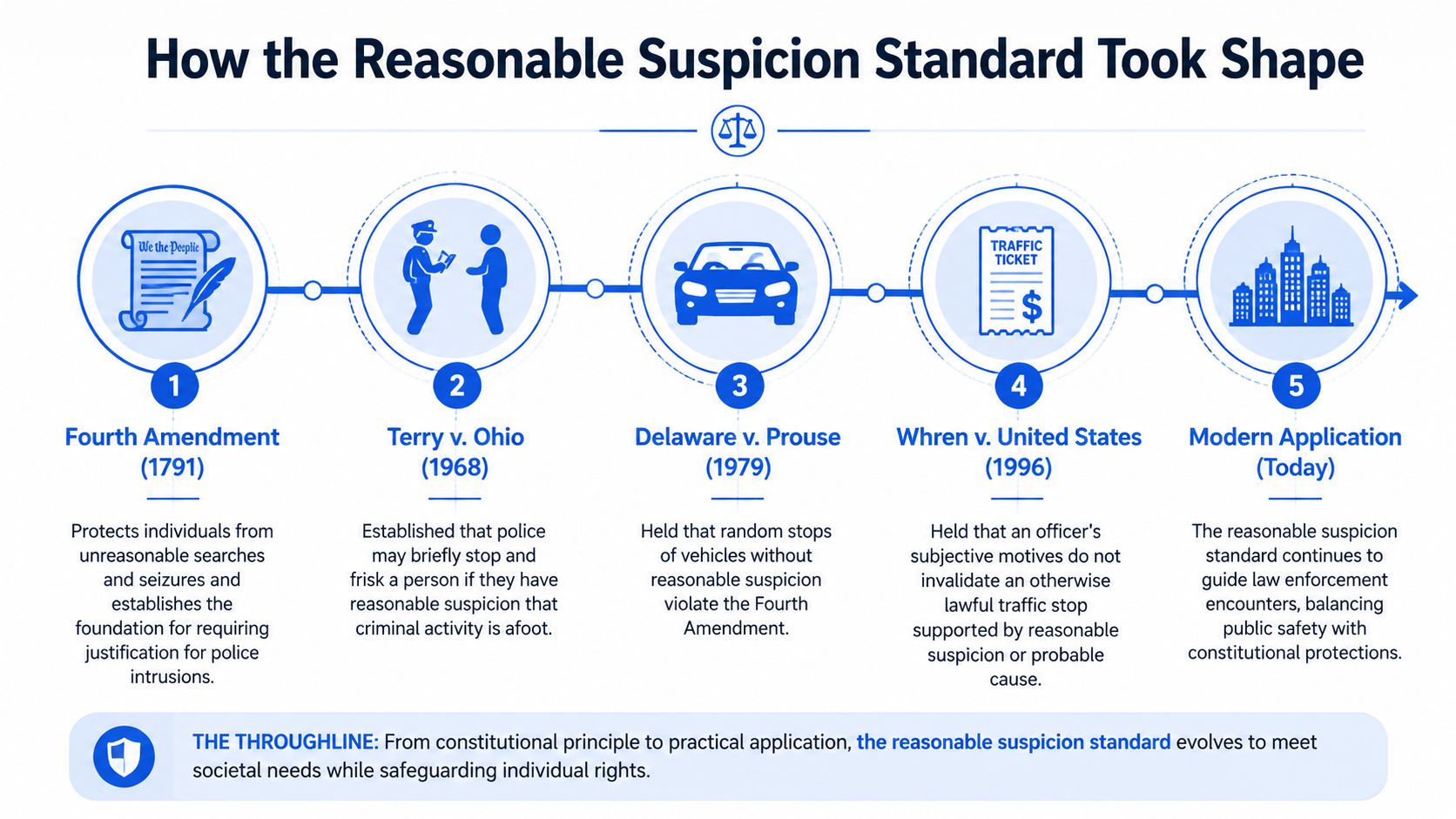
The Fourth Amendment protects people against unreasonable searches and seizures. The modern legal foundation for a reasonable-suspicion traffic stop traces to Terry v. Ohio, decided by the U.S. Supreme Court on June 10, 1968, in an 8–1 ruling. The Court held that an officer may briefly stop a person when specific, articulable facts suggest criminal activity may be occurring, even without probable cause to arrest. The decision also recognized a limited frisk when the officer reasonably believes the person is armed and presently dangerous. Read the Terry v. Ohio decision for the Court's constitutional framework.
That rule supplied the foundation. Later cases applied and refined it in vehicle settings. Arizona v. Johnson, decided in 2009, held that an officer may frisk a passenger during a routine traffic stop when the officer reasonably suspects the passenger is armed and dangerous, even without separate suspicion of criminal activity beyond the traffic stop itself. The passenger question is therefore not merely, “Was the driver suspected of a crime?” It can require a separate safety analysis.
In Kansas v. Glover, decided in 2020, the Court accepted a practical inference from objective information. The Court allowed a stop when an officer learned that the vehicle's registered owner had a revoked license and had no information indicating that someone else was driving. The case illustrates how reasonable suspicion can rest on an inference rather than direct proof, while still requiring identifiable facts.
The modern Florida application
Florida officers still need a lawful, fact-based reason to initiate a stop. Florida's temporary detention statute allows an officer to detain a person when circumstances reasonably indicate that the person committed, is committing, or is about to commit a violation of state or local criminal law. The detention may last only as long as reasonably necessary to accomplish that purpose. The Florida temporary detention statute provides the state-law framework.
Florida materials also recognize that a traffic stop may be supported by a reasonable, well-founded, articulable suspicion of a traffic offense, or by probable cause to believe a traffic infraction occurred. That makes the officer's observations important. A defense lawyer will compare the stated reason with traffic-camera footage, dashcam recordings, dispatch information, and the officer's testimony.
The doctrine has evolved from Terry's investigative-stop rule into a broadly used roadside standard. Its lower threshold gives police room to investigate, but it doesn't eliminate the requirement that the officer explain the facts that began the detention.
What Facts Officers Cite and Which Ones Hold Up
Not every fact carries the same legal weight. A visible equipment violation is usually easier for the State to defend than a report describing a driver's general nervousness. Florida trial courts evaluate the full context, but the quality of the officer's explanation often determines whether the suspicion is objective or merely conclusory.
A practical strength comparison
Observed Fact | Legal Strength |
|---|---|
Clearly observed broken taillight or expired registration | Stronger, because the officer identifies a visible, objective vehicle or equipment issue |
Documented failure to signal, speeding, or traffic-control violation | Stronger when the report explains what happened and where |
Weaving, inconsistent speed, or abrupt braking | Moderate, depending on the description, road conditions, duration, and connection to a suspected violation |
A license-plate or registration inquiry suggesting a revoked license | Potentially sufficient when the officer has objective information and no information indicating the registered owner isn't driving, as addressed in Kansas v. Glover |
Nervousness, heightened awareness, or avoiding eye contact | Weaker when offered alone because these observations are subjective and can have innocent explanations |
An officer's reference to agency policy without describing observed lawbreaking | Weak, because policy does not replace the constitutional requirement for specific facts |
A report that says “the vehicle was weaving” may not answer enough questions. How did it move? Did it cross a lane marker? For how long? Was there traffic, construction, weather, or another explanation? The officer doesn't need to eliminate every innocent possibility, but the report should allow a court to evaluate the reasoning.
A broken taillight or a clearly expired tag presents a different problem for the defense. If the officer observed the issue before the stop, that fact may provide a straightforward basis even if the officer later develops a DUI or drug investigation.
The gaps defense lawyers examine
The most useful weaknesses often appear in the spaces between a report's conclusion and its factual detail:
Vague movement descriptions: The report uses labels such as “erratic” or “suspicious” without describing the actual driving.
Unexplained plate information: The officer cites a plate read but doesn't explain the database information, timing, or whether another driver could reasonably have been operating the vehicle.
Post-stop reasoning: The officer relies on what was discovered after the detention instead of facts known before it began.
Conflicting records: Dispatch audio, body-camera footage, citation notes, and the written report describe different reasons.
Unclear timing: The report doesn't establish when the officer observed the conduct or when the decision to stop occurred.
If a DUI investigation followed the stop, the roadside sequence matters. A driver should speak with counsel before deciding whether to perform or challenge field sobriety exercises. A Florida field sobriety test guide can help explain why the conditions, instructions, performance, and officer observations all deserve review.
What an Officer Can and Cannot Do During a Stop
A valid stop doesn't give police unlimited authority. The officer may address the traffic mission, protect personal safety, and investigate additional criminal activity when new facts create the required suspicion. The constitutional question often turns on what happened, for how long, and why.
Routine tasks and safety measures
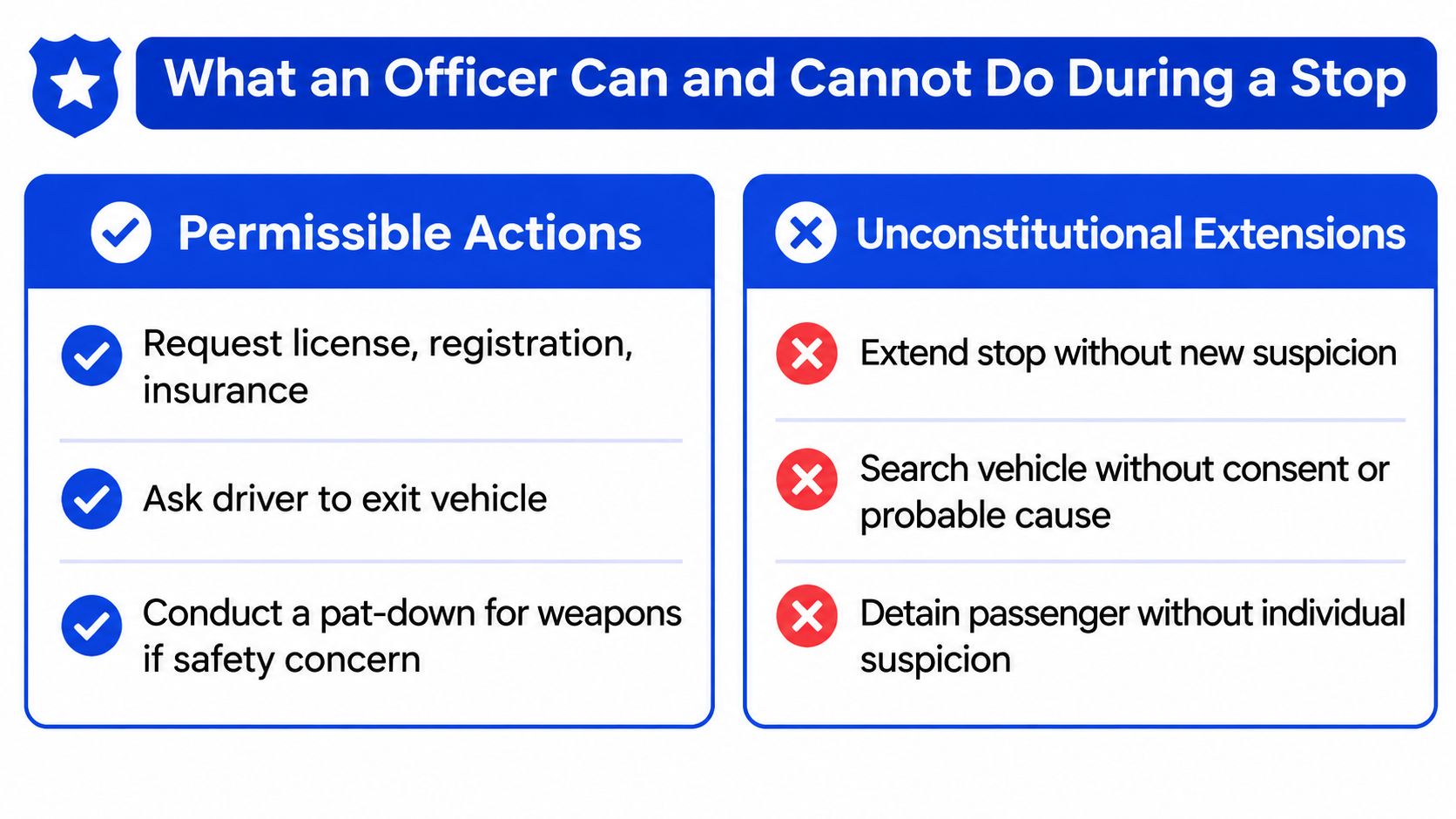
During an ordinary stop, an officer may request a driver's license, registration, and proof of insurance. The officer may run appropriate checks connected to the stop and may ask occupants to exit the vehicle as a safety measure.
A frisk is narrower. Under Terry, an officer may conduct a limited pat-down when specific facts support a reasonable belief that the person is armed and presently dangerous. The frisk is for weapons, not a general search for evidence. Arizona v. Johnson also recognizes that a passenger may be frisked when the officer has the required individualized safety suspicion.
Duration is the dividing line
The officer may not prolong a routine traffic stop beyond the time reasonably needed to handle the traffic mission unless independent reasonable suspicion arises. In Rodriguez v. United States, the Supreme Court held that police couldn't extend a completed traffic stop for a dog sniff without independent reasonable suspicion. The Rodriguez v. United States ruling is central to challenges involving drug-detection dogs and other investigative delays.
An officer may ask unrelated questions during a stop, but questioning alone doesn't automatically authorize extra detention. The problem arises when unrelated investigation adds time after the traffic work should have ended and the officer lacks a new factual basis.
Consent deserves careful treatment. You can decline a request to search, but you shouldn't physically resist. Agreeing to a search may make a later challenge more difficult, although consent can still raise questions about voluntariness, scope, and whether police unlawfully prolonged the encounter.
Passengers aren't invisible, but their rights aren't identical to the driver's responsibilities. A passenger may be detained during the traffic stop, yet a frisk still requires the officer's separate safety-based justification. If police move from a traffic investigation to a broader search or interrogation, the facts supporting that escalation deserve close review.
Challenging an Unlawful Stop in Florida
A motion to suppress asks a Florida court to exclude evidence obtained through an unlawful stop or search. It identifies the constitutional defect, connects that defect to the evidence obtained, and asks the judge to prevent the State from using that evidence at trial. This motion to suppress evidence guide explains the filing's basic purpose.
Preserve the timeline immediately
Write down what you remember before details blur. Small gaps in an officer's report can matter, especially when the report omits what happened between the traffic investigation and a later search or questioning. Include:
Location and direction: Record the road, nearby landmarks, lane, and direction of travel.
Officer identifiers: Note the agency, vehicle or unit number, and badge information if available.
Reason given: Write the exact explanation the officer gave for the stop, as closely as you can recall.
Sequence of events: Mark when documents were checked, when the traffic mission appeared complete, and when new questioning or searches began.
Witnesses and recordings: Identify passengers or bystanders and preserve any dashcam, phone, business-camera, or other recording.
Ask counsel to seek body-camera, dashcam, dispatch, computer-aided dispatch, and database records early. Those materials may show whether the officer's report leaves out the facts needed to support the stop, or whether the detention continued after its lawful purpose ended. Agencies follow different retention practices, so footage may not remain available indefinitely. Do not contact witnesses in a way that could be misunderstood or create a new issue. Give their information to your lawyer.
What happens at a suppression hearing
The State generally must justify the seizure with admissible evidence. The officer may testify, while the defense can use reports, recordings, photographs, maps, citations, and cross-examination to expose missing, changed, or inconsistent facts.
A judge may find that the stop was supported at its inception but that police later exceeded its lawful scope or duration. The court may also determine that the initial stop lacked an objective basis. If suppression is granted, important evidence may be excluded. That ruling can weaken the prosecution's case and may support dismissal or a negotiated reduction, depending on the charge, evidence, and court's decision.
Timing matters. A lawyer should evaluate suppression issues before plea discussions move too far, because an early ruling can change the practical choices in a DUI, drug, firearm, or traffic-crime case. The defense may also need to preserve the issue carefully for appellate review.
Protecting Your Rights and Next Steps
A traffic stop should rest on specific, articulable facts tied to a suspected traffic violation or criminal activity. Reasonable suspicion is weaker than probable cause, yet stronger than a hunch. Evidence discovered later does not retroactively justify a detention that lacked an objective basis at the start.
During the encounter, remain respectful and avoid physical resistance. Provide required documents, keep unnecessary explanations to yourself, and clearly state that you do not consent to a search if that is your decision. You have the right to remain silent. Silence does not override lawful commands, such as producing your license and registration.

Afterward, write down the sequence of events while it remains fresh. Preserve recordings, collect witness information, and request a formal review of the stop. A Florida defense lawyer can compare the officer's stated reason with the timeline, identify missing facts in the report, and examine whether the detention, search, or questioning continued beyond its lawful purpose. That review may matter in a Florida criminal defense case involving DUI, drugs, weapons, theft, violence, probation, or another offense.
Before you plead: Confirm that your lawyer has reviewed the stop, search, statements, and available recordings. A suppression ruling may determine whether key evidence can be used and whether dismissal, reduction, or trial is the sounder path.
Contact a defense lawyer early, ideally before arraignment or advanced plea negotiations. Ask for a case review and specifically discuss whether a motion to suppress is appropriate. A stop-evidence checklist can help you preserve documents, recordings, and witness details.
Ticket Shield, PLLC reviews Florida traffic stops and related DUI, drug, firearm, and criminal cases for constitutional weaknesses, including unsupported stops, unlawful extensions, and improper searches. Visit Ticket Shield, PLLC to request a confidential consultation.