Veterans Court Florida
Jason Goldsmith, Esq
Florida has 32 veterans courts in operation as of July 2024, and the statewide network reached 33 programs by October 2025, but veterans court isn't an automatic right. Eligibility generally depends on veteran or servicemember status plus a qualifying service-related condition, and admission remains discretionary.
You may be standing before a judge in Broward County, Fort Lauderdale, Miami-Dade, Palm Beach, or another Florida circuit, trying to explain how military service, untreated trauma, substance use, or a brain injury relates to the criminal charge in front of you. You may have heard that “veterans court” can make the case disappear. Sometimes successful completion can produce a dismissal or another favorable disposition, but the program requires court approval, treatment, monitoring, and sustained compliance.
The most important early decision is learning whether your case fits the local program and whether entering it is safer than litigating the charge. A defense lawyer can investigate the facts, protect against an uninformed plea, and present your service history and treatment needs in a way the prosecutor and judge can evaluate.
Table of Contents
Introduction to Veterans Treatment Courts
A former servicemember is arrested after an argument at home. The charge might involve alcohol, drugs, alleged violence, a probation violation, or another offense. At the first hearing, the person's family asks whether military service changes the case. The answer is more precise than yes or no.
Veterans treatment court is a specialized criminal court docket designed to address conditions connected to military service. Those conditions may include substance use disorder, a mental health condition, traumatic brain injury, psychological problems, or military sexual trauma. Instead of focusing only on punishment, the court combines treatment with judicial supervision and accountability.
That structure resembles other problem-solving courts, but the qualifying connection to military service matters. A veteran facing a drug charge, for example, may need a treatment plan that addresses both substance use and trauma. The legal strategy can differ from a standard drug-court application, even though both systems may use testing, counseling, court reviews, and consequences for noncompliance. You can learn more about the distinction through this overview of Florida drug court.
Treatment is not the same as automatic dismissal
Traditional criminal court asks whether the State can prove the charge beyond a reasonable doubt. Veterans court adds another question, whether structured treatment and monitoring can address the circumstances contributing to the alleged conduct while protecting the public.
That doesn't erase the charge. Participation may involve assessments, treatment sessions, drug or alcohol monitoring, frequent court appearances, mentoring, and honest communication with the treatment team. A missed appointment or failed test may trigger a response under the program's written strategy.
Practical rule: Never accept veterans court without understanding what happens if you leave, fail to comply, or are discharged unsuccessfully.
The program can create an important opportunity, particularly in cases involving nonviolent offenses or supervision violations, but it also requires a deliberate decision. Your attorney should examine the evidence, possible defenses, immigration or employment consequences, licensing concerns, and the precise terms offered by the local circuit.
Understanding Florida Veterans Court Law
Florida's statewide framework comes from the T. Patt Maney Veterans' Treatment Act, created in 2012. It authorized a Military Veterans and Servicemembers Court Program for people whose military-related conditions affect their involvement in the criminal justice system. Florida's judicial system describes the model as combining evidence-based treatment, judicial monitoring, and accountability through specialized courts. The Florida courts veterans court information also identifies the Florida Veterans Court Best Practice Guidelines.
A qualifying veteran does not automatically enter the program. The law permits admission at any stage of a criminal proceeding, but it expressly says participation is not a right. The judge retains discretion. The prosecutor's position, the offense facts, criminal history, treatment needs, willingness to participate, and local resources can all affect the decision.
That discretion can determine whether a case reaches a judge who can consider treatment-based sentencing. Defense counsel should raise the option before major plea decisions, because timing may affect what remains available. A pre-adjudication diversion track may allow dismissal after successful completion. A post-adjudication track may involve a plea, probation, or a sentencing plan that makes treatment part of the disposition.
Why the framework is diagnosis-linked
Florida does not operate one identical veterans court in every county. Local programs may differ in eligibility screening, offense limits, supervision terms, and available services. Clinical findings and service history help the court assess whether a condition relates to the alleged conduct, what treatment fits, and whether the participant can follow supervision.
A lawyer's role is more than submitting a military record. Counsel must develop the service-related explanation, address weaknesses in the application, evaluate the evidence and possible defenses, and present a workable treatment plan. Without that preparation, a veteran may never receive meaningful consideration by the appropriate judge.
Successful completion may support dismissal, early termination of probation, or a reduced sentence, depending on the procedural track and the court's authority. These are possibilities, not guarantees. The written agreement and local program rules control.
Eligibility Requirements and Who Qualifies
Eligibility has two parts that must be evaluated together. First, you need a qualifying military connection. Second, you need a qualifying service-related condition and a case the local program can accept.
Florida statutes and circuit materials identify conditions such as mental illness, traumatic brain injury, substance use disorder, psychological problems, or military sexual trauma. The precise application process and offense restrictions can vary by circuit, which is why a statewide description can't replace a local eligibility review.
Veterans Court Eligibility Overview | Eligible | May Be Disqualified |
|---|---|---|
Military connection | Veteran or servicemember status | No qualifying military or servicemember status |
Service-related condition | Documented or clinically supported condition connected to service | No qualifying connection shown |
Participation | Voluntary agreement to treatment and supervision | Refusal to participate or inability to accept required conditions |
Criminal case | An offense accepted under the local program | An excluded offense, safety concern, or case outside local authority |
Prior program history | No prior disqualifying veterans treatment participation | Prior entry or recorded rejection may permit denial under applicable law |
Location | A case pending in a circuit with an applicable program | No available local docket, capacity, or pathway for the case |
Out-of-state veterans and military-affiliated applicants
People often ask whether Florida citizenship is required. The relevant issue usually isn't where you live. It is whether the circuit handling the criminal case recognizes you as eligible and has a program capable of serving you.
The answer can be especially confusing for Department of Defense contractors and former military members of foreign allied countries. Materials from Florida's Twentieth Judicial Circuit expressly discuss those categories, while the statewide court page uses the broader veterans-court framework. That difference means an out-of-state veteran, contractor, or allied-country service member shouldn't assume either automatic acceptance or automatic exclusion. The local judge, prosecutor, statute, and program policy must be examined together.
A mental health condition also doesn't automatically establish eligibility. Counsel may need service records, discharge information, medical records, treatment history, or a clinical assessment linking the condition to military service. Before signing releases or making admissions, discuss the consequences with a lawyer. A Florida mental health court explanation can provide useful context, but veterans court has its own military-related requirements.
How Veterans Court Programs Work
Florida veterans courts commonly use one of two procedural tracks. A participant may enter pretrial diversion, or the person may resolve the case through a plea and complete treatment as part of probation or another post-adjudication disposition. One Florida circuit describes voluntary participation and a team review involving the prosecutor, defense counsel, and judge.
The Eleventh Judicial Circuit offers a concrete example of the commitment involved. Its program uses two tracks based on risk and need, includes five treatment phases, and requires judicial monitoring for a minimum of 14 months while participants attend treatment, court sessions, and follow their case plans. Those details illustrate one local structure, not a promise that every Florida circuit operates identically.
A practical phase-by-phase view
The exact labels differ, but a phased program often follows this progression:
Assessment and orientation. The team reviews military history, diagnoses, substance use, risk, housing, employment, and immediate treatment needs. This phase helps create an individualized plan rather than assigning identical services to every participant.
Early treatment and stabilization. Participants may begin intensive counseling, recovery services, medication management, testing, and regular court contact. The court is looking for engagement and reliability, not merely a promise to improve.
Skill development. The participant works on relapse prevention, emotional regulation, communication, employment, housing, and strategies for managing trauma-related symptoms. Progress is measured through treatment reports and conduct between hearings.
Stabilization and reduced risk. The team may recommend fewer interventions when the participant demonstrates sustained compliance. The court still retains authority to respond to missed requirements or new concerns.
Discharge planning. The final phase focuses on continuing care, support systems, benefits coordination, and completion requirements. The judge considers recommendations before entering the appropriate case disposition.
Noncompliance can lead to graduated sanctions, additional treatment, or removal from the program. A Florida deferred prosecution guide may help explain one possible procedural concept, but the veterans court agreement controls your case.
Veterans Court Availability in Your County
A veteran in South Florida may hear that Florida has veterans courts and assume the nearest program must be available. The practical question is narrower: does the circuit handling the case operate a program, and will that program consider this charge and applicant?
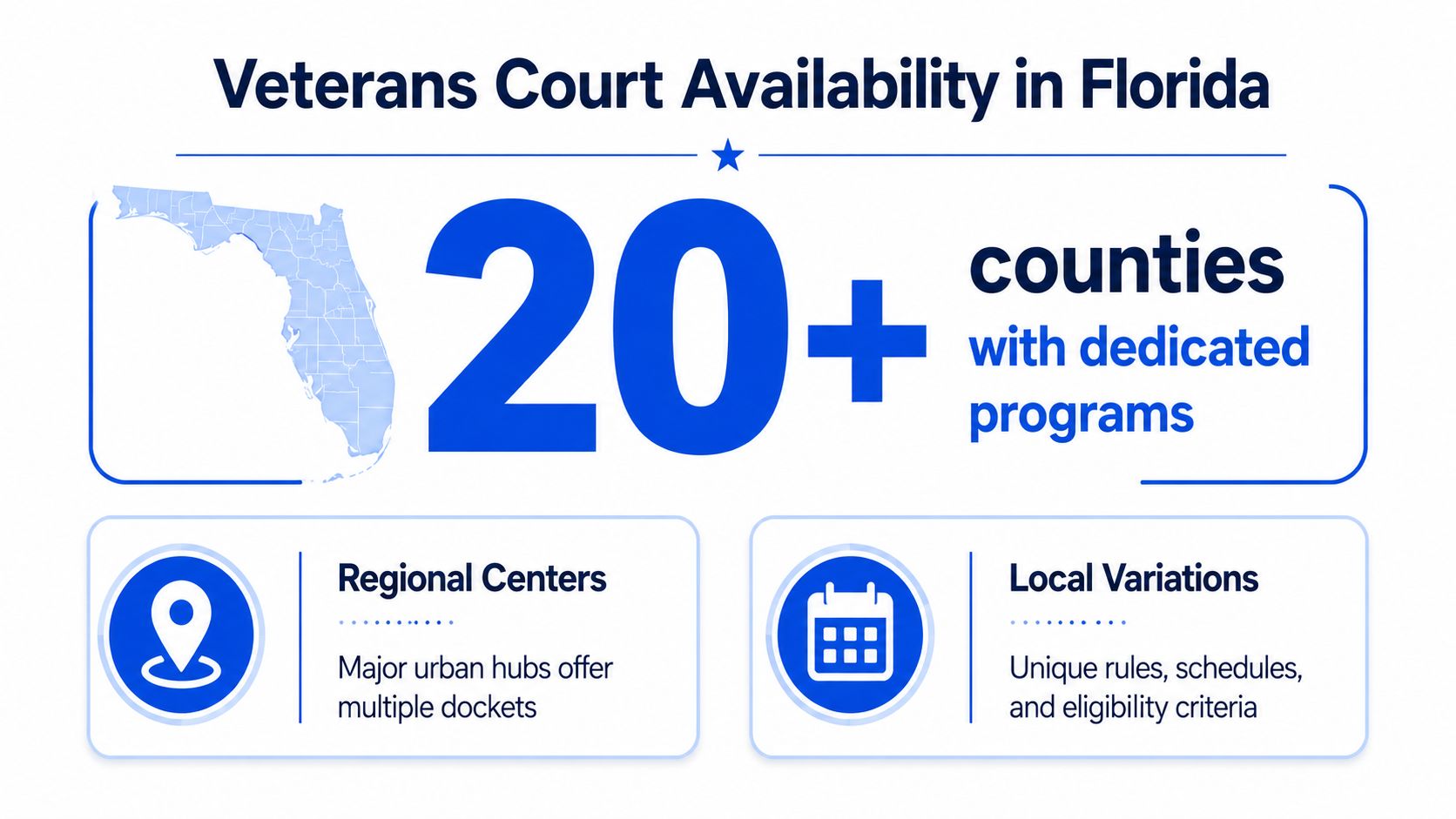
Florida's network has expanded across the state. Reported counts rose from 31 veterans courts by September 2018 to 32 operating as of July 2024, with 33 programs by October 2025. Those figures show continued development, not uniform access. Circuits can differ in docket schedules, eligibility rules, treatment providers, referral procedures, and available capacity. The statewide figures appear on the Florida courts veterans court program page.
Why county location matters
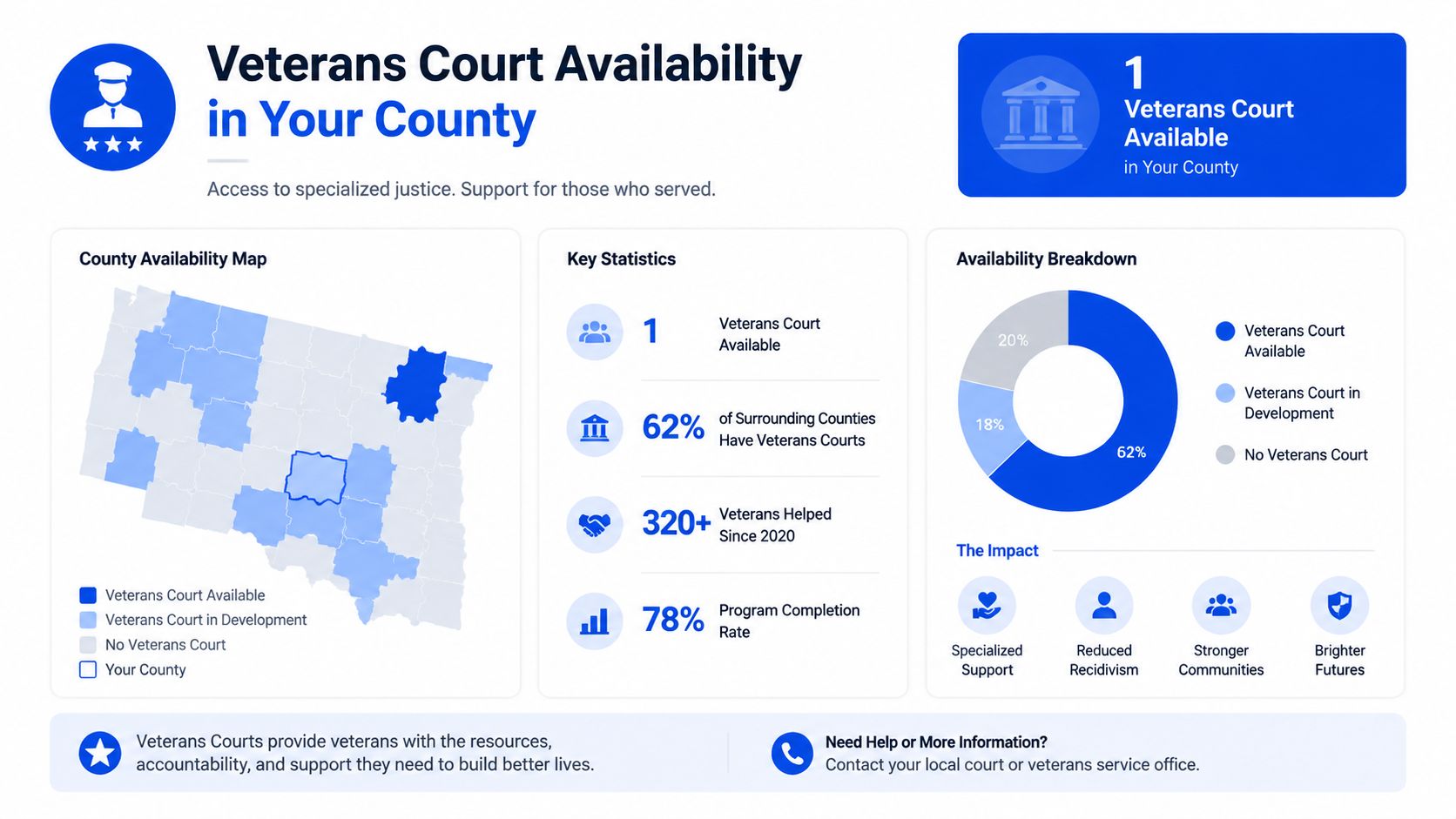
Broward County, Miami-Dade, Palm Beach, and nearby circuits may handle applications differently. A program in the same broad region may apply different standards from the court assigned to your case. One circuit might consider a contractor or allied-country military member, while another interprets eligibility more narrowly. Staffing, treatment resources, and docket space can also limit admissions.
Start by identifying the assigned circuit. The clerk of court, criminal division, State Attorney's Office, or circuit veterans court coordinator can confirm the current contact and procedure. An old online form is not reliable evidence of current practice, and a neighboring county's rules do not automatically transfer to your case.
Your lawyer should ask whether the circuit will consider pre-adjudication diversion, post-plea probation, or a post-adjudication treatment disposition. Counsel can also determine where the application must go and whether timing affects review. Admission remains discretionary, so an attorney's early involvement may put the case before a judge who can consider an alternative sentence instead of leaving the issue unresolved until after a plea.
Local-court reality: A statewide program count shows that Florida has a veterans court network. It does not show whether your local courtroom will approve your application.
Applying for Veterans Court in Florida
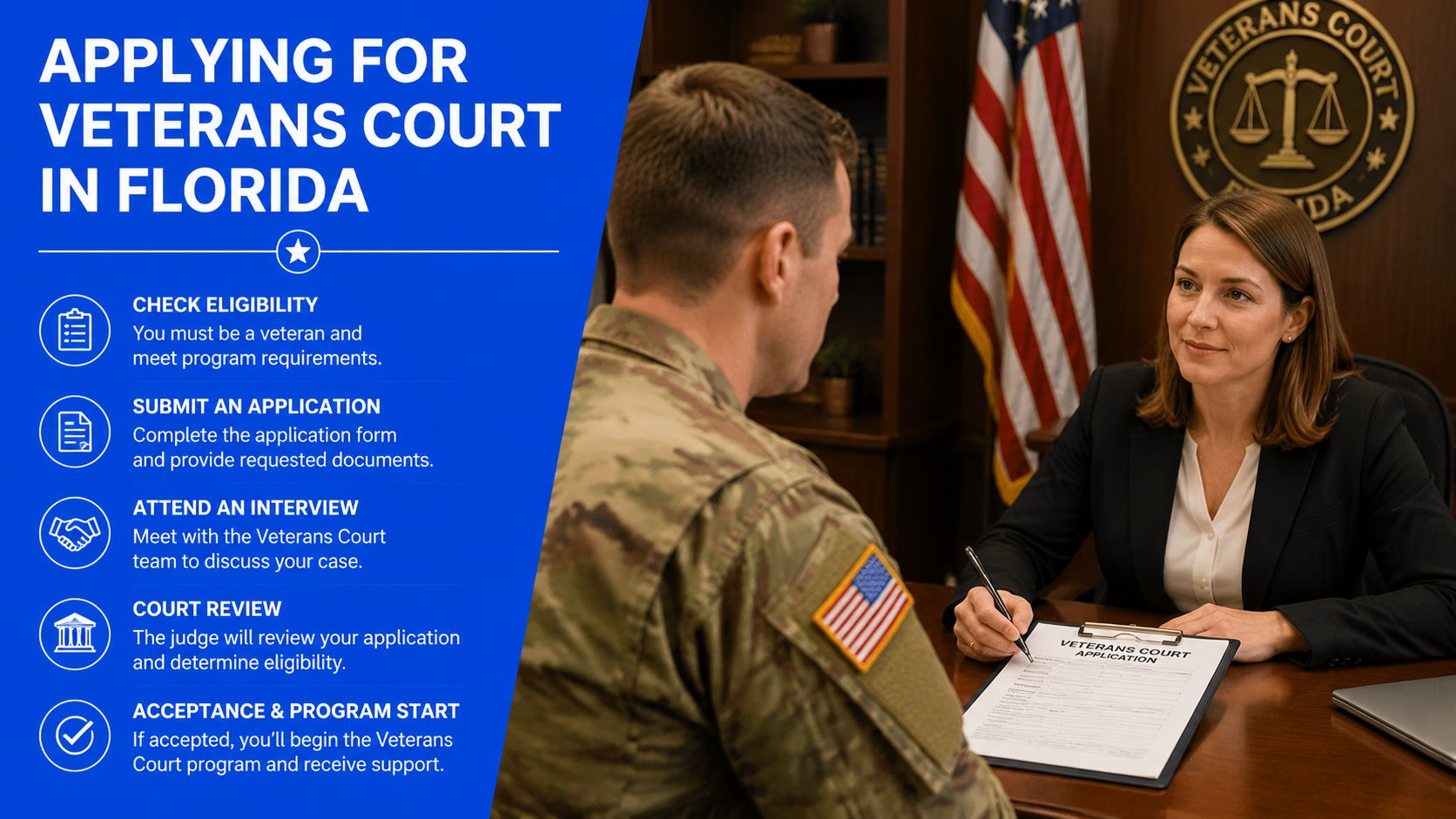
The application process should begin as early as possible, ideally before you make an irreversible plea decision. Florida judicial guidance states that the State Attorney's Office must review each application and refer applicants to the appropriate Veterans Administration Judicial Outreach Coordinator. The Florida judicial administrative guidance also confirms that participation isn't an automatic entitlement.
The usual sequence
Tell your defense lawyer about your service history. Explain deployments, discharge status, injuries, diagnoses, treatment, medications, substance use, and any connection you see between service and the current accusation. Details that seem unrelated may affect the clinical assessment.
Identify the local program. Counsel contacts the appropriate circuit, prosecutor's office, or coordinator and asks about the current application, offense limits, assessment process, and available track.
Collect supporting records. Useful materials can include discharge documentation, service records, VA treatment information, prior evaluations, medication history, and proof of current treatment. Your attorney should review what must be disclosed before submitting it.
Complete the evaluation. The Veterans Administration Judicial Outreach Coordinator or another approved provider may assess service-related conditions, treatment needs, risk, and program suitability. Be truthful, but don't discuss the underlying facts casually without legal advice.
Address the team review. Prosecutors, defense counsel, the judge, and treatment professionals may evaluate the application. The defense should explain why the proposed plan is realistic and how it addresses both public safety and the legal case.
Review the agreement before accepting. Confirm the track, treatment obligations, testing, court dates, confidentiality releases, violation responses, plea terms, and expected disposition after completion.
Why counsel changes the process
A defense attorney doesn't control the judge's decision, but counsel can prevent the application from being treated as a vague request for leniency. The lawyer can investigate constitutional issues, challenge weak evidence, negotiate the procedural track, explain mitigating facts, and identify conditions that create an unreasonable risk of failure.
You can begin a confidential case review through this secure case submission page. Don't sign a plea, waiver, or treatment disclosure without understanding how it affects both veterans court and the underlying defense.
Outcomes, FAQ, and Next Steps
Veterans court can produce different results depending on the track and the terms approved by the court. After successful completion, potential outcomes may include dismissal of charges, early termination of probation, or a reduced sentence. A pre-adjudication path may be more favorable for avoiding a conviction, while a post-adjudication path may provide treatment within probation or sentencing. The written agreement matters more than a general online description.
A dismissal may also create a later opportunity to explore record sealing or expungement in Florida, but eligibility must be reviewed separately. A dismissed case doesn't automatically mean every record disappears.
Frequently asked questions
Is veterans court guaranteed if I qualify?
No. Florida law says the program doesn't create a right to participate. The State Attorney's Office reviews applications, and the judge and local program retain discretion.
Can an out-of-state veteran apply?
Possibly. Residence alone doesn't answer the question. The circuit where the case is pending must apply its own rules and determine whether the applicant and case fit the available program.
Can contractors or allied-country service members qualify?
Some Florida circuit materials expressly include current or former Department of Defense contractors and former military members of foreign allied countries. Other program descriptions are narrower, so counsel must verify the rule in the specific circuit.
What happens if I violate the program?
The response depends on the written coordinated strategy and the seriousness of the violation. The court may impose additional treatment or another sanction, or it may discharge you and return the case to the regular criminal division. A new arrest can create additional complications.
Can veterans court help with a probation violation?
It can be possible, particularly where the violation involves treatment needs or supervision issues, but eligibility and transfer authority depend on the circuit, the type of violation, and whether the alleged conduct is a new criminal offense.
Will participation affect VA benefits?
Veterans court is a criminal case process, not a general determination of VA benefit eligibility. Because your records and treatment information may be shared for assessment and monitoring, ask your lawyer how the required releases and disclosures could affect your situation before signing.
If you're facing a DUI, drug charge, domestic violence accusation, theft case, violent offense, gun charge, sex offense, federal matter, or probation violation in Broward County or elsewhere in South Florida, ask about veterans court before entering a plea. You also have the right to investigate ordinary defenses, including unlawful searches, unreliable identification, weak witness statements, defective testing, and failures in the State's proof.
Ticket Shield, PLLC provides confidential criminal defense consultations for veterans seeking a careful veterans court review, as well as defense against DUI, drug, weapons, violent-crime, theft, and probation-violation charges. Visit Ticket Shield, PLLC to connect with Attorney Jason S. Goldsmith and discuss your eligibility, deadlines, and defense options.