
What Is Administrative License Suspension?
Jason Goldsmith, Esq
You leave the police station believing the criminal DUI charge is the only problem you need to solve. Then you look at the paperwork and see that your driving privilege has already been suspended. No judge has found you guilty, yet Florida has opened a separate civil process that can affect your ability to work, take children to school, and handle ordinary responsibilities in Broward County, Fort Lauderdale, Miami-Dade, Palm Beach, and throughout South Florida.
That process is called administrative license suspension, or ALS. The critical point is timing. After a Florida DUI arrest, the civil license case and the criminal court case move on parallel timelines, and the deadline to request a formal review is generally 10 days. Missing that window can eliminate the hearing opportunity before you've had a meaningful chance to challenge the suspension.
Table of Contents
The Night Everything Changes at a DUI Stop
The first warning is usually the reflection of blue lights in the rearview mirror. You pull over, lower the window, and answer questions while trying to understand why the officer stopped you. The officer may ask where you're coming from, whether you've been drinking, and whether you'll perform field sobriety exercises.
The legal basis for the stop matters from the beginning. A traffic violation or other facts may support the officer's investigation, but an unlawful stop can affect everything that follows. Understanding how probable cause and traffic stops work helps explain why the first moments of the encounter can become important evidence later.
After an arrest, the scene changes quickly. Your hands may be cuffed, your vehicle may be towed, and you may be taken to a station for a breath, blood, or urine test. Florida law treats certain testing events as triggers for an administrative suspension. The officer may take your physical license and give you a notice explaining that your driving privilege is suspended or will be suspended.
The paperwork starts a second case
The criminal side involves the DUI charge, booking, court dates, and prosecution by the State Attorney's Office. The license side involves the Florida Department of Highway Safety and Motor Vehicles, often called DHSMV or FLHSMV, and its Bureau of Administrative Reviews.
You may leave the station with release paperwork, a suspension notice, and instructions that seem easy to overlook after an exhausting night. The notice date, effective date, and review deadline can control whether you get a hearing at all.
Practical rule: Treat the suspension notice as an urgent legal document, not as routine booking paperwork.
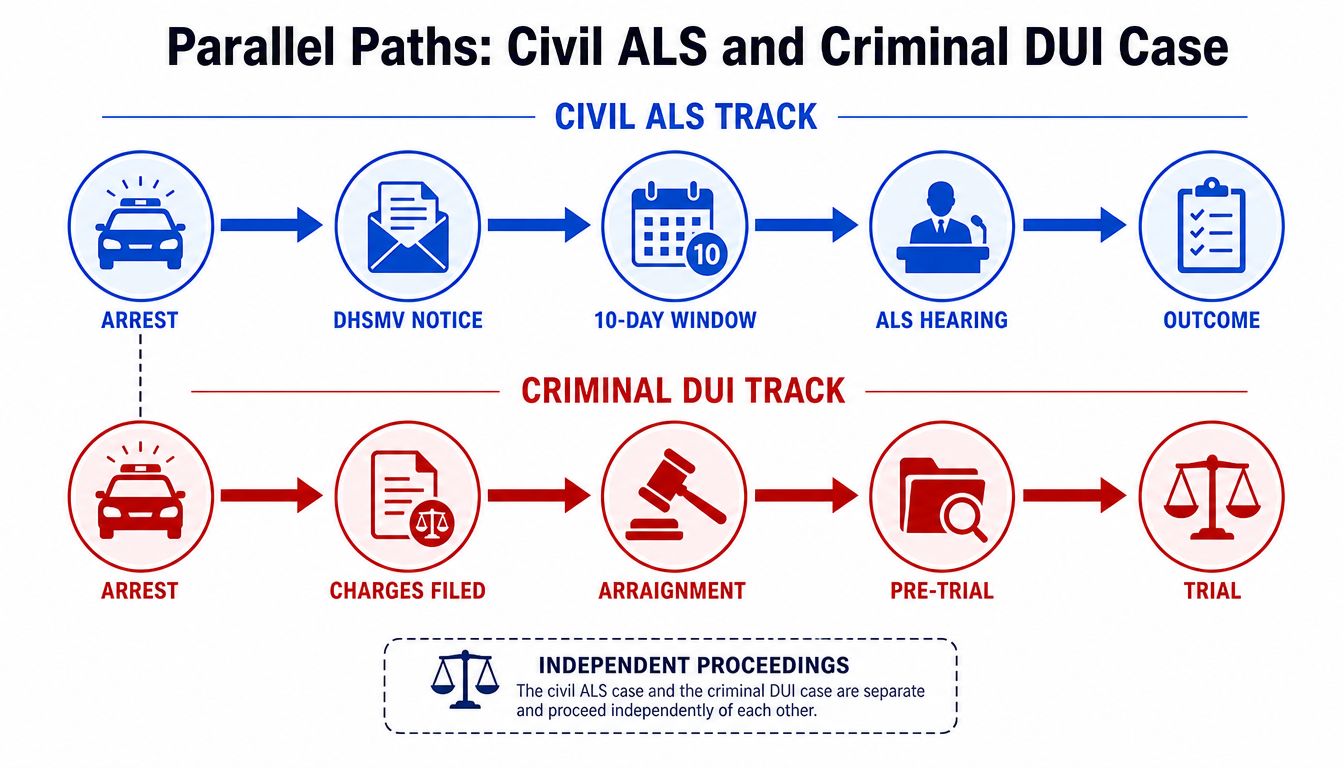
Many drivers assume they'll have weeks to contact a lawyer because the criminal case hasn't reached court. That assumption can cost them. The administrative track may already be moving while the criminal case is still waiting for an arraignment or first appearance.
What Administrative License Suspension Actually Means
Administrative license suspension is a civil, pre-conviction action involving your driving privilege. It's separate from the criminal DUI prosecution. Florida's motor-vehicle agency can suspend a license after a qualifying chemical-test result or refusal, even though a criminal court hasn't decided whether the driver is guilty.
Florida's law applies when a driver is in actual physical control of a motor vehicle and has an unlawful blood-alcohol or breath-alcohol level of 0.08 or higher, or refuses a qualifying urine, breath-alcohol, or blood-alcohol test, as described in the Florida administrative suspension law.
Two agencies, two legal questions
The State Attorney prosecutes the criminal DUI case. That case can involve motions, plea negotiations, trial, and the criminal standard of proof, which is proof beyond a reasonable doubt.
The administrative case is handled through DHSMV's Bureau of Administrative Reviews. A hearing officer examines the statutory requirements for the suspension. The hearing doesn't decide whether you committed every element of the criminal DUI offense, and it doesn't replace the criminal court proceeding.
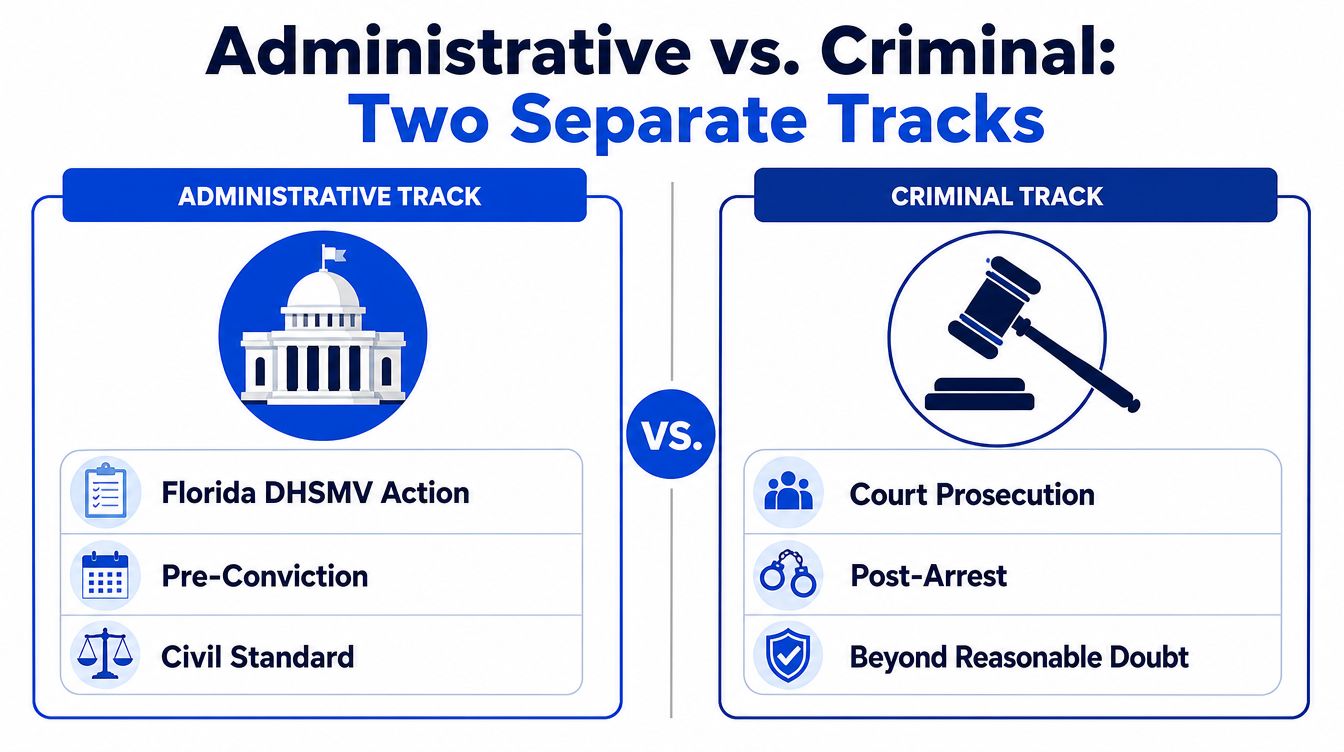
The separation creates a common misunderstanding. A driver can challenge the criminal charge and still remain suspended administratively. Conversely, a failed ALS hearing doesn't establish that the State can prove the DUI charge in criminal court.
Administrative track | Criminal track |
|---|---|
Civil license action | Criminal prosecution |
Usually begins before conviction | Proceeds through Florida courts |
Reviewed by a DHSMV hearing officer | Prosecuted by the State Attorney |
Focuses on statutory suspension issues | Addresses criminal guilt or innocence |
May continue even if the criminal case changes | Can produce separate court penalties |
For a broader explanation of Florida license consequences, review this guide to driver's license suspension in Florida. The practical lesson is simple: you must defend the license case and the DUI case as separate matters.
When the Suspension Triggers and How Long It Lasts
Florida Statute 322.2615 generally creates two primary ALS trigger events. The first is a qualifying breath or blood result. The second is a refusal to submit to a lawful breath, blood, or urine test.
For an adult driver, the central threshold for an unlawful breath or blood-alcohol level is 0.08. The plan notes for Florida law also identify lower thresholds of 0.04 for commercial drivers and 0.02 for drivers under 21, making the driver's age and license type important parts of the analysis.
Failed test and refusal are not treated identically
A first failed test generally produces a six-month suspension, while a first refusal generally produces a one-year suspension. Repeat refusals or a history of DUI convictions can create longer consequences. Florida's official and policy materials should be reviewed alongside the individual notice because the exact suspension depends on the trigger and prior record.
Trigger Event | First Offense | Second or Subsequent |
|---|---|---|
Breath or blood result at or above the applicable legal threshold | Six months for a first failed test | Longer suspension based on prior history and applicable law |
Refusal to submit to a lawful breath, blood, or urine test | One year for a first refusal | Longer periods for prior refusals or DUI convictions |
The suspension notice identifies when the action becomes effective. The review process can create an automatic stay under the circumstances set by Florida law, but that protection isn't a substitute for filing on time. You should also avoid assuming that a refusal is harmless because no numerical result exists. Refusal carries its own administrative consequences, and the surrounding facts may matter in both proceedings.
A refusal can also affect the criminal case differently from the license case. The administrative question is whether the statutory conditions for suspension were met. The criminal case may examine the officer's warnings, the legality of the detention, the request for testing, and other evidence. A careful defense must keep those questions distinct. Drivers who want to understand the related constitutional and practical issues can review whether you can refuse a breathalyzer in Florida.
The 10-Day Window and How the ALS Hearing Works
The formal review deadline is a calendar deadline. In Florida, a driver generally must request review through the Bureau of Administrative Reviews within 10 days after receiving the suspension notice. The petition carries a $25 filing fee, and waiting for the criminal court date doesn't preserve the administrative hearing.
Follow the process in order
Read the notice immediately. Identify the date you received it, the effective date, the alleged trigger, and the stated deadline.
File the request for formal review. Submit the request to the appropriate Bureau of Administrative Reviews office and include the required filing fee.
Prepare for the hearing. The hearing officer reviews the Department's materials and the issues governed by Florida Statutes Section 322.2615(7). The driver carries the burden on the statutory issues presented at the hearing.
Address testimony and records. Evidence may include the officer's sworn report, testing records, certification materials, video, and testimony. The hearing officer can consider documentary evidence and sworn testimony within the administrative procedure.
Obtain the written order. The hearing officer issues an order sustaining or invalidating the suspension. That order controls the administrative case unless further legal action is available.
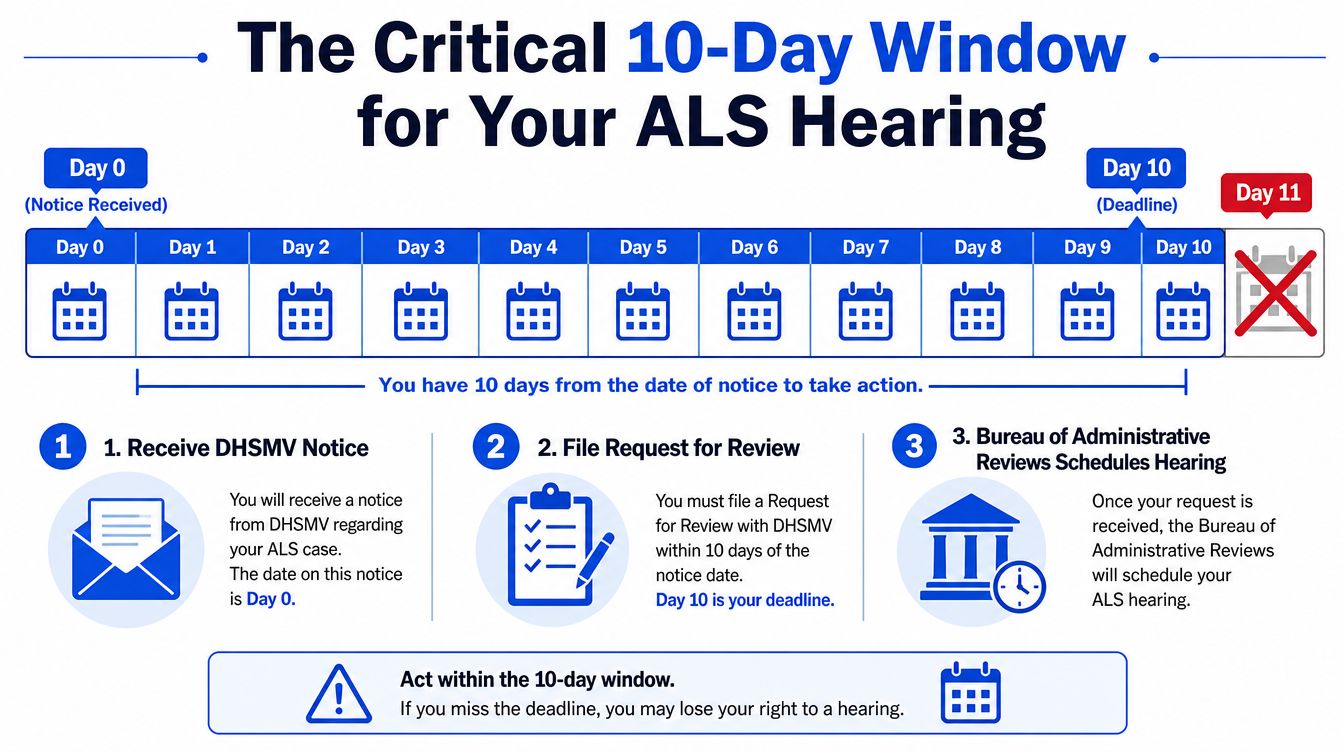
The timeline is unforgiving. There isn't an automatic extension because you were confused, hospitalized, busy at work, or waiting for a criminal lawyer to call back. If the deadline passes, you may lose the right to a formal review and leave the suspension in place without testing the Department's evidence.
This Florida administrative license suspension hearing guide provides additional procedural context. A short educational video can also help orient you to the process:
Defenses That Can Win Back Driving Privileges
An ALS hearing isn't a miniature criminal trial, but it can be the most immediate opportunity to attack the legal foundation for the suspension. The defense should focus on the statutory issues, the reliability of the Department's records, and whether the officer followed lawful procedures.
The stop may be the first weakness
If the officer lacked reasonable suspicion of a traffic violation or criminal activity, the initial stop may be unlawful. That issue can affect the later detention, arrest, and request for chemical testing. The hearing strategy must account for the administrative record, while a related constitutional challenge may also belong in the criminal case.
A stop defense is fact-specific. The video, dispatch information, officer report, and witness accounts may tell different stories. Do not assume that the written report contains every detail that matters.
Testing procedures require close review
A lawyer may examine whether:
The operator was authorized: The breath-test operator's permit and training records can matter.
The instrument was maintained: Inspection, maintenance, and certification records may reveal gaps.
Observation requirements were documented: The required observation period and the officer's compliance should be tested against the records.
Timing was proper: The test must be examined in relation to the statutory testing window and the timeline from driving to collection.
A technical defect doesn't automatically invalidate a suspension. The defense must connect the defect to a required legal element or to the reliability of the evidence.
Rising alcohol concentration can change the analysis
A rising-BAC defense argues that absorption was still occurring when testing took place. The theory is that the driver's alcohol concentration may have been below the applicable threshold while driving, even if it reached or exceeded that threshold later.
That argument usually requires careful timing evidence and, in an appropriate case, expert analysis. It isn't established merely by saying that the driver drank shortly before driving. The motion to suppress evidence process may also become relevant to the criminal case.

A successful challenge can result in reinstatement of the driving privilege without relying on a hardship license. But no defense is automatic. The best approach depends on the notice, the sworn report, the testing records, the video, and the facts of the stop.
How the ALS Case Connects to the Criminal DUI Case
The civil ALS proceeding and the criminal DUI case begin with the same arrest, but they answer different questions. The hearing officer applies the administrative framework, while the criminal court addresses whether the State can prove the DUI charge beyond a reasonable doubt.
That difference explains why one outcome doesn't predict the other. An unfavorable ALS ruling doesn't prove criminal guilt, and a favorable ALS ruling doesn't guarantee that the State will dismiss the DUI charge.
Criminal resolutions can have license consequences
A criminal case may end through a plea, a reduction to reckless driving, a withhold, an acquittal, or dismissal. Each result can interact with the driver's licensing history differently. A withhold or acquittal may shorten the suspension in some circumstances, but the civil suspension doesn't automatically disappear merely because the criminal charge changes.
A DUI conviction can also create a court-ordered suspension that operates with the administrative consequences. Ignition interlock conditions, SR-22 insurance filings, and future licensing decisions can depend on the final record and the applicable statutory requirements.
A criminal victory and an administrative victory are different accomplishments. Counsel should track both from the first day.
Florida drivers should also understand the record distinction between a civil licensing action and a criminal conviction. The two entries can affect future decisions in different ways, especially when a driver later seeks reinstatement, holds a commercial license, or faces another traffic allegation.
Your First Steps and Why Early Legal Help Matters
The first two days after arrest should be organized around preservation and deadlines, not speculation about what the officer “probably” did correctly. Start with the documents in your possession and build a timeline.
A practical first-48-hours plan
Read every page: Find the notice date, effective date, alleged test result or refusal, and the review instructions.
Confirm the deadline: Calculate the formal review deadline from the date you received the notice, then verify the filing method with the Bureau of Administrative Reviews.
Preserve evidence: Write down witness names, locate vehicle or business surveillance, and ask counsel to pursue dashcam and bodycam footage.
Protect your case: Don't discuss the facts publicly or post about the arrest. Statements can affect both the civil and criminal tracks.
Do not drive unlawfully: Driving while suspended can create a separate criminal problem and make the original situation more difficult.
Self-representation is possible in some administrative matters, but the hearing can involve subpoenas, sworn officer testimony, technical records, and objections to evidence. A driver who doesn't know what to request may not obtain the materials needed to identify a defect.
An experienced Florida ALS attorney can request the hearing, obtain and review Department records, subpoena witnesses when appropriate, cross-examine the officer, and present the legal argument for invalidating the suspension. Counsel can also preserve issues for review, discuss lawful hardship licensing options, and coordinate the administrative strategy with defense of the DUI charge.
Ticket Shield, PLLC handles Florida administrative suspension hearings and criminal DUI defense, including the time-sensitive review process. The firm serves clients in Fort Lauderdale, Broward County, Miami-Dade, Palm Beach, and other Florida courts, with communication available by phone, text, or email.
Common Questions Drivers Ask After the Arrest
Can I get a hardship or Business Purpose Only license?
Eligibility depends on the type of suspension, your driving history, and compliance with Florida requirements. A Business Purpose Only license generally limits driving to approved work, educational, medical, religious, or other permitted purposes. You may need to enroll in DUI school, satisfy ignition interlock conditions, and follow strict work-related driving limits.
A hardship license isn't permission to drive anywhere at any time. Keep the approval documents with you and follow the stated restrictions.
Does Florida's ALS affect an out-of-state license?
It can. States exchange driver-record information through interstate reporting systems, and the Driver License Compact may allow the state that issued your license to respond to a Florida suspension or DUI-related event. An out-of-state driver should contact counsel familiar with both Florida's administrative process and the licensing state's rules.
What happens if the DUI charges are dropped or reduced?
A dropped charge, reduction, or withhold may change some criminal and licensing consequences, but it doesn't automatically erase the civil suspension. A successful Bureau of Administrative Reviews challenge is the direct way to contest the ALS during its administrative timeline. The final criminal disposition should then be reviewed for any separate reinstatement or suspension consequences.
When is an ignition interlock device required?
Florida may require an ignition interlock as a condition connected to DUI-related licensing or court consequences. Whether installation is mandatory, how long it remains required, and what restrictions apply depend on the driver's record, case result, and governing order. At the provider, expect installation, identity and vehicle verification, periodic service, and compliance monitoring. Don't drive a vehicle subject to an interlock requirement until the device and paperwork are properly in place.
Ticket Shield, PLLC can request and defend your Florida ALS hearing, review the DHSMV records, challenge unlawful stops or testing problems, and coordinate the license strategy with the criminal DUI case. Visit Ticket Shield, PLLC for a confidential consultation before the 10-day review window closes.