Probable Cause Definition: Your 2026 Florida Legal Guide
Jason Goldsmith, Esq
A lot of people first look up the probable cause definition after something already went wrong. A traffic stop got tense on I-95. An officer asked to search a car in Fort Lauderdale. A loved one was arrested in Broward County after what started as a simple conversation with police. In that moment, the legal language sounds distant, but the consequences are immediate.
As a Florida criminal defense lawyer and former prosecutor would tell a new client, probable cause matters because it often decides whether police were allowed to arrest, search, or seek a warrant in the first place. If the officer crossed the line, that issue can shape everything that happens next in a DUI case, drug case, theft case, gun charge, domestic violence allegation, probation violation, or other South Florida criminal matter.
Table of Contents
The Thin Line Between a Warning and an Arrest
You're driving home through Broward County. Blue lights come on behind you. The officer says you drifted, asks where you're coming from, then starts watching your hands, your speech, and everything inside the car. What felt like a routine stop now feels like a criminal investigation.
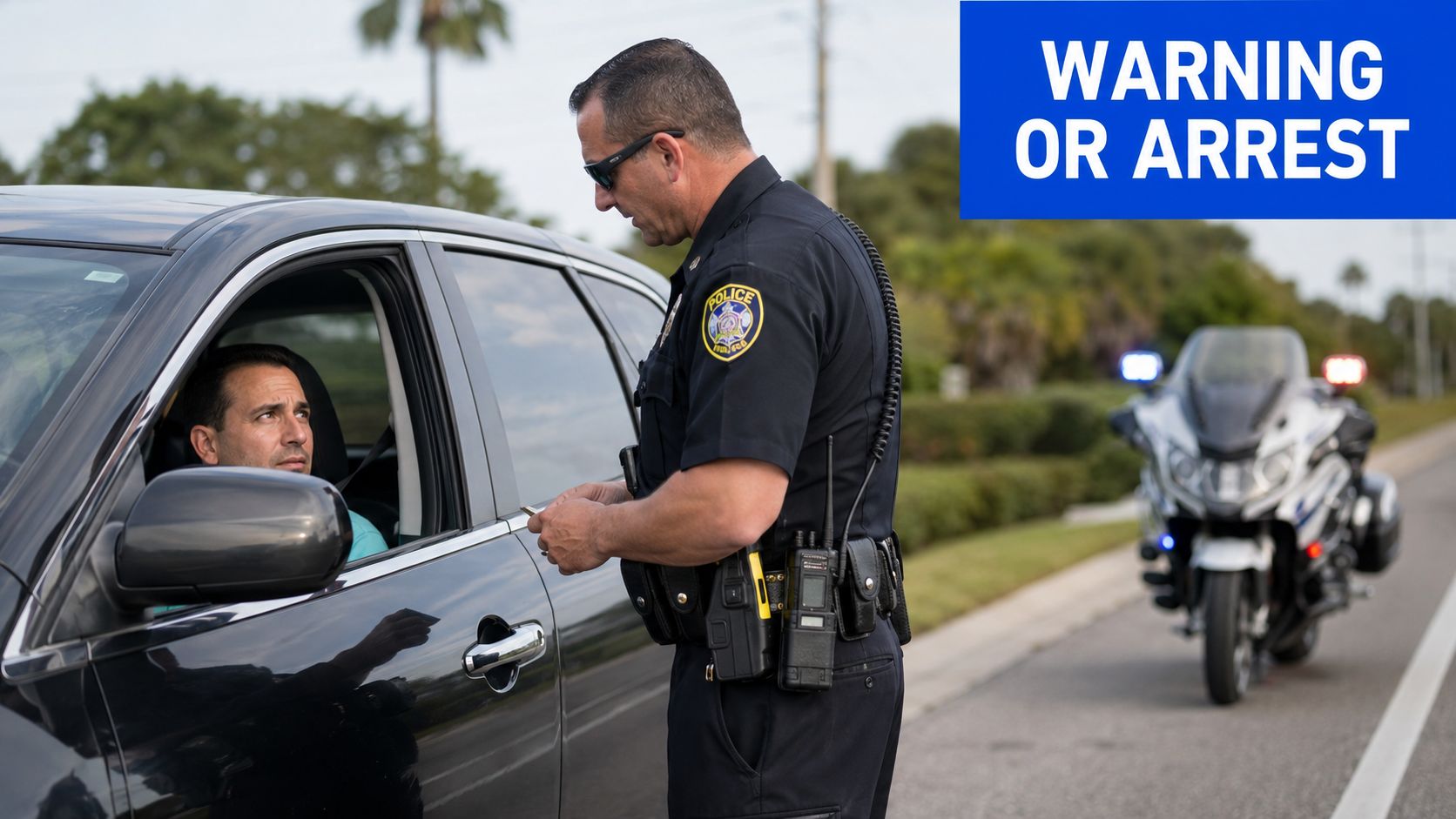
That shift happens fast in South Florida cases. A stop for speeding can turn into a DUI investigation. A question about what's in the center console can turn into a search. An officer who started out deciding between a citation and a warning may suddenly decide they have enough to arrest.
Why this legal line matters
The line between police curiosity and police authority is where probable cause lives. It isn't just courtroom vocabulary. It's the constitutional standard that often determines whether law enforcement can take the next step against you.
If police had the legal basis to act, the case moves forward on very different footing. If they didn't, your defense may focus on excluding evidence, challenging the arrest, and attacking the foundation of the State's case before trial even begins.
Practical rule: If an officer's actions escalated from questioning to searching or arresting, the key issue is often not what police found later. It's what they actually knew at the time.
Where clients get confused
It is often assumed that if police arrested someone, the arrest must have been valid. That's not how Florida criminal defense works. Courts regularly examine whether the officer had enough objective facts before making the arrest or search.
This matters across practice areas people search for every day, from a Fort Lauderdale DUI lawyer to a Broward County drug crime attorney, Florida domestic violence defense, Florida gun charge defense, theft crime penalties in Florida, probation violation lawyer issues, and record sealing Florida concerns after a case ends. In many of those cases, the first serious fight is over whether police had lawful grounds to act at all.
The Legal Definition of Probable Cause in Florida
The best way to understand the probable cause definition is to strip away the legal jargon. In plain English, it means police must have enough reliable facts to justify believing a crime happened, or that evidence of a crime will be found in a specific place.

What the phrase really means
The U.S. Supreme Court has ruled that probable cause is "incapable of precise definition or quantification into percentages." Instead of a 51% certainty, the standard requires a "fair probability" or "substantial chance" based on facts sufficient "to warrant a belief, by a man of reasonable caution, that a crime is being committed," as explained in this Alameda County discussion of probable cause.
That language clears up a major misunderstanding. People often ask whether probable cause means police have to be more likely right than wrong. Legally, that's not the test. The standard is flexible, practical, and based on common sense rather than math.
Florida courts apply that idea by looking at the totality of the circumstances. That means they don't isolate one fact and ignore the rest. They look at all the facts the officer knew at the time and ask whether those facts would lead a reasonable person to believe criminal activity was involved.
Why the Fourth Amendment matters
The Fourth Amendment is what protects people from unreasonable searches and seizures. Probable cause is one of the main constitutional limits placed on police power. It requires more than a hunch, but it doesn't require proof strong enough to convict.
A useful way to think about it is this:
Not enough: vague suspicion, a gut feeling, or an unsupported accusation
Enough in many cases: specific facts the officer can explain and defend in court
More than required: trial-level proof showing guilt beyond a reasonable doubt
When police search a vehicle, seek a warrant, or make an arrest in a South Florida case, the question becomes whether the officer could point to specific, objective facts. That is why search and seizure issues can be central in DUI, drug crimes, gun and weapons charges, theft offenses, and federal crimes.
If you want a deeper look at how these Fourth Amendment issues develop in Florida cases, review this discussion of illegal search and seizure in Florida.
A strong probable cause argument isn't about whether the officer was confident. It's about whether the officer can articulate facts that hold up under judicial review.
Probable Cause vs Reasonable Suspicion A Critical Distinction
Clients mix these standards up all the time, and that confusion is completely understandable. Both involve police judgment. Both come up during street encounters and traffic stops. But they authorize different police actions.
They are not the same standard
Under Florida law, police don't need probable cause to briefly detain someone for a stop-and-frisk. They need the lower standard of reasonable suspicion. Florida Statute 901.151 allows officers to briefly detain a person based on specific, articulable facts suggesting a crime is about to occur, while a warrant to search a home or vehicle requires the higher probable cause standard, as explained in this Florida stop-and-frisk discussion.
That means an officer may be allowed to stop you and ask questions even when the officer doesn't yet have enough to arrest you. In some cases, the officer may also pat down for weapons if the situation justifies it. What the officer can't do is use a bare suspicion to leap straight to a full arrest or a broader evidentiary search.
If you're dealing with a DUI stop, this distinction often appears when roadside observations turn into requests for field sobriety exercises. Many drivers don't realize how that escalation happens. This overview of Florida field sobriety tests helps explain that stage of the encounter.
Probable Cause vs. Reasonable Suspicion
Standard | Required Proof | Police Action Allowed | Example |
|---|---|---|---|
Reasonable suspicion | Specific, articulable facts suggesting crime may be happening or about to happen | Brief detention, limited questioning, possible pat-down for weapons in appropriate circumstances | An officer sees conduct that suggests possible impaired driving and initiates a roadside investigation |
Probable cause | Enough reasonably trustworthy facts to justify a reasonable belief that a crime occurred or evidence is present | Arrest, search warrant, and many searches tied to lawful police authority | An officer gathers enough observations during the investigation to justify a DUI arrest |
Why the difference changes outcomes
This distinction affects suppression motions, plea negotiations, and trial strategy. If police only had reasonable suspicion, they may have been allowed to stop and investigate. But if they arrested too early or searched too broadly, the defense can challenge what happened after that point.
That matters in all kinds of South Florida cases:
DUI and traffic crimes: Was the officer still investigating, or had the officer moved into arrest territory?
Drug crimes: Did police have enough to search for evidence, or only enough to ask questions?
Weapons cases: Was a protective frisk used as a shortcut to look for evidence?
Probation violations: Did the alleged new law offense begin with a lawful detention?
A former prosecutor sees where officers and prosecutors often try to blur this line. A defense attorney's job is to sharpen it.
Real-World Examples of Probable Cause in South Florida
Legal definitions become clearer when you see how they play out in actual situations. In Fort Lauderdale, Miami-Dade, Palm Beach, and surrounding South Florida courts, probable cause disputes often turn on what the officer observed firsthand, what came from another witness, and what facts existed before the arrest.
DUI stop in Fort Lauderdale
A driver is stopped late at night near Las Olas after weaving within a lane and braking erratically. The officer reports an odor of alcohol, slurred speech, and difficulty following instructions. The driver then performs poorly on field sobriety exercises.
Those combined observations may give police grounds to argue probable cause for a DUI arrest. Not because one fact alone proves intoxication, but because the facts stack together. In a real defense review, though, the details matter. Was the driving unsafe? Did body camera footage match the report? Were medical issues, fatigue, or nerves mistaken for impairment?
A checkpoint case raises different issues than an ordinary traffic stop. If your arrest started at a roadblock, this discussion of Florida DUI checkpoint legality may help you spot additional defenses.
Suspected drug activity in Miami-Dade
Police receive information that someone is selling drugs from a vehicle parked outside an apartment complex. Officers arrive, watch briefly, and then move in based mostly on the report.
That scenario should trigger caution. A tip can start an investigation, but the officer still needs reliable supporting facts before making an arrest or seeking a warrant. If the officer never independently confirms suspicious conduct, the probable cause argument may be weak.
Defense insight: Anonymous tips are often the beginning of a case, not the end of the probable cause analysis.
Retail theft allegation in Palm Beach County
A store employee says a customer concealed merchandise and walked past the registers. Officers arrive after the customer is stopped outside. Whether police have probable cause may depend on what the employee personally saw, what surveillance shows, and whether the officer can identify facts tying the person to the alleged theft.
Florida also draws an important line between felony and misdemeanor warrantless arrests. Under Florida Statute 901.15, for a warrantless felony arrest, an officer only needs probable cause to believe the person committed it, even if it happened outside the officer's presence. For most misdemeanors, however, the offense must occur "in the presence of the officer" for a warrantless arrest to be lawful.
That distinction becomes highly practical in theft crimes, domestic violence allegations, certain traffic offenses, and some low-level violent crime accusations. The same facts may support a report, but not necessarily a lawful warrantless arrest.
How a Defense Attorney Challenges Lack of Probable Cause
When a client says, "The officer had no reason to search me," the legal tool that usually follows is a motion to suppress. This is how the defense asks the court to exclude evidence obtained through an unconstitutional search or seizure.

What a motion to suppress does
A suppression motion forces the prosecution to defend the officer's actions. The judge reviews what police knew, when they knew it, and whether that information justified the stop, search, warrant, or arrest. If the court finds the action unlawful, key evidence may be excluded.
For clients, that can change the advantage in a case dramatically. In some prosecutions, especially drug crimes, DUI cases, gun charges, and search-heavy investigations, the State's evidence depends on that initial police action being lawful.
If you want to understand the mechanics, this guide on what a motion to suppress evidence means in Florida is a useful starting point.
A short video can help make that process more concrete.
Where experienced review changes a case
A former prosecutor reads police paperwork with a distinct perspective. The defense isn't limited to what the report claims. The essential work involves comparing every source of evidence:
Police reports: Do the officer's written reasons support the legal standard?
Body camera and dash camera footage: Does the video confirm the officer's timeline and observations?
Witness statements: Did anyone with personal knowledge contradict the police version?
Warrant affidavits: Did the officer rely on unsupported assumptions or missing details?
One recurring issue involves tips from anonymous sources. Anonymous tips alone rarely establish probable cause in Florida unless they are corroborated by independent police investigation that provides "reasonably trustworthy information." Courts have increasingly scrutinized warrants and arrests based on unverified tips, which makes corroboration a major defense issue, as discussed in this probable cause refresher addressing anonymous tip problems.
Sometimes the most important question in a criminal case is simple. What did the officer actually know before acting?
That question shows up in search and seizure issues, drug possession arrests, domestic violence investigations, theft cases, juvenile crimes, white collar investigations, and even federal crimes. If the answer is weak, the defense should press it hard.
Protecting Your Rights and Answering Your Questions
When police stop you, your goal isn't to win an argument on the roadside. Your goal is to protect your rights and avoid making the situation worse.
What to do during a police encounter
Use calm, direct behavior.
Stay respectful: Don't argue, reach suddenly, or physically resist, even if you believe the stop is unfair.
Use your right to remain silent: You can identify yourself when required, but you don't have to explain, guess, or talk your way out of an investigation.
Don't consent casually: If an officer asks to search, you can state clearly that you do not consent.
Notice details: Try to remember what the officer said, what was searched, whether you were ordered out of the car, and whether anyone else was present.
Call a lawyer quickly: Early legal review matters in DUI, drug crimes, theft offenses, gun cases, violent crimes, and probation violations.
Police authority is judged later by a court, not by how confident the officer sounded in the moment.
Courts evaluate probable cause in hindsight when ruling on a motion to suppress evidence. The issue is whether the officer had "reasonably trustworthy information" known at the time, and the legal hierarchy places probable cause above reasonable suspicion but below proof beyond a reasonable doubt, as explained in this Nolo definition of probable cause.
Frequently asked questions
Can police search my car if they smell marijuana?
It depends on the full facts of the encounter and current Florida law issues being argued in court. Odor may become part of the officer's explanation, but any real case needs careful review of timing, location, other observations, consent, and what the officer did next. Don't assume the search was automatically valid just because police claimed to smell something.
Can I refuse a search?
You can refuse consent to a search. That doesn't mean police will stop. It does mean you've preserved an important issue. If the officer searches anyway, your lawyer can later challenge whether there was lawful authority without your consent.
Can an anonymous tip alone get me arrested?
Usually, that is a weak foundation by itself. If police relied heavily on an unverified tip, your attorney should closely examine whether officers independently corroborated enough facts before acting.
If you were arrested in Fort Lauderdale, Broward County, Miami-Dade, Palm Beach, or anywhere in South Florida, and you believe police searched, stopped, or arrested you without proper legal grounds, get the case reviewed immediately. Early action can make the difference between reacting to the State's evidence and attacking its foundation.
If you need help reviewing whether police had lawful grounds to stop, search, or arrest you, contact Ticket Shield, PLLC for a confidential consultation. The firm represents clients across Broward County, Fort Lauderdale, Miami-Dade, Palm Beach, and throughout Florida in DUI, drug crimes, theft offenses, violent crimes, gun charges, probation violations, record sealing matters, and other criminal defense cases. A focused review of probable cause, the police report, video, and warrant paperwork may reveal defenses that can protect your freedom, record, and future.