Probable Cause Traffic Stop: A Florida Driver's Guide
Jason Goldsmith, Esq
You're driving through Fort Lauderdale when an officer lights you up for a tag light. You pull over, hand over your license, and answer a few questions. Within seconds, the officer is asking where you're coming from, whether there's anything illegal in the car, and whether you'll agree to a search. What felt like a minor traffic citation may now determine whether a DUI, drug, gun, or other criminal case moves forward.
I've reviewed hundreds of stop videos and dashcam transcripts from the perspective of both a former Florida prosecutor and a defense attorney. The gap between an officer's citation and what the video proves can be decisive. The key questions are separate: Was the initial stop lawful, and was everything that followed independently lawful?
That distinction matters throughout Broward County, Fort Lauderdale, Miami-Dade, Palm Beach, and the rest of South Florida. This guide explains probable cause, reasonable suspicion, vehicle searches, detention extensions, and the defense strategies used to challenge evidence in Florida courts. If you want a broader explanation of how officers use minor violations to investigate unrelated crimes, review this guide to pretext traffic stops.
Table of Contents
Why Your Florida Traffic Stop Can Make or Break Your Case
A traffic stop is a legal seizure, not merely a conversation beside the road. Florida law requires at least reasonable suspicion that a traffic offense or another crime occurred before an officer may temporarily detain a driver, as explained in the Florida Bar's materials on vehicle stops. The officer must point to specific facts, not a hunch.
The first moments matter because the officer's stated reason for stopping you becomes the foundation for everything else. A claimed equipment violation, lane violation, speeding observation, or registration issue may justify the initial detention. But that justification doesn't automatically authorize a vehicle search, a passenger search, or an unrelated investigation.
The two questions that control the case
Ask these questions immediately after a stop:
Was the initial seizure lawful? The officer must have an objective basis tied to an actual traffic violation or criminal activity.
Was the next step lawful? A search, arrest, prolonged detention, or evidence collection needs its own legal justification.
An officer may write that you were stopped for a tag light and later claim to have smelled alcohol or seen contraband. The body camera, dashcam, dispatch recording, and timing often tell a more precise story. If the video doesn't support the report, that discrepancy can become the center of a suppression motion.
Why the distinction affects your defense
A valid stop can still produce an invalid search. A lawful citation can still be followed by an unlawful detention extension. And an officer's subjective desire to investigate drugs or weapons doesn't automatically invalidate a stop if an objective traffic violation existed. Your attorney must examine each stage rather than treating the encounter as one uninterrupted event.
In Florida, that analysis can affect DUI prosecutions, drug charges, weapons cases, theft investigations, and other traffic crimes. It can also protect your license, record, and ability to avoid a conviction when the State's evidence depends on what officers discovered after the stop.
What Probable Cause Actually Means Under Florida Law
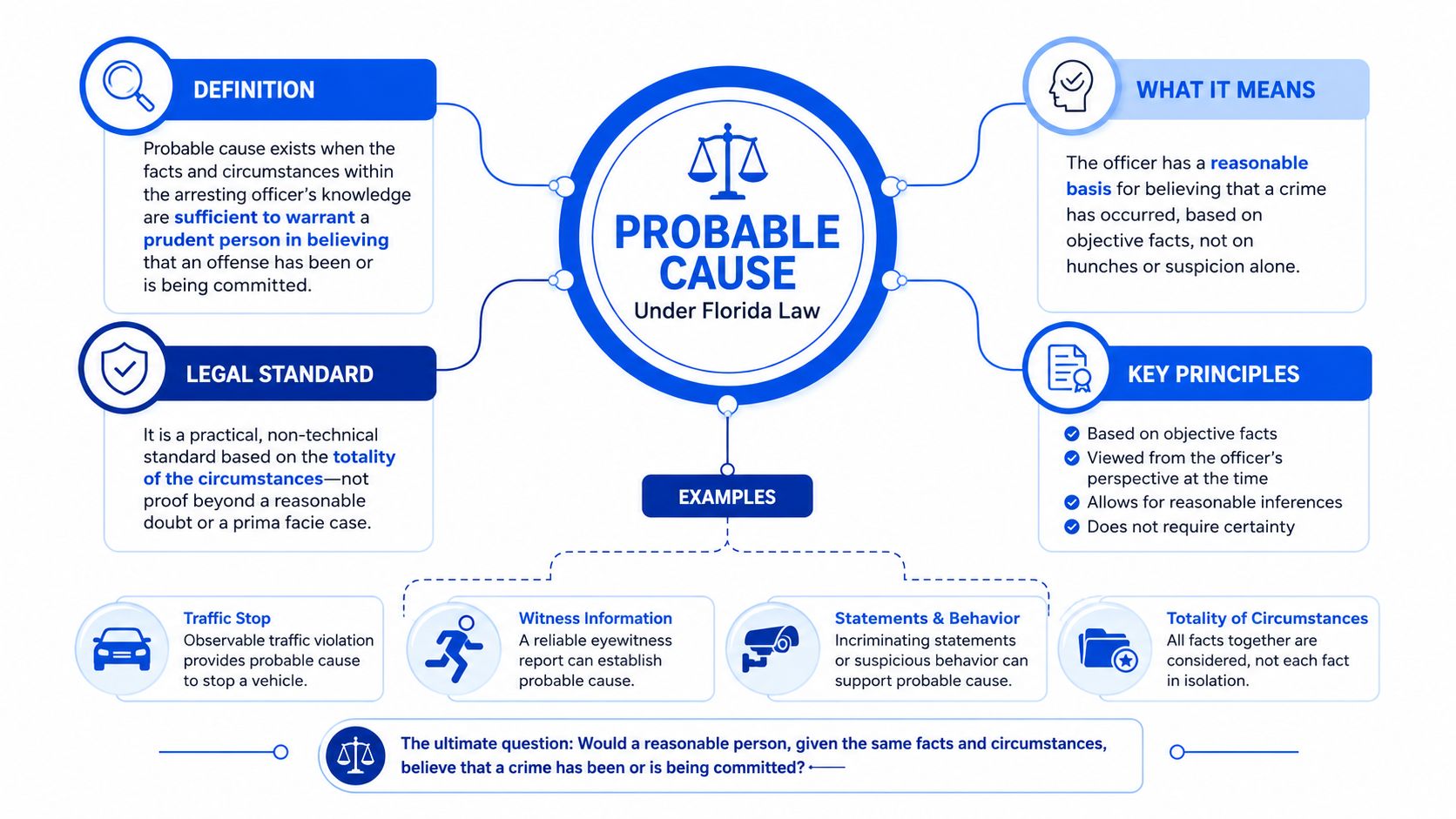
Probable cause means facts and circumstances that would lead a reasonable officer to believe a traffic violation or another crime has occurred, is occurring, or is about to occur. The standard is practical and objective. It doesn't require proof beyond a reasonable doubt, but it does require more than a feeling that something might be wrong.
Florida officers generally need a well-founded, articulable suspicion before stopping a vehicle. Florida's stop-and-frisk statute permits temporary detention when circumstances reasonably indicate that a person has committed, is committing, or is about to commit a criminal offense. The detention must last no longer than reasonably necessary and must remain where it began or in the immediate vicinity. If probable cause doesn't develop after the inquiry, the person must be released under Florida Statute 901.151.
What officers must be able to identify
An officer should be able to describe facts such as:
Observed conduct: The officer saw a driver speed, fail to signal, cross a lane marker, or commit another identifiable violation.
Reliable information: Dispatch or another source provided information that objectively connected the vehicle or person to possible criminal activity.
Developing evidence: During a lawful detention, new facts created a stronger basis for arrest or a search.
A vague statement such as “the driver looked suspicious” doesn't explain what happened. Nervousness, an unusual travel plan, or a driver's refusal to answer unrelated questions may influence an officer's attention, but those facts alone don't automatically establish probable cause.
The statutory limit matters
Florida's statute doesn't give officers unlimited time to investigate. The detention must stay within a reasonable scope and duration. Once the original purpose has been addressed, the officer needs a valid reason to continue holding the driver. If no probable cause develops, continued detention becomes vulnerable to challenge.
That's the practical definition you should remember: the officer needs specific, objective facts that connect the stop or detention to a traffic violation or crime. A hunch isn't enough, and the detention can't continue indefinitely while the officer searches for a reason.
Probable Cause vs Reasonable Suspicion in Traffic Cases
Drivers often hear officers and prosecutors use reasonable suspicion and probable cause as though they mean the same thing. They don't. Reasonable suspicion is the lower threshold for a brief investigative stop. Probable cause is the stronger standard commonly required for an arrest, a warrantless vehicle search, or an evidence-based expansion of the encounter.
The distinction is reflected in Florida traffic-stop practice and summarized in training materials explaining the difference between the standards. Probable cause requires facts that would warrant a reasonable officer to believe a traffic law or other crime has occurred, while reasonable suspicion is only a minimal, objective justification. Both rely on the totality of the circumstances.
Standard | What It Requires | What It Justifies | Typical Florida Traffic Example |
|---|---|---|---|
Reasonable suspicion | Specific, articulable facts suggesting a traffic violation or criminal activity | A brief investigative stop or temporary detention | An officer observes conduct that reasonably suggests impaired driving or a traffic violation |
Probable cause | Facts and circumstances supporting a reasonable belief that a violation or crime occurred | Arrest, seizure, or a vehicle search when the probable cause relates to the search | An objectively observed violation, visible contraband, or other facts tied to a specific crime |
How the examples work
Swerving within a lane may support reasonable suspicion when the movement, surrounding circumstances, and officer observations suggest a traffic or impairment issue. A cracked tail light, expired tag, tinted windows, or failure to signal may support a stop if the officer reasonably believes the conduct violates Florida law. The officer must still accurately identify the conduct and the applicable law.
Probable cause requires the facts to add up to a stronger conclusion. Visible contraband, an admission, or observations supporting an impaired-driving arrest may move the encounter beyond a brief investigation. But an officer can't label reasonable suspicion as probable cause because the officer wants to search.
Practical rule: The standard that justified the stop may not justify what happened five minutes later.
That is why the timing and sequence matter. A defense lawyer needs to identify the precise moment when the officer shifted from traffic enforcement to criminal investigation, then test whether the stronger justification existed at that moment. For a fuller treatment of the distinction, see this explanation of reasonable suspicion versus probable cause.
The Facts That Usually Create Probable Cause During a Stop
Probable cause comes from the facts an officer can identify and defend, not from the label placed on a citation. In a typical Florida stop, those facts may begin with an observed traffic violation and later develop through what the officer sees, hears, or smells. The court evaluates the circumstances objectively.
Roadside observations
Common facts officers may rely on include:
Speeding: An officer's observation or reliable measurement may support enforcement action.
Reckless driving: Driving behavior that objectively creates a serious roadway risk can provide a stronger basis for intervention.
Equipment violations: A defective light or other equipment issue may justify a stop if the officer correctly identifies a violation.
Registration or license indicators: An expired registration or information suggesting a suspended license may support the initial detention.
Lane violations: Failure to maintain a lane can matter when the officer can describe what the vehicle did and why it violated the law.
The citation alone doesn't settle the issue. I compare the language in the citation and report with the dashcam angle, road conditions, lighting, traffic flow, and the officer's actual description. A report that says “weaving” may look different when the video shows a normal lane adjustment.
Facts that develop after the stop
A lawful stop can produce new information. An officer may claim to see contraband in plain view, smell alcohol, hear an admission, or observe conduct that supports a criminal investigation. Those facts must be evaluated in context. The question isn't whether the officer wrote that probable cause existed. The question is whether the underlying facts objectively supported that conclusion.
The Whren problem
The U.S. Supreme Court's decision in Whren v. United States, decided on June 10, 1996, and reported at 517 U.S. 806, held that a stop is objectively reasonable under the Fourth Amendment when officers have probable cause to believe a traffic violation occurred, even if the officer had a different subjective motive, according to the case reference. The decision became the leading national authority for pretextual traffic stops and remains central in major jurisdictions, including Florida.
That rule makes the objective facts especially important. A defense attorney usually won't win merely by showing that the officer wanted to investigate drugs. The stronger challenge is showing that the claimed violation didn't occur, was misinterpreted, or was used to justify conduct that exceeded the lawful scope of the stop.
When a Search Becomes Legal After a Valid Stop
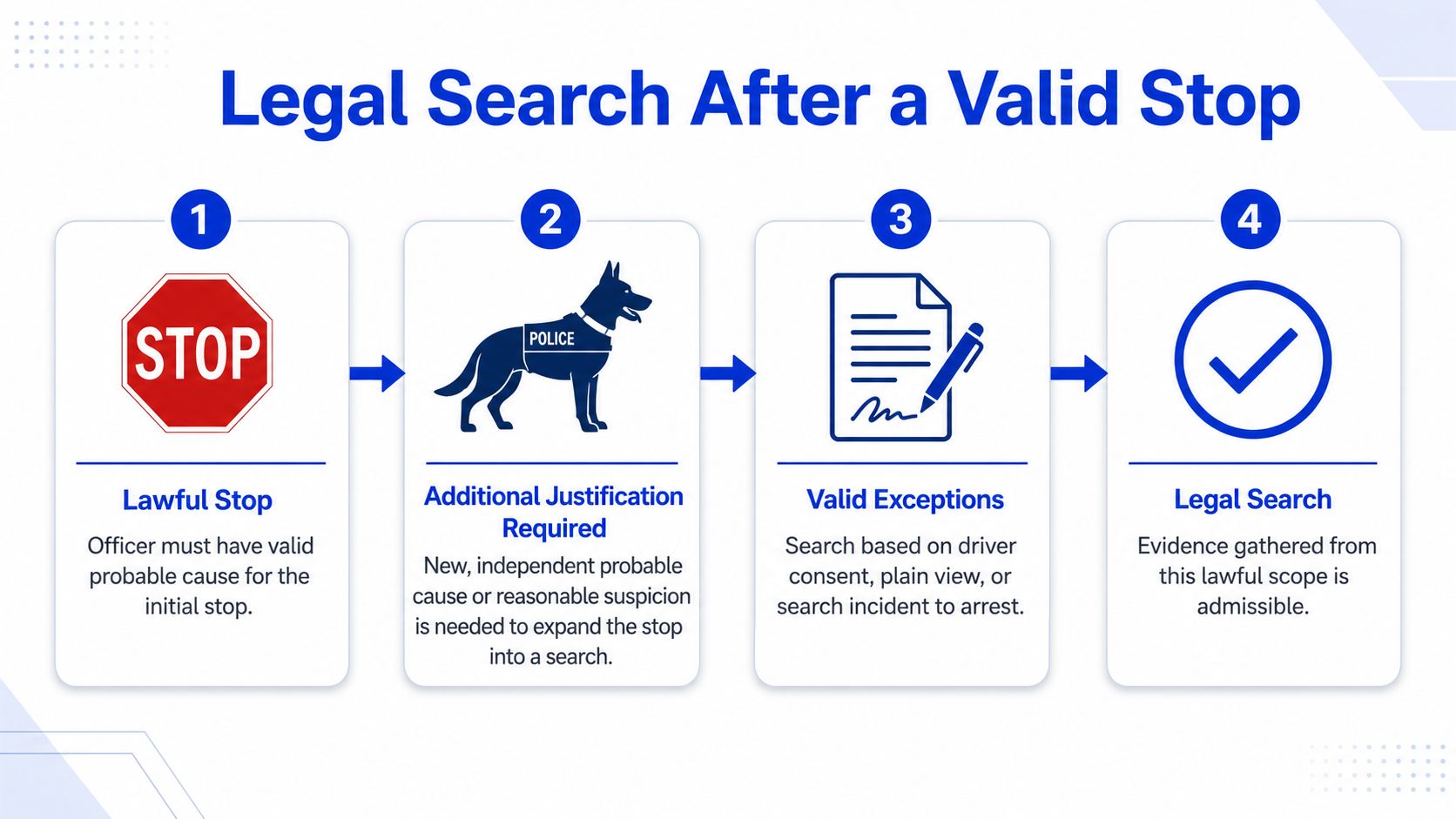
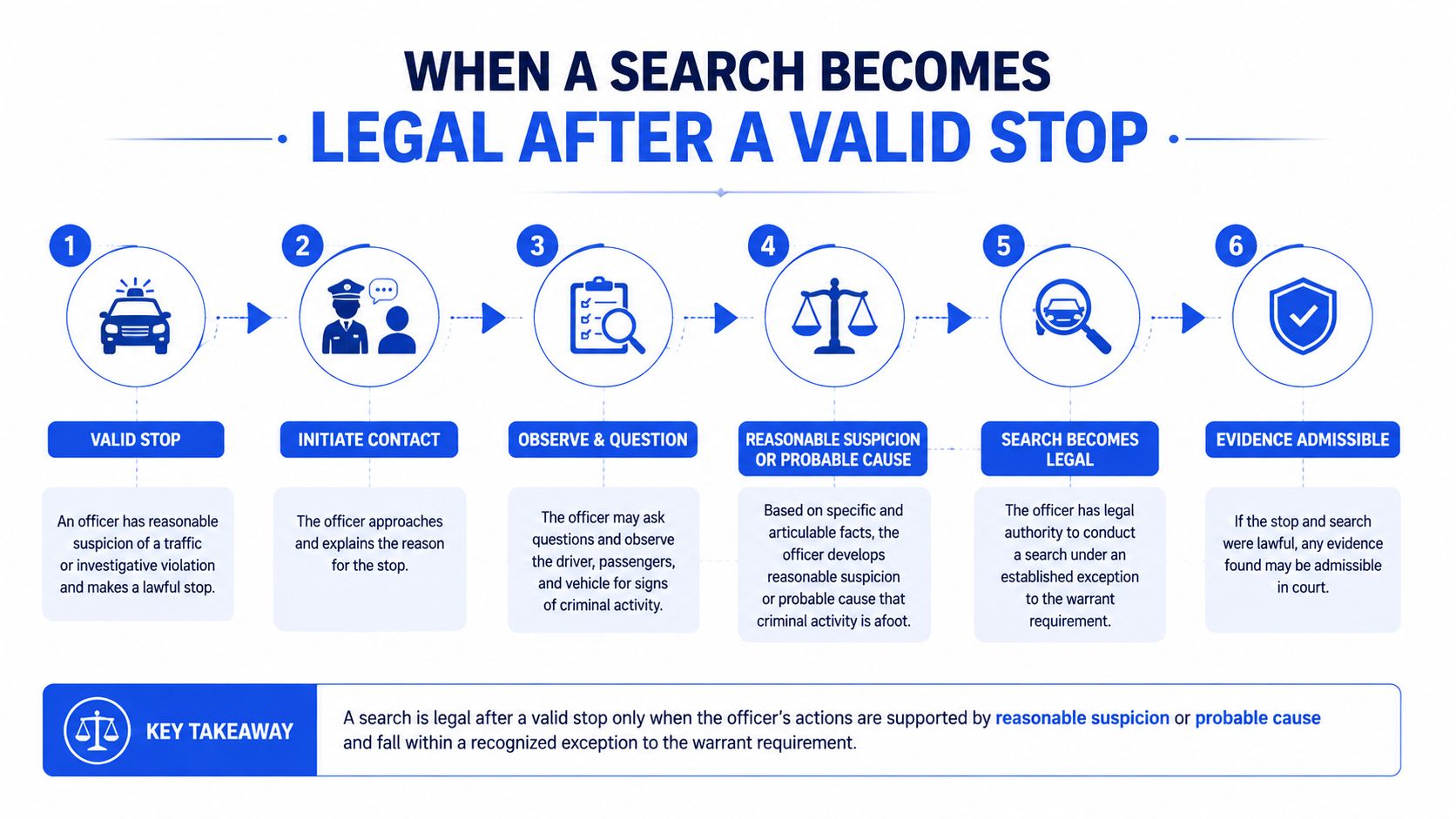
A valid traffic stop doesn't give an officer automatic permission to search the vehicle. It doesn't automatically authorize a search of the driver, a passenger, or a passenger's bag. The officer needs probable cause tied to the search itself, voluntary consent, or another recognized exception.
The District of Columbia Metropolitan Police Department's traffic-stop materials emphasize the separation between the stop standard and the search standard. Probable cause may justify the stop, but a vehicle search still requires probable cause connected to the search unless another exception applies.
Common search pathways
Probable cause tied to the vehicle can support a warrantless search under the automobile exception. The facts must indicate that evidence or contraband is likely located in the vehicle. A lawful stop by itself isn't enough.
Voluntary consent is another route. You can decline consent politely. Refusal doesn't automatically establish probable cause, and an officer can't treat the refusal alone as proof that the car contains evidence.
Plain view may permit seizure when an officer is lawfully positioned and the item's incriminating character is apparent. That doesn't authorize rummaging through closed containers to find something else.
Search incident to arrest has limits. An arrest doesn't create unlimited authority to search every part of a vehicle or every passenger's property. The scope depends on the circumstances and governing law.
Inventory searches serve an administrative purpose when a vehicle is lawfully impounded. Police must follow standardized procedures rather than using inventory as a pretext for investigation.
Why these challenges have real consequences
Pennsylvania State Police data illustrates why probable-cause searches deserve close review. In 2025, traffic-stop searches totaled 19,220. Of those searches, 2,907, or 15.1%, were based on probable cause and/or reasonable suspicion. Those discretionary searches produced seizures 66.5% of the time, compared with 57.3% for consent-based searches, and the report states that the seizure rate for probable-cause and reasonable-suspicion searches remained within the 64% to 66% range, according to the Pennsylvania State Police report.
Florida cases involving drugs or weapons often turn on this seam. If the stop was lawful but the search lacked consent, probable cause, or another exception, the evidence may be challengeable through an illegal search and seizure defense.
What Drivers Should and Should Not Do During a Florida Stop
Your goal at the roadside is safety and preservation of your rights. Don't try to win the constitutional argument beside the patrol car. Keep your hands visible, pull over safely, provide required documents, and avoid sudden movements or confrontational language.
A practical roadside playbook
Pull over safely. Use a safe location when possible, activate your signal, and keep the vehicle stationary.
Keep documents accessible. Have your license, registration, and insurance information available without reaching into hidden areas.
Answer identification questions. Provide the information the officer lawfully requests.
Avoid substantive explanations. You don't need to explain your entire trip, defend your character, or answer questions about unrelated conduct.
Decline consent clearly. Say, “I don't consent to a search.” Don't physically block the officer or argue.
Follow lawful commands. A rights violation is addressed later through counsel and the court, not through resistance.
Ask for counsel. If the encounter becomes an arrest or the officer begins seeking substantive admissions, ask for a lawyer before answering.
If the officer asks where you're coming from or where you're going, you can respond briefly or say you don't want to answer questions. Silence and a polite refusal to consent aren't proof of guilt. They're ways to avoid volunteering statements that may later be presented out of context.
Florida issues that create confusion
Open-container questions, passenger ownership, and DUI procedures can complicate a stop. A passenger's refusal to consent may matter differently from the driver's refusal depending on who has authority over the property. An officer may also give implied-consent warnings in a DUI investigation, and refusing a breath test can create separate administrative and legal consequences. Read about the related issue of refusing a breathalyzer in Florida before making assumptions about what refusal means.
A phone mounted on the dashboard may record the encounter, but don't reach for it or manipulate it while the officer is standing at the window. Preserve the recording safely and provide it to your attorney.
Most important: Once arrest appears likely, ask for a lawyer before answering substantive questions.
How Defense Attorneys Challenge the Stop and the Evidence
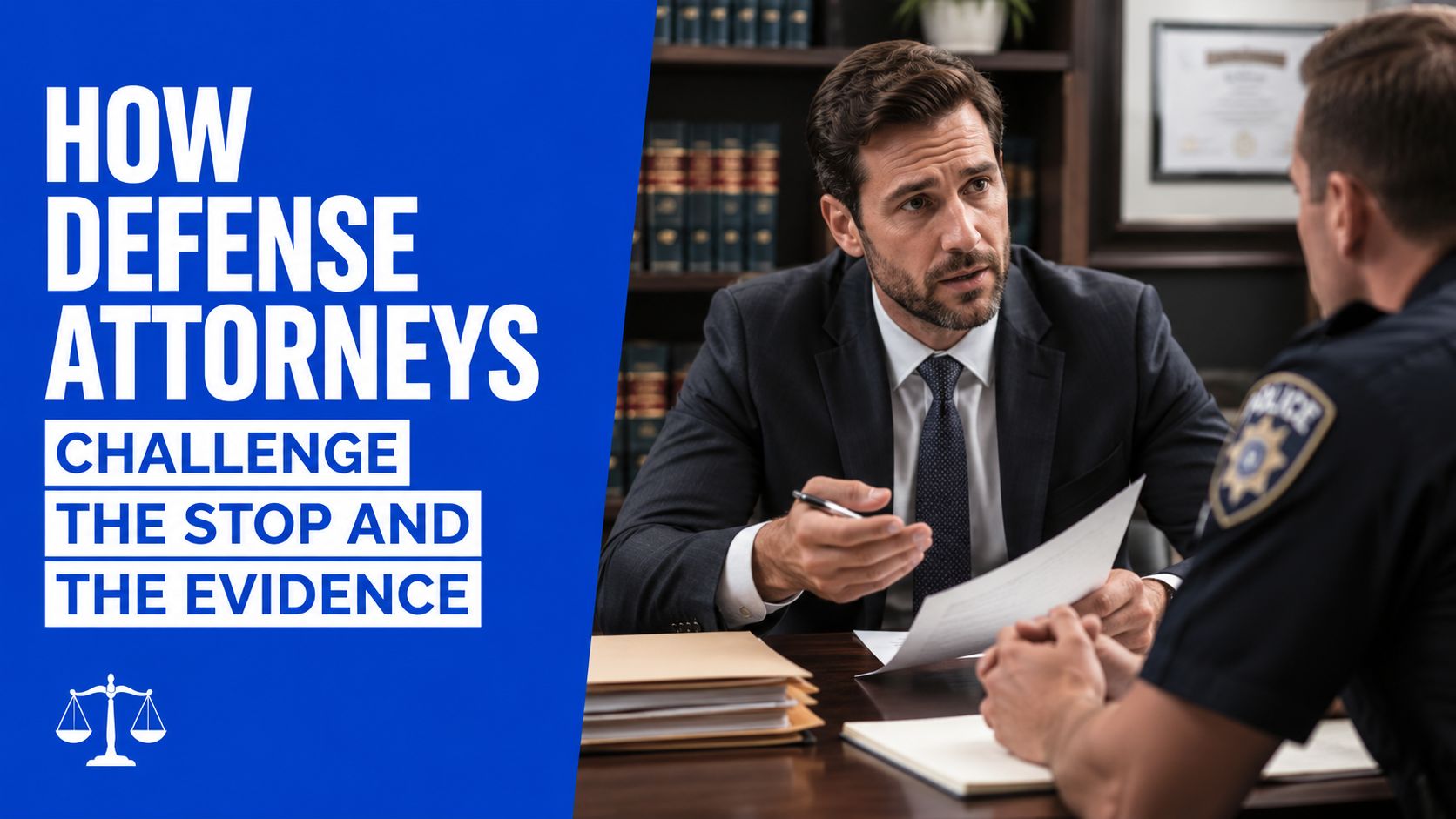
The primary tool is often a motion to suppress evidence. The defense asks the court to exclude evidence obtained through an unlawful stop, search, arrest, or detention. The timing and factual development of that motion matter because the court needs a clear record of what happened.
Building the record
I start with the officer's stated reason for the stop, then compare it against every available source:
Dashcam and body-camera footage: Does the video show the claimed lane movement, equipment problem, odor-related interaction, or admission?
Dispatch records: What did the officer communicate before and during the stop?
Citation and report language: Do the documents describe the same violation consistently?
Timing: How long did the traffic mission take, and when did unrelated questioning or a search begin?
Consent evidence: Did the driver clearly agree, or did the officer repeatedly pressure the driver?
The State must defend the legality of the seizure and the evidence-gathering steps. At a suppression hearing, the judge may hear testimony, review video, examine records, and decide whether the officer had the required objective basis.
Where reports often fail
An officer may write that a driver was visibly impaired, but the footage may show organized speech and steady movement. A report may describe a search as consensual, while the audio reveals repeated requests after the driver declined. A citation may identify one violation, while the officer later relies on another explanation.
Those inconsistencies don't automatically decide the case. They do give the defense material to test credibility and challenge the State's version.
What suppression can change
A court may sever the State's case from the evidence obtained after an unlawful event. If drugs, a firearm, a statement, or test evidence came directly from the challenged stop or search, exclusion may leave the prosecution without proof it needs to proceed.
For a more detailed explanation of the procedure, see this guide to motions to suppress evidence. A former prosecutor's perspective helps because the defense can anticipate how the State will characterize the officer's observations, consent, timing, and report language, then confront those arguments with the actual record.
Florida Driver FAQs and Your Next Steps
Does an officer need probable cause to initiate a traffic stop?
Usually, the officer needs at least reasonable suspicion of a traffic violation or other criminal activity. Probable cause is the stronger standard and may support an arrest or search when it relates to that specific action. Florida courts apply an objective test, so the legal question is whether the facts supported the stop, not just what the officer says the motive was.
Can a passenger refuse a search of their own bag?
A passenger can state that they don't consent to a search of their own property. The officer may still search if another legal exception applies, but refusal alone doesn't create probable cause. Ownership, control, consent, and the factual basis for the search all matter.
What happens if police search without consent or probable cause?
Your attorney can ask the court to suppress evidence gathered through the unlawful search. The court may examine the stop, the detention's duration, the officer's observations, the claimed exception, and the connection between the evidence and the constitutional violation. Suppression may affect drug, weapon, theft, DUI, or other criminal charges.
Can I challenge the stop if I was actually speeding?
Yes, but the challenge must target a real legal defect. If the officer objectively observed speeding, the stop may be valid even if the officer also had an investigative motive. The defense may still challenge what happened afterward, including a prolonged detention, unsupported search, coerced consent, or arrest without adequate facts.
Why should I act quickly?
Video and electronic records can become harder to obtain as time passes. Write down the sequence while you remember it, preserve any recording, save the citation, and avoid discussing the facts publicly. Early review can reveal whether the officer's written account matches the footage and whether the search exceeded the lawful scope.
Ticket Shield, PLLC reviews Florida traffic stops and related criminal cases, including DUI, drug, weapons, and search-and-seizure issues. Contact the Broward County-based firm, available 24/7 across Florida, for a confidential consultation focused on the citation, video, detention timeline, and potential suppression issues.
Ticket Shield, PLLC can review your probable cause traffic stop, dashcam or body-camera evidence, citation, and any resulting criminal charge. Visit Ticket Shield, PLLC to request a confidential consultation and get focused guidance before the State's version of the stop becomes the only version in the record.