
Know Your Rights: Reasonable Suspicion vs Probable Cause
Jason Goldsmith, Esq
You saw the lights in your rearview mirror, pulled onto the shoulder, and now the whole encounter can turn on one question. Did the officer have reasonable suspicion, or did the State later build enough facts for probable cause? In Florida, that line decides whether a stop stayed lawful, whether a search crossed the Constitution, and whether evidence can be challenged in court.
For people facing a DUI stop, a drug arrest, a domestic violence call, or a weapons case in Broward County, Miami-Dade, Palm Beach, or anywhere in South Florida, these aren't abstract legal labels. They're the difference between a brief detention and a search, between a roadside conversation and an arrest, between evidence that comes in and evidence that gets attacked. A defense lawyer who knows how police reports are written, and how they're supposed to be written, looks for the exact moment the officer moved too far, too fast.
Legal standard | What it means in plain English | What police can usually do | What police still cannot do |
|---|---|---|---|
Reasonable Suspicion | A specific, articulable basis to think criminal activity may be happening | Brief stop, questions, limited frisk in the right circumstances | Full arrest or broad search |
Probable Cause | Facts that create a fair probability a crime occurred or evidence will be found | Arrest, full search, warrant application | Act on a bare hunch or unsupported guess |
Table of Contents
Pulled Over in Florida Your Rights Hinge on Two Legal Phrases
A Closer Look at Reasonable Suspicion The Standard for a Police Stop
Understanding Probable Cause The Threshold for Arrests and Searches
Reasonable Suspicion vs Probable Cause in Action South Florida Scenarios
Challenging the Evidence How We Fight Illegal Stops and Searches
What to Do When Stopped by Police in Florida A Practical Guide
Pulled Over in Florida Your Rights Hinge on Two Legal Phrases
The flashing lights are behind you, the officer walks up, and the whole encounter suddenly feels bigger than the traffic issue in front of you. That feeling is justified, because a stop that starts as a traffic matter can quickly become a DUI investigation, a drug search, a domestic violence inquiry, or a gun case. What separates a lawful stop from an unlawful escalation is usually whether the officer had reasonable suspicion at the start and probable cause when things got more intrusive.
Florida courts deal with this question every day because the line matters in real life, not just in textbooks. Under Florida law, reasonable suspicion is the threshold for a temporary investigatory detention, especially in traffic stops or police contacts based on tips, and it has to rest on the totality of the facts and circumstances, not a mere hunch (Florida criminal defense explanation). That means the officer needs specific, common-sense facts that can be explained later.
Practical rule: if the officer can't point to facts, and only has a feeling, the stop is vulnerable.
That's why a good defense lawyer doesn't accept the report at face value. The report may say the driver was “weaving,” the passenger was “nervous,” or the person “matched a description,” but the key question is whether those facts, taken together, legally justified the stop or the arrest. In Florida criminal cases, that distinction is often where suppression fights begin.
Defining the Legal Standards for Police Action
The Fourth Amendment protects people from unreasonable searches and seizures, and both standards come out of that protection. Police don't get to decide on instinct alone, they have to justify what they're doing at the level the Constitution requires. That's why the law uses two different thresholds, one for a brief stop and another for a search or arrest.
Reasonable suspicion is the lower rung
Reasonable suspicion is more than a hunch, but it's less than probable cause. It allows a temporary detention when the officer has specific, articulable facts suggesting criminal activity may be happening, and Florida materials stress that the officer must be able to explain those facts in a commonsense way (Florida defense discussion of articulable suspicion). The point is not certainty. The point is whether the officer can justify a brief intrusion.
Probable cause is the higher rung
Probable cause is the threshold for arrests, full searches, and warrants. Courts and training materials describe it as a fair probability or substantial chance, not a demand for proof beyond dispute (probable cause basics). In plain English, the facts have to be strong enough that a reasonable person would believe evidence or a crime is likely involved.
The important Florida takeaway is simple. Reasonable suspicion lets police stop and ask. Probable cause lets them move into arrest or full search authority. That difference is why a stop in Fort Lauderdale or Palm Beach can be lawful at first, but still collapse later if the officer overreaches.
A Closer Look at Reasonable Suspicion The Standard for a Police Stop
Reasonable suspicion is the standard commonly encountered first, even if the term is never heard at the roadside. It's the legal basis for a brief detention, and it has to come from specific and articulable facts, not a guess dressed up as police work (federal and Florida defense explanation of the stop standard). Officers often rely on observations such as lane drift, unusual movements, inconsistent answers, or a tip that points them to a person or car.
What it allows and what it doesn't
A lawful stop based on reasonable suspicion can support a short conversation, a license check, and limited questioning. In the right circumstances, it can also support a limited pat-down for weapons. But it does not automatically authorize a full car search, a trunk search, or an arrest, and that's where many Florida suppression issues start.
A stop may begin lawfully and still become unlawful if the officer treats the lower standard like it's enough for everything. The defense question is always whether the officer had enough factual support to justify that first detention, and whether the officer stayed within the scope of that detention once it began. If the officer stretches the encounter beyond what the facts support, the State has a problem.
A stop based on “maybe” is not the same thing as a search based on evidence.
The key point from Florida appellate guidance is that the suspicion must have a factual foundation in what the officer observed and how those observations were interpreted through training and experience, with conduct that may be afoot even though probable cause still doesn't exist (reasonable articulable suspicion guidance). That's the place where a careful defense review often finds weakness, especially in DUI stops, traffic stops, and drug investigations. See also illegal search and seizure.
Understanding Probable Cause The Threshold for Arrests and Searches
Probable cause is where the State has to do more than say, “something seemed off.” It's the level of justification police need before making an arrest, obtaining a warrant, or conducting a full search. Courts describe it as a fair probability, and the Supreme Court has repeatedly said it is less than proof by a preponderance of the evidence, which means it does not require greater-than-50% certainty (probable cause basics).
Why the standard is still flexible
That flexibility matters. Probable cause is not a math test, and courts have never required officers to assign a percentage to their belief. Instead, judges look at the totality of the facts, then decide whether those facts would make a reasonable person believe a crime was committed or that evidence would be found. A stop can be supported by suspicion, but a search or arrest needs stronger ground.
The practical difference in Florida cases
In real cases, the State often overstates what the officer knew. A driver may have appeared nervous, a passenger may have made a vague movement, or an officer may have noticed an odor or a container. Those facts may build toward probable cause, but only if they add up in a legally meaningful way. If they don't, the arrest or search can be challenged.
That's why the probable cause question is so important in DUI, drug, theft, and weapons cases across South Florida. If police had the right to stop but not the right to escalate, the defense can attack the jump from suspicion to arrest. For a broader explanation, see what is probable cause.
Reasonable Suspicion vs Probable Cause in Action South Florida Scenarios
A roadside stop in Broward County doesn't unfold in a vacuum. The officer sees a car, a person, a movement, a tone of voice, and then decides whether to keep going. The law asks whether those observations fit the lower standard for a stop or the higher standard for arrest and search authority.
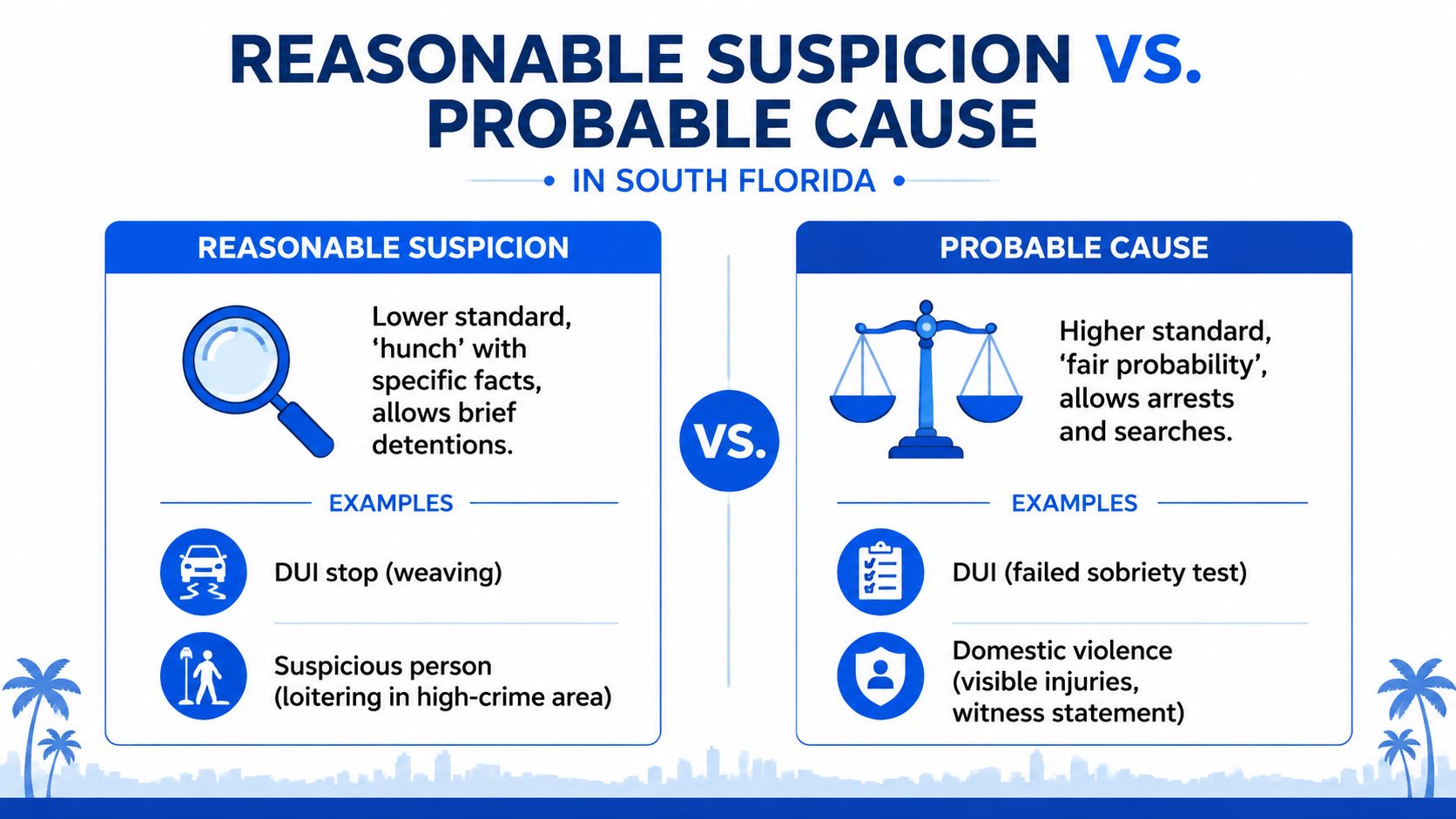
DUI stop
A DUI investigation often starts with reasonable suspicion. Swerving, lane drift, or another observable driving issue can justify a brief stop if the facts are specific enough and not just a vague complaint. Once the officer makes contact, the question becomes whether new facts justify moving from a detention to probable cause for arrest.
That transition matters. The officer may notice slurred speech, balance issues, or failed field observations, and those facts can be used to argue probable cause. But a defense lawyer will still test whether those observations were reliable, whether the stop itself was lawful, and whether the officer rushed to arrest without enough corroboration.
Drug investigation
Drug cases often begin with a tip, a suspicious exchange, or behavior the officer says looked consistent with a transaction. Reasonable suspicion can support a stop, but probable cause takes more. If the officer only has a vague description of conduct and no stronger corroboration, the search is vulnerable.
Domestic violence or weapons case
A 911 call or witness report can justify initial police contact, but it doesn't automatically give probable cause for arrest. Florida law still requires facts that support the escalation, such as observed injuries, credible statements, or conduct that clearly fits the offense. The same is true in gun cases, where the officer needs a lawful basis for the arrest or search, not just concern.
In practical terms, this is the break point that drives suppression motions. A stop can be lawful, but the next step can still be illegal if the facts don't rise high enough.
Challenging the Evidence How We Fight Illegal Stops and Searches
Defense work starts with the report, the body-worn video, the dispatch notes, and the sequence of events. A former prosecutor knows how officers are trained to frame the encounter, and that perspective helps expose when the facts were thin from the beginning. The issue is not whether the officer sounded confident. The issue is whether the facts support what the officer did.
Where the gap usually shows up
Authoritative summaries describe probable cause as a fair probability based on the totality of facts, while reasonable suspicion can rest on less reliable information and may exist even where innocent explanations are still plausible (CRS summary of the evidentiary gap). That gap is where defense challenges usually focus, because the State often relies on ordinary behavior and treats it as suspicious after the fact. A shaky stop can make everything after it vulnerable.
A motion to suppress is the main tool for attacking that chain. If the initial detention lacked reasonable suspicion, or the arrest and search lacked probable cause, the court can exclude the evidence that flowed from that illegality. See what is a motion to suppress evidence.
What a careful defense review looks for
Timing problems: the officer said one thing in the report, but the underlying reason developed later.
Scope problems: the stop started validly, then turned into a search without enough new facts.
Observation problems: the officer described behavior that's just as consistent with innocence as with crime.
Corroboration problems: the officer relied on a tip or assumption without enough confirmation.
When those weaknesses line up, the defense can argue the State crossed the line. In Broward, Miami-Dade, and Palm Beach courts, that argument can be the difference between evidence coming in and evidence getting thrown out.
What to Do When Stopped by Police in Florida A Practical Guide
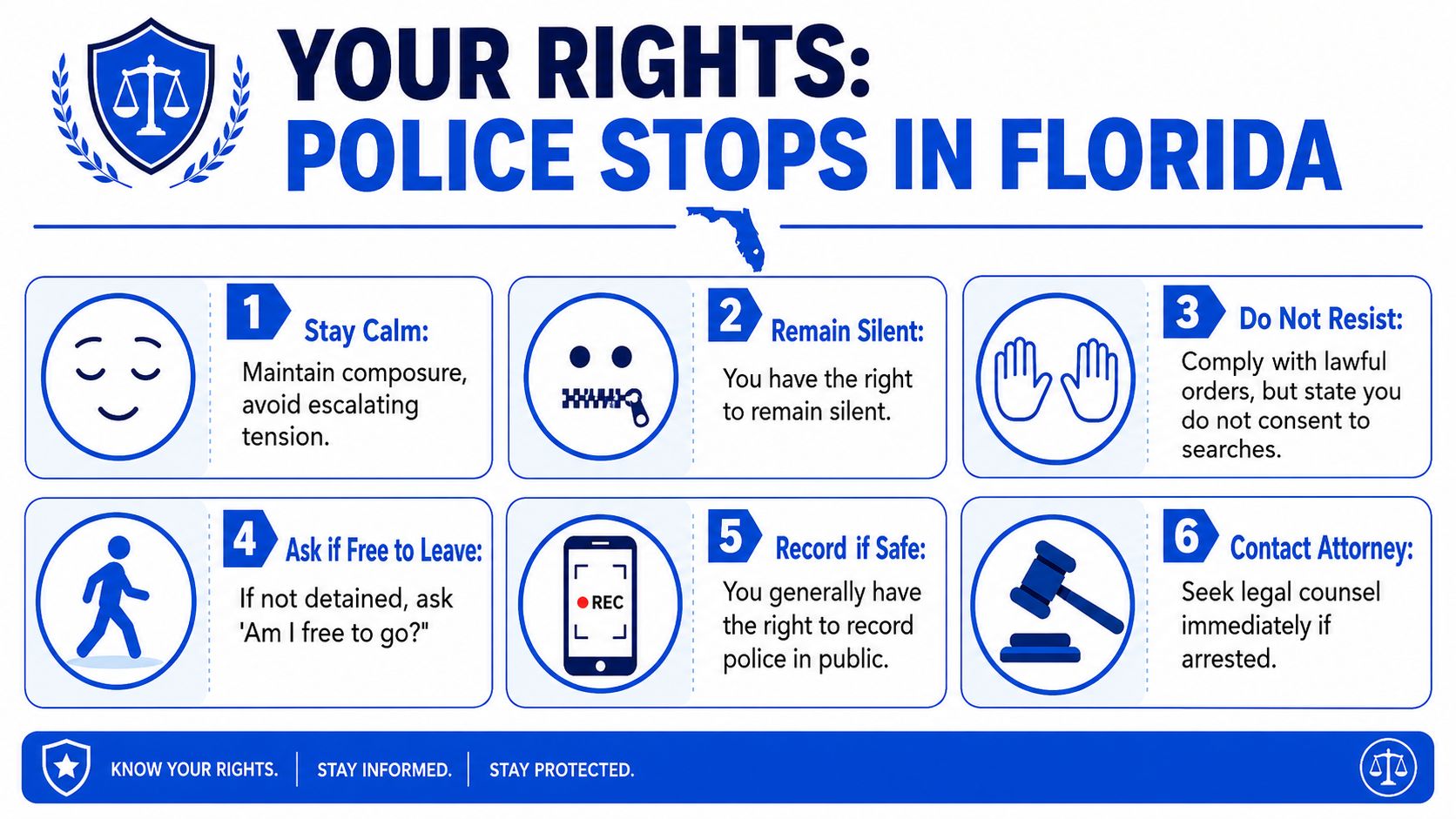
Stay calm and keep your hands visible. Don't argue on the roadside about whether the officer has enough suspicion, because that fight belongs in court, not at the window. Be polite, but don't volunteer extra facts that the State can later use against you.
Use clear phrases
Stay calm: Keep your voice steady and your movements slow.
Remain silent: You can say, “I'm choosing to remain silent.”
Refuse consent clearly: Say, “Officer, I do not consent to any searches.”
Ask if you're free to go: If the encounter seems open-ended, ask, “Am I free to leave?”
Don't resist: Comply with lawful commands, even while refusing consent.
Call a lawyer fast: If you're arrested, get counsel immediately.
For anyone who has just been detained, the Miranda issue can come up quickly, especially once questioning becomes custodial. A short explanation is available in what are Miranda rights.
If police in Florida stopped you, searched you, or arrested you and you're not sure whether they had reasonable suspicion or probable cause, get legal help now. Contact Ticket Shield, PLLC for a confidential consultation, and have a Florida criminal defense attorney review the stop before the State's version of events becomes the only version on the record.