
Florida Illegal Search and Seizure: Know Your Rights
Jason Goldsmith, Esq
You were driving on I-95 through Fort Lauderdale. The lights came on behind you. The officer asked routine questions, then shifted gears: “Mind if I take a look in the car?” Maybe the officer reached toward your phone after seeing a text preview. Maybe police later showed up at your home and said they just wanted to “clear a few things up.”
That's where many Florida cases turn.
A lot of people charged with DUI, drug crimes, theft offenses, gun charges, probation violations, or other offenses in Broward County, Miami-Dade, Palm Beach, and across South Florida assume that if police found evidence, the case is over. That isn't always true. If law enforcement violated the rules governing searches and seizures, the evidence may be challenged, and in some cases suppressed.
The hard part is that police don't always need a warrant, and digital evidence from smartphones has made the law even more complicated. The phrase fruit of the poisonous tree matters here. If the original search was unlawful, later evidence that grew out of that search may also be excluded. But in phone-search cases, especially during roadside investigations, the answer often depends on details not commonly understood.
Table of Contents
What Is an Illegal Search and Seizure in Florida
An illegal search and seizure happens when police or another government officer searches you, your car, your home, your phone, or your property without legal authority. In plain English, it means the government crossed a constitutional line.
In Florida, those protections come from both the federal and state constitutions. In Florida, under Article I, Section 12 of the state Constitution and the Fourth Amendment of the U.S. Constitution, police must obtain a judge-signed warrant based on probable cause to search a person, home, vehicle, or belongings unless a specific exception applies; probable cause requires a reasonable belief that evidence of a crime will be found in the place to be searched, as explained in this discussion of Florida search and seizure rights.
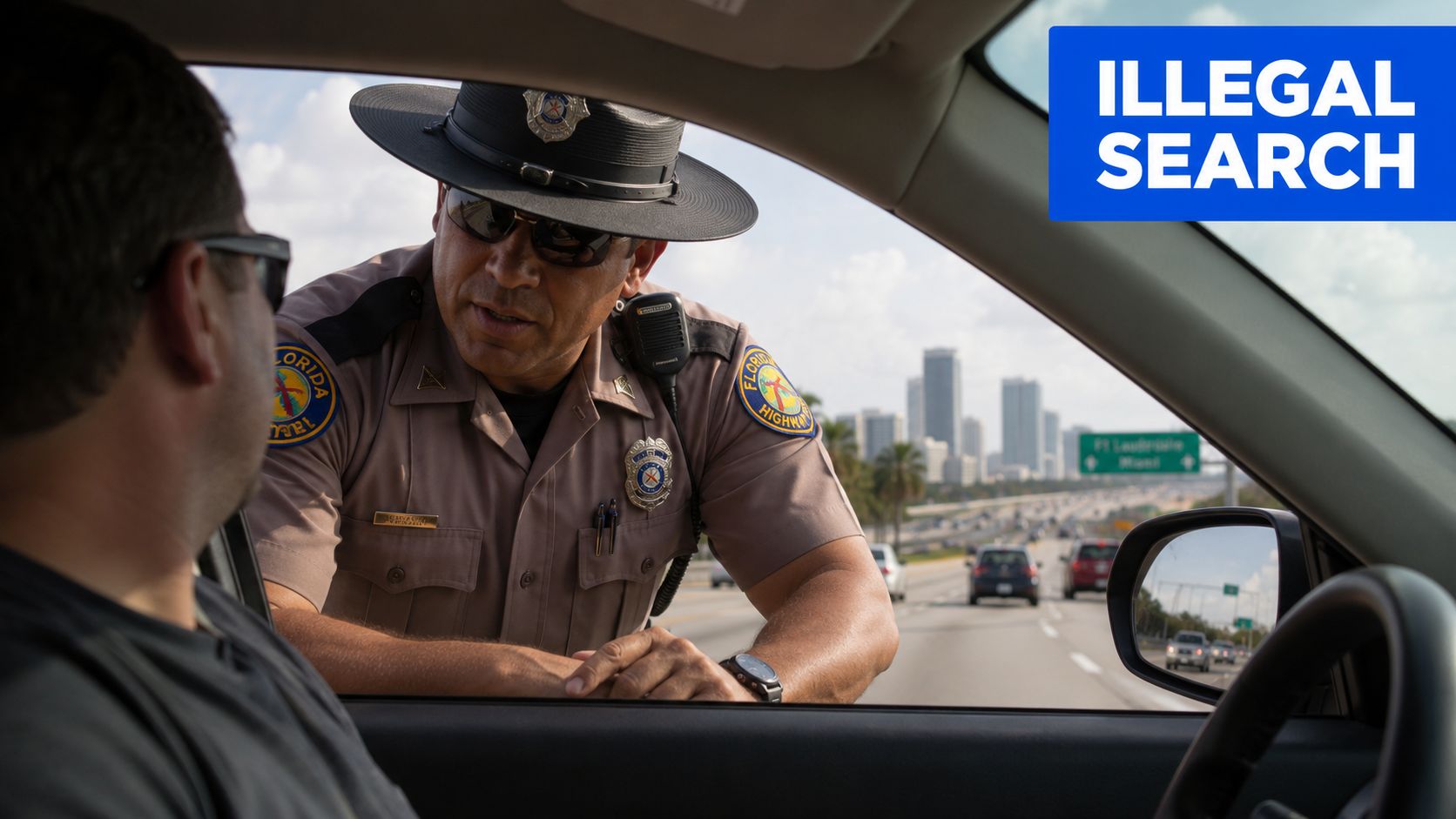
A common example is a traffic stop. An officer smells alcohol, sees nervousness, or notices a pill bottle. None of that automatically gives police the right to search everything you own. The law asks a more precise question: did the officer have a warrant, valid consent, probable cause, or some other recognized exception?
What makes a search illegal
A search may be unlawful when:
Police act without a warrant and no valid exception applies.
Consent wasn't voluntary because it was pressured, ambiguous, or coerced.
The search went too far beyond what the warrant or exception allowed.
Officers seized property improperly and held or used it in a way the law doesn't permit.
Practical rule: If police violated the search rules, the evidence doesn't automatically become untouchable, but it often becomes vulnerable.
That matters because the remedy can be powerful. If the court finds the search unconstitutional, key evidence may be thrown out. In many criminal cases, especially DUI, drug, gun, theft, and probation matters, that can change the entire negotiation and trial posture.
The Foundation of Your Rights Warrants and Probable Cause
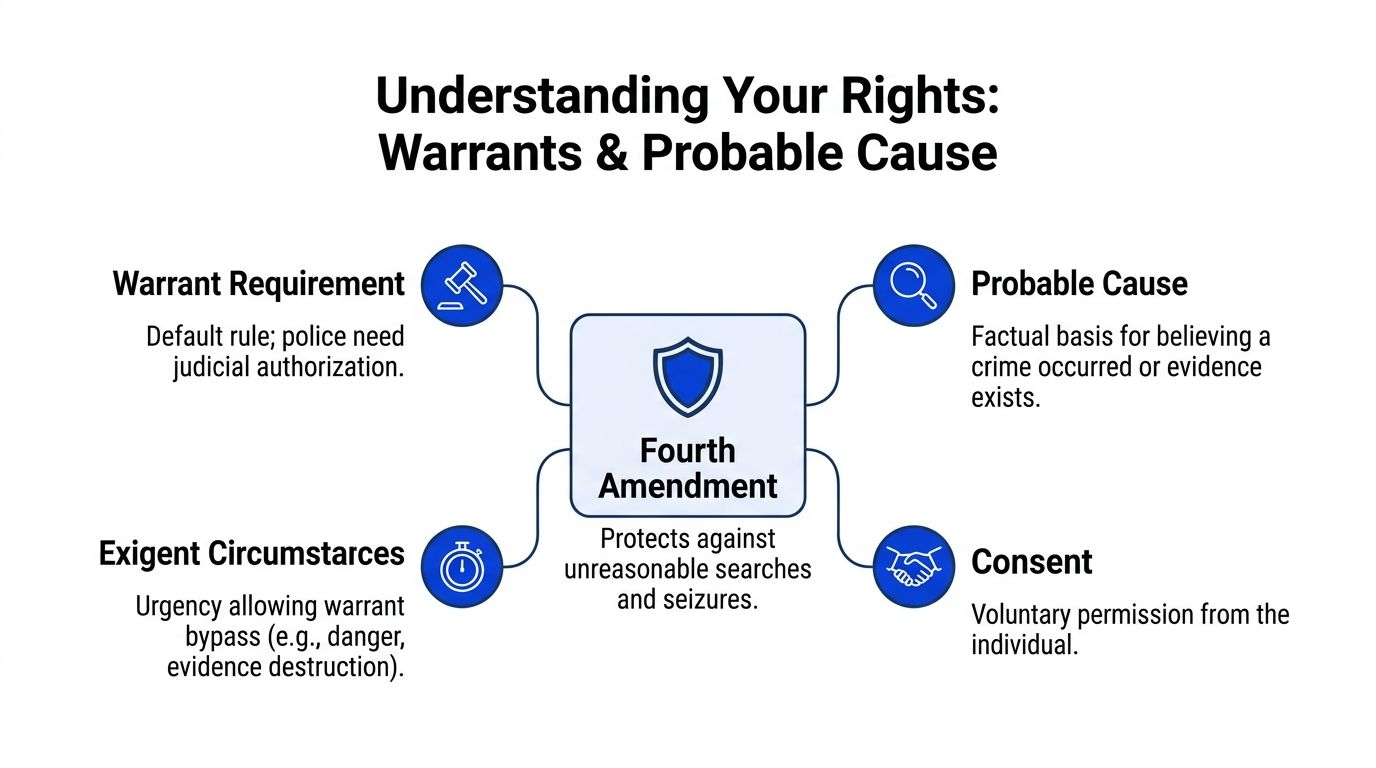
The default rule is simple. Police are supposed to get a warrant when it's reasonably practical.
Under the Fourth Amendment and Federal Rule of Criminal Procedure 41, the touchstone of lawful search and seizure is reasonableness, and officers must use search warrants whenever reasonably practicable. A warrant is invalid unless it is based on probable cause supported by oath and particularly describes the place to be searched and the items to be seized, as summarized in Federal Rule of Criminal Procedure 41.
What probable cause actually means
Probable cause is more than a hunch. It's not enough for an officer to say, “Something felt off.” The officer must be able to point to facts that make it reasonable to believe evidence of a crime will be found in the place searched.
For non-lawyers, this helps. Probable cause is not proof beyond a reasonable doubt. It's a lower standard. But it still requires a factual basis. Courts look for specifics, not guesses.
Examples of facts that may matter include:
Observable evidence, such as contraband in plain sight
Reliable information, such as statements or evidence tied to a location
Circumstances tied to a crime, not just generalized suspicion
Why privacy expectations matter
The law also asks whether you had a legitimate expectation of privacy. If you did, the Fourth Amendment usually applies. If you didn't, your challenge becomes harder.
Your home receives the strongest protection. Your phone often contains private information and can become a major battleground in modern cases. Property exposed to the public is different. That's why the legal analysis isn't one-size-fits-all.
The strongest search challenges usually come from small details. A vague affidavit, an overbroad warrant, or a search that drifted beyond its stated purpose can all become central issues.
What a valid warrant must include
A proper warrant should be:
Requirement | Why it matters |
|---|---|
Issued by a neutral judge | Police can't authorize their own search |
Based on sworn facts | The request must rest on more than suspicion |
Particularized | It must identify where police can search and what they can seize |
A defective warrant can be challenged. So can a valid warrant that officers execute improperly. In practice, many search-and-seizure fights are won or lost not on broad slogans, but on close reading of documents, body camera footage, dispatch records, and officer testimony.
When Can Police Search Without a Warrant in Florida
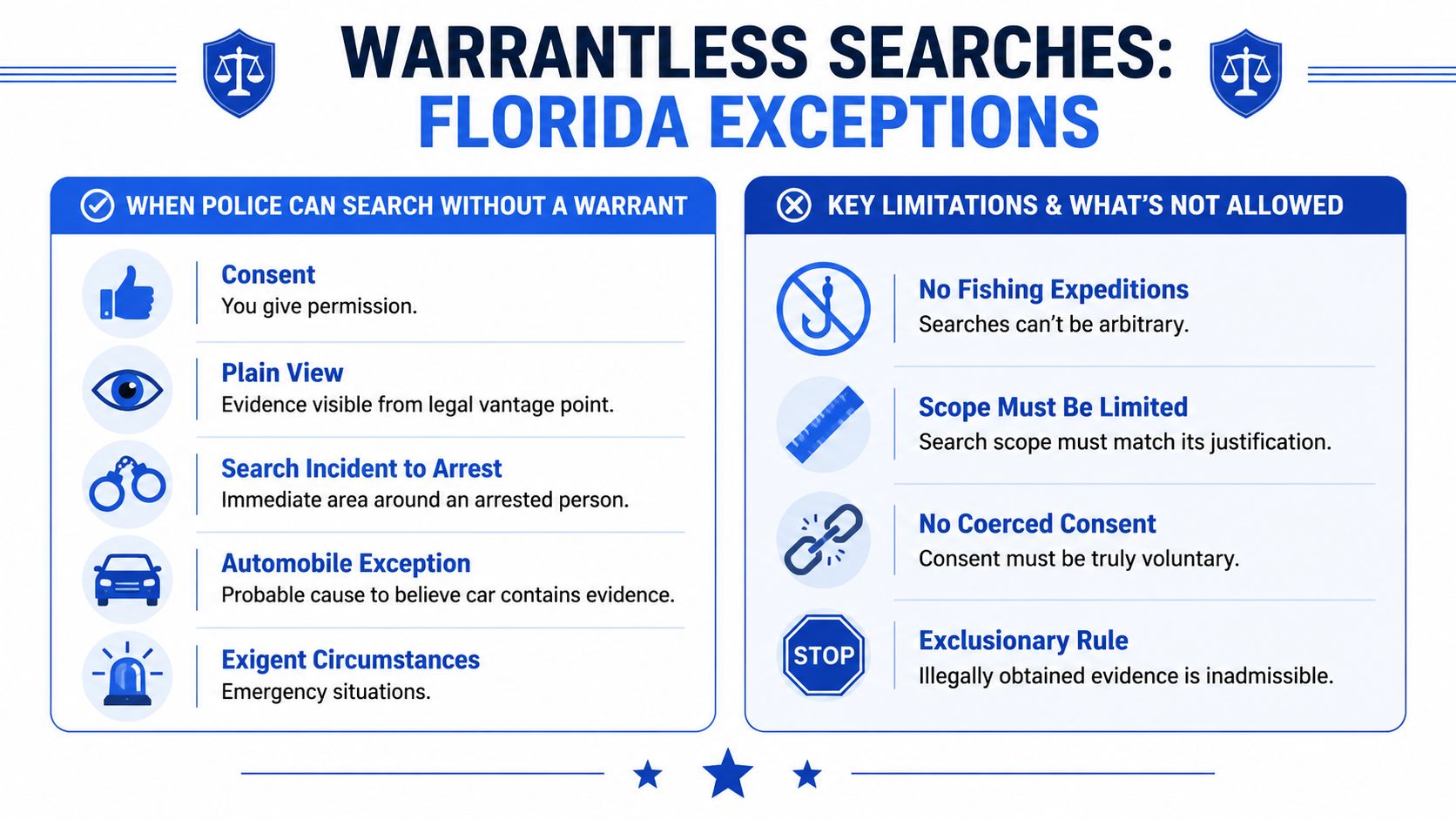
Florida law recognizes several exceptions to the warrant requirement. Police rely on them every day. Some are valid. Some are stretched far beyond their limits. That's where a careful defense matters.
Consent searches
Consent is one of the most common ways officers avoid the warrant requirement. If you give permission, the search may be lawful.
The problem is that many people don't realize they can refuse. They think saying no will make things worse. Legally, refusing consent doesn't create probable cause by itself.
What works in real life is simple and calm language: “I don't consent to any searches.”
What doesn't work is arguing, physically blocking the officer, or giving mixed signals.
Plain view
If an officer is lawfully present and sees contraband or evidence in plain view, that item may be seized. This is narrower than many people assume.
If a firearm is visible on a seat, that's different from opening containers, scrolling through a phone, or searching a locked compartment. Plain view doesn't authorize a fishing expedition.
Search incident to arrest
Police may search areas connected to a lawful arrest. The key limit is scope. The search must be tied to the arrest and officer safety or evidence concerns recognized by law.
A valid arrest doesn't give unlimited authority to rummage through everything you own. In South Florida cases, this often becomes a fight over how far the search extended and whether it remained connected to the arrest.
Exigent circumstances
Exigent circumstances involve urgency. Think immediate danger, hot pursuit, or a real risk that evidence will be destroyed before a warrant can be obtained.
This exception is often overused in argument. Courts still expect facts showing actual urgency, not a convenient after-the-fact explanation.
If an officer had time to secure the scene and seek a warrant, “emergency” becomes a much weaker argument.
Vehicle searches
Cars are treated differently from homes. That doesn't mean police can search every vehicle they stop. It means the legal rules are more flexible when officers have a recognized basis tied to the vehicle.
The line between a lawful car search and an illegal search and seizure often turns on what the officer knew before opening a compartment, bag, console, or trunk.
For a related discussion of roadside enforcement issues, see this article on DUI checkpoint legality in Florida.
Border and checkpoint issues
One exception many Floridians never think about involves federal border authority. According to Pacific Legal Foundation, federal agents have authority to conduct warrantless and suspicionless searches within 100 miles of any U.S. border, a zone that covers nearly two-thirds of the U.S. population, and they may stop and board vehicles without a warrant or probable cause under the Immigration and Nationality Act of 1952, as explained in this analysis of the border and Fourth Amendment.
That authority creates serious trade-offs. Officers may have broader power in some settings, but broad power is not unlimited power. The legality of a stop or search still depends on who conducted it, where it happened, and what legal basis was applied.
Illegal Search Scenarios DUI Stops Homes and Vehicles
The law becomes easier to understand when you apply it to situations people in Broward County, Fort Lauderdale, Miami-Dade, and Palm Beach face.
DUI stops in South Florida
A DUI stop often begins with alleged driving patterns, an odor of alcohol, bloodshot eyes, or statements the driver made. But a police officer has no automatic right to search a person or vehicle during a traffic stop; the officer must obtain voluntary consent or have probable cause to conduct a lawful search, as discussed in this article about vehicle searches during traffic stops.
That matters in DUI cases. An officer can investigate impairment. That doesn't mean the officer can search your entire car because you looked anxious or because there was a disagreement at the roadside.
If you're also being asked to perform balancing exercises, it helps to understand how those roadside investigations work. This overview of the Florida field sobriety test process explains why those encounters can quickly expand beyond the original stop.
Police at your door
Home searches raise different issues. Police may knock and ask questions. You usually don't have to invite them inside.
If officers say they only want to “talk,” keep the distinction clear. Talking at the doorway is different from consenting to entry. Once police enter, disputes often arise over whether consent was given, how broad it was, and whether officers exceeded it.
A practical response is brief and respectful. You can say you don't consent to a search and want to speak with a lawyer.
Vehicle searches in drug and weapons cases
Drug and gun cases often involve claims about odor, visible contraband, statements from passengers, or items found during an arrest. Those facts can support a lawful search in some cases. In others, they become overstated after the fact.
Look at the common pressure points:
Passenger statements: A passenger's conduct may justify more investigation, but it doesn't automatically open every container in the vehicle.
Closed compartments: The legal basis for opening a glove box, backpack, or trunk must match the actual facts.
Inventory searches: If police impound a vehicle, they must follow standardized procedures. Inventory can't be used as a pretext for evidence hunting.
These distinctions matter in everything from Broward County drug cases to South Florida weapons charges. Small deviations in police procedure often become major suppression issues later.
How Your Attorney Can Challenge an Illegal Search
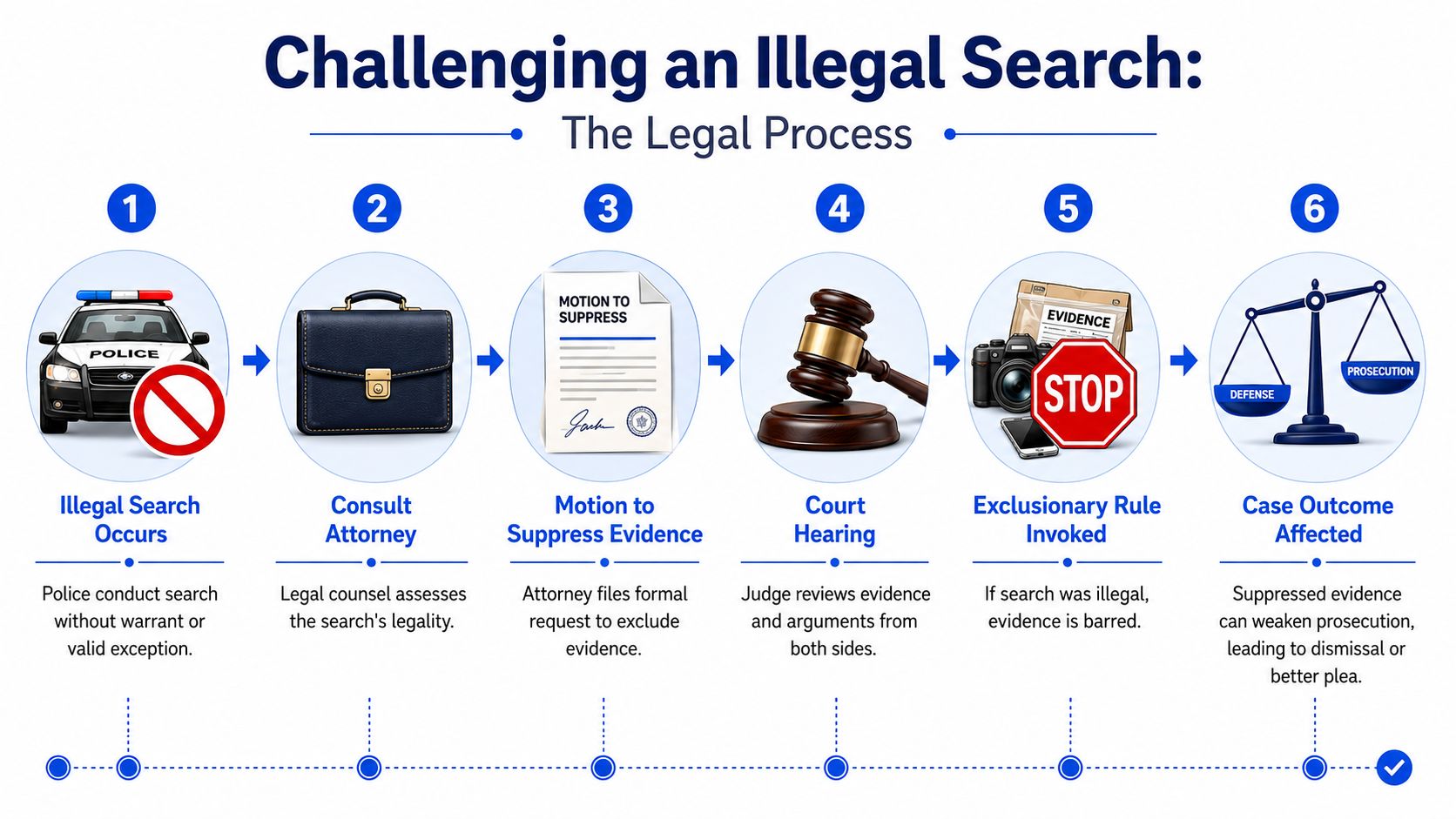
A strong defense doesn't stop at saying the search felt unfair. The challenge has to be specific, documented, and legally framed. That usually means attacking the search through a motion to suppress.
Early in the case, a defense lawyer reviews the police reports, body camera footage, dispatch records, warrant documents, and the timing of the encounter. Former prosecutors know something important here. Officers often summarize events in a way that sounds tighter on paper than it did in real time. Cross-examination exposes that.
The exclusionary rule in real cases
Florida courts apply the exclusionary rule, which means evidence obtained through an unlawful search must be suppressed and cannot be used at trial, as explained in this discussion of Florida search and seizure law.
That's not a technical side issue. In many cases, the seized evidence is the case. If the drugs, firearm, statements, phone contents, or physical evidence are excluded, the prosecution may lose its advantage or even lose the case altogether.
Digital evidence and the fruit of the poisonous tree
Modern cases get complicated.
If police unlawfully search a smartphone during a DUI stop or roadside investigation, the problem may extend beyond the phone itself. A text message, photo, app data, contact history, or follow-up lead can become fruit of the poisonous tree if it was derived from the original illegal search.
But digital cases aren't automatic wins. People often assume that if police looked at a phone without a warrant, every result disappears. Not always. According to the Harvard Law Review source provided here, recent state appellate rulings in 2025 created a good faith exception in some situations involving officers who relied on outdated statutes, leaving 42% of defendants unable to prove their digital evidence was illegal despite the lack of a warrant, as discussed in this analysis of judicial review in search and seizure cases.
Here is a short explanation of suppression strategy in practice.
A phone-search case often turns on timing, scope, and the officer's stated reason for touching the device in the first place.
What a motion to suppress does
A motion to suppress asks the judge to exclude unlawfully obtained evidence. It is one of the most important litigation tools in Florida criminal defense.
The process usually includes:
Fact investigation. The defense compares reports to video, timestamps, and witness accounts.
Legal challenge. Counsel identifies why the search lacked a warrant, valid consent, probable cause, or another lawful basis.
Suppression hearing. The officer testifies. Cross-examination matters.
Court ruling. If the judge suppresses key evidence, the State's case may weaken significantly.
For a closer look at that process, read this guide on what a motion to suppress evidence does in Florida.
What to Do During a Police Encounter to Protect Your Rights
When police stop you, your job isn't to win the legal argument on the roadside. Your job is to avoid making things worse and preserve issues for your lawyer.
Use a short checklist.
Stay calm: Keep your hands visible. Don't make sudden movements. Don't match the officer's intensity.
Ask a clear status question: “Am I being detained, or am I free to go?”
Refuse consent clearly: “Officer, I do not consent to any searches.”
Don't physically resist: Even if the search is illegal, roadside resistance usually creates new charges and new problems.
Say less: You don't need to explain where you've been, what you were doing, or whose property something is without legal advice.
State objections out loud: If an officer searches anyway, calmly repeat that you do not consent.
Silence and consent are different issues. You can be polite, provide required identifying information when legally required, and still decline consent.
If questioning continues after custody or pressure escalates, issues involving warnings and statements may also matter. This discussion of a Miranda rights violation in Florida cases explains why statement suppression can become just as important as physical evidence suppression.
Remember this: Be respectful. Be clear. Don't volunteer. Don't consent. Don't fight on the street.
FAQs About Florida Search and Seizure Laws
Can police search my trash can if it's on the curb
Possibly. Once trash is placed out for collection in an area exposed to the public, privacy arguments become weaker. The exact location and access still matter.
What is an inventory search
An inventory search happens when police lawfully impound a vehicle and catalog its contents. It isn't automatically valid. Officers must follow standardized procedures, and inventory can't be used as a shortcut to look for evidence.
If my passenger has drugs can police search my whole car
Not automatically. The answer depends on where the drugs were found, what the officer observed, what statements were made, and whether those facts created a lawful basis to search other parts of the vehicle.
Can police search my phone during a DUI stop
Sometimes police claim an exception applies, but smartphone searches raise major constitutional issues. The legality often turns on consent, urgency, scope, and whether officers later try to justify the search through a good-faith argument.
Does an illegal search always get my case dismissed
No. But it can remove critical evidence and dramatically improve the defense position. In some cases that leads to dismissal. In others it leads to reduced charges, stronger negotiations, or a better trial posture.
If you're facing DUI charges, drug allegations, theft accusations, a weapons case, domestic violence allegations, white collar accusations, juvenile charges, probation violation claims, or another criminal case in Fort Lauderdale, Broward County, Miami-Dade, Palm Beach, or surrounding South Florida courts, search issues should be reviewed early. Small constitutional violations are often missed until an experienced defense lawyer digs into the facts.
If police searched your car, home, phone, or property and you're now facing criminal charges, speak with Ticket Shield, PLLC as soon as possible for a confidential consultation. A former prosecutor can review whether the stop, seizure, consent, warrant, or digital search can be challenged, and whether suppressing evidence could change the direction of your case in Broward County, Fort Lauderdale, Miami-Dade, Palm Beach, or anywhere in Florida.
Evidence from an illegal search can be thrown out entirely. Learn your search and seizure rights under Florida and federal law.