How to Report Probation Violation
Jason Goldsmith, Esq
A Tuesday afternoon call can force an uncomfortable decision. A neighbor says a probationer left the county without permission. A family member reports a missed check-in. A probation officer mentions a positive drug screen, or police contact turns into a new arrest. The caller may wonder how to report a probation violation, while the probationer may already be asking whether a warrant has been signed.
Florida probation cases move quickly once a report reaches the right office. Probation isn't a closed case until the sentence ends, and a report can lead to a warning, stricter supervision, a court hearing, a warrant, or revocation. This guide explains the process from both sides, including what a reporter should document and what a probationer should do immediately after learning about an allegation.
Table of Contents
When Reporting a Probation Violation Becomes Necessary
Probation gives a person an opportunity to remain in the community under court-ordered conditions. It doesn't erase the court's authority. A probationer remains responsible for following each condition until supervision ends, including requirements that may seem minor after months of compliance.
Common allegations include:
Failure to report: Missing an appointment, phone call, or required check-in can create a documented supervision problem.
Unpaid obligations: A person may face scrutiny for failing to pay court-ordered costs, restitution, or other required amounts.
Unauthorized travel: Leaving the county or state without permission can violate a written condition.
Substance use: A positive drug or alcohol test may become the basis for a report.
New law enforcement contact: An arrest, citation, or police investigation can create a separate violation issue, even before the new case is resolved.
Incomplete requirements: Treatment, counseling, community service, classes, or other court-ordered tasks must be completed and documented.
The U.S. Sentencing Commission recorded 108,115 federal violation decisions over a five-year period, with annual violation-hearing rates ranging from 16.2% to 18.4%, averaging 16.9% of people under supervision. The same report states that federal districts handled about 21,600 violations per year, which shows why a written allegation can trigger formal review rather than an informal conversation. The U.S. Sentencing Commission's federal violation report also discusses the frequency of technical issues such as drug use and failure to report.
Practical rule: Report facts that can be checked. Don't turn suspicion, anger, or a personal dispute into an accusation without supporting details.
A credible report protects the process for everyone. It gives the probation officer a usable record, and it gives the probationer a fair chance to understand the allegation and respond through counsel. In Broward County, Fort Lauderdale, Miami-Dade, Palm Beach, and other South Florida courts, that distinction can affect whether the matter stays with the probation office or moves into a formal violation proceeding.
Florida Law That Authorizes a Probation Violation Report
Florida Statutes § 948.06 supplies the central legal authority for responding to an alleged violation. The statute permits a probation or law enforcement officer to arrest a probationer without a warrant when the officer has reasonable grounds to believe the probationer violated probation in a material respect. A judge may also issue a warrant based on an affidavit from someone with knowledge of the relevant facts. Florida Statutes § 948.06 should be read with the exact probation order, because the order defines the conditions that control the case.
Technical and substantive allegations
A technical violation usually involves noncompliance with a supervision condition, such as missing a report, failing a test, or not completing a required program. A new-law violation involves alleged criminal conduct. The distinction matters because the court may treat a technical breach differently from an allegation that the probationer committed a new offense.
The violation also needs to be material, not merely a trivial disagreement about wording. The report should identify the condition, explain the conduct, and provide facts supporting the alleged breach. A bare conclusion that someone is “not following probation” isn't enough to make the report useful.
Florida law provides a specific limitation for certain first-time technical violations. When the statutory requirements apply and the probationer has less than 90 days of supervision remaining, the court may revoke probation and impose a maximum of 90 days in county jail, rather than a longer prison sentence. The later version of Florida Statutes § 948.06 contains the applicable restrictions and exceptions. A defense lawyer must check the offense, violation history, supervision status, and statutory exclusions before assuming the cap applies.
For a Florida-specific explanation of the defense process, review the firm's Florida violation of probation resource.
The reporting path also depends on whether the conduct is a supervision problem or a new crime. The law authorizes action on a supported allegation, not punishment based solely on rumor.
Who to Contact and When to Escalate
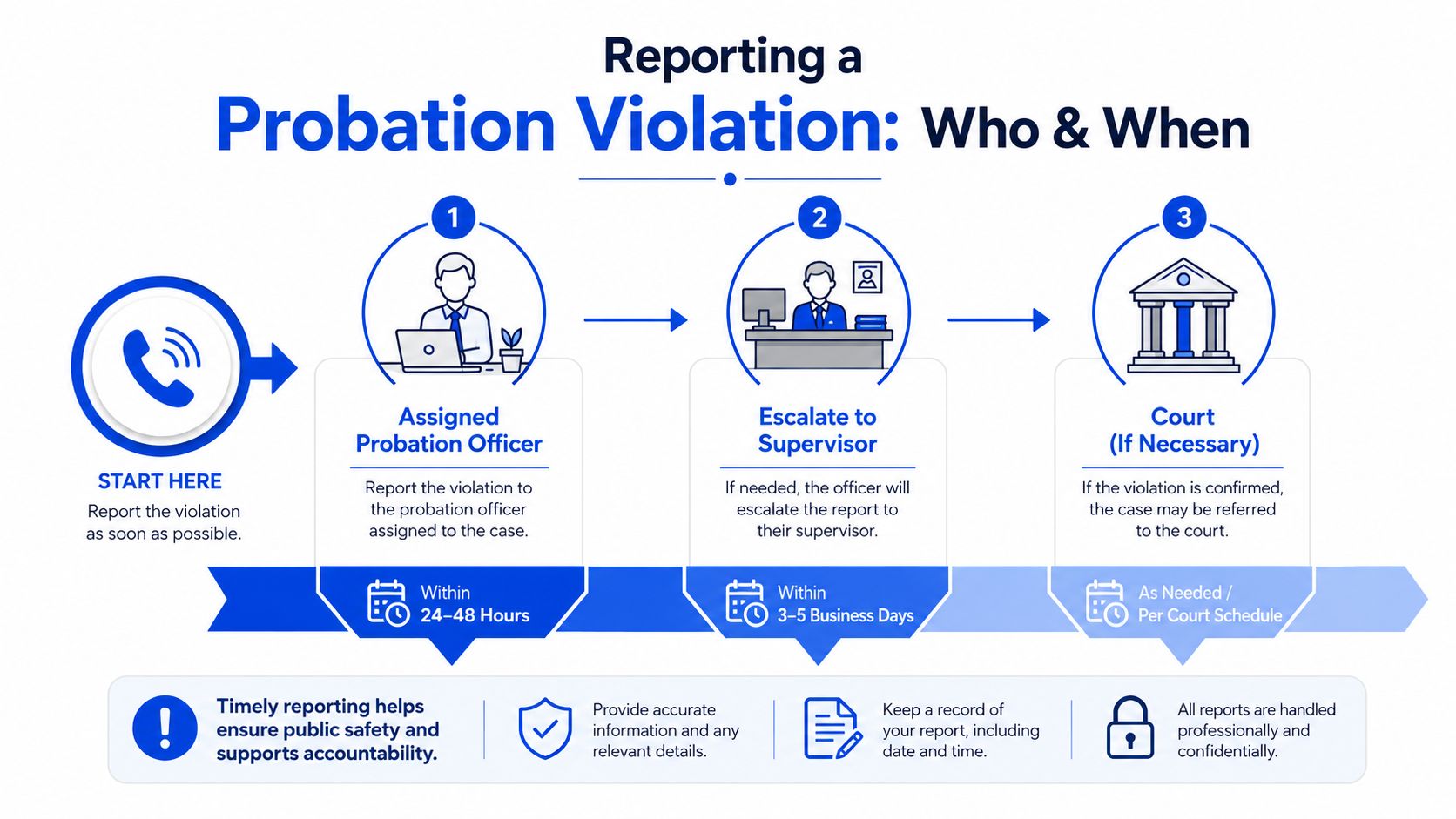
Start with the assigned probation officer or local probation office when the allegation concerns supervision. That office maintains the probation record and can evaluate missed reporting, travel, treatment, testing, payment, or community-service issues. A probation officer may recommend a warning, seek a court response, request a warrant, or take no immediate action after reviewing the facts.
Don't send a technical complaint to every government office at once. Multiple uncoordinated reports can create confusion, duplicate allegations, and credibility problems. Use the channel that matches the conduct.
Choose the correct channel
For a technical violation, contact the probation office. Provide the probationer's identifying information, the alleged condition, and the facts supporting the report.
For a suspected new crime, contact local police or the appropriate law enforcement agency. Federal guidance states that there is no general probation tip line. If someone may have committed a crime, the first step is to contact local police, followed by the probation office duty officer during business hours. The published supervision guidance reflects the practical distinction between reporting criminal conduct and reporting a supervision breach.
For immediate danger or a victim-related incident, call emergency services or local law enforcement first. A probation office isn't a substitute for emergency response. Preserve evidence and tell investigators that the person is on probation, if that fact is known.
If the officer is unavailable, leave a documented message and contact the supervising office or designated supervisor. The sentencing court clerk can explain filing procedures, but clerks generally don't investigate allegations or decide whether a warrant should issue. The state attorney's office may become involved in a formal court case, but it usually isn't the first destination for a routine supervision complaint.
Keep a record of every contact:
Write down delivery details: Note the date, time, office, method, and name of the person who received the report.
Preserve originals: Keep the original messages, photographs, videos, documents, and recordings.
Ask for confirmation: Request a case or incident reference when the agency provides one.
Avoid confrontation: Don't threaten, pressure, or coach witnesses after making the report.
If you need to discuss a probation allegation with a Florida defense lawyer, you can contact Ticket Shield, PLLC for confidential guidance.
What to Include in a Violation Report
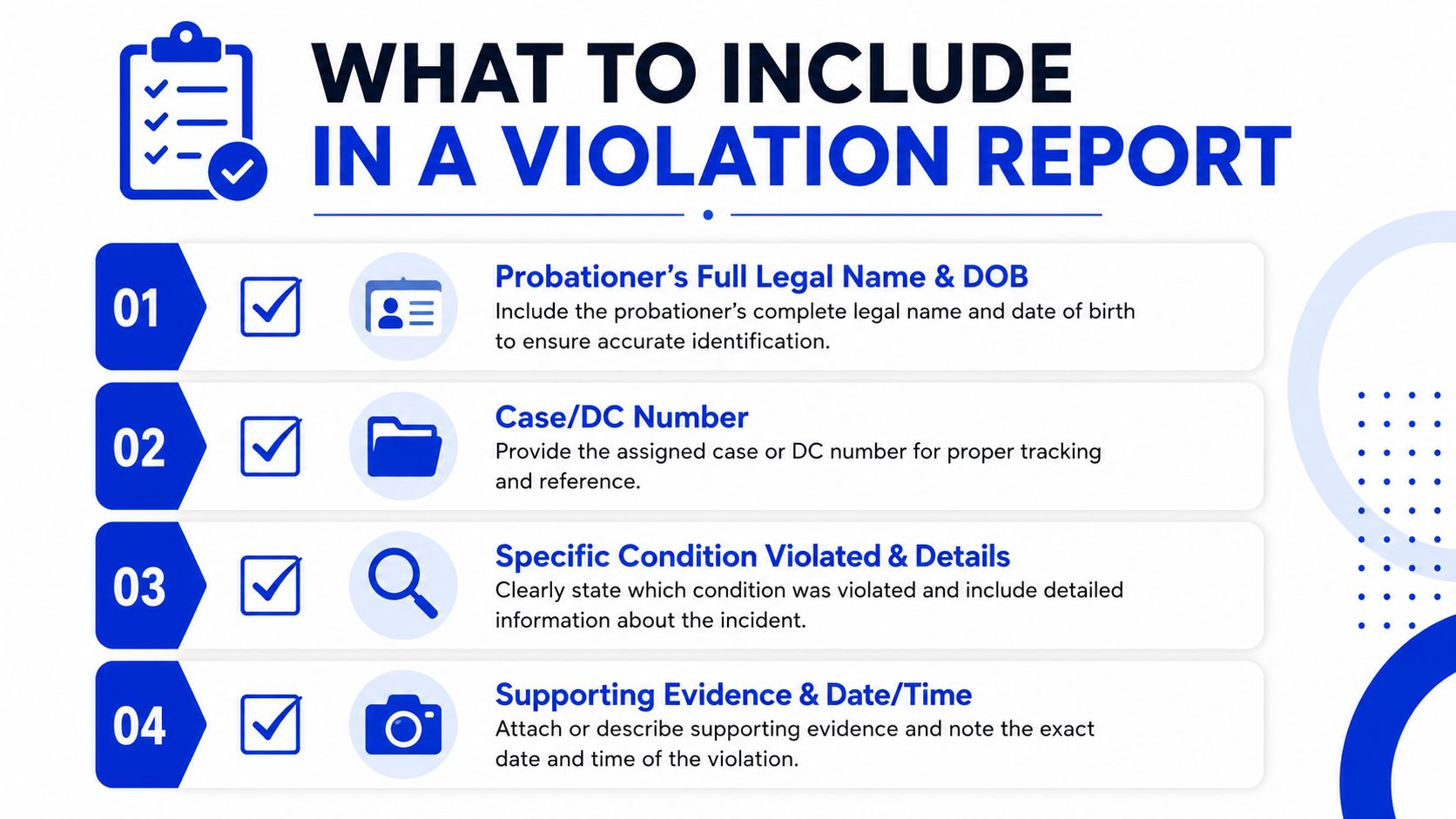
A useful report lets the officer answer four questions quickly: Who is the probationer? What condition applies? What happened? What proves it? Include the probationer's full legal name, date of birth, and case or DC number if available. Those details reduce the risk that the report gets attached to the wrong file.
Identify the exact condition allegedly violated. If you have the signed probation order, quote the relevant language accurately and identify the page or paragraph. Don't paraphrase a condition in a way that changes its meaning.
Build a factual timeline
State the date, time, and location of the incident. Name witnesses and provide reliable contact information. Explain what you personally observed, then separately identify what someone else told you. “I saw the probationer leave the residence at a stated time” is materially different from “the probationer was probably traveling without permission.”
Attach supporting material where it exists:
Digital records: Include screenshots of messages, emails, call logs, or social media posts, with surrounding context.
Images and recordings: Preserve photographs, video, voicemail files, and original timestamps.
Testing and official records: Provide urine or breath test results, police incident numbers, citations, or court documents.
Witness information: List people who saw or heard the event rather than repeating conclusions about what they believe occurred.
Don't embellish. Character attacks, insults, unsupported claims, and speculation distract from the alleged condition. Probation officers and judges can evaluate dated, verifiable information more effectively than an emotional narrative.
Protect the record
Keep a complete copy of everything submitted. Save attachments in their original form, record the delivery method, and note any follow-up conversation. If the report involves a victim, avoid direct contact with the probationer and let law enforcement or the probation office manage communication.
The person accused should understand that the report isn't the final decision. It is evidence for an administrative and court process. The Florida probation violation defense guide explains why the wording, timing, and supporting record can matter.
A report should be specific enough to investigate, restrained enough to remain credible, and complete enough to preserve the underlying evidence.
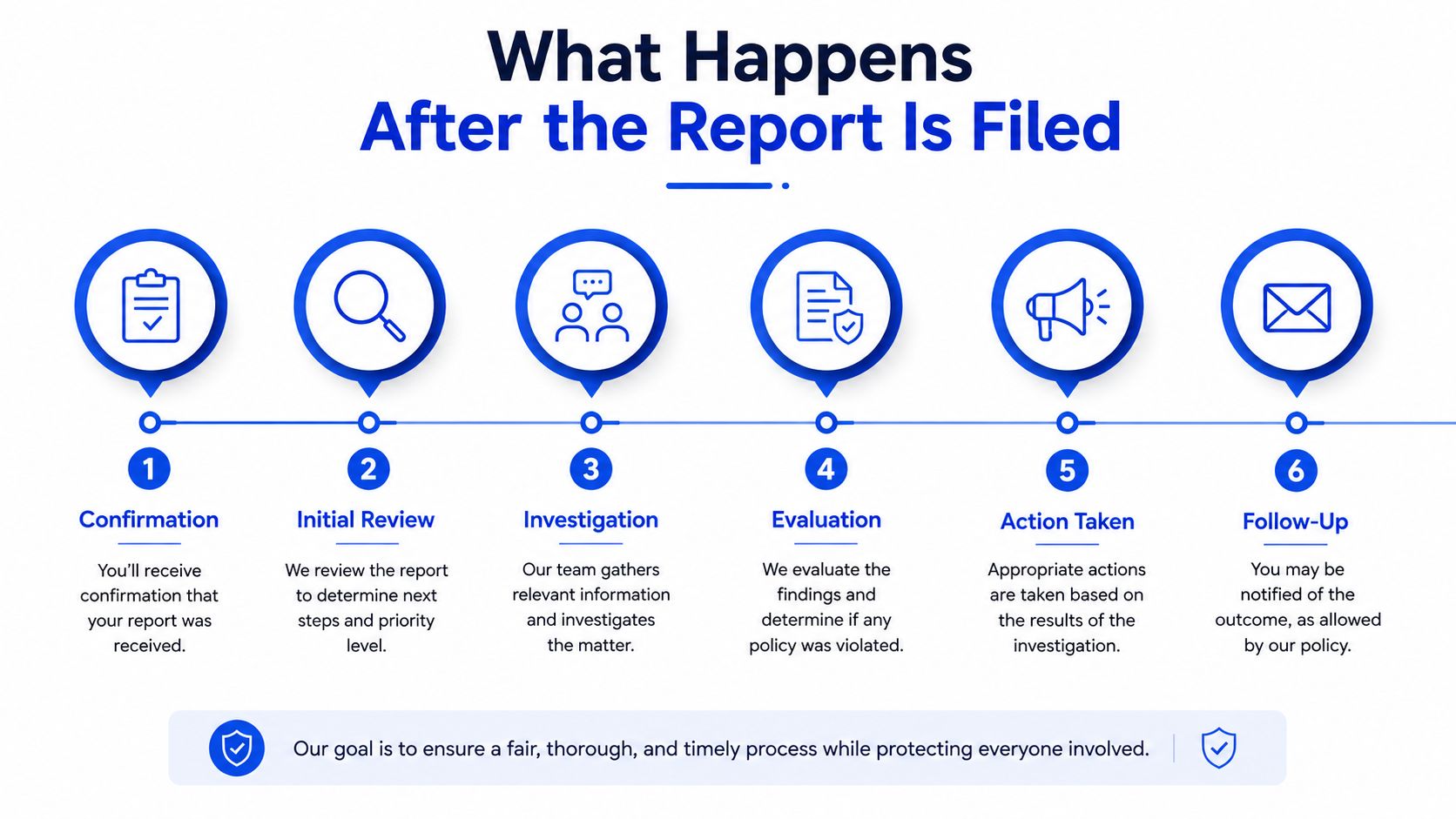
What Happens After the Report Is Filed
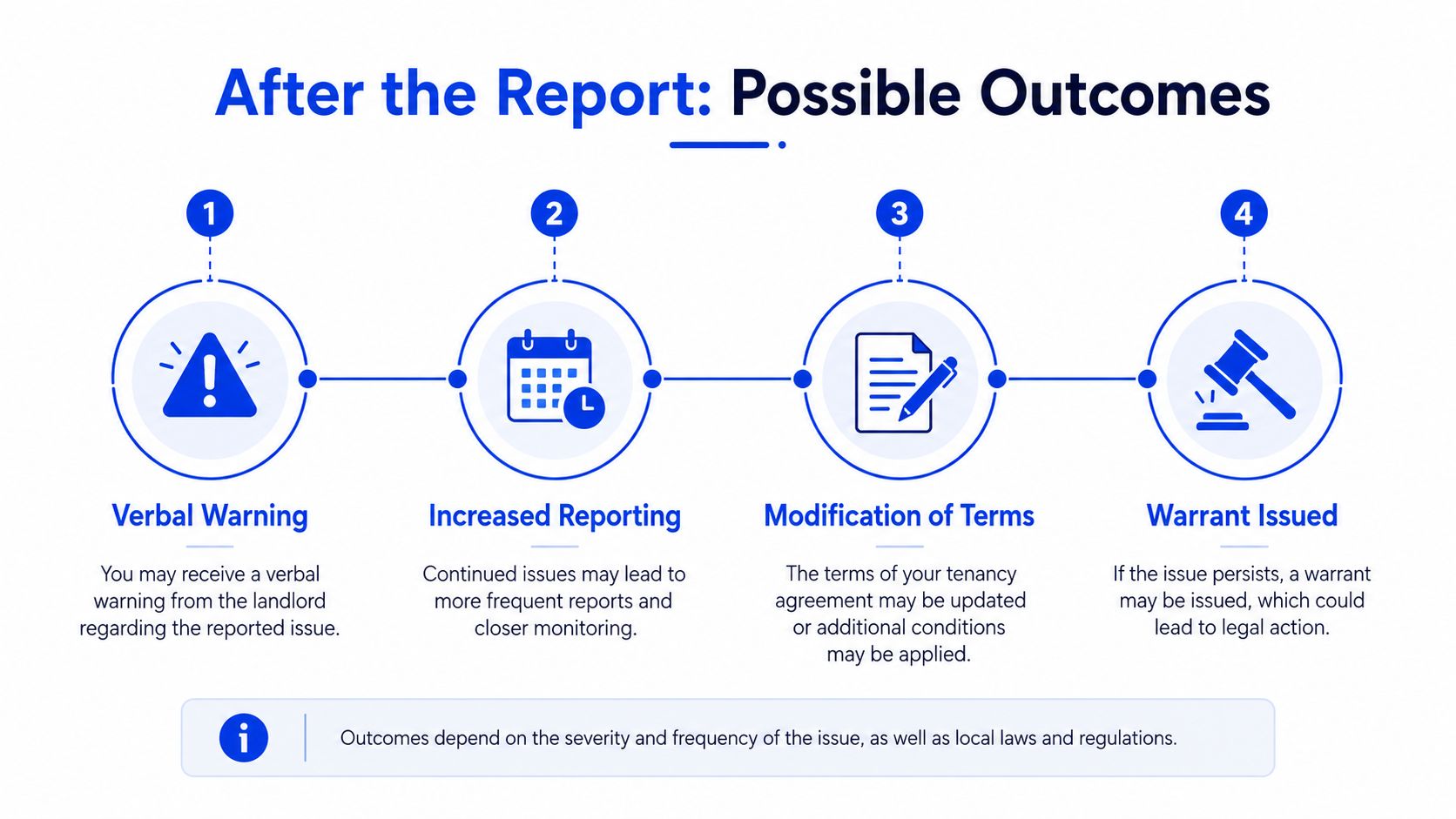
A report can start a review, but it does not automatically revoke probation. The probation officer examines the allegation, checks the supervision file, considers the conduct and the available proof, then chooses a response. That response may be a warning, more frequent reporting, additional testing, tighter conditions, a violation affidavit, or a warrant.
For a lower-level technical issue, the officer may impose more check-ins, a curfew, increased drug screening, or electronic monitoring. Treat every revised condition as binding. Ask for the change in writing, confirm when it begins, and keep proof of compliance. A new requirement creates another basis for an alleged violation.
The formal violation path
A serious or disputed allegation may move into a court proceeding under Florida procedure. The case may involve a warrant, a violation affidavit filed with the court, or a summons ordering the probationer to appear. Florida Rule of Criminal Procedure 3.790 governs important parts of probation and community-control violation proceedings, though the exact sequence depends on the court and the case history.
At the violation hearing, the sentencing judge, not a jury, decides whether the violation occurred. The State generally must prove the violation by a preponderance of the evidence, which is lower than proof beyond a reasonable doubt. The hearing still deserves serious preparation. The exact probation condition, testimony, records, testing evidence, and police reports can determine the result.
Possible outcomes include:
Possible response | What it can mean |
|---|---|
Reinstatement | Probation continues under the existing terms. |
Modified conditions | The judge adds or changes supervision requirements. |
Extended supervision | The court continues probation for a longer period when legally permitted. |
Revocation | The judge ends probation and imposes a sentence authorized by law. |
The record matters at every stage. The Bureau of Justice Statistics' 2022 probation report reports that the U.S. probation population remained under 3 million in 2022. It also records 45% of probation exits as successful completions, 23% as incarceration, death, or another unsatisfactory exit, and 31% as unknown or not reported. Those categories show why a complete supervision file matters. Missing records can blur the difference between compliance and failure.
Nebraska's published revocation data shows that technical and law violations can follow different patterns. Those figures are not Florida statistics, but the point applies in either role: a reporter should identify the exact condition and supporting proof, while a probationer should determine precisely what conduct is alleged. Treating every report as the same can lead to the wrong response.
For South Florida readers, this felony probation violation overview explains the risks of a formal allegation and the issues that can shape the next court decision. A report should be specific enough to investigate, restrained enough to remain credible, and complete enough to preserve the underlying evidence.
What to Do If a Report Has Been Filed Against You
Finding out that someone reported you can trigger panic. Don't respond by explaining everything to the probation officer, texting the reporting person, or posting your version online. The first move is to protect your rights and determine exactly where the case stands.
You have the right to remain silent and the right against self-incrimination. You also have the right to counsel during a violation proceeding. A probation condition may require communication with an officer, but that requirement doesn't mean you should give an uncounseled statement about disputed conduct without understanding the consequences.
Immediate steps that protect your position
Find out whether a warrant exists. Ask a defense lawyer to check the court record and contact the appropriate office. Don't walk into a police station or courthouse assuming the issue is only an informal report.
Don't attend a voluntary interview alone. A casual meeting can become the source of admissions, inconsistencies, or new allegations. Counsel can communicate with the officer and determine whether a meeting is necessary.
Gather mitigation immediately. Collect employment records, treatment receipts, completion certificates, transportation records, medical documentation, payment receipts, and character references. Documents that explain why an event occurred can be more useful than a long verbal explanation.
Continue complying with existing conditions. Attend every check-in, test, treatment appointment, class, and required service. Don't create a second allegation while trying to solve the first.
Preserve communications. Save messages, call records, location information, receipts, and documents that may confirm your account. Don't delete material because it looks unfavorable. Let counsel evaluate it.
Conduct to avoid
Don't contact the reporting party to demand a retraction. Don't discuss the case on social media, threaten witnesses, travel without permission, associate with people prohibited by your order, or skip appointments because you're afraid of the office. Each action can create additional evidence or a separate allegation.
Defense perspective: Early silence is not evasion. It gives your lawyer time to separate an actual violation from a misunderstanding, an inaccurate report, or a condition the State can't prove.
A defense lawyer can also evaluate whether the allegation is technical, substantive, or tied to a new criminal case. That classification affects strategy, possible sanctions, and whether the lawyer should negotiate before the officer submits a formal affidavit.
Getting Legal Help Before the Process Moves Forward
A probation violation consultation should happen before the warrant door opens. Once an officer files an affidavit or requests formal action, the defense may be reacting to a record that the State has already shaped. Early counsel can still challenge that record, but prevention and correction are usually more effective before the paperwork becomes the court's starting point.
At intake, a Florida probation violation lawyer should:
Obtain the governing order: Review the judgment, signed probation conditions, amendments, and any written warnings.
Classify the allegation: Determine whether the report concerns a technical condition, a new law violation, or both.
Test the facts: Compare the alleged date, location, witnesses, records, and conduct against the actual condition.
Look for defects: Check whether the report identifies a material violation and whether the supporting facts are sufficient.
Open communication early: Contact the probation officer or prosecutor when appropriate, present mitigation, and seek a resolution before a warrant is requested.
Bring the signed probation order, written conditions, notices, test results, treatment records, employment information, witness names, and a timeline of relevant dates. If you have received a written warning or summons, bring the original. Don't rely on memory when documents can answer the question.
The 90-day technical-violation rule deserves careful attention in Broward and Palm Beach cases, but it isn't an automatic shield. A lawyer must determine whether the violation qualifies, whether the offense is excluded, whether the person has the required supervision history, and whether the court has other sentencing authority. The potential consequence is too important to analyze from a generic online summary.
Cost also deserves a direct conversation. Flat-fee probation-violation representation is widely available, but the scope varies. Ask what the fee covers, whether it includes a hearing, and what happens if the allegation expands into a new criminal charge. A clear agreement is better than making a decision based only on the lowest quoted number.
For people searching for a probation violation lawyer near me, location matters less than immediate access to a lawyer who can review the order, communicate with the supervision office, and appear in the correct Florida court. Ticket Shield, PLLC, led by former prosecutor Jason S. Goldsmith, handles probation violations and other criminal defense matters across South Florida and statewide, with confidential consultations available around the clock.
If you're facing a probation violation report in Broward County, Fort Lauderdale, Miami-Dade, Palm Beach, or elsewhere in Florida, contact Ticket Shield, PLLC for a confidential review of the allegation, your probation order, and the next practical step. Don't wait for a warrant or hearing notice to begin building your defense.